No, you are wrong. Once the transition between inertial frames has been made the thrust and drag forces are no longer balanced so the plane will accelerate. This is Newtons second law.
General or Special? It doesn't really matter since we are dealing with non-relativistic mechanics. You might be trying to say Galilean invariance, but that just states that the fundamental laws of physics are true in all inertial frames and proves my side of the argument and not yours.
Woah! now we are getting into some technical talk.

You have proved nothing.
When Mythbusters did it, the microlight they used managed to accelerate so that it had sufficient airspeed in the opposite direction to the direction of movement of the pickup dragging the "conveyor" to achieve lift.
Correct.
No diagram needed ... imagine a model aircraft in a real aircraft cabin! now tell me it won't fly! .... Sit on a moving bus and throw a paper plane at the driver :shrug: ... of course it will fly ....

Drive down the motorway and get someone to throw a ball from the back seat to the front seat passenger, does the ball splat through the rear window? ... of course not! ... It's all relative

Flawed in so many ways, too many variables.

Okay, why don't you explain why an aircraft won't fly in your imaginary ball :razz:
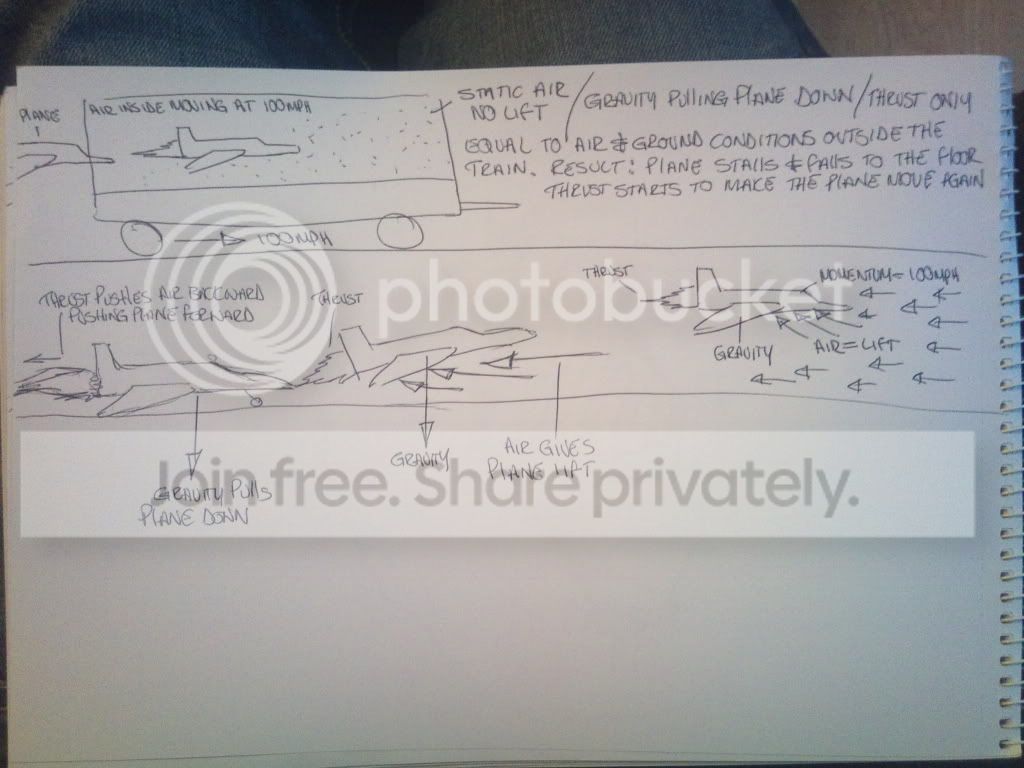
Assuming the ball is moving at 100mph with a plane inside it then the plane wont fly as there is no AIR FLOW.
If the ball is big enough and the plane is on the floor of the ball then it would be able to generate enough speed and fly hitting the far end when it runs out of space, which leads me to the next part of the argument.
You start the clock and both plane and train being to move.
Both gradualy increase speed, from 0-100mph, after a certain speed the air moving around the plane gives it lift and its up in the air. (remember this part)
The plane now manouvers to the open carraige. (forgetting turbulence and assuming its a perfect world.)
Now the air inside the train is moving relative to the train at 100mph.
From inside the train the air is NOT moving, static air.
The plane is now occupying the same space and air as it did before it started to move in the first place.
The velocity of the plane cannot give it lift either as it is moving at the same speed as the train, occupying air that is travelling at the same speed as the plane and train. Since there is no AIR FLOW over the wings of the plane there will be no lift.
Propulsion either from propeller or engines, will give the plane lift, after it has reached the speed neccesary for it to take off from a static position.
If the plane was able to speed up once inside the train, then you have almost achieved perpetual motion, as you could, in affect, do this over and over again, moving in and out of open carraiges until the plane has reached a tremendous speed.
But as this is not possible, and all things being a perfect world, the AIR FLOW thats gives the plane lift, dissapears once inside the train, making the plane fall or stall, with engines going bonkers trying to push the air backwards and propel the plane forwards so that it gets lift again.
Co'r i said all of that without using technical words,