Skyline On Fire
Suspended / Banned
- Messages
- 1,391
- Name
- Luke
- Edit My Images
- Yes

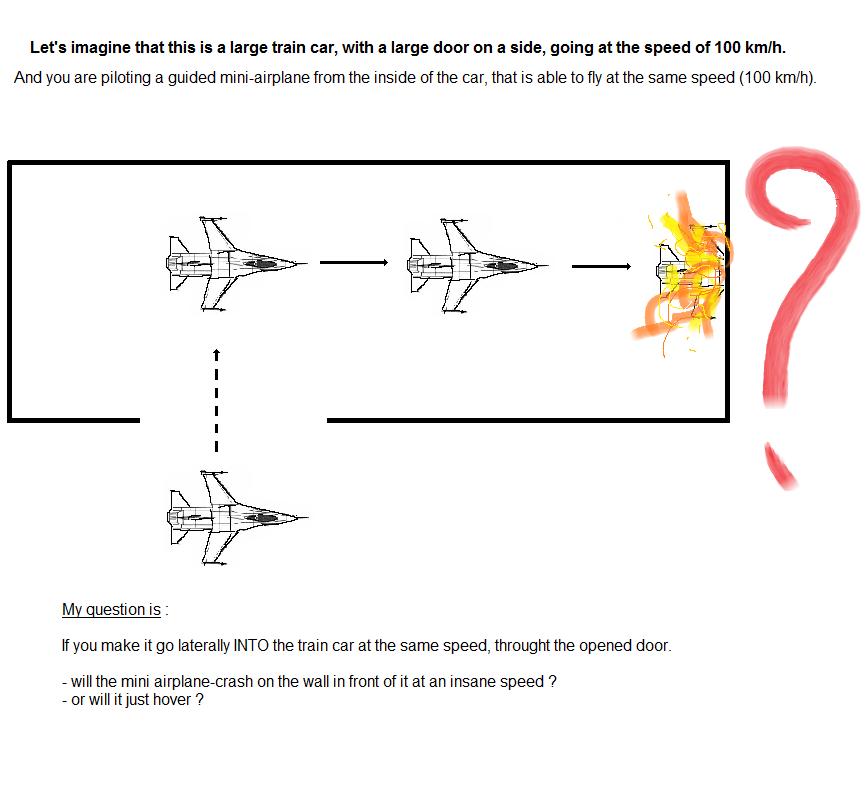
It will appear to hover but is in fact flying at the same velocity as the train


NO, No airflow.


Actually it will probably crash if it's an enclosed carriage as there won't be any air flowing over/under the wings.
Why? The plane will still have its engines pumping out thrust

Because at the point of it entering the box, there will be dramatically reduced airflow over the wings. Thrust does not cause an aircraft to lift - airflow does. Thrust simply enables the wings to gain enough speed to generate the lift required to overcome gravitational pull. .
It will, however have momentum, which will carry it forward when inside the box - therefore the actual answer (ignoring minimal airflow and turbulence caused by the open door in the box) depends on the amount of momentum has stored up, it's original speed (how close is it to stalling?) and the height it enters the box.
Of course, there is an argument that there would also be no resistance inside the box, so the plane will immediately speed up and therefore overcome the lack of airflow relatively quickly.
It doesn't really matter - it WILL crash, either on the floor of the box or the front wall of the box.
It will not be possible for the aircraft to "hover" once inside the box, as has been said, there is no airflow over the wings and therefore it will hit the floor of the box
It will, however have momentum, which will carry it forward when inside the box - therefore the actual answer (ignoring minimal airflow and turbulence caused by the open door in the box) depends on the amount of momentum has stored up, it's original speed (how close is it to stalling?) and the height it enters the box.
Of course, there is an argument that there would also be no resistance inside the box, so the plane will immediately speed up and therefore overcome the lack of airflow relatively quickly.
.

Aircraft fly because of the airflow over the wings - because the front of the cabin is blocked off, there isn't enough air flowing over the wing to keep it in a stationary position relative to the train cabin, so it will hit the front of the cabin.
A helicopter would be able to stay stationary relative to the train cabin, but a plane would not.
Wrong.
Even though the plane has momentum, its moving relative to the train;
Plane=100mph Train=100mph, when inside the train+air moving at 100mph there is no more momentum, there is no more air flow and the plane would need its original distance to take of again, for this instance assuming that its 50 yards.

Since the airflow over the wings would suddenly be almost zero, the wings would lose lift and the model 'plane would hit the floor rather than the front of the truck. If the controller was skilled enough and the engine responsive enough, it's possible that he/she could hit the throttle at just the right time to get the airspeed up but that would be some party trick to pull off!

Wrong.
Even though the plane has momentum, its moving relative to the train;
Plane=100mph Train=100mph, when inside the train+air moving at 100mph there is no more momentum, there is no more air flow and the plane would need its original distance to take of again, for this instance assuming that its 50 yards.
True. I stand corrected.

I always get suckered in to these threads....
AAAARRRGGGHHHH!!!!!
End of the day - who actually cares what happens in an imaginary situation?


Why no momentum? What stops the plane ...?
Nothing stops it, there just isn't anything to make it go :bang:
As has been said many many times on the interweb, unless a plane has air moving around the wings it doesn't fly.
Well assuming no transition effects of moving between the separate airflows:
At the start it is travelling at a constant speed so all of the forces on the plane (thrust, lift, drag & gravity) are balanced.
Once it has moved into the train car the airspeed is reduced to 0km/h as the air in the train car is also moving at a constant speed equal to that of the plane (this is equivalent to the plane moving into a very strong tailwind). This will eliminate the drag force so the plane will start to move forward until the plane has an airspeed of 100km/h (ground speed 200km/h) and the thrust and drag forces are balanced again.
At the same time as no air is now moving over the wings the lift force is eliminated and the plane will descend until the airspeed reaches 100km/h and lift once again match gravity. At which point it will continue to move forward at it's new lower height.
So depending on many, many variables the plane would either hit the floor or the front wall of the train car (but as others have pointed out it is more likely to crash on the transition).
with regards to the OP! The only thing that changes is the inertial frame of reference for the aircraft! The air is not moving in either situation, unless you read something in the OP I didn't! ... Assuming all things being equal
Assuming all things being equal
The air is in a moving train car and is moving along with it.
The air is moving over the wings at 100 km/hr until the plane enters the box, at that point the air is not moving over the wings until the plane has built up speed. The plane will either drop to the floor before it reaches that speed through the air or hit the front of the box as it attempts to.

Why does the the air speed of the plane change?
Airspeed is the relative difference between the speed of the air and the plane, so when moving between still air (outside) and moving air (inside) the airspeed will change. At the exact point of the move, the ground speed of the aircraft is unchanged but then changes in the time following the move.