Can anyone figure this one out?

Skyline On Fire

Suspended / Banned
Messages
1,391
Name
Luke
Edit My Images
Yes
oaojfaaci.jpg
 
It will appear to hover but is in fact flying at the same velocity as the train
 
Correct and the same if the train sped up.
 
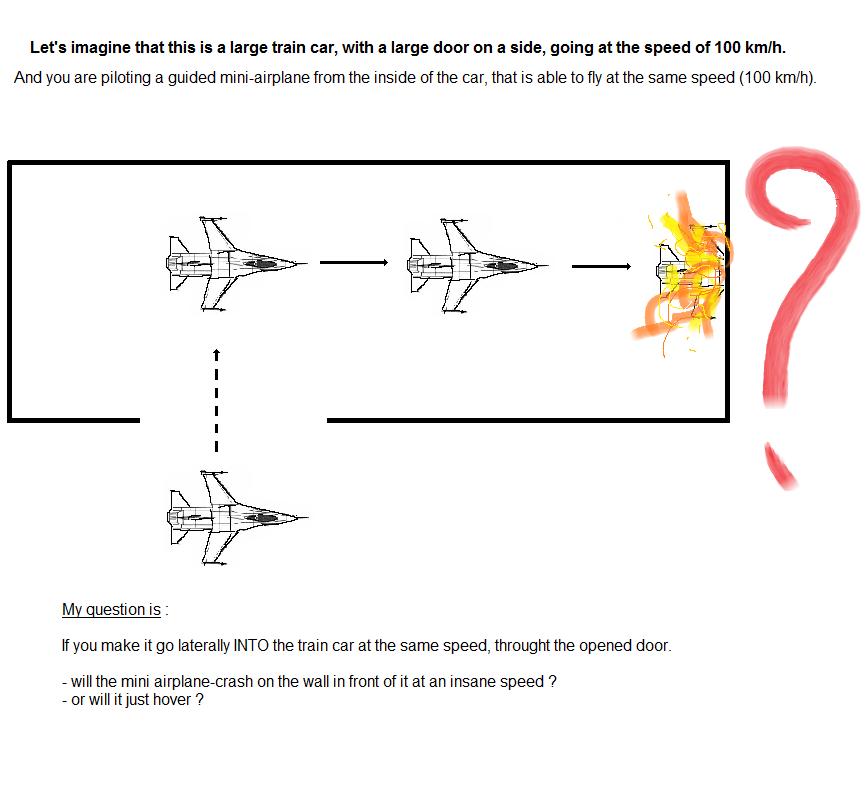
Aircraft fly because of the airflow over the wings - because the front of the cabin is blocked off, there isn't enough air flowing over the wing to keep it in a stationary position relative to the train cabin, so it will hit the front of the cabin.

A helicopter would be able to stay stationary relative to the train cabin, but a plane would not.
 
It would hit the wall in front of it (unless the train carriage had no doors or windows) as the air inside the train carriage would be static, so the plane's speed would remain relative to the surrounding atmosphere.
 
How is this plane propelled? Fuel? or propeller? either way it matters not, the plane only gets lift from air flow, speed is what makes it fly, i would guess that the plane would just hit the floor as there is no more air flow to give it lift inside the cabin.

The air inside the cabin is moving at the same speed as the cabin, but from inside the cabin it is not moving at all, this you must understand, "theory of relativity"

It's not different than if you threw a ball from inside the train forward, to a person standing on the outside the ball would have moved at the speed you threw it plus the speed of the train, to a person on the inside it would have only moved the speed you threw it.

However, if the side's where open in the cabin only having a top, front and back, then the plane would hover as the air flow would be constant relative to the outside, thus causing drag, giving the plane lift and able to fly.

confused yet? :D
 
did we have one of these a few months ago - different machines, same kind of scenario?

...and I reckon James has it pretty much right

Yes - the age old "will a plane take off if it was on an massive conveyor belt"

HERE!!!
 
I go along with the hit the floor argument
It gets lift from the airflow
inside the car, there's no airflow, so no lift
there is still forward thrust, so it wil slither to a halt on the floor

second and bigger problem would be actually getting it inside the car
ignoring turbulence, there is still massive windshear between air movingat 100 kph and air that is stationary

so the real answer is either
a) it would smash into the (out)side of the car
or
b)
lose control and fall under the wheels
 
NO, No airflow.

Actually, it was more the point of whether the aircraft would travel along the conveyor belt at all, bearing in mind that the wheels are not driven by the engine, as they are in a car.

Therefore, with a non driven wheel, the plane would theoretically still move forward along the belt, and could therefore take off. A car, however would sit still, although it was being driven and the wheels would drive at the speed of the belt. As soon as the wheels are turning faster than the belt, the car would then move forward.

It really depends though on whether the plane would sit still, with it's wheels rolling with no power applied or if it would move backwards on the belt. If it's moving backwards with it's wheels still, the propulsion unit would need to be sufficiently powerful enough to firstly bring the body of the plane to a standstill and then to move it forwards fast enough to get enough lift for it to take off.
 
Actually it will probably crash if it's an enclosed carriage as there won't be any air flowing over/under the wings.


Why? The plane will still have its engines pumping out thrust :D
 
Why? The plane will still have its engines pumping out thrust :D

Because at the point of it entering the box, there will be dramatically reduced airflow over the wings. Thrust does not cause an aircraft to lift - airflow does. Thrust simply enables the wings to gain enough speed to generate the lift required to overcome gravitational pull.

It will, however have momentum, which will carry it forward when inside the box - therefore the actual answer (ignoring minimal airflow and turbulence caused by the open door in the box) depends on the amount of momentum has stored up, it's original speed (how close is it to stalling?) and the height it enters the box.

Of course, there is an argument that there would also be no resistance inside the box, so the plane will immediately speed up and therefore overcome the lack of airflow relatively quickly.

It doesn't really matter - it WILL crash, either on the floor of the box or the front wall of the box.

It will not be possible for the aircraft to "hover" once inside the box, as has been said, there is no airflow over the wings and therefore it will hit the floor of the box.
 
It's even more likely that as the first wing enters the box the plane will spin round and hit the far side of box or the rear of it. Or even send it back out again.
 
Last edited:
Because at the point of it entering the box, there will be dramatically reduced airflow over the wings. Thrust does not cause an aircraft to lift - airflow does. Thrust simply enables the wings to gain enough speed to generate the lift required to overcome gravitational pull. .

It may drop, but it's speed will not (of any significance anyway) Assuming the carriage is long enough then the plane should continue forward

It will, however have momentum, which will carry it forward when inside the box - therefore the actual answer (ignoring minimal airflow and turbulence caused by the open door in the box) depends on the amount of momentum has stored up, it's original speed (how close is it to stalling?) and the height it enters the box.

The airflow should not change if the plane maintains its speed within the carriage.

Of course, there is an argument that there would also be no resistance inside the box, so the plane will immediately speed up and therefore overcome the lack of airflow relatively quickly.

That's what I'm saying.

It doesn't really matter - it WILL crash, either on the floor of the box or the front wall of the box.

I agree, but seeing as the question doesn't refer to the floor ... ?

It will not be possible for the aircraft to "hover" once inside the box, as has been said, there is no airflow over the wings and therefore it will hit the floor of the box

I agree

The aircrafts ground speed will effectively double but it's air speed will be the same.
 
To Outlore, i never clicked the link, just assumed that the conveyor was rolling with no propolsion.

The Plane question is quite simple. Moving in 100kph/mph of air will allow it to fly, as the plane nears the train car, turbulence will affect the plane but i don't think sufficient to cause it to crash, but that depends on how fast you are going to manouver it in the train.

Once in the train, and going by the diagram, the airflow would immediately stop causing the plane to fall to the ground.

The weight to speed ratio would not be enough to allow the plane to hit the wall, as propulsion would need to be extremely great in order to move the object, if its just a petrol plane of aorund 3ft in length then its not enough weight and not enough propulsion.

However if you scale things up a little and use a real jet plane with the same scenario then yes, it would hit the wall and crash, because the force needed to move the plane is so great that once inside, the weight to speed ratio would be far greater as gravity is working differently.
 
It will, however have momentum, which will carry it forward when inside the box - therefore the actual answer (ignoring minimal airflow and turbulence caused by the open door in the box) depends on the amount of momentum has stored up, it's original speed (how close is it to stalling?) and the height it enters the box.

Of course, there is an argument that there would also be no resistance inside the box, so the plane will immediately speed up and therefore overcome the lack of airflow relatively quickly.

.

Wrong.
Even though the plane has momentum, its moving relative to the train;

Plane=100mph Train=100mph, when inside the train+air moving at 100mph there is no more momentum, there is no more air flow and the plane would need its original distance to take of again, for this instance assuming that its 50 yards.
 
Aircraft fly because of the airflow over the wings - because the front of the cabin is blocked off, there isn't enough air flowing over the wing to keep it in a stationary position relative to the train cabin, so it will hit the front of the cabin.

A helicopter would be able to stay stationary relative to the train cabin, but a plane would not.

Since the airflow over the wings would suddenly be almost zero, the wings would lose lift and the model 'plane would hit the floor rather than the front of the truck. If the controller was skilled enough and the engine responsive enough, it's possible that he/she could hit the throttle at just the right time to get the airspeed up but that would be some party trick to pull off!
 
Wrong.
Even though the plane has momentum, its moving relative to the train;

Plane=100mph Train=100mph, when inside the train+air moving at 100mph there is no more momentum, there is no more air flow and the plane would need its original distance to take of again, for this instance assuming that its 50 yards.

True. I stand corrected.
 
Since the airflow over the wings would suddenly be almost zero, the wings would lose lift and the model 'plane would hit the floor rather than the front of the truck. If the controller was skilled enough and the engine responsive enough, it's possible that he/she could hit the throttle at just the right time to get the airspeed up but that would be some party trick to pull off!

And still only result in the plane crashing into the front of the carriage ;)
 
Wrong.
Even though the plane has momentum, its moving relative to the train;

Plane=100mph Train=100mph, when inside the train+air moving at 100mph there is no more momentum, there is no more air flow and the plane would need its original distance to take of again, for this instance assuming that its 50 yards.

Why no momentum? What stops the plane ...?

True. I stand corrected.

Is it? Not sure why :thinking:
 
I always get suckered in to these threads....


AAAARRRGGGHHHH!!!!!

End of the day - who actually cares what happens in an imaginary situation?

:lol:
 
Why no momentum? What stops the plane ...?
:thinking:

Nothing stops it, there just isn't anything to make it go :bang:

As has been said many many times on the interweb, unless a plane has air moving around the wings it doesn't fly.
 
Nothing stops it, there just isn't anything to make it go :bang:

As has been said many many times on the interweb, unless a plane has air moving around the wings it doesn't fly.

So what about it's engines :shrug: They don't suddenly stop, do they? :D
 
Well assuming no transition effects of moving between the separate airflows (such as turbulence in the doorway, torsional force on the plane when it is half in the train, etc):

At the start it is travelling at a constant speed so all of the forces on the plane (thrust, lift, drag & gravity) are balanced.

Once it has moved into the train car the airspeed is reduced to 0km/h as the air in the train car is also moving at a constant speed equal to that of the plane (this is equivalent to the plane moving into a very strong tailwind). This will eliminate the drag force so the plane will start to move forward until the plane has an airspeed of 100km/h (ground speed 200km/h) and the thrust and drag forces are balanced again.

At the same time as no air is now moving over the wings the lift force is eliminated and the plane will descend until the airspeed reaches 100km/h and lift once again match gravity. At which point it will continue to move forward at it's new lower height.

So depending on many, many variables the plane would either hit the floor or the front wall of the train car (but as others have pointed out it is more likely to crash on the transition).
 
Last edited:
Well assuming no transition effects of moving between the separate airflows:

At the start it is travelling at a constant speed so all of the forces on the plane (thrust, lift, drag & gravity) are balanced.

Once it has moved into the train car the airspeed is reduced to 0km/h as the air in the train car is also moving at a constant speed equal to that of the plane (this is equivalent to the plane moving into a very strong tailwind). This will eliminate the drag force so the plane will start to move forward until the plane has an airspeed of 100km/h (ground speed 200km/h) and the thrust and drag forces are balanced again.

At the same time as no air is now moving over the wings the lift force is eliminated and the plane will descend until the airspeed reaches 100km/h and lift once again match gravity. At which point it will continue to move forward at it's new lower height.

So depending on many, many variables the plane would either hit the floor or the front wall of the train car (but as others have pointed out it is more likely to crash on the transition).

Assuming all things being equal :thinking: with regards to the OP! The only thing that changes is the inertial frame of reference for the aircraft! The air is not moving in either situation, unless you read something in the OP I didn't! ... :D
 
Assuming all things being equal :thinking: with regards to the OP! The only thing that changes is the inertial frame of reference for the aircraft! The air is not moving in either situation, unless you read something in the OP I didn't! ... :D

The air is in a moving train car and is moving along with it.
 
Assuming all things being equal :thinking: with regards to the OP! The only thing that changes is the inertial frame of reference for the aircraft! The air is not moving in either situation, unless you read something in the OP I didn't! ... :D

The air is moving over the wings at 100 km/hr until the plane enters the box, at that point the air is not moving over the wings until the plane has built up speed. The plane will either drop to the floor before it reaches that speed through the air or hit the front of the box as it attempts to.
 
The air is in a moving train car and is moving along with it.

Yes it is! ... and?

The air is moving over the wings at 100 km/hr until the plane enters the box, at that point the air is not moving over the wings until the plane has built up speed. The plane will either drop to the floor before it reaches that speed through the air or hit the front of the box as it attempts to.

Why does the the air speed of the plane change? :)
 
Airspeed is the relative difference between the speed of the air and the plane, so when moving between still air (outside) and moving air (inside) the airspeed will change. At the exact point of the move, the ground speed of the aircraft is unchanged but then changes in the time following the move.
 
Last edited:
Why does the the air speed of the plane change? :)

As has been said, the air in the box is also travelling at 100 km/hr, the same speed as the plane. So when the plane enters the box both the plane and air are travelling at the same speed. Because there is no air resistance the thrust from the engine will propel the plane forward, but there will also be no lift until the plane reaches speed, by which time it would hit the front of the box or drop to the floor.
 
Airspeed is the relative difference between the speed of the air and the plane, so when moving between still air (outside) and moving air (inside) the airspeed will change. At the exact point of the move, the ground speed of the aircraft is unchanged but then changes in the time following the move.

Why is the air inside the carriage moving? :thinking:
 
once it passes the turbulence in the doorway it will begin to acelerate until it is moving at 100 km/h relative to the air inside the carriage, causing it to crash into the front of the carriage
 
Back
Top
