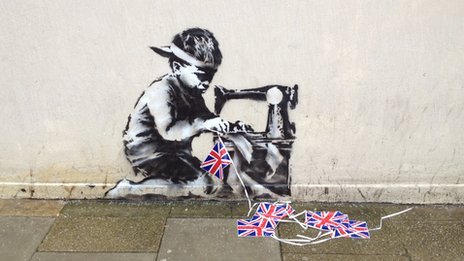
Is photographing some criminal damage grafitti any different to Crimewatch re-enacting any other crime?
Yes...
We're talking copy-right of the image. Intelectual rights to that unique creation.
A re-enactment or 'pastiche'...finding another wall where you can legally paint something 'in the style of' a Banksy mural, and photographing that, is neither committing any crime, if Banksy commited one in the first place, nor is it 'copying' his actual intelectual work, it is merely 're-enactment' or 'pastiching', following the style of.
Hundreds of artists, and gazillions of photographers 'emulate' or 're-enact' images in the style of great 'masters'... the great masters in fact often pastiched or emulated thier mentors, learning thier craft to develop and form thier own style. Its perfectly acceptable..... provided they don't attempt to pass it off as the actual genuine work of the master... that's forgery!
You have to separate the variables here.
Bansky owns the intelectual rights to his artistic creation. That is a fundemental precept.
Yes, he MAY have committed an illegal act in producing his 'work'. In essence, 'criminal damage', and a low level of criminal damage at that, 'defacing' a wall.
Justice would suggest that you should not 'profit' by an illegal act. However, creating his ART was not an illegal act; using materials that were not his own, that he did not have permission to paint, was the illegal part.
Lets say, that an artist paints a picture on canvas in thier own studio; but with oil paints and canvas shop-lifted from Hobby-Craft.....
Artist would still own the intellectual rights to THEIR work.... fact that they were created with illegally obtained materials does not change that. They would still own the copy-right.
Lets say, that materials, in Hobby-Craft were in total marked up to a value of £25. Painting then sells for £10,000 in an exhibition. Court could punish them for stealing canvas and paint; but within limits comensurate to the value of that canas and paint, not the painting produced with it.
This is 'justice'. If I had stolen the materials and made a painting from them... I'm not artist... I probably be lucky to get £1 for it in a car boot sale... its the same 'crime', and What would be the extend of punishment for shop-lifting and passing stolen goods? Court could NOT punish artist who flogs his painting created with £25 of stolen materials any more harshly, just because thier artistic imput making a master-piece out of those materials results in a work worth £10K insead of 10p!
Legal owner of stolen goods? Hobby-Craft. Artistic Thief is cought and punished. Like any shop-lifter; probably a fine and a bit of community service. A Punishment 'commensurate' with the crime. But what of the legal owner of the goods originally stolen. They are still their property.
Would Hobycraft 'own' either the £10K or 10p painting?
No. That was NOT stolen from them. What was stolen was the paint and canvas. Not the art-work.
Shop-Lifter, steals £30's worth of stake from Tesco's.... that stolen goods, soon as it is cooked and eaten no longer exists in the form stolen. In fact, once out of the chiller and degrading its NOT the goods stolen. So they would probably not want them back even if recovered, they would want 'compensation', to the value of their 'loss'.
So, our £10K painting and our 10p painting; neither may be deemed the property stolen; Hobycraft from who materials were stolen has NO claim to the artwork created from them, those materials in the form stolen no longer exist, they are entitled merely to compensation to the value of thier loss, NOT the value of resultant art-work created from them.
Back to Banksy.... Applying that legal reasoning then; Wall owner selling his art-work, AS art-Work, is selling an image that technically still belongs to Bansky.....
Except, that act of creating 'Graffiti', would imply that he is 'discarding' his art-work.... it's technically 'Rubbish'.
He has taken no precautions or made no provision, to enable him to retain the 'artifact' or to enable him to use, utilise or profit from that artifact in the future, creating it on a wall, in a public place.... hence he has 'thown it away'
Gold Ring; if it falls off my finger to be lost in the street; it is 'lost' property, it still belongs to me, even if discovered by some-one else. Legal, they have no claim or right to it, until they have exhausted all 'reasonable' measures to return it to legal owner. Ie handed it in to cop-shop and waited the month or whatever it is to see if its claimed.
However; lets say its a wedding ring; I'm just divorsed and I take it off and THROW it away, a deliberate act of disguardment, with NO intention of ever recovering that property. THEN any-one who finds that ring, as 'rubish' has claim to it.
Applying that legal reasoning then, would be implied that Banksy 'threw away' his intelectual rights, including copy-right, with the original image, as he took no precautions or meatures to claim or preserve them, before during or after the creation of the art-work.
Which would ultimately suggest the answer is NO-ONE owns the Copy-Right to the mural; mural itself is owned by the building owner.
Brings us back to the photo of the mural; and implication is that Mural is non copy-right material. Photographer owns copy-right to his photo, BUT any-one else taking photo of that mural would own copy-right to THEIR photo, even though it may be nie on identical to the other. Selling either would not be a copy-right infringement against either photographer, they only own copy-write to thier image, not its subject. Same as three photographers may take pretty much identical photo's of the same footballer at a football match and each sell them to different news-papers, without copy-right infringement.
But I'm no lawyer.