Astrophotography - focus and other advice

eoSimon

Suspended / Banned
Messages
664
Name
Simon
Edit My Images
Yes
I just watched an youtube video on an introduction to astro. The presenter talked about focusing using manual focus and live view on the nearest/brightest star. I understand manual focus as you dont want the camera focus ‘hunting’ but id assumed the lens would just be set to infinity.
If this is correct can someone explain please ?
 
Infinity might look good enough when your focusing on a large mountain in the distance, but when you're focusing on stuff light years away that's a single pin prick of light you want it pin sharp. Also Infinity might not actually be bob-on infinity on your actual lens.

Not all lens's have infinity as the furthest focus, canon for instance have a little bit extra for focus breathing for when they lens's get hot and the material expands.

Just focus on infinity, use live view, zoom in to a bright star s much as possible and just rock the focus ring back and forwards until its as small and tight as possible. Job done.
 
I use the Samyang 12mm F2 for astro. Its manual focus only. If you simply turn the focus ring all the way to the end where it says Infinity, it goes past it and becomes blurry. I did a test during daylight, to get the actual infinity focus point then put a small tipex mark on the correct point. This means its easy to set in the dark with a headtorch and nothing showing on the camera screen. Its not an expensive lens so guess the looseness of focus is part of the compromise.

For foreground, just light up a certain point with a headtorch and get the camera to focus on that either manually or automatically.

Most cameras autofocus will struggle in near pitch black conditions though.
 
Thanks all. The lens i planned to use was a canon 50mm f/1.4.
I had read that wide angle is better but will see how it goes with the above
 
Pretty much any lens can be used for astro*, depending on what you're trying to capture - a fisheye (180° type) will get the whole sky in while a telephoto will get you "closer" to the celestial bodies.

I've found that focussing on the Moon then switching to manual focus (or locking focus another way) works well, especially if the camera doesn't want to focus on a star.


*The faster (widest aperture) the better to help with focus and other low light issues!
 
Thanks all. The lens i planned to use was a canon 50mm f/1.4.
I had read that wide angle is better but will see how it goes with the above
Whether wide angle is better or not only depends upon what type of aspect you want i.e. if you want to get a lot of foreground or sky. If youre doing milky way then wide angle is usually needed to fit plenty of sky in the frame with a bit of forgeround as well.

The only thing that matters in terms of whether a lens is capable of astro is how much light it will let in I.e. max aperature. You don't really want anything above F2.8. Your 50mm 1.4 will let plenty enough light in for astro, you will just be stuck with 50mm style scenes. You could do panoramas but this can be difficult with stars and star trails.
 
Whether wide angle is better or not only depends upon what type of aspect you want i.e. if you want to get a lot of foreground or sky. If youre doing milky way then wide angle is usually needed to fit plenty of sky in the frame with a bit of forgeround as well.

The only thing that matters in terms of whether a lens is capable of astro is how much light it will let in I.e. max aperature. You don't really want anything above F2.8. Your 50mm 1.4 will let plenty enough light in for astro, you will just be stuck with 50mm style scenes. You could do panoramas but this can be difficult with stars and star trails.
The alternative is my 24-105 f/4. I’ll try the 50 - its only an experiment so no need for GAS yet !
 
My advice would be try each suggestion given for focusing and go with the one you feel world best. Feels like a cop out answer but ultimately it's what works for you.


On my om1 it has star auto focus which I rely on. On the Z7ii (only just got so learning myself) I've been zooming in on viewfinder and manual focusing.

Regarding all other things astro, try as many methods as you see and experiment.

I got this with my Nikon d610 and 50mm 1.8D as a pano. I'm not saying this the standard, but it's what I got with similar sounding gear and I'm happy with it. (And we all know Nikon and Oly are better than canon )

View: https://flic.kr/p/2fCtKfT


My astro attempts are hit and miss as I don't do a lot and it's a rabbit hole. There's the 500 rule to stop start trails, what some swear by. Others say it's redundant on DSLR as the higher resolution means you'll get star trails sooner.

Either way happy shooting.
 
it was inevitable that some one did it

Not all lens's have infinity as the furthest focus, canon for instance have a little bit extra for focus breathing for when they lens's get hot and the material expands.

A lot of more modern lenses, don't really have an infinity. Quite a few don't even have an infinity 'stop' anymore and can go well past actual infinity fairly out of focus.

I always manual focus with magnification.

 
For a fixed camera, rather than one guided to follow the stars, there is also the 500 rule to consider to help prevent star trailing. As the Earth turns the stars appear to move across the sky and if the shutter speed is to long they will appear as trails rather than points of light.

It is more a guideline than a rule but is

Shutter speed to prevent trailing = 500/(crop factor of the camera x focal length of the lens)

I see from you details you have a Canon 6D. If you are using that camera then as its full frame there is no crop factor and the above is just 500/focal length of the lens.

There is a bit of trial and error involved to discover what amount of trailing you find acceptable.

Dave
 
For a fixed camera, rather than one guided to follow the stars, there is also the 500 rule to consider to help prevent star trailing. As the Earth turns the stars appear to move across the sky and if the shutter speed is to long they will appear as trails rather than points of light.

It is more a guideline than a rule but is

Shutter speed to prevent trailing = 500/(crop factor of the camera x focal length of the lens)

I see from you details you have a Canon 6D. If you are using that camera then as its full frame there is no crop factor and the above is just 500/focal length of the lens.

There is a bit of trial and error involved to discover what amount of trailing you find acceptable.

Dave
Thanks Dave, i didnt know that.
So with a 50mm lens my maximum shutter speed should be 10 seconds. Yes i was expecting a lot of testing to see what works but its good to have a starting point.
 
Thanks Dave, i didnt know that.
So with a 50mm lens my maximum shutter speed should be 10 seconds. Yes i was expecting a lot of testing to see what works but its good to have a starting point.

In reality it's much less than that even. If you use a wide lens, you'll notice the stars on the edge start to trail even as low as 10 seconds on a 16mm, whilst the ones in the centre are nice and sharp. Although luckily it's not really much of an issue unless you pixel peep.
 
assumed the lens would just be set to infinity.
Some lens designs (particularly in ye olden days) focussed past infinity (something to do with infrared focus performance is hanging around in the back of my brain) so a clear focus at infinity wasn't the end stop of the lens for visible light.
 
Some lens designs (particularly in ye olden days) focussed past infinity (something to do with infrared focus performance is hanging around in the back of my brain) so a clear focus at infinity wasn't the end stop of the lens for visible light.
That's right...there used to be a little red mark just to the left (I think) of the focus indicator.
 
Some lens designs (particularly in ye olden days) focussed past infinity (something to do with infrared focus performance is hanging around in the back of my brain) so a clear focus at infinity wasn't the end stop of the lens for visible light.

Extreme temperatures and atmospheric density can also change where infinity focus is. The marks on a lens are more of a guideline to use in "normal" conditions.
 
Are any of the Astro nebula photos actually legitimate?

Apologies for the thread hijack, but I remember a lady (Years ago) who took the most amazing photos of Space, but she said the amount of processing that occurred for each image was monstrous, I believe she actually converted her house (I want to say in Spain) so she could take these photos.

I’ve seen really good pictures of the Milky Way which are 100% attainable with relatively good gear and little light pollution. But how accurate are photos further away?
 
Are any of the Astro nebula photos actually legitimate?

Apologies for the thread hijack, but I remember a lady (Years ago) who took the most amazing photos of Space, but she said the amount of processing that occurred for each image was monstrous, I believe she actually converted her house (I want to say in Spain) so she could take these photos.

I’ve seen really good pictures of the Milky Way which are 100% attainable with relatively good gear and little light pollution. But how accurate are photos further away?

They are legit.

Some moreso than others, but it depends on your definition. They're often very faint, much fainter than the milky way so require MUCH longer exposures - Exposures of 30mins+ aren't really practical, so we take many shorter exposures and stack them. Hours of long exposures at relatively high ISO brings a lot of noise too, so we take dark frames and flat frames which we then average and subtract from the stacked image, then we need to do the "regular" processing to bring out details and contrast, sharpening, saturation etc etc, which is far more fiddly than normal because there's such little difference in brightness between the object and the night sky.

A lot will also depend on how dark the sky is at the time. The darker the sky, the less processing required to lift the data from a murky background.

Some will use filters to bring out a certain part of the nebula, others use an array of filters to capture different chemicals, each one in monochrome, then assigning a colour to each one before mergning them into a final colour image - this is what Hubble does.

So yes, it takes a lot of processing, but it's mainly very delicate processing to extract very faint data, rather than heavy handed painting with a dodge/burn brush.

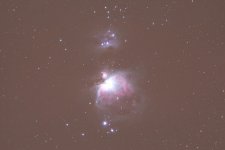
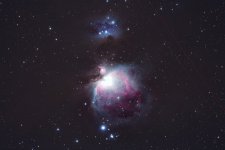
Some, like M45, are barely a whisp and require a lot of exposure and processing to extract it. Others, like M42 can be seen easily in a single frame, but just need more exposure time to bring out the finer details.

I've attached a single frame and stacked version of M42. The single frame is an 8 minute exposure, which in itself could be processed and made into a decent image. The stacked image is only a little over an hour (8 x 8 minutes), with darks and flats.


IMG_07521.jpgIMG_07522.jpg
 
They are legit.

Some moreso than others, but it depends on your definition. They're often very faint, much fainter than the milky way so require MUCH longer exposures - Exposures of 30mins+ aren't really practical, so we take many shorter exposures and stack them. Hours of long exposures at relatively high ISO brings a lot of noise too, so we take dark frames and flat frames which we then average and subtract from the stacked image, then we need to do the "regular" processing to bring out details and contrast, sharpening, saturation etc etc, which is far more fiddly than normal because there's such little difference in brightness between the object and the night sky.

A lot will also depend on how dark the sky is at the time. The darker the sky, the less processing required to lift the data from a murky background.

Some will use filters to bring out a certain part of the nebula, others use an array of filters to capture different chemicals, each one in monochrome, then assigning a colour to each one before mergning them into a final colour image - this is what Hubble does.

So yes, it takes a lot of processing, but it's mainly very delicate processing to extract very faint data, rather than heavy handed painting with a dodge/burn brush.

Some, like M45, are barely a whisp and require a lot of exposure and processing to extract it. Others, like M42 can be seen easily in a single frame, but just need more exposure time to bring out the finer details.

I've attached a single frame and stacked version of M42. The single frame is an 8 minute exposure, which in itself could be processed and made into a decent image. The stacked image is only a little over an hour (8 x 8 minutes), with darks and flats.


View attachment 467562View attachment 467561

This is beautiful work.

I am concerned we may be steering away from the OP, but do you have any threads of your setup? Step by step of your process etc?
 
Don't worry … thread was from a beginner pov even though the original question was specific. I have changed the title. Good to see other advice…
 
Don't worry … thread was from a beginner pov even though the original question was specific. I have changed the title. Good to see other advice…

I’m very much into Astro-anything but have never been able to get any decent shots, even through Telescopes.
 
One easy way to get into astro photography is to get a smart telescope. They are not that expensive and solve problems like auto focussing , finding and going to your target object and taking fairly long exposures and even stacking them. Models like DWARF 3 or Seastar S50 produce amazing results.

I have posted some on here in the past,
 
One easy way to get into astro photography is to get a smart telescope. They are not that expensive and solve problems like auto focussing , finding and going to your target object and taking fairly long exposures and even stacking them. Models like DWARF 3 or Seastar S50 produce amazing results.

I have posted some on here in the past,

The Seestar S50 looks incredible. And not too much money either.
 
This is beautiful work.

I am concerned we may be steering away from the OP, but do you have any threads of your setup? Step by step of your process etc?

It's been a long time and I don't remember the exact software + steps because it would change as I learned more. The mount was an EQ5, camera was a 700d I believe, and it could have been one of a few scopes or just a lens.

It was most likely a Takumar 200mm at those exposure lengths, I wouldn't have gone that long with a scope. It would have been guided too, using my trusty synguider.
 
It's been a long time and I don't remember the exact software + steps because it would change as I learned more. The mount was an EQ5, camera was a 700d I believe, and it could have been one of a few scopes or just a lens.

It was most likely a Takumar 200mm at those exposure lengths, I wouldn't have gone that long with a scope. It would have been guided too, using my trusty synguider.

Thanks, I’m going to do a bit more research before I start spending.
 
I think an important thing with astrophotography is having the right expectations of what realistic results are for the gear used.

There's the milky way photos with the purples and blues etc but whenever I take a photo it looks nothing like it. I was really disappointed with the photos I as taken, until I saw a youtube video that showed how much editing went into it.
 
I think an important thing with astrophotography is having the right expectations of what realistic results are for the gear used.

There's the milky way photos with the purples and blues etc but whenever I take a photo it looks nothing like it. I was really disappointed with the photos I as taken, until I saw a youtube video that showed how much editing went into it.

Agreed, but I have seen photos of the Milky Way, that are as raw as you’re going to get, that yielded amazing results.

No purples in them however.
 
I think an important thing with astrophotography is having the right expectations of what realistic results are for the gear used.

There's the milky way photos with the purples and blues etc but whenever I take a photo it looks nothing like it. I was really disappointed with the photos I as taken, until I saw a youtube video that showed how much editing went into it.

Agreed, but I have seen photos of the Milky Way, that are as raw as you’re going to get, that yielded amazing results.

No purples in them however.

Hands down the biggest factor is how dark the sky is. A tiny scope on a simple tracking mount in the middle of a desert will absolutely blow away a huge, fast, expensive scope in a suburban back yard.

I've seen raw frames from dark sites that look better than other people's finished results.
 
Hands down the biggest factor is how dark the sky is. A tiny scope on a simple tracking mount in the middle of a desert will absolutely blow away a huge, fast, expensive scope in a suburban back yard.

I've seen raw frames from dark sites that look better than other people's finished results.
Yes for me light pollution is the biggest challenge to my experiment so will probably wait for my return to rural suffolk.
 
Back
Top