They are legit.
Some moreso than others, but it depends on your definition. They're often very faint, much fainter than the milky way so require MUCH longer exposures - Exposures of 30mins+ aren't really practical, so we take many shorter exposures and stack them. Hours of long exposures at relatively high ISO brings a lot of noise too, so we take dark frames and flat frames which we then average and subtract from the stacked image, then we need to do the "regular" processing to bring out details and contrast, sharpening, saturation etc etc, which is far more fiddly than normal because there's such little difference in brightness between the object and the night sky.
A lot will also depend on how dark the sky is at the time. The darker the sky, the less processing required to lift the data from a murky background.
Some will use filters to bring out a certain part of the nebula, others use an array of filters to capture different chemicals, each one in monochrome, then assigning a colour to each one before mergning them into a final colour image - this is what Hubble does.
So yes, it takes a lot of processing, but it's mainly very delicate processing to extract very faint data, rather than heavy handed painting with a dodge/burn brush.
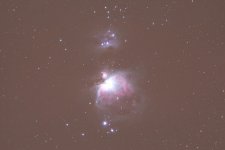
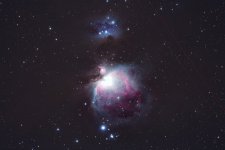
Some, like M45, are barely a whisp and require a lot of exposure and processing to extract it. Others, like M42 can be seen easily in a single frame, but just need more exposure time to bring out the finer details.
I've attached a single frame and stacked version of M42. The single frame is an 8 minute exposure, which in itself could be processed and made into a decent image. The stacked image is only a little over an hour (8 x 8 minutes), with darks and flats.
View attachment 467562View attachment 467561