Any electronics experts in the house?

I think my best option is to wire it up and test it out :0) I can't find any data online for/against jumping off the 5v to power the leds and charge the battery but like you say, I think the charge function would just be reduced.

I started with the assumption of running two usb in feeds (either a dual port cable or two separate cables), neither of which are very neat and is where I am currently with a dedicated USB feed in after the boost module to power the LEDs directly. An alternative is that I run a 12v feed in (using a dedicated wall adaptor) and then split that internally to provide an LED power source and feed the battery charge module separately. I would then need the same switching solution to allow the leds to run on battery power but without the concerns about exceeding USB2 limitations. The main downside of this method is that a dedicated power adaptor is required instead of using any freely available USB port.

Obviously the alternative is a standard 5v usb input with a simple passthrough switch to a female USB port so the lights can be switched off and a secondary device charged using the 5v input. However, this then prevents wireless utilisation!

I'll try out the split 5v feed first though I think.

Cheers
Steve
 
Last edited:
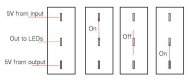
Ok so, latest update. I've created a new circuit by wiring a direct 5v line from the incoming micro USB on the power bank circuit board via a diode to the LEDs with an ON-OFF latching button.

I've then wired a 5v line from the outgoing USB on the power bank circuit with a two position switch in line to the LEDs via the same ON-OFF latching button. As a result, when an external power adaptor is connected to the incoming micro USB, the LEDs are powered by it as well as the lipo battery being charged. By switching the two position switch inline from the battery > LEDs, there is no risk of voltage drain from the battery by the LEDs so the charge cycle can complete minus the load taken by the LEDs and any external device being charged.

When the external power is disconnected and the two position switch moved to the alternative position, the LEDs are then powered by the lipo as well as the outgoing USB port offering power to another device.

View attachment 28663

External 5v power connection powering the LEDs, charging the lipo and powering an external device (in this case another strip of LEDs)

View attachment 28664

NO external 5v power so the LEDs and external device are both powered by the lipo.

View attachment 28665

In a real world scenario, I would see the LightFrame being connected to an external 5v source for the majority of time either on a desk/bedside so it will always be charging the lipo ready for whenever there was a requirement to use it 'wirelessly'.

At the moment, the only power bank I have only puts out 350ma and is not idevice compatible hence me using the second LED strip to test the circuit. The next step is to build the housing for the Lightframe and pick up a higher output power bank circuit to use with a 3000mah lipo I've already got here and ensure a mobile phone can be charged sufficiently.

I also need to look at alternatives for taking power from the incoming 5v micro USB because soldering to SMD sized connections is not fun!

Cheers
Steve
 
Cool, so it works as expected.
I would just replace the two switches with a single panel mount on-off-on rocker. That would eliminate the need for the diode... btw, I think the diode should be before the 5V out junction in your diagram.
 
Well spotted with my 'deliberate' diagram mistake...thanks ;0)

With regards to the ON-OFF-ON I'm not sure how that would be best wired up? At the moment I have a Master ON-OFF latching button to control the LEDs regardless of their power source. The second switch is basically to block the battery power to the LEDs when the unit is powered by an external 5v source. Am I right in thinking one side of the latching rocker would be power from the external 5v and the other would be power from the battery with the centre being 'lights off' but charging the lipo if an external 5v source is connected?
 
That's a really useful link, thanks for the heads up. From the site name I assume that's yours?

Weirdly, I was awake at about 4:30 with my daughter and realised that the 3 pin switch I've been using already is almost what I need except that it doesn't have an OFF position. I'll pick up another toggle switch and put that inline.

Thanks again
Steve
 
Not sure this should be in this thread or in your general product development thread I have a few thoughts on recent developments. If I had one of these I don't think I would need or want any kind of extra USB charging for external devices. I envisage it being wall mounted so clean lines are paramount for me but even desk mounted I don't think I'd be disappointed if I couldn't charge my mobile phone or e-cig (if I smoked an e-cig), IMHO it's an unnecessary complication.
The important factors for me are ability to display different size reversal frames simply and easily in quality mounts, the frame itself should be unfussy and not be out of proportion to the frames being displayed, it should be easy to charge if using a rechargeable system and if using normal AA or AAA batteries it should last a decent amount of time before requiring replacement. Keep it simple :thumbs:
 
I agree. If I was making this, I would probably put a USB connector on it as well as a socket for one of the most common co-axial connectors as found on plug top power supplies. These sockets have a a contact which disconnects with a plug inserted so it could isolate the USB input.

That way, it could be powered up a variety of ways without having to much superfluous functionality or additional components.


Steve.
 
Thanks Nick and Steve. I was planning on asking these sort of questions in my main build thread so you beat me to it :0)

My original intention was always to make a lightframe that could be used either on a desk or hung on the wall. For wall hanging the question was always about how long a battery (or batteries) would power the LEDs because of the brightness required to properly display slides.

When I started looking at Lipo batteries I naturally looked at including an external charge function because most simple Lipo charge circuits include an output function and also, on a personal level, I felt that if I used the lightframe as a bedside nightlight for example, I would take up a plug socket for the 5v power source hence needing to charge my phone somewhere else. However, my main priority is to make a product that looks good and fits in to a 'normal' usage situation whilst still delivering on its original brief. Specifically, I do agree with Nick's "keep it simple" suggestion :0)

The main concern I have now is being able to wall mount the unit whilst still getting use out of it. That is, I wouldn't want a lightframe that needed to be charged/batteries replaced every time I went to use it so I'm looking at 10000/13000mah lipo cells which will take longer to charge but will then offer much longer wireless usage. However, my current backend frame design is built around using rechargeable AA/AAA batteries held in the support stand with the idea that in the event of the batteries being flat, new ones can be inserted straight away and the frame can be used again without having to wait for a lipo to charge or need to use a cable.

Sorry for the long post guys but I feel like I'm at a bit of a junction. Do I build a unit specifically to sit on a desk and be powered by a cabled connection permanently or do I implement a battery to allow 'wireless' usage that will give up to 10-12 hours of usage from a large lipo before a recharge is required? Decision, decisions!

All feedback/suggestions appreciated
 
Ok, keeping with the simplicity/functional mantra I'm looking to implement a dual power function using standard 5v input (from USB or wall charger) as well as a 4 x AA battery holder. Whilst this adds a little complexity into the backend design to house the 4AA battery holder/circuit, it adds the benefit of using freely available batteries (ideally rechargeables) when using the frame wirelessly but still offers a desktop function too.

I've been looking at battery holders and associated 5v regulator circuits but have come across the following AA USB power bank units. I'm looking to build one of these into the rear of the LightFrame in a slot to the battery unit can be slotted in to power the device and easily removed to change/charge the batteries as well as using the power bank outside of the frame if required.

30637-BK.jpg


30637-BK-1.jpg


The USB connection will be inside the lightframe unit so the outside will still have clean lines. Internally, the LEDs will be controlled by a master latching switch which will take it's power from whichever is the highest rated source (e.g. external 5v input when connected).

Whilst the use of Lipos and an internal charge circuit appeals to me for external appearance, I realise that AA batteries will offer a similar performance (rechargeables) but add simplicity of swapping them out when flat instead of having to reconnect the frame to a power source if the lipo is flat.
 
Last edited:
That's a really useful link, thanks for the heads up. From the site name I assume that's yours?
Yes, that's one of mine... I also make custom guitar pickups, restore vintage pickups, and do some custom wiring/luthier work.

I do agree that there is no major plus to the output; but IMO, if it's already part of the board you are using there's no harm in including it. Someone might find it useful if they use the frame on the desk/shelf.

The idea of a switching jack makes sense, but IMO only if you are not going to be using any jacks on the board. 5V USB supplies are more common/cheaper than others these days. You would still need a switch to turn on/off battery power.

Be VERY careful about using a charger box like that. As I mentioned earlier, there is a reason you don't see consumer products that take common replaceable batteries and also charge them. And that's because different batteries require different charge methods. If it's a NiCd charger it's probably only good for NiCd batteries. If it is a NiMh charger it *may* or *may not* be good for both NiMh and NiCd but not NiZn. If it is for NiZn it is only good for those. And NONE are ok to be charging standard alkalines. If it is designed for lithium then using batteries of another type wont work. And about the worst thing you could do is put/charge lithiums in a box designed for another type (serious fire potential).
If I were going to do it I would find a smart board the recognizes NiMh and NiCd and I would be very specific (WARNING) about only using/charging those types of batteries.

Has any consideration been given to cooling? LED's run "cooler" but they can still give off a good bit of heat in an enclosed space. Most LED assemblies like this have the LEDs mounted to an aluminum frame/heat sink. I would be somewhat concerned with long term heat effects/buildup on the slides/batteries.
 
Hi Steve, I agree that having a 5v output is useful if it's already on the circuit in use. However, I think I'm going to revert to my original plan of simplicity over 'gadget' factor hence the easily replaceable AA power.

With regards to the AA power bank, this one doesn't have a AA charger built in so that those issues you've highlighted aren't a problem. I did see a few other manufacturers selling units with both a battery charger and usb output combined but I prefer this one. By making the unit a relatively dumb battery holder, the onus is on the end user to manage the AA battery charging outside of the frame so it negates those concerns.

Thanks for your help with this
Steve
 
Sorry, I forgot to say, with regards to cooling there will be quite a large air space in and around the LEDs although I've left them running continually in my test unit for a few days and haven't seen a massive amount of heat build up so I'll run some more long term testing in the final unit. I can always add some air holes into the back to allow heat to escape too.
 
Hi Steve, I agree that having a 5v output is useful if it's already on the circuit in use. However, I think I'm going to revert to my original plan of simplicity over 'gadget' factor hence the easily replaceable AA power.

With regards to the AA power bank, this one doesn't have a AA charger built in so that those issues you've highlighted aren't a problem.

I think that makes reasonable sense for a product that is intended to be primarily cable powered. In that case, all you need is a 4AA box wired in series (6V) and an on/off switch for it. There's no need for a board or anything. You could remote a panel mount LED to indicate battery power if you wanted. And you could put a resistor in line if you really can only accept 5V max. But it's probably not necessary and it will only eat power.
And in that case, a switching jack also makes sense. USB>3.5mm barrel cables and 5V 3.5mm barrel wall warts are both reasonably sourced.
 
I was looking at plain 4xAA battery holders first and there are a lot with basic fly leads and an on/off switch, including some with lids fitted but then I came across the power bank cases which I think add to the design in that they can be used outside of the frame if needed as well as being easier to build in neatly. Also, the price difference between a bare battery box and these is minimal so I'll take a look :0)

I'm going to be using a dedicated power button for the frame anyway so having the on/off switch on the battery box itself isn't a major benefit so I may remove it from the power bank entirely.

I'll take a look at the switching jacks as an input option instead of USB too, at least they will be easier than micro USB to add on the circuit internally :0)
 
Back
Top