Any electronics experts in the house?

stevelmx5

Suspended / Banned
Messages
10,176
Name
Steve
Edit My Images
No
Hi all,

I'm after a little bit of advice/clarification for the circuit I'm building for my Lightframe. My basic requirement is for the leds to be powered by either the 2 AAAs with boost module (5v) or an external USB input (5v). I'm looking to include a Schottky diode inline with both positive feeds to prevent return voltage from either power source causing damage to the other in the event that the usb source is connected at the same time that batteries are fitted.

From my planning, I think the circuit would look like this but I'm not sure if each positive feed needs its own diode or if they could both be fed to a single diode before the leds?

View attachment 28356

If anyone can confirm this i'd really appreciate it.

Cheers
Steve
 
Last edited:
I'm no good with this sadly, maybe @PMN or @Steve Smith can shed some light.
 
That will do it. It does need two diodes.

It is possible that one or both of the units will not mind having voltage applied to the output but the diodes are best used - just in case.

EDIT: 1A diodes ar a bit overkill though!

Steve.
 
How are you driving the emitters? Is the boost circuit a current device or a voltage step? It'll work either way but if is a simple voltage device I'd put the diode directaly after the battery to ensure the step up is actually delivering 5v. If its a current driver, which are optimal for led, then it won't matter.

Edit. Actually probably doesn't matter at all since your other source should be a well regulated 5v with the same voltage drop.
 
Last edited:
Thinking again. I'd probably do it differently. I'd use a dedicated LED driver which could take a input of 1.5v - 6v and output the correct current. LED's don't really care about voltage, the ones in my simple dynamo light get >50v, but they do get fried if you breach their current rating usually about 1a for well heat sunk high output emitters but much less for simple ones.

Though I woudn't go to the effort of redesigning if you've got this working.
 
Thanks for the help Steve(s) :0)

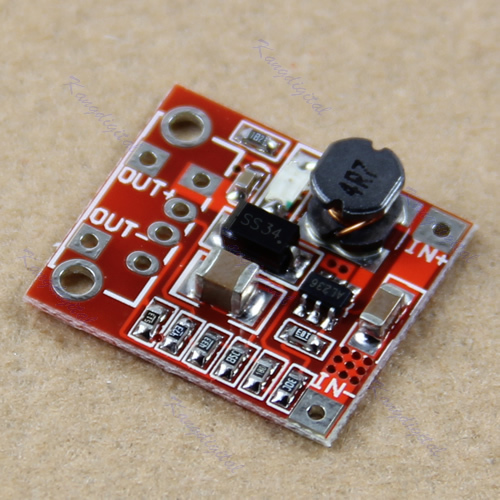
This is the voltage step up boost module I'm planning on using;

$_12.JPG


The technical spec is;

  • Size : 20mmX20mmX5mm/0.78''X0.78''X0.19''(inch) (approx)
  • Module Properties: non-isolated boost
  • Rectification: non-synchronous rectification
  • Input voltage: 2.5V-6V
  • Output voltage: 4V-12V (adjustable)
  • Output Current: 1000mA (Max)
  • Conversion efficiency: 92% (the highest)
  • Switching frequency: 1MHz
  • Output ripple: 20mV (max)
  • Load Regulation: ± 0.5%
  • Voltage Regulation: ± 2.5%
This looked to be the best fit for what I need because it's small, works with inputs between 2.5v and 6v, and delivers a constant 5v output with only a small about of dropoff. I was originally planning to use 3 x AAA batteries hich would mean that I could have probably run the circuit without the boost module but in the end I've decided to go with 2 batteries instead for size and easier fitment in the design.

The additional USB input is a secondary option as I can see these frames being used on desks next to a PC/wall outlet as much as on the wall so it makes sense to be able to power it using standard 5v 500ma USB.

Assuming I use this module, am I right with my original circuit design using a schottky diode inline with the positive feed from the USB input and the positive feed after the boost module?

Cheers
Steve
 
Could you not just drive the boost from both the battery and the USB, you'd still need a diode on the AA line to stop the USB trying to charge the cells. Should be a little simpler with only one set of outputs and saves a diode.
 
I hadn't thought about doing that as I'd assumed they would need to be wired separately for the diode to work. It would make it a simpler circuit although (I might be wrong!), would the voltage into the boost module be doubled if both the battery and USB inputs were connected at the same time? Its operating voltage is >6v
 
Last edited:
Yes, it would toast the poor thing. Although I'm not sure what would happen to your emitters if both inputs were powered in the original design.
 
Yeah, I am a little worried about the implications of someone connecting both sources! An alternative option I have is to provide a dedicated USB cable with an adaptor that slots in to the battery holder (after the batteries are removed) to provide the USB input. Whilst this is a more complex way of providing USB power, it negates the risk of burning out the boost module/LEDs.
 
Although I'm not sure what would happen to your emitters if both inputs were powered in the original design.

Actually I am.

If you've limited the current with resistors (which is the least you need to do) then they'll light up very bright and burn out as the V in VIR climbs too high and makes your current breach the emitters design limits. If you've got a proper LED driver and its input voltage is between 5v and 20v then it will continue to output the correct current whilst only wasting a little bit of power as heat.
 
I'm using 5v led strips rather than individual leds so, as far as I know, they have built in regulators;

View attachment 28544

I'm not sure how the LED driver would work if the LED strips already have these built in?
 
Looks like resistors on each emitter, might be worth checking with the supplier if they're regulated and if so what their safe voltage range is. If it is resistors they're probably calibrated for a relatively stable 5v so adding more voltage will release the magic smoke. If its a proper regulator then you might be okay with out a driver.

I think a driver will be okay with inline resistors, probably less efficient, but I doubt a driver will play nicely with any other form of regulator.
 
Actually, not sure why I didn't think of this before to save any complications/risks. The LightFrame will have a master power switch so I can just make that a 3 position switch;

Battery << OFF >> USB

That way, the hard switch can control the power source and there's no risk of voltage leak or damage to the boost module.
 
Yeah, I like neat but then again I'm not a massive fan of magic burny smoke appearing from the inside of my LightFrame either :0)

Thanks a lot for your help though, much appreciated mate.
 
I'm not exactly an electronics expert, but I've messed around with electronics and LED strips more than a bit.

Driving the boost module with the 5v and 3v in parallel will not increase the voltage to the module. It will pull from whichever is higher (i.e. automatic switching). The main problem is any of the 5v not being used will want to reverse current into the 3v (i.e. recharge the batteries). Without some kind of recharge monitoring this is not a good idea, a diode can fix that. The other risk would be that the amperage delivery potential does increase, but the LED's would never draw enough to be problematic because the resistors on the strip regulate the current (amperage) driving the LEDs. (LED's are current driven)

On the other hand, the boost module already has a 3A 40V reverse current diode in the circuit (the SS34 diode). I would just put the usb supply in parallel after the boost module with a diode on it's positive leg. (i.e. as drawn, just eliminate the boost module's additional diode). I would use at least a 1A diode as that's the max output from the boost module.

The bigger issue I see is the amperage capability. With the batteries in series the amperage capability will be the same as what one is rated for. If you put two standard non rechargeable AA's rated at 500mAh and the strip runs at .5a draw, you would only get ~ 1hr run time with ~ a 1v drop (discounting the voltage/amperage draw of the boost module itself, it would probably be less). You could go with high mAh batteries (i.e. 2800mAh NiMh) to get a longer run time with less voltage drop if you have control over that.
And then there is the USB supply concern. USB1/2 is limited to .5A/2.5W load ...all LED strips I've seen draw more than that and could burn up the supply. USB3 is good for .9A and is enough for a single short strip of 4.5W or less, so probably ~ .5 meter of led's, maybe less. But you would need to make the port USB3 specific.
 
Last edited:
Thanks for the help and information. I've just received the boost module and can see the diode built in (I hadn't noticed that before).

So am I right in saying that the circuit I drew is correct apart from having one too many diodes? If the two positive feeds are joined after the boost module, is it the LED strip that determines which source to take power from (the higher voltage)?

With regards to the length of usage, I need to run a full soak test but from testing with a 1000mah lipo I was getting 2-3 days of constant use so am hoping to achieve somewhere similar with the batteries. However, I would personally run the LightFrame from a usb source when possible anyway to save swapping batteries.

The LED strips are specifically designed to run from standard usb and actually came with a usb plug attached so have had no issues with excessively high draw in the testing I've done with lipo's, a wall adaptor with USB and a laptop USB port.

Thanks again
Steve
 
Thanks for the help and information. I've just received the boost module and can see the diode built in (I hadn't noticed that before).

So am I right in saying that the circuit I drew is correct apart from having one too many diodes? If the two positive feeds are joined after the boost module, is it the LED strip that determines which source to take power from (the higher voltage)?
Regarding the diagram, yes, I think so. Assuming the integrated diode is appropriately placed.
In a parallel circuit it's a "stronger" wins and "path of least resistance" type of thing. Think of a 5k kid and a 3k kid and they both want to move forward. If they run into each other the 5k kid will overpower the 3k kid (reverse charging). But if there is a draw off to the side (path of least resistance/voltage load) the 5k kid will divert towards that instead. Whatever portion isn't being drawn off to the side will remain in conflict with the 3k kid (diode protected). There is no way the 3k kid is going to overpower the 5k kid to get there.

With regards to the length of usage, I need to run a full soak test but from testing with a 1000mah lipo I was getting 2-3 days of constant use so am hoping to achieve somewhere similar with the batteries.
Those things must be being under driven significantly... or they are some very low spec LED's.

What are you doing with them in your frame?
 
Last edited:
Thanks for your help with the circuit diagram. I've just finished putting it together with both the 2xAAA batteries (with 5v Boost module) and the 5v USB input along with a diode on the USB positive lead after the boost module and am happy to say that it's working perfectly. I'll leave both power sources connected tomorrow with new AAA batteries and make sure everything stays happy but initially it looks fine with no heat build up or magic smoke..

I'll upload some pictures of the completed circuit in a minute but I'm basically putting together a 6x4 lightbox frame to display 35mm/120 format slides. I've had a build thread running since I started putting it together

http://www.talkphotography.co.uk/threads/a-95-finished-product-im-working-on.542635/page-4

Thanks again for the advice
Steve
 
Last edited:
This is the complete circuit. I've wired in a latching push button to control the power.

View attachment 28566

There's a small indicator LED on the boost module which is correctly showing only when there is power draw coming from the batteries.

View attachment 28567

It's strange that even though I knew the dimensions of this module when I bought it, I was amazed at just how small it actually is (20mm x 20mm). I'll have no problem housing this inside the LightFrame along with the USB power input.
 
I'm basically putting together a 6x4 lightbox frame to display 35mm/120 format slides. I've had a build thread running since I started putting it together

That's cool... but you're only lighting from one edge?
If the load is really as low as you measured you could probably run a second strip in parallel. Running them in parallel would double the current draw and 1/2 the battery life but I think it could probably easily tolerate it. (the 24hrs on 1000mAh would be around 40mA/.2W)

If I were you I would consider using a 2600-3000mAh 5V USB rechargeable "power bank" in place of the AAA pack/power booster AND the USB jack as the only power source. There's a variety of sizes/shapes (some quite small) and they can be found for ~ $10 (maybe less ordered direct and in qtty). Use the USB input to charge the battery and for USB power supply; use the USB output to drive the LEDs. The USB rechargeables have the protection/monitoring/boost circuits built in. You can buy just the boost/charge modules w/ USB jack for ~ $2 and supply the LiIon batteries yourself.

The load on the USB source (computer) will be higher when it is both charging the battery and powering the LEDs, but I think it should tolerate that fine. Even running two strips in parallel the load would only be ~ 80mA/.4W which is well below the 500mA/2.5W for USB2. That leaves a lot of room for additional charging current (it's like jumping a car). That's assuming your load test is accurate... an in line amp meter test might be better (without actual test readings I'm guessing on the numbers...and I could be making a mistake somewhere).

I've done similar with 12V LiPo's to run 5meter LED strips... but testing would be required. There could be something particular about the circuitry of the chosen battery that would prevent simultaneous input (USB power/charge) and output... but I doubt it.

But how cool would that be?... Power from computer/wall wart or rechargeable battery with no fuss.
 
Last edited:
Hi SK66, rather than disregard your last post I've actually done the same since last night :0) As per my other thread I've been backwards and forwards between using lipos versus AAA/AA batteries. I came to the conclusion that it would make more sense to use off the shelf batteries with direct USB power as an alternative. However, as per your post and my testing, the Lipo I have (3.7v 3000mah) easily outperforms AAA/AA batteries for longevity as well as allowing me to make a sealed unit as I always planned.

I bought a slim 3000mah USB power bank a while ago to strip down and use it's charging/output circuit and cell so have had it in the cupboard doing nothing. When I looked into Lipos originally, my concern was that they really need to be charged without any load on them to prevent damage or low charge scenarios and I couldn't find a suitable circuit for this. However, after playing with a SPDT switch in my circuit last night to segregate loads I realised that I could simply use that to split the Lipo input between the load out to the boost module and the charge circuit. As a result, I've now wired the SPDT switch in line between the charger/load and can run the Lipo in double duty depending on whether it is being charged or powering the LEDs.

Using the Lipo with it's own charge circuit also adds the advantage of an Idevice compatible USB output for charging from the Lipo itself so the LightFrame can serve both purposes as I originally planned.

Not sure if that post makes sense but basically, the circuit I have now offers the following;

1) Lightframe powered by external USB input from PC or wall charger / Internal Lipo charging another device (e.g. Iphone) using standard cable

2) Lightframe powered by external USB input from PC or wall charger / Internal Lipo being charged by same USB input

3) Lightframe powered by internal Lipo / No external charging

This then gives the option to run the LightFrame 'wirelessly' and then when it's re-connected to a USB source, the Lipo is charged.
 
A sealed unit makes sense... Plus, a 3.7v supply will have a higher boost module efficiency than 3v will (but 3 batteries at 4.5 volts would be even better).

I was thinking you could use a Li control board and a AA battery box. That would allow for USB battery charging and manual exchange of the batteries... which would allow the unit to run on any AA's available at the moment. The battery box would need wired in parallel which keeps the voltage the same as for 1 battery but adds the mAh capacities together... and you would want a boost circuit that accepts ~1V as it's minimum input. I don't really know if the boost circuit would be more/less efficient boosting 1V at higher current (mAh capacity) than it would be boosting 3V at lower current. But I think a "Joule Thief" (simple voltage booster) is current based and it might be more efficient with higher current as opposed to higher voltages.

The big issue would be that it would be REALLY bad to have any other type of batteries in the box during USB connection/battery charge. Sealed is probably just safer/smarter...plus it's easier to build with an internal battery as opposed to w/ a battery door/box.

I'm not sure I understand the switch/charging... just a jumper from usb power to both the lipo and leds in parallel when lipo is disconnected from the led's? The switch is an on/on type? Either way, I'm not really seeing an "off position" for when it's plugged in. And I'm not seeing any protection to prevent the battery from being under load while being charged (i.e. something plugged into the output jack). A 6pole DPDT on-off-on rocker type switch makes more sense the way I'm thinking (or maybe an on-on-on)...and they are easy to surface mount.
 
You're right in that the switch I'm currently using is ON-ON but it is splitting the positive terminal from the Lipo between its' charge circuit and the LED circuit. My thinking is that when it's switched to the LED circuit, the Lipo will power the LEDs (still controlled with a secondary locking push switch). When it's switched to the charge circuit, the Lipo acts the same as it did when in the Power Bank case so can power an external USB device or be charged using the micro-USB in connection. I've been trying to locate some schematics to work out how the charge circuit will handle both an Input connection and an output. From what I can see, the lipo cell charge function takes priority before sending a 5v output to the external device.

Assuming the original Lipo Charge/output circuit is happy functioning as per design, I'm looking at the possibility of jumping off the Micro-USB input to provide the LED circuit USB power so that in the event of the Lipo being charged, the LEDs can still be used. My main concern with that is if the single USB input can provide enough power to light the LEDs, charge the Lipo and potentially charge an external device. I'm thinking that's not really a viable option so the next best would be two USB inputs and one output. One input to power the LEDs directly, one to charge the Lipo and the output to charge an external device.
 
Last edited:
Not a great shot but this shows the ON-ON switch splitting the positive terminal from the lipo between charge/led circuits.

View attachment 28606

When switched to the left, power from the lipo goes to the LEDs via the 5v boost module and a latching push button. There is also a direct USB input with diode after the boost module.

When switched to the right, the lipo power goes to its charge/output circuit and no longer powers the LEDs.
 
A sealed unit makes sense... Plus, a 3.7v supply will have a higher boost module efficiency than 3v will (but 3 batteries at 4.5 volts would be even better).

And four cells at 6 volts with a current limiting resistor and no boost circuit would be better still.


Steve.
 
1) Lightframe powered by external USB input from PC or wall charger / Internal Lipo charging another device (e.g. Iphone) using standard cable

2) Lightframe powered by external USB input from PC or wall charger / Internal Lipo being charged by same USB input

3) Lightframe powered by internal Lipo / No external charging
I'm not seeing those options the way you have it wired.
I see either battery supplying power or battery being charged... unless the spliced in 3rd USB is your USB power.

I'm looking at the possibility of jumping off the Micro-USB input to provide the LED circuit USB power so that in the event of the Lipo being charged, the LEDs can still be used. My main concern with that is if the single USB input can provide enough power to light the LEDs, charge the Lipo and potentially charge an external device.

Based upon your run time tests I think it could...the question is the draw of the third item.

Your battery pack is/was a 5V supply right? That means it has the boost circuit built in as well as the charge circuit. I would pull USB 5V from the board's input jack to one side of an on-off-on switch. I would pull the battery 5V from the board's output jack to the other side of the switch. LED output in the middle. Eliminate the rest of the mess.
This should give:
With switch to the USB 5V input side: USB LED power with Battery charge in parallel thru the board... USB battery output to third item controlled by the boards priority/protection.
With switch in the middle: off
With switch to the USB 5V output side: Battery LED power with output item in parallel. Total output protected by the circuit.

If 5V was simultaneously input to the board the load on the input would be controlled/prioritized by the circuitry. I.e. if it prioritizes battery charging then you couldn't run the LED's off of the battery switch position... it would automatically be blocked; at least until the batteries reached charge limit. But you could run it off of the "correct" USB power switch position and simultaneously charge the battery.
 
Not sure this will work as intended. Have you calculated in the 0.7v drop across your junction?
Is 1a 5v enough to power your LEDs (5w power)?
Is it not easier to see if Maplin or RS make on already.
Instead of normal batteries have you considered a power bar for a mobile phone. I bought on for £7 from TK Maxx. Rechargeable via USB and output by USB. 2200mah 5v, you can get bigger if you want. Using this will mean only 1 usb for you circuit so no diods needed.
 
Firstly, thanks SK66 for the post. I'm drawing the power to the switch directly from the battery at the moment (3.7) hence still using the boost module to power the LEDs. Your suggested switch setup does sound more simple, I wasn't sure if a single USB input would be sufficient but splitting the input and still utilising the power bank circuit sounds ideal. I'll set that up tonight and see how it goes.

Peter, thanks for the suggestion of he power bar. The LiPo battery and circuit I have is actually from one of those so great minds think alike :0)

Cheers
Steve
 
Sorry Steve, just seen your post too. And yes, in using a Schottky for minimal forward voltage drop off the direct usb input.
 
Firstly, thanks SK66 for the post. I'm drawing the power to the switch directly from the battery at the moment (3.7) hence still using the boost module to power the LEDs. Your suggested switch setup does sound more simple, I wasn't sure if a single USB input would be sufficient but splitting the input and still utilising the power bank circuit sounds ideal. I'll set that up tonight and see how it goes.

Peter, thanks for the suggestion of he power bar. The LiPo battery and circuit I have is actually from one of those so great minds think alike :0)

Cheers
Steve

The main concern is the board current in parallel with the led current... it could easily be 500mA charging + the LED load which would be above USB2 specs. There's not much chance of damaging the USB computer port because it's supposed to be current limited... That's why some USB devices won't run on USB2 port power, but they don't hurt it. Your solution for not enough current supply would be a "dual USB" supply cable for USB2 (uses two computer ports)... a single port should be sufficient for USB3 supply. But I think the probable result will just be the LED's pull their current and the battery charge circuit gets a lower current (I doubt it will care, just slower battery charge).

The only other option I see is to just use on/off switching and only the board's 5V out... let the board's circuit dictate what works/when. This is probably safest but might have undesired results (i.e. LED's won't turn on if battery is charging).
Or possibly two USB inputs and one out with an on/off/on switch. The second USB input would be for LED drive alone.
 
Last edited:
Back
Top