A story of Incident light metering

I don't want to take this thread too far off topic, but on the subject of celebrity photographers...

There is one gentleman in another country who sells a little plastic gizmo. He sells it at a very high price and claims great things for it, and says that as he is one of his country's top wedding photographer and uses it at all the very high priced weddings that he shoots, other people need it. But nobody has ever actually found any real evidence that he actually photographs weddings. In fact, he is so busy promoting his expensive little gizmo that some people have worked out that he doesn't have time to photograph weddings.

Then there is someone else who sells a very expensive lighting accessory, it's identical to other products on Hong Kong Ebay except that his name is printed on it and it costs 6 times as much.

Then there is someone else, who I saw demonstrating some lighting equipment. He used a superb model and 'photographed' her in a range of different poses and with different lighting setups, and the finished shots were displayed on a big screen. Except that they weren't, what was displayed were shots that he had taken earlier and which had been very skilfully retouched. As someone who has a lot of experience in using that type of lighting equipment, I can categorically say that those results could not be obtained without the retouching.

And there's someone else who seems to make pots of money training other photographers. Good luck to him on the money making aspect, but personally I would place him very much at the beginner level.

What do all of these people have in common? Good presentation and good marketing.

Terry says that
Many of the more visible ones that have a massive web presence are almost unknown in the real world, and equally many highly successful ones have no web presence at all.
and this is very true. Some of the very best photographers just can't show the work they do, they may have the legal right to do so but they would lose their clients if they did.

I don't claim to be in their class, but I did close down my own website some years ago, I was getting too much work and didn't want to gain any more clients. Since then, the work has fallen off to some extent but because I am doing more and more work for Lencarta I'm very happy with the regular work that comes in from regular clients.

In other words, and to misquote C.S.Forrester,
I judge a man not by what others say about him but from what I see him do.
 
Last edited:
The problem with regarding a histogram as representing an image, is that there is no way of knowing what part of it relates to what in the image.

That is why I called it bean counting. Any and all parts of an image that happen to record as black will be added together and put in the black column. That is equally true of all other tones. If for instance there are no tones in a particular image that record as 18% that column will be blank. It will not indicate anything about the exposure.

The accuracy of the equipment we use is a separate issue, and that is why many photographers establish their own exposure indexes or calibrate their meters.
What is vital is that our equipment is consistent. it is less important that it is accurate.

I do not know what a technically correct exposure is...
One could say it is when all the tones in the scene are captured, and when the mid grey in the scene is a mid grey in the image.
However that is not always achievable or desired.Though the 18% part of it can be consistently achieved with an incident reading.
A correct exposure could also mean that the desired portion of the tonal range is fully captured on the sensor, as this is what we are aiming for.
The difficulty here is that desired portion is nether scientific nor quantifiable.

Agree :) Though it would be helpful to also be clear on what 'correct' exposure is, eg mid-tones in the subject recorded in the middle of the histogram, with highlights and shadows correctly rendered either side. This is what all exposure meters attempt to achieve and as a starting point at least it's a very useful reference point.

And if you're outputting directly from JPEGs, that definition also stands as 'optimum' exposure in 99% of cases. However, when shooting Raw and post-processing, optimum exposure can have multiple and varied definitions, depending on the subject, the desired result, the camera etc. TBH, I don't find the histogram that much help on its own, for the reasons you've noted - they're often hard to read reliably even with experience. There's a little quiz on the Sekonic site to match the histograms to the images, and when I posted a link on here some time ago I don't think anyone got them all right.

But combined with blinkies (a true gift from the Gods of Digital) then the whole thing comes to life. I know where I am and, after some practise, can make very accurate decisions. My ideal camera would have a direct access button that would call up blinkies on the highlights, press it again and it would show 'zebras' over 18% grey. Perfect :thumbs:
 
a true gift from the Gods of Digital
However, don't forget that histograms, zebras and all these fancy things are built from the thumbnail jpeg of the camera. This means after the raw data has already been processed by the camera according to the white balance, contrast, etc. set in your parameters.

About where to point the flashmeter, I have a Sekonic L-758D and, in the manual (yes, I read the manuals), Sekonic says:
Measurements should be with the Lumisphere aimed towards the camera
direction from the subject position

what is fine for me.

or
Measurements are basically made by the method of measuring with the
lumisphere aimed in the camera direction (more precisely, in the
direction of the lens axis) at the position of the subject.

I cannot understand how the "direction of the lens axis" is different from the "direction of the camera". If we consider only the axis, we are always in the direction of this axis (as the intersection with the axis of the lightmeter is not indicated).

Do you have an explanation for that?
 
However, don't forget that histograms, zebras and all these fancy things are built from the thumbnail jpeg of the camera. This means after the raw data has already been processed by the camera according to the white balance, contrast, etc. set in your parameters.

About where to point the flashmeter, I have a Sekonic L-758D and, in the manual (yes, I read the manuals), Sekonic says:


what is fine for me.

or


I cannot understand how the "direction of the lens axis" is different from the "direction of the camera". If we consider only the axis, we are always in the direction of this axis (as the intersection with the axis of the lightmeter is not indicated).

Do you have an explanation for that?

You have a very fine meter there.

There could be a difference if one was being pedantic.
The lens axis of a camera taking a full length portrait is probably pointing to their middle.
however the natural thing for most of us, is to walk up and take it more from their face region or chest.
Also when shooting a couple it is hard to not take it from the brides position, when the lens axis is probably pointing between them.
Personally I doubt the reading would be measurably or significantly different.
 
Some of the common and significant variables that hand meters know nothing about: f/number vs T/stop, diaphragm accuracy, lens vignetting, sensor ISO.

The meter knows 'every variable' that you input into it such as the aperture or ISO and will work out the time for you. Conversely if you input a time it will give you an aperture. Diaphragm accuracy and vignetting is tacit knowledge.
 
2) change to the flat sensor and take individual readings from all the lights in turn, that are illuminating the front to the model, and trim the powers to achieve the desired balance ratio. Re check the Exposure with all the frontal light on and adjust to the required base exposure. (If an fixed aperture is a must, this can be an iterative process.)
What is the "required base exposure"?
What is adjusted at this step? The power of the various lights? Or the aperture on the camera?
3) treat the back ground as a separate object and take a reading toward the camera to establish its exposure, adjust the power as necessary
5) set the power of the effect lights to the necessary level to lift them above the main light setting.
3 to 5... is 4) missing?

Once you have calibrated your meter to give a correct exposure, It should always do so in these circumstances. There should be no need to bracket.
What do you mean with "calibrated the meter"?
 
What is the "required base exposure"?
What is adjusted at this step? The power of the various lights? Or the aperture on the camera?

3 to 5... is 4) missing?

Base exposure is the suitable exposure you chose and established in stage (1) for the main light.

4) is missing because I am stupid and misnumbered.
In stage 2) you adjust the power of each light so that the ratio of fill light to the main light is as you want it which might be anything from 1/2 a stop (very light shadows), to 3 stops (very dark shadows).


What do you mean with "calibrated the meter"?

Some people find that their meter always seems to give a slightly wrong exposure by the same amount every time they use it.
If this is the case and is less than a stop. You can adjust the ISO by the opposite amount to compensate. The cause may in fact be their technique, their camera or the light meter. compensating in this way will in practice give a correct exposures in subsequent readings.

However if the variation is just random, You need to establish why and what is causing it. It may be an inaccurate shutter or aperture in the camera, or it may be a faulty meter. in either of those situations they need checking.
If they are both fine, then it is probably something you are doing yourself, such as changing the way you hold your meter, or letting you own shadow interfere with the light falling on the meter.

It is very important that things are done in a consistent way.

I will think about your questions and see if I can make my previous post clearer.
Thanks...
 
Last edited:
The meter knows 'every variable' that you input into it such as the aperture or ISO and will work out the time for you. Conversely if you input a time it will give you an aperture. Diaphragm accuracy and vignetting is tacit knowledge.

Apertures and shutters suffer from wear and lubrication faults, and are often inaccurate in the first place. If they are consistent we can allow for them. if they are random then so are exposures. The camera or meter knows nothing about these things.
 
Granted, but if things really get that bad I would suggest it may be worth thinking about a lens / body upgrade or at the very least a service. If you have any piece of kit out of kilter it's net going to be good. Working with asymmetric isn't going to help at all.
 
Granted, but if things really get that bad I would suggest it may be worth thinking about a lens / body upgrade or at the very least a service. If you have any piece of kit out of kilter it's net going to be good. Working with asymmetric isn't going to help at all.

Each and every one of has Kit that is not perfectly accurate. there are tolerances set in the standards of all manufacturers. and the amount of use and conditions of use increase these further.This is inevitable, expected and totally reasonable. it does not signify a fault.
Perhaps the most unfortunate part is that these faults working in tandem, as between a camera, exposure meter and lens can either cancel each other out or reinforce the error. When that is the case, the error can be significant and problematic, even though each individual item is within the manufacturers tolerances.

It was such a problem for DSLR makers and lens manufacturers, who were having to adjust so many lenses and cameras to match the focussing between them.
That recently, the more expensive cameras have had calibration systems built in.
Very few cameras and light meters are sent back to have their exposure tolerances checked. not because there are no errors, but because users blame them selves or think such errors in exposure are normal and expected.

It is not that these are "that bad" as you put it. They exist in all our equipment. It is simply fine tuning so that all our kit functions together as well as it can.


In another field altogether, and another of my serious interests "woodworking". Tools arrive in an as manufactured state. They certainly do not arrive set up and ready for use. Take a hand plane for instance. It probably takes four or more hours to bring a finishing plane up to fine joinery standards. The sole will not be perfectly flat as the metal will have seasoned and warped in the weeks since it was made. The mouth will need backing off to allow the finest setting and not block up with shavings. The blade iron will need flattening on a stone and be sharpened and honed and the back iron fettled to match it. the frog and seat will need cleaning up and setting. Even then it may still need further fettling in the weeks to come.
Finally it will arrive at a point when you can remove shavings of less than a 1/10 of a millimetre with little or no effort.
If a wood worker can do this, why not the manufacturer? Some very expensive bronze tools are finished to near this standard.( but always need a little fettling) However most tools are not destined for fine joiners, antique restorers or cabinet makers, but are used by site fixers and carpenters who have no interest in the finest work.

The same applies to Photographers and their equipment ... most are quite happy with what ever comes out of the box.
 
Last edited:
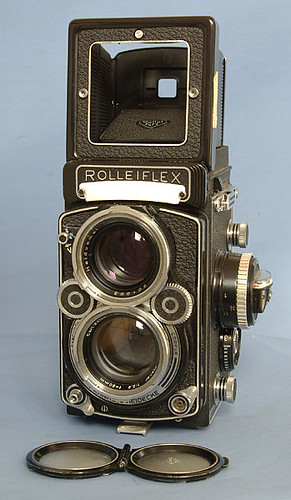
I have several Weston Master meters -- the original Mk II with that proper Mk II Invercone my Dad got me ( Tax Free from Jersey C I ) a Mk III given recently and several Mk V given -- I have the correct Mk V Invercones and some give good readings wich agree, some the needles do not move properly -- I have taken apart the Mk II and Mk III and re-stuck the glass back as the old glue had gone rotten. However, I have a 1960 Rolleiflex 2.8 F Planar with the flat 'Incident' attachment and it still works after all these years and giver accurate readings -- I have used it for many weddings ( no longer do weddings ! )


Rollei 2.8F Planar
by pentaxpete, on Flickr
 
I too have those particular models of Weston meters with invercones. Fortunately all are in working condition. however when using the early ones one must remember they are calibrated to the old Weston scale and you need to adjust by a 1/3 stop to bring them in line with ISO readings. The early two part invercones are hard to find.
I also have a Sixon and Sixtomat that have sliding translucent covers for taking incident readings.
I love the look of your Rolleiflex and I have used early ones like that and the earlier rolleiflex standards, but preferred the controls of the 2.8F Though I more often than not used a hand meter rather than the built in one, as I found it rather fiddly, not all Rollei meters were fully linked to the shutter/aperture controls.

It is a pity so few Rolleiflexes still have the incident attachment, but they are easily lost.
 
when using the early ones one must remember they are calibrated to the old Weston scale and you need to adjust by a 1/3 stop to bring them in line with ISO readings.

In case anyone reading this needs it translated into numbers, Weston is 0.8 x ISO so ISO 100 is 80 Weston, ISO 400 is 320 Weston, etc.

(I know that you know this!).

I have two Weston Master III meters which work perfectly.

My father used to get free meters from the Weston sales representative. Sangamo Weston also make central heating controllers, My father used to be a central heating system designer. Whenever their sales representative came to visit, he would bring my father a new meter!


Steve.
 
Last edited:
Would be celebrity photographers certainly create great web sites.
I'm not talking about web sites!! We are talking images - These guys are not wouold be celebrities either!? I seriously find it very odd that you would make comments about guys at the top of their game.

Some even borrow material and ideas. Some can even make disciples of would be photographers.

These guys are not thieves as you seem to be alluding to either!! They are working professional photographers highly skilled in their craft.

Some produce excellent work even if they do not truly understand what they are doing.
And where do you see yourself in this?

For your further enlightenment a histogram does not measure exposure. It shows in graphic form the quantity of each tonal value represented in the captured image.
Correct

The colour channel views do the same thing for each of the three selected hues. the higher the peak on the graph the more of that particular tone or colour is represented in the image. This might be the result of the colour of the illumination or the colour of the objects in the photograph.
Correct

A histogram does not nor can not distinguish between the two.
No but you can distinguish this by reviewing the histogram yourself.

In simple terms a Histogram is a bean counter. And can not help in exposure setting with out a great deal of prior knowledge of the subject and your intention regarding how you want your image to appear.
We disagree here as the histogram also shows the brightness of each pixel in the image. Obviously it will depend on the image to an extent. But in the majority of cases clipping the highlights will result on ovber exposure. Yes there are exceptions. You can generally easily see the detail in Photoshop's cureves panel of what pixels are located along the histogram

Any shaped histogram can represent a correctly exposed image. The difficulty is describing a correctly exposed image in the first place.
A high key, a low key and a silhouette have widely different Histogram distributions, but are each are representative of a correct exposure.
We were not looking at a high key or a silhouette here.
 
Last edited:
We don't point an incident meter at the sun, it'd overexpose; we point it back to the camera and it averages out the light falling on the (dome) subject from all directions. Surely the same principle applies with flash?

Phil surely when doing that, the area lit by the sun would be over exposed - unless in front of the subject
 
Last edited:
Why the argument? There is no universally 'correct' method of light metering. The concept of incident metering is a good one, and that is really what this post is about I think, but I'm sure there isn't a studio photographer in the land who doesn't meter to the light at some point, even if metering to the camera is the more reliable for overall exposure. Metering to the camera doesn't work with any light that is behind the main subject - background lights, accent lights like a hair light, or rim lighting from directly behind. And then that reading must be adjusted according to experience - the hair light might be a stop above the key front light, the background light might be over- or under-exposed from the meter reading and quite often deliberately fading across the frame, a rim light could also be set either up or down from 'correct'.

A hand meter is just a tool that measures brightness, but that's quite a long way from measuring correct exposure, for the many reasons already discussed, and also, it takes no account of yet another set of variables that happen after the light hits the lens and is ultimately recorded. That's why film shooters always bracket critical exposures, why Polaroids were so heavily used back in the day, and why today's digital photographer should refer to the LCD/histogram/blinkies for final exposure setting. Video users also have 'zebras' (like blinkies, but can be set to different values such as skin tones, to maintain consistency - Sony A7 has zebras, so maybe they're coming to stills shooting now).

My own workflow for a typical portrait starts by setting the lights, and a) moderating power by metering towards each light and adjusting by experience, then b) metering towards the camera as a starting point, then c) tweaking the final lighting ratios and exposure setting with reference to the LCD/histogram/blinkies. That's three different methods of exposure assessment, with some knowledge and experience required at each stage, and they very rarely result in the same settings.

The most sensible post here.
 
Phil surely when doing that, the area lit by the sun would be over exposed - unless in front of the subject
Overexposed? It'll certainly have more light falling on it.

But the aim would be to have the face of the subject correctly exposed, and measuring backlight won't do that unless I'm then going to 'calculate' an exposure based on it.
 
Phil surely when doing that, the area lit by the sun would be over exposed - unless in front of the subject
I am not sure you have fallen in by how the dome works yet.
The dome stands in for the subject as seen by the camera.
all the light. including any from the sun, that hits the part of the subject that can be seen by the camera will be integrated and measured.
This will ensure a correct exposure.
However if you are happy for the portion that is hit by the sun to be ignored, and to burn out, the solution is simple, shade the sun from striking the meter.
It will then only be able to integrate the light that is striking from elsewhere.
all options are open even when using an incident meter, but you need to know what it is doing and what the effect will be.

An incident meter does not measure the light falling on the back of a subject... why would it?
however if the background is lit differently its can be measured separately, so you can perhaps modify the light in some way. but you can only set one exposure on a camera.
 
Last edited:
I wasnt thinking of a backlit subject - A light is from behind is no longer the main light lighting the subjects face
 
I wasnt thinking of a backlit subject - A light is from behind is no longer the main light lighting the subjects face

Nor was I in particular,
My post covered both aspects
and how they could be managed.

A light from behind can be a main-light when you are aiming for a rim-light silhouette against a dark ground.
Lighting has absolutely countless options, all of which have solutions for exposure setting.
 
Back
Top