

A story of Incident light metering

Terrywoodenpic

Suspended / Banned
Messages
8,172
Name
Terry
Edit My Images
Yes
A story of Incident light metering


In the late 1930's Don Norwood an American military captain and photographer, invented the “Heliosphere” the half spherical light receptor common to most incident light meters today.

This solved two of the major problems faced by professional cine photographers. How to measure the light falling on a three dimensional subject to achieve a standardised exposure, and how to standardise skin tones and other important tones appearing in multiple scenes. He published a patent application for this sphere in. 1938. From that time to this, incident readings have become the mainstay of Cine and studio photography.


His new meters displaced the Weston meter and other reflected light meters, as the first choice for this type of work. Later Weston introduced the invercone attachment for their meters which avoided Norwood's patents, they were used widely by stills photographers up to recent times.


Why then did incident light meters not take the same prominent position among professional and serious amateur photographers as they had among Cine workers? I would suggest the main reason was that it solved problems they did not know they had, and in a way that was counter intuitive.

A second and perhaps more practical reason was that they were not as easy to incorporate into the the functioning of still cameras, as were the various solutions provided by reflection meters.

Even today after 76 years of constant use, many photographers can not understand how measuring the light falling on a subject is more effective than measuring the light reflected from it.


So how do the two compare in the way they estimate exposure?

Both use a light receptive unit to measure the received light.

Both are calibrated to to mimic an 18% grey card ( most meters are in fact calibrated to around 12.5%)

However a reflection meter establishes an exposure that will produce an 18% grey of what ever tone it is reading from. If pointed at a white dress or a black background it will assign the same 18% to each of them, they each then reproduce as grey. This calibration is based on the common understanding that the average scene, made up of many tones, reflects back 18% of the light striking it.

The down side of measuring in this way, is few scenes conform to this expectation. And adjustments need to be made for each situation, depending on how they are lit and their tone distribution.

Modern cameras partially but effectively get over this problem by incorporating complex algorithms, that both measure the light distribution and calculate an appropriate exposure based on a library of samples.


None of this is necessary when using an Incident meter. The Light sphere and the calibration, as devised by Don Norwood and used ever since, require that the meter is placed close to the subject in the same light and pointed toward the camera. The shape of the sphere mimics the shape of a 3D object and integrates the light that strikes it from all directions, this is them measured by the photo cell. This arrangement behaves with a very close relationship to the illumination of real life objects. And gives the same reading and exposure, independent of the the colour, tone, luminance of any thing in the field of view.

In this way a black object is always reproduced as black, a white object as white and a continuous grey scale as a continuous grey scale. All tone are reproduced as in the original.


Most incident meters give a simple way of accommodating the more limited brightness range of transparency film or digital sensors . Clipping can be limited to one end of the scale or the other as required. This can be achieved by the simple process of an up or down. exposure adjustment However it must be realised that in doing so, you are moving the entire grey scale reproduction. With the result that all the tones are shifted, a grey card will no longer be reproduced as the original 18% but to the new value. How much each tone is changed, will be exactly the same as the stop value used for the shift. Such shifting can not change the extent of the recorded brightness range, just which portion of it that is to be captured.


Studio and off camera flash.

Incident light meters have dominated flash measurement ever since the introduction of electronic studio flash.

Norwood style meters also dominated studio work using continuous light, and for much the same reasons.

Those reasons include their ability not only to capturer highly accurate standardised exposures, but ones that are not influenced by the background, The the set, the tone nor colour of the subject, all of which will be reproduced as seen.

The original instruction, patent and calibration require that the reading is taken from the camera position toward the camera. This is still the recommendation by all the manufacturers of Incident light meters. However a few well known workers have published, on line, that the exposure reading should be taken toward the main light. This view has been repeated on many forums. It does work, but gives different and non standard results)


The important factor in all this is that the domed receptor accepts all the light from all the directions that fall on the the portion of subject that can be seen from the camera position, and that they are integrated in their correct proportions to achieve a standard exposure.

An incident meter is not a Highlight Meter as might be supposed if you were to use it by pointing the dome at the light source. Just like a reflected light meter, it is calibrated to 18% (12%) of the total received light.


In flash use, particularly in the studio, an Incident light meter can be used to assist and measure the balance of the various lights. This can be done by moving, modifying or changing the power of individual lights. To achieve this the flat receptor is usually used to measure the intensity of each individual lightin turn, so as to establish and adjust the lighting ratios between them. In this way the subject tones, shadows and background strengths can be predetermined. However the actual exposure value used is that determined by the domed receptor, in the normal way.


This same flat receptor can be used to measure correct exposure for flat subjects.


Virtually all Incident meters are supplied with a simple grid like adapter to enable direct reflected light reading to be taken.


The earliest Norwood meters were made to his patent by various manufacturers, they included the first Norwood Director type A in 1947 through to the Super Director a new Patent and made directly for him by Waltz. from 1958-1960. The various models made from1956 till today by Sekonic were based on his original patent. To these can now be added all the Digital flash/ambient meters made by Sekonic, Minolta, Gossen and Spectra. The original patent ran out in 1960


(I still own this Norwood Super Director bought new in 1958 and made by Waltz).
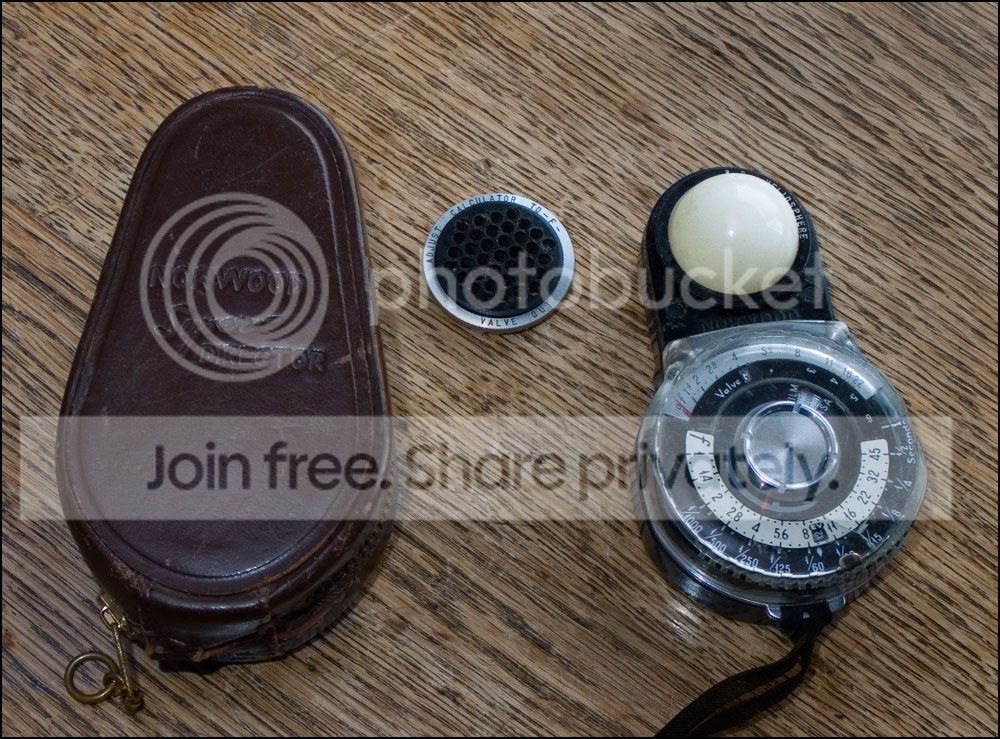


The basic theory and calibration of light meters can be found here http://en.wikipedia.org/wiki/Light_meter
 
Last edited:
I agree with pretty much all you say, except that people like me use flat receptors when photographing flat artwork, for obvious reasons - domes for everything else.

Possibly the reason that still photographers didn't wake up to the benefits of incident measurement as quickly as cine photographers (and of course many still haven't) is simply because it has to be RIGHT with cine, not just within parameters that the photographer considers to be acceptable. Many still photographers would probably find cine impossibly complicated, just from an exposure perspective, limited to a fixed shutter speed and relying on aperture and a matte box for all controls.

As for metering towards the light, this has come up several times just on this forum, there is always some "lighting God" (AKA "celebrity" photographer) who has said that metering should be towards the light, and people who don't know any better simply accept this and are deaf to all explanations.
 
I agree with pretty much all you say, except that people like me use flat receptors when photographing flat artwork, for obvious reasons - domes for everything else.

Possibly the reason that still photographers didn't wake up to the benefits of incident measurement as quickly as cine photographers (and of course many still haven't) is simply because it has to be RIGHT with cine, not just within parameters that the photographer considers to be acceptable. Many still photographers would probably find cine impossibly complicated, just from an exposure perspective, limited to a fixed shutter speed and relying on aperture and a matte box for all controls.

As for metering towards the light, this has come up several times just on this forum, there is always some "lighting God" (AKA "celebrity" photographer) who has said that metering should be towards the light, and people who don't know any better simply accept this and are deaf to all explanations.


Thanks

I mentioned Flat work about 5 line up.
 
Alternative methods when using Incident light meters.


Pointing to the main light

This method is advocated by a number of recent studio photographers contrary to the advise of the manufactures and ignoring the actual calibration of the meter.


The normal method of pointing the meter toward the camera integrates all the light falling on the subject in to a single reading. All the light, including light reinforcing the highlights from the secondary lights is accounted for. This method satisfies the normal 18% aka (12%) calibration.


By comparison pointing the meter at the main light to acquire the exposure reading, floods the whole of the dome with this strongest of the lights but ignores any secondary light from other units.

The meter interprets this as if the light falling on the subject were stronger than for which the meter was calibrated and gives an exposure reading corresponding to a smaller aperture value. This will in effect give an exposure that will result in the equivalent of shifting a histogram to the left. That is to say slightly underexposing. In some instances this will help some digital sensors as it will reduce the chance of highlight clipping, but by an unknown amount, but at the expense of the shadow areas


In the narrow circumstance found in a studio environment this will be found to produce consistent but unquantifiable results. However in more demanding situations, or in mixed lighting this lack of a measurable shift in the exposure is not acceptable and very confusing.


Controlled brightness range

A more controlled way to ensure the Highlights are not clipped by the sensor's lack of latitude, is to use the method recommended by the manufacturers. That is to measure the brightness range, and shift the exposure by the necessary number of stops. This only needs to be established once and used with that particular ISO and sensor. The result will be the equivalent to shifting the histogram to the right by the maximum extent that still avoids clipping. The exposure reading would be taken from the subject to the camera. With the shift applied.


Duplex Readings

An earlier method was once known as a duplex reading and has proved reliable for strong side lit situations or where one light is disproportionally powerful . Two readings are taken one toward the camera and the other to the strong light. The average of the reading is then set. The effect is to somewhat reduce the exposure. And is more likely to hold the highlights. However, like the toward the camera method, is is not quantifiable.


Extreme low light situations

It has been found that any light meter. including reflected light meters, can be used as a lowlight incident meter. And can be worth trying in extremis.

Remove any baffles or domes and point the meter at the light source illuminating the scene. Add Four and a half stops to the exposure and try your luck . This value has worked with a majority of my meters. But is easy to establish for your own meters by trial and error. Once found that stop value addition will always work. Such metering is likely to include areas where there are fewer photons than can be sensed , these areas will remain black in the resulting shot.

Most modern digital cameras can read and expose at this level by default, so the method is for them redundant.
 
This method is advocated by a number of recent studio photographers contrary to the advise of the manufacturers

When this subject was raised on another thread, I did a quick Google search to see if what I thought was correct actually was. However I found more or less a 50/50 mix of point it at the camera and point it at the light suggestions. The most surprising of which was a point it at the light suggestion from one of the light meter manufacturers - Sekonic I think.

Pointing at the light source is clearly nonsense as this will always give the same recommendation for exposure regardless of the light's angle to the subject and the camera's angle to the subject. Obviously a light at more or less the same position as the camera is going to have more light reflected from the subject back to the camera than the same light source would if it was ninety degrees to the subject. Even less if the light is behind the subject putting it into silhouette.

A second and perhaps more practical reason was that they were not as easy to incorporate into the the functioning of still cameras

I have a couple of Kodak Retina Reflex III cameras with built in Gossen light meters with plastic diffusers (flat rather than dome) which can be fitted to take an incident reading. This is the only camera I am aware of which can take incident readings.


Steve.
 
Last edited:
When this subject was raised on another thread, I did a quick Google search to see if what I thought was correct actually was. However I found more or less a 50/50 mix of point it at the camera and point it at the light suggestions. The most surprising of which was a point it at the light suggestion from one of the light meter manufacturers - Sekonic I think.

While Sekonic recommend pointing at the camera. They do point out that in some extreme cases it can be advantageous to take two readings (what I call a duplex reading) as this is so simple to do, convenience can override accuracy.

Pointing at the light source is clearly nonsense as this will always give the same recommendation for exposure regardless of the light's angle to the subject and the camera's angle to the subject. Obviously a light at more or less the same position as the camera is going to have more light reflected from the subject back to the camera than the same light source would if it was ninety degrees to the subject. Even less if the light is behind the subject putting it into silhouette.
absolutely

I have a couple of Kodak Retina Reflex II cameras with built in Gossen light meters with plastic diffusers (flat rather than dome) which can be fitted to take an incident reading. This is the only camera I am aware of which can take incident readings.

Gossen also made such light meters for Rolleiflex and leica and I believe Zeiss But that may have been a derivative of the Ikophot which had a removable translucent screen. I have four different examples of that meter.


Steve.[/quote]
 
But that may have been a derivative of the Ikophot which had a removable translucent screen. I have four different examples of that meter.


I have two and they are both still accurate enough to use for slide film.

The odd thing about my Ikophots (possibly all of them) is that if you set it to 100 ASA it does not point to 21 DIN on the other side. One range is a stop and a bit out from the other. Set it to 21 DIN which should be 100 ASA and it points to 40 ASA. Mine appear correct if you set the ASA scale and ignore DIN.

EDIT: I just did another search on the subject and I'm pleased to say that everything I found from Sekonic said to point the meter at the camera.

I did find this from The New York Instsitute of Photography which says towards the light: http://www.nyip.edu/photo-articles/archive/incident-and-gray-card-readings
With a name like that, they should know better.


Steve.
 
Last edited:
I have two and they are both still accurate enough to use for slide film.

The odd thing about my Ikophots (possibly all of them) is that if you set it to 100 ASA it does not point to 21 DIN on the other side. One range is a stop and a bit out from the other. Set it to 21 DIN which should be 100 ASA and it points to 40 ASA. Mine appear correct if you set the ASA scale and ignore DIN.


Steve.

I must check mine ... I think one has either Iso or Bs as the alternative.
One is basically a cine version.
another is scaled for the 1/25--1/50--1/100, one has the 1/125-- 1/250--1/500 scale and the last has both of those scales.
I have not seen any other versions but I would probably buy one if I did.
 
As for metering towards the light, this has come up several times just on this forum, there is always some "lighting God" (AKA "celebrity" photographer) who has said that metering should be towards the light, and people who don't know any better simply accept this and are deaf to all explanations.

Some of the most successful photographers in the UK, USA and beyond advocate this. Nice to see that it'still rolling on!!
 
Last edited:
Some of the most successful photographers in the UK, USA and beyond advocate this. Nice to see that it'still rolling on!!
And some of the most successful celebrities take drugs, that's their choice but it doesn't make their choices logical or sensible and those choices fly in the face of all the evidence :)

There's nothing complicated about working out the advantages/disadvantages of both methods, it's all down to very simple applied physics.
 
I still use mine a lot, the other thing thatcan be difficult is that the meter has to be where the subject will be, pretty difficult in changeable light or for a fast moving or dangerous subject :)
 
I still use mine a lot, the other thing thatcan be difficult is that the meter has to be where the subject will be, pretty difficult in changeable light or for a fast moving or dangerous subject :)

Any hand meter has problems in those situations. However the meter does not have to be where the subject is, as long as the light falling on it and the subject is the same, which is the case for most outside situations. If you are using strobes or led lighting as your main light out doors there is not a problem anyway.
If the problem is insoluble you can always use an incident meter in the reflected light mode.

The biggest problem for any meter is when you have a split scene, where half is in the shade and the other half in bright sun. Some suggest taking two readings and averaging them. but this rarely works for any sort of meter as the brightness range is simply too large for either film or sensor to cope. In these situations you must make a choice about what is important, attempt a HDR or balance the light will flash or reflectors. metering in itself will not help.


No one is denying that this is what a few photographers do, and as I said in the OP it "Works" in a non standard way
However it works even better if you do it the way the Incident meter is calibrated for.
If you point toward the light the dome integrator is doing nothing, so is in fact redundant. You would get the same reading with a flat cell, or even a translucent cover on a reflection meter ... all would give the same result.

Just about every film you have ever seen since the late 30's was metered with the cell pointing toward the camera. ( though some special purpose cine cameras use gate meters and other devices).
 
Some including Frankdoorhof say....... the quite idiotic
When you meter towards the camera you’re metering light that comes from the camera…

That is not just misunderstanding what the heliosphere does, but is laughable.

The sphere is a stand in for the three dimensional subject and is lit in exactly the same way as the subject.
The light cell that does the measuring is inside that dome and receives only light from the inside of that translucent surface.
this light is an exact sample of the light falling on its surface from all of the lights, not just the main light.
All that light is integrated and measured against the meters 18% calibration.
It does not measure highlights it measures and establishes the standard 18% tone. and by extension all other tones.
This is what we mean by using the meters to peg tones from one shot and another.
Pointing at the main light alone can not achieve this standard between shots and between different lighting set ups.

No light comes from the camera, the cell can not ever see the camera, such thoughts are childish.
Rather like worrying that the man in the TV can see you.
 
Last edited:
The the photo above you can see that the heliosphere shows window light coming from top right, a soft general light coming from the ceiling and walls and a central high light reflection from an off camera flash bounced from a small area behind and above the camera to lift the shadows, and which has created its own shadow down the right side of the case.
In such a situation where would a "light pointer" type of photographer direct the meter dome?

1) give up and go home.
2) any where but at the camera
3) At the camera, and pretend he had not.
 
Some including Frankdoorhof say....... the quite idiotic
When you meter towards the camera you’re metering light that comes from the camera…

That is not just misunderstanding what the heliosphere does, but is laughable.

The sphere is a stand in for the three dimensional subject and is lit in exactly the same way as the subject.
The light cell that does the measuring is inside that dome and receives only light from the inside of that translucent surface.
this light is an exact sample of the light falling on its surface from all of the lights, not just the main light.
All that light is integrated and measured against the meters 18% calibration.
It does not measure highlights it measures and establishes the standard 18% tone. and by extension all other tones.
This is what we mean by using the meters to peg tones from one shot and another.
Pointing at the main light alone can not achieve this standard between shots and between different lighting set ups.

No light comes from the camera, the cell can not ever see the camera, such thoughts are childish.
Rather like worrying that the man in the TV can see you.

I agree with that - It doesn't make sense.
 
And some of the most successful celebrities take drugs, that's their choice but it doesn't make their choices logical or sensible and those choices fly in the face of all the evidence :)

There's nothing complicated about working out the advantages/disadvantages of both methods, it's all down to very simple applied physics.
Like I've said before the proof is in their pudding.
 
This is what I took from Frank's piece.
"Setup your light straight above the camera on let’s say 2 mtrs, now meter towards the camera and it should be perfect, however now start moving the light more and more to the sides (keep exactly the same distance), when you meter towards the camera the value will go down, however when you meter towards the light it will stay constant, and that’s correct because the inverse square law dictates that light at the same distance will stay the same in value, and also when you shoot your model you will see that metering towards the light source is the only right way."
 
Sure
The the photo above you can see that the heliosphere shows window light coming from top right, a soft general light coming from the ceiling and walls and a central high light reflection from an off camera flash bounced from a small area behind and above the camera to lift the shadows, and which has created its own shadow down the right side of the case.
In such a situation where would a "light pointer" type of photographer direct the meter dome?

1) give up and go home.
2) any where but at the camera
3) At the camera, and pretend he had not.

So the main light is coming from the window. Light doesn't "come from" the ceiling and walls - It's reflected light - from the window I would guess (so just ambient light easily recorded ands is just a natural fill. You are adding more to the fill light with the flash which is bouncing from the ceiling and walls I would guess - Again easily recorded using the flash meter.

So the meter would still be pointed at the main light that is lighting the subject.
 
Last edited:
"Setup your light straight above the camera on let’s say 2 mtrs, now meter towards the camera and it should be perfect, however now start moving the light more and more to the sides (keep exactly the same distance), when you meter towards the camera the value will go down, however when you meter towards the light it will stay constant, and that’s correct because the inverse square law dictates that light at the same distance will stay the same in value, and also when you shoot your model you will see that metering towards the light source is the only right way."


That makes no sense. Obviously the light reflecting back to the camera changes depending on the light position. If you always point the meter at the light it will always give the same reading. If you point it at the camera, it will compensate for any change in light direction.


Steve.
 
As per Steve. above.
I think that one of the things that the proponants of "point at the light" just don't get is that doing so takes no account whatever of the fact that light at an angle to the subject (not square on) isn't all reflected back towards the camera, a certain amount is lost due to the effect of cosine law. In my experience this is typically less than 1 stop, but I've known it to be as high as 5 stops.

Pointing towards the camera, which a semi spherical dome, avoids this problem, as Terry pointed out more eloquently than I.

One on of the earlier threads, which included some "strongly held views" one particular gentleman sent me a very nasty PM telling me that I must be wrong because his mentor says so, and his mentor has no less than 67 photographic fellowships so he must be right:)

And someone posted a diagram that explained it all, I'm not sure but I think it was Richard King.

People are entitled to believe anything they like, but the evidence for taking a reading from the subject position towards the camera position is overwhelming, when in the studio. In daylight, with the inverse square law having no measurable effect, the reading can be from either the subject to the camera or from anywhere between the camera and the subject, as long as the light is the same in both places.
 
Garry, why not show it by example?
 
Sure


So the main light is coming from the window. Light doesn't "come from" the ceiling and walls - It's reflected light - from the window I would guess (so just ambient light easily recorded ands is just a natural fill. You are adding more to the fill light with the flash which is bouncing from the ceiling and walls I would guess - Again easily recorded using the flash meter.

So the meter would still be pointed at the main light that is lighting the subject.

As I said look at the dome. The light coming from the ceiling and walls is certainly reflect light but important nevertheless. it originated from three main sources the ceiling light, the flash and the window all of which integrated to give a general glow. as you can see on the dome. neither the window light nor the flash can be though of as the main light as they balance... my intention. only by metering to the camera would all three sources be picked up and accounted for.

One of the best lighting arrangements for portraiture involves a main light and a reflector. with the sitter in 3/4 position with the shadow side towards you.

what is certain is that however you arrange your lights pointing the meter at the camera always works. pointing at the main light only sometimes does.
 
Hi Garry,

On the blog, you said "subject", while it should be camera instead:
but I made the mistake of mentioning that the meter needs to be pointed, not at the light, but at the subject.

Jean-Luc
 
Hi Garry,

On the blog, you said "subject", while it should be camera instead:


Jean-Luc
Many thanks for that, I've changed it now
 
You mean show it again?
I've already done this, please see here

Gary cmon lets see some real work. Those that are producing the goods show their work.

I lookewd at your images and the ones you say are correctly exposed are over exposed in the reds (liook at the histogram) Also the lighting is shocking - Who would use lights like that?
 
As I said look at the dome. The light coming from the ceiling and walls is certainly reflect light but important nevertheless. it originated from three main sources the ceiling light, the flash and the window all of which integrated to give a general glow. as you can see on the dome. neither the window light nor the flash can be though of as the main light as they balance... my intention. only by metering to the camera would all three sources be picked up and accounted for.

One of the best lighting arrangements for portraiture involves a main light and a reflector. with the sitter in 3/4 position with the shadow side towards you.

what is certain is that however you arrange your lights pointing the meter at the camera always works. pointing at the main light only sometimes does.

Terry I apologise I didn't pick up there was a ceiling light - I understand what you mean now. Also I'm not saying reflected light is not important. In order to get the lights to balance you need to know what light power is coming from the window -so you need to meter the window light and thenm match with the flash exposure.
 
Gary cmon lets see some real work. Those that are producing the goods show their work.

I lookewd at your images and the ones you say are correctly exposed are over exposed in the reds (liook at the histogram) Also the lighting is shocking - Who would use lights like that?
That blog entry was produced to demonstrate the point - I think that's obvious to most people.
And who would use lights like what exactly? People who understand lighting use all sorts of lighting in all sorts of different ways. I don't post examples of my commercial work on the web for obvious reasons, but there are plenty of examples of my personal work.
Why do you feel a need be unpleasant?
 
Garry you know what I do really apologise - It's not really like me to be like that and I enjoy a good debate. But I do get wound up by this and I've let that annoy me which is obvious in my posts. I'm honestly sorry I really don't mean to be unpleasant and it's unfair of me to say such things......

BUT back to the debate..... Guys like Damian McGillicuddy, Frank Dorrhof, Gary Hill, Kenny Martin - are producing top quality work week in week out and advocate the very thing you say is wrong......?
 
If the lighting is within about a 135 degree arc in front of the subject, then there isn't going to be much of a variance and metering towards the light is going to work. As you move the lights round though, the amount reaching the camera is going to reduce. Pointing the meter at the camera will show that reduction. Pointing it at the light will not.

To demonstrate it, it would be easier to move the camera. Use a single light to illuminate a spherical object such as a football with a single colour (preferably white). With a camera on aperture priority, move around the ball and see how the shutter speed changes. Or even use a hand held reflective meter and measure the light reflecting from the ball at various points.

Metering towards the light cannot possibly compensate for that change in reflected light. Metering towards the camera does.


Steve.
 
From (admittedly) the little I've read about pointing a meter towards the flash, I thought the advice was to point the meter at the light then to 'calculate' the exposure. ie measure the light from all directions then decide what our priority is for metering?

And if that's the case, and the dome does that 'by design' isn't it simply a case of calculating it ourselves or letting the meter and dome do it?

We don't point an incident meter at the sun, it'd overexpose; we point it back to the camera and it averages out the light falling on the (dome) subject from all directions. Surely the same principle applies with flash?
 
I have a Minolta flash meter IV which I have owned for over twenty years. It's brilliant for taking ambient light readings outside as well. I just set the ISO I am using, point it towards the camera, the aperture I want to shoot on and let it work out the speed. That said with modern matrix metering, AF facial recognition and exposure it's pretty much redundant.

In the studio It comes into it's own when you stand next you your model, point it at the camera, get some one to fire the flash. It makes for a very accurate light reading. Quick simple and with auto bracketing a foolproof way of getting the perfect exposure. It really is that easy without complicating the issue.
 
Last edited:
Garry you know what I do really apologise - It's not really like me to be like that and I enjoy a good debate. But I do get wound up by this and I've let that annoy me which is obvious in my posts. I'm honestly sorry I really don't mean to be unpleasant and it's unfair of me to say such things......

BUT back to the debate..... Guys like Damian McGillicuddy, Frank Dorrhof, Gary Hill, Kenny Martin - are producing top quality work week in week out and advocate the very thing you say is wrong......?
I think that we all do the wrong things for the right reasons sometimes, and conversely the right things for the wrong reasons too. If people do the wrong things but are happy with the results, then who am I to say that they are wrong even if they are obvious wrong in technical terms? What annoys me a bit is that some of these people teach other people to do it wrongly, and seem to be using false science to press home their viewpoint.

Another factor to take into account is the direction of the light, If the lighting is fairly flat and frontal, then it makes little or no difference in practical terms whether the meter (if fitted with a spherical dome) is pointed at the camera or the key light; but the more acute the angle of incidence becomes, the greater the difference between the measurements.

Then, throw into the mix the fact that photography is largely a subjective subject anyway, and that all that a meter can possibly do is to provide data that tells us what the theoretical exposure should be, we then interpret that data and 'correct' it to provide the effect that we want, and/or we 'correct' it in PP, for the same reasons. Often, a 'correct' exposure isn't what's wanted at all. Anyone who has been on one of the art nude lighting workshops that I used to run for Lencarta will be aware that, as the day progressed and I moved from frontal lighting towards rim lighting, I used the meter less and less, and when I arranged shots with only rim lighting I didn't use a meter at all, I just used my experience. I could have used a meter, but if I had pointed it at my camera I would have ended up with a theoretically correct exposure that would have been grossly overexposed in artistic terms, and if I had pointed it at one of the light sources I would have ended up with exposure that was theoretically correct for that part of the subject and way out for the rest.
"Terry Woodenpic" has, AFAIK, spent all or most of his working life in the most demanding and technically difficult genre of all - the movies. I only have a tiny fraction of his experience in this field, although I have been responsible for lighting quite a few TV commercials, so I have a grasp of the basics. People who know about lighting for movies really do know about lighting, it is totally unforgiving, it has to be absolutely right 100% of the time and, if it's wrong, there is no opportunity to go back and do it again. When people who have that kind of background make a technical point, they need to be listened to.
 
Last edited:
I'd like to add - Thanks to Terry for taking the time to do this, it's definitely done a lot towards my 'learning something new every week'.
 
Why the argument? There is no universally 'correct' method of light metering. The concept of incident metering is a good one, and that is really what this post is about I think, but I'm sure there isn't a studio photographer in the land who doesn't meter to the light at some point, even if metering to the camera is the more reliable for overall exposure. Metering to the camera doesn't work with any light that is behind the main subject - background lights, accent lights like a hair light, or rim lighting from directly behind. And then that reading must be adjusted according to experience - the hair light might be a stop above the key front light, the background light might be over- or under-exposed from the meter reading and quite often deliberately fading across the frame, a rim light could also be set either up or down from 'correct'.

A hand meter is just a tool that measures brightness, but that's quite a long way from measuring correct exposure, for the many reasons already discussed, and also, it takes no account of yet another set of variables that happen after the light hits the lens and is ultimately recorded. That's why film shooters always bracket critical exposures, why Polaroids were so heavily used back in the day, and why today's digital photographer should refer to the LCD/histogram/blinkies for final exposure setting. Video users also have 'zebras' (like blinkies, but can be set to different values such as skin tones, to maintain consistency - Sony A7 has zebras, so maybe they're coming to stills shooting now).

My own workflow for a typical portrait starts by setting the lights, and a) moderating power by metering towards each light and adjusting by experience, then b) metering towards the camera as a starting point, then c) tweaking the final lighting ratios and exposure setting with reference to the LCD/histogram/blinkies. That's three different methods of exposure assessment, with some knowledge and experience required at each stage, and they very rarely result in the same settings.
 
Gary cmon lets see some real work. Those that are producing the goods show their work.

I lookewd at your images and the ones you say are correctly exposed are over exposed in the reds (liook at the histogram) Also the lighting is shocking - Who would use lights like that?

Wow.... where does any one start with a post like that?
Would be celebrity photographers certainly create great web sites. Some even borrow material and ideas. Some can even make disciples of would be photographers.
Some produce excellent work even if they do not truly understand what they are doing. Many of the more visible ones that have a massive web presence are almost unknown in the real world, and equally many highly successful ones have no web presence at all.

The first two Photographic samples Garry showed were traditionally lit with the main light in the correct position. As he explained in the text he could have use a fill for the shadow area, but he chose not to, to demonstrate the principal rather more clearly and not confuse the issue. The position of the main light that he used is the starting point of almost all classic lighting set ups. As to who would use lighting like that ...Experts who know what they are doing.

For your further enlightenment a histogram does not measure exposure. It shows in graphic form the quantity of each tonal value represented in the captured image.
The colour channel views do the same thing for each of the three selected hues. the higher the peak on the graph the more of that particular tone or colour is represented in the image. This might be the result of the colour of the illumination or the colour of the objects in the photograph. A histogram does not nor can not distinguish between the two. In simple terms a Histogram is a bean counter. And can not help in exposure setting with out a great deal of prior knowledge of the subject and your intention regarding how you want your image to appear.

Any shaped histogram can represent a correctly exposed image. The difficulty is describing a correctly exposed image in the first place.
A high key, a low key and a silhouette have widely different Histogram distributions, but are each are representative of a correct exposure.
 
<snip>
For your further enlightenment a histogram does not measure exposure. It shows in graphic form the quantity of each tonal value represented in the captured image.

That is what exposure is. The tonal values recorded by the sensor are the only things that matter.

The colour channel views do the same thing for each of the three selected hues. the higher the peak on the graph the more of that particular tone or colour is represented in the image. This might be the result of the colour of the illumination or the colour of the objects in the photograph. A histogram does not nor can not distinguish between the two. In simple terms a Histogram is a bean counter. And can not help in exposure setting with out a great deal of prior knowledge of the subject and your intention regarding how you want your image to appear.

If a histogram is a bean counter, then a meter is just a photon counter. But what we ultimately eat is the beans.

Any shaped histogram can represent a correctly exposed image. The difficulty is describing a correctly exposed image in the first place.
A high key, a low key and a silhouette have widely different Histogram distributions, but are each are representative of a correct exposure.

Technically 'correct' exposure is when the tones in the image are represented by the same tonal values in the image, eg mid-grey sits in the middle of the histogram. But that is not the same as 'optimum' exposure, and Expose-To-The-Right is a common example of that. Histograms and blinkies etc are not perfect, they need understanding and interpreting too, but they are by far the best guide we've got.

Some of the common and significant variables that hand meters know nothing about: f/number vs T/stop, diaphragm accuracy, lens vignetting, sensor ISO.
 
Why the argument? There is no universally 'correct' method of light metering. The concept of incident metering is a good one, and that is really what this post is about I think, but I'm sure there isn't a studio photographer in the land who doesn't meter to the light at some point, even if metering to the camera is the more reliable for overall exposure. Metering to the camera doesn't work with any light that is behind the main subject - background lights, accent lights like a hair light, or rim lighting from directly behind. And then that reading must be adjusted according to experience - the hair light might be a stop above the key front light, the background light might be over- or under-exposed from the meter reading and quite often deliberately fading across the frame, a rim light could also be set either up or down from 'correct'.

A hand meter is just a tool that measures brightness, but that's quite a long way from measuring correct exposure, for the many reasons already discussed, and also, it takes no account of yet another set of variables that happen after the light hits the lens and is ultimately recorded. That's why film shooters always bracket critical exposures, why Polaroids were so heavily used back in the day, and why today's digital photographer should refer to the LCD/histogram/blinkies for final exposure setting. Video users also have 'zebras' (like blinkies, but can be set to different values such as skin tones, to maintain consistency - Sony A7 has zebras, so maybe they're coming to stills shooting now).

My own workflow for a typical portrait starts by setting the lights, and a) moderating power by metering towards each light and adjusting by experience, then b) metering towards the camera as a starting point, then c) tweaking the final lighting ratios and exposure setting with reference to the LCD/histogram/blinkies. That's three different methods of exposure assessment, with some knowledge and experience required at each stage, and they very rarely result in the same settings.


I would suspect a majority of photographers do something like you suggest as your work flow. Most of it is straight out of the text books.

1) Most would set the model in position and use them to set the position of the main light.
2) they would then position a fill light or reflector to create visually the effect they are after
3) Any effect lights would then be added Rim, Hair,Spill or what ever.
4) they would then position any back ground lights
5) they might then adjust any flats , barn doors or other modifiers

All this would be done by eye and experience and with the help of any modelling lights, but not bothering up to that stage about taking even a single exposure reading.
Then start the balancing of the lights, which should by now be quick and easy.

1) switch off all lights except the main one, and main fill point the meter at the camera and take a reading, adjust the power to give a suitable aperture. This will be the base exposure.
2) change to the flat sensor and take individual readings from all the lights in turn, that are illuminating the front to the model, and trim the powers to achieve the desired balance ratio. Re check the Exposure with all the frontal light on and adjust to the required base exposure. (If an fixed aperture is a must, this can be an iterative process.)
3) treat the back ground as a separate object and take a reading toward the camera to establish its exposure, adjust the power as necessary
5) set the power of the effect lights to the necessary level to lift them above the main light setting.

Take the shot at the exposure established at stage 2)

There should be no need to adjust the exposure as the shoot progresses, unless you move the main light to totally re-light new poses, even then it is unlikely to be by much.

In reality Photographers soon learn standard set ups and take their own short cuts.

My personal view is that I do not find histograms particularly helpful in these situations, though blinkies can be helpful if they turn up in unexpected places. Rim lights and effect lights excepted.
Once you have calibrated your meter to give a correct exposure, It should always do so in these circumstances. There should be no need to bracket.
No model can effectively hold a pose for you to bracket with out becoming wooden.
 
That is what exposure is. The tonal values recorded by the sensor are the only things that matter.
If a histogram is a bean counter, then a meter is just a photon counter. But what we ultimately eat is the beans.
Technically 'correct' exposure is when the tones in the image are represented by the same tonal values in the image, eg mid-grey sits in the middle of the histogram. But that is not the same as 'optimum' exposure, and Expose-To-The-Right is a common example of that. Histograms and blinkies etc are not perfect, they need understanding and interpreting too, but they are by far the best guide we've got.
Some of the common and significant variables that hand meters know nothing about: f/number vs T/stop, diaphragm accuracy, lens vignetting, sensor ISO.


The problem with regarding a histogram as representing an image, is that there is no way of knowing what part of it relates to what in the image.

That is why I called it bean counting. Any and all parts of an image that happen to record as black will be added together and put in the black column. That is equally true of all other tones. If for instance there are no tones in a particular image that record as 18% that column will be blank. It will not indicate anything about the exposure.

The accuracy of the equipment we use is a separate issue, and that is why many photographers establish their own exposure indexes or calibrate their meters.
What is vital is that our equipment is consistent. it is less important that it is accurate.

I do not know what a technically correct exposure is...
One could say it is when all the tones in the scene are captured, and when the mid grey in the scene is a mid grey in the image.
However that is not always achievable or desired.Though the 18% part of it can be consistently achieved with an incident reading.
A correct exposure could also mean that the desired portion of the tonal range is fully captured on the sensor, as this is what we are aiming for.
The difficulty here is that desired portion is nether scientific nor quantifiable.
 
Back
Top