


Terrywoodenpic
Suspended / Banned
- Messages
- 8,172
- Name
- Terry
- Edit My Images
- Yes
A story of Incident light metering
In the late 1930's Don Norwood an American military captain and photographer, invented the “Heliosphere” the half spherical light receptor common to most incident light meters today.
This solved two of the major problems faced by professional cine photographers. How to measure the light falling on a three dimensional subject to achieve a standardised exposure, and how to standardise skin tones and other important tones appearing in multiple scenes. He published a patent application for this sphere in. 1938. From that time to this, incident readings have become the mainstay of Cine and studio photography.
His new meters displaced the Weston meter and other reflected light meters, as the first choice for this type of work. Later Weston introduced the invercone attachment for their meters which avoided Norwood's patents, they were used widely by stills photographers up to recent times.
Why then did incident light meters not take the same prominent position among professional and serious amateur photographers as they had among Cine workers? I would suggest the main reason was that it solved problems they did not know they had, and in a way that was counter intuitive.
A second and perhaps more practical reason was that they were not as easy to incorporate into the the functioning of still cameras, as were the various solutions provided by reflection meters.
Even today after 76 years of constant use, many photographers can not understand how measuring the light falling on a subject is more effective than measuring the light reflected from it.
So how do the two compare in the way they estimate exposure?
Both use a light receptive unit to measure the received light.
Both are calibrated to to mimic an 18% grey card ( most meters are in fact calibrated to around 12.5%)
However a reflection meter establishes an exposure that will produce an 18% grey of what ever tone it is reading from. If pointed at a white dress or a black background it will assign the same 18% to each of them, they each then reproduce as grey. This calibration is based on the common understanding that the average scene, made up of many tones, reflects back 18% of the light striking it.
The down side of measuring in this way, is few scenes conform to this expectation. And adjustments need to be made for each situation, depending on how they are lit and their tone distribution.
Modern cameras partially but effectively get over this problem by incorporating complex algorithms, that both measure the light distribution and calculate an appropriate exposure based on a library of samples.
None of this is necessary when using an Incident meter. The Light sphere and the calibration, as devised by Don Norwood and used ever since, require that the meter is placed close to the subject in the same light and pointed toward the camera. The shape of the sphere mimics the shape of a 3D object and integrates the light that strikes it from all directions, this is them measured by the photo cell. This arrangement behaves with a very close relationship to the illumination of real life objects. And gives the same reading and exposure, independent of the the colour, tone, luminance of any thing in the field of view.
In this way a black object is always reproduced as black, a white object as white and a continuous grey scale as a continuous grey scale. All tone are reproduced as in the original.
Most incident meters give a simple way of accommodating the more limited brightness range of transparency film or digital sensors . Clipping can be limited to one end of the scale or the other as required. This can be achieved by the simple process of an up or down. exposure adjustment However it must be realised that in doing so, you are moving the entire grey scale reproduction. With the result that all the tones are shifted, a grey card will no longer be reproduced as the original 18% but to the new value. How much each tone is changed, will be exactly the same as the stop value used for the shift. Such shifting can not change the extent of the recorded brightness range, just which portion of it that is to be captured.
Studio and off camera flash.
Incident light meters have dominated flash measurement ever since the introduction of electronic studio flash.
Norwood style meters also dominated studio work using continuous light, and for much the same reasons.
Those reasons include their ability not only to capturer highly accurate standardised exposures, but ones that are not influenced by the background, The the set, the tone nor colour of the subject, all of which will be reproduced as seen.
The original instruction, patent and calibration require that the reading is taken from the camera position toward the camera. This is still the recommendation by all the manufacturers of Incident light meters. However a few well known workers have published, on line, that the exposure reading should be taken toward the main light. This view has been repeated on many forums. It does work, but gives different and non standard results)
The important factor in all this is that the domed receptor accepts all the light from all the directions that fall on the the portion of subject that can be seen from the camera position, and that they are integrated in their correct proportions to achieve a standard exposure.
An incident meter is not a Highlight Meter as might be supposed if you were to use it by pointing the dome at the light source. Just like a reflected light meter, it is calibrated to 18% (12%) of the total received light.
In flash use, particularly in the studio, an Incident light meter can be used to assist and measure the balance of the various lights. This can be done by moving, modifying or changing the power of individual lights. To achieve this the flat receptor is usually used to measure the intensity of each individual lightin turn, so as to establish and adjust the lighting ratios between them. In this way the subject tones, shadows and background strengths can be predetermined. However the actual exposure value used is that determined by the domed receptor, in the normal way.
This same flat receptor can be used to measure correct exposure for flat subjects.
Virtually all Incident meters are supplied with a simple grid like adapter to enable direct reflected light reading to be taken.
The earliest Norwood meters were made to his patent by various manufacturers, they included the first Norwood Director type A in 1947 through to the Super Director a new Patent and made directly for him by Waltz. from 1958-1960. The various models made from1956 till today by Sekonic were based on his original patent. To these can now be added all the Digital flash/ambient meters made by Sekonic, Minolta, Gossen and Spectra. The original patent ran out in 1960
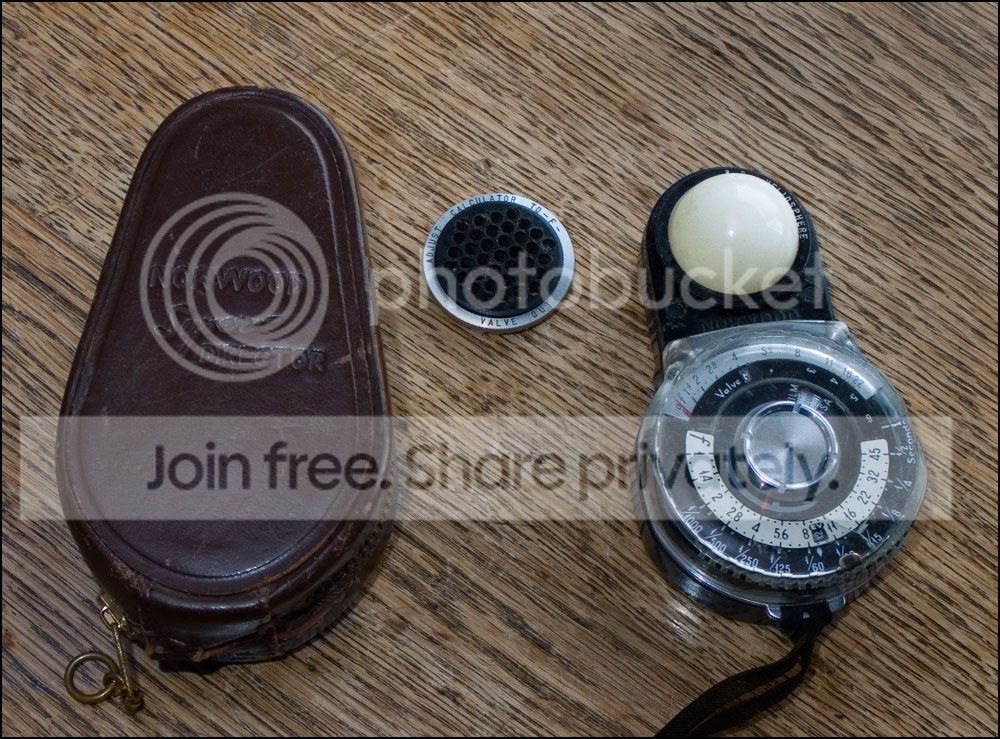
(I still own this Norwood Super Director bought new in 1958 and made by Waltz).
The basic theory and calibration of light meters can be found here http://en.wikipedia.org/wiki/Light_meter
In the late 1930's Don Norwood an American military captain and photographer, invented the “Heliosphere” the half spherical light receptor common to most incident light meters today.
This solved two of the major problems faced by professional cine photographers. How to measure the light falling on a three dimensional subject to achieve a standardised exposure, and how to standardise skin tones and other important tones appearing in multiple scenes. He published a patent application for this sphere in. 1938. From that time to this, incident readings have become the mainstay of Cine and studio photography.
His new meters displaced the Weston meter and other reflected light meters, as the first choice for this type of work. Later Weston introduced the invercone attachment for their meters which avoided Norwood's patents, they were used widely by stills photographers up to recent times.
Why then did incident light meters not take the same prominent position among professional and serious amateur photographers as they had among Cine workers? I would suggest the main reason was that it solved problems they did not know they had, and in a way that was counter intuitive.
A second and perhaps more practical reason was that they were not as easy to incorporate into the the functioning of still cameras, as were the various solutions provided by reflection meters.
Even today after 76 years of constant use, many photographers can not understand how measuring the light falling on a subject is more effective than measuring the light reflected from it.
So how do the two compare in the way they estimate exposure?
Both use a light receptive unit to measure the received light.
Both are calibrated to to mimic an 18% grey card ( most meters are in fact calibrated to around 12.5%)
However a reflection meter establishes an exposure that will produce an 18% grey of what ever tone it is reading from. If pointed at a white dress or a black background it will assign the same 18% to each of them, they each then reproduce as grey. This calibration is based on the common understanding that the average scene, made up of many tones, reflects back 18% of the light striking it.
The down side of measuring in this way, is few scenes conform to this expectation. And adjustments need to be made for each situation, depending on how they are lit and their tone distribution.
Modern cameras partially but effectively get over this problem by incorporating complex algorithms, that both measure the light distribution and calculate an appropriate exposure based on a library of samples.
None of this is necessary when using an Incident meter. The Light sphere and the calibration, as devised by Don Norwood and used ever since, require that the meter is placed close to the subject in the same light and pointed toward the camera. The shape of the sphere mimics the shape of a 3D object and integrates the light that strikes it from all directions, this is them measured by the photo cell. This arrangement behaves with a very close relationship to the illumination of real life objects. And gives the same reading and exposure, independent of the the colour, tone, luminance of any thing in the field of view.
In this way a black object is always reproduced as black, a white object as white and a continuous grey scale as a continuous grey scale. All tone are reproduced as in the original.
Most incident meters give a simple way of accommodating the more limited brightness range of transparency film or digital sensors . Clipping can be limited to one end of the scale or the other as required. This can be achieved by the simple process of an up or down. exposure adjustment However it must be realised that in doing so, you are moving the entire grey scale reproduction. With the result that all the tones are shifted, a grey card will no longer be reproduced as the original 18% but to the new value. How much each tone is changed, will be exactly the same as the stop value used for the shift. Such shifting can not change the extent of the recorded brightness range, just which portion of it that is to be captured.
Studio and off camera flash.
Incident light meters have dominated flash measurement ever since the introduction of electronic studio flash.
Norwood style meters also dominated studio work using continuous light, and for much the same reasons.
Those reasons include their ability not only to capturer highly accurate standardised exposures, but ones that are not influenced by the background, The the set, the tone nor colour of the subject, all of which will be reproduced as seen.
The original instruction, patent and calibration require that the reading is taken from the camera position toward the camera. This is still the recommendation by all the manufacturers of Incident light meters. However a few well known workers have published, on line, that the exposure reading should be taken toward the main light. This view has been repeated on many forums. It does work, but gives different and non standard results)
The important factor in all this is that the domed receptor accepts all the light from all the directions that fall on the the portion of subject that can be seen from the camera position, and that they are integrated in their correct proportions to achieve a standard exposure.
An incident meter is not a Highlight Meter as might be supposed if you were to use it by pointing the dome at the light source. Just like a reflected light meter, it is calibrated to 18% (12%) of the total received light.
In flash use, particularly in the studio, an Incident light meter can be used to assist and measure the balance of the various lights. This can be done by moving, modifying or changing the power of individual lights. To achieve this the flat receptor is usually used to measure the intensity of each individual lightin turn, so as to establish and adjust the lighting ratios between them. In this way the subject tones, shadows and background strengths can be predetermined. However the actual exposure value used is that determined by the domed receptor, in the normal way.
This same flat receptor can be used to measure correct exposure for flat subjects.
Virtually all Incident meters are supplied with a simple grid like adapter to enable direct reflected light reading to be taken.
The earliest Norwood meters were made to his patent by various manufacturers, they included the first Norwood Director type A in 1947 through to the Super Director a new Patent and made directly for him by Waltz. from 1958-1960. The various models made from1956 till today by Sekonic were based on his original patent. To these can now be added all the Digital flash/ambient meters made by Sekonic, Minolta, Gossen and Spectra. The original patent ran out in 1960
(I still own this Norwood Super Director bought new in 1958 and made by Waltz).

The basic theory and calibration of light meters can be found here http://en.wikipedia.org/wiki/Light_meter
Last edited:


