


sk66
Suspended / Banned
- Messages
- 9,557
- Name
- Steven
- Edit My Images
- Yes
That kind of surprised me because I saw a bunch of promotional and review video’s touting how great it is. The review videos aren’t surprising as they were generally mostly “how to,” “does it work,” or very limited in situations/experience… and because everyone needs “content.”
But one in particular was by a professional sports photographer, and promoted by Nikon; where he showed a snowmobile doing jumps, and a skateboarder in low light. However, on closer viewing I noticed that none of the example footage showed the Z9 actually taking in focus pictures while using Auto-capture. They all showed red AF points (out of focus) or grey AF points (not focusing at all).
Sure, they all had example photos showing good focus… even a blind squirrel finds a nut every once in a while. I have many images over the years that are in focus and where the camera's AF system disagreed (was off subject/behind/etc).
Here’s a few things I found have after a fair bit of use and testing the Z9's auto-capture:
The camera is not focusing during auto-capture standby. Therefore something has to be enough in-focus to activate auto-capture; and then it will attempt to focus. Low light tends to demand large apertures, which means much less is in-focus enough to trigger it.
The camera’s auto-capture is not utilizing the output viewfinder stream in the same way the camera normally does for stills. Therefore activating “starlight view” or “adjust for ease of view” does not improve auto-capture activation. Low light, low contrast, low depth of focus means the camera doesn’t see much, and therefore auto-capture isn’t triggered in a large number of cases.
(but I have not been able to definitively determine if, once auto-capture has been activated, either of those settings improve the low light AF speed/accuracy the same as they do normally)
Motion triggering alone is most likely to activate auto-capture… particularly the more sensitive settings. But then even tiny things like fireflies may trigger it. And it can even be triggered just by image noise (ISO); low light also tends to require higher ISO’s.
Subject detection triggering is also working with limited information initially (defocused regions, no viewfinder stream, etc). So, to be generous, I’ll just say it is also less accurate. During testing, and with my camera set to animal detection only; auto capture was triggered by my wife, and by a small flower pot sitting on the shelf. But it was not triggered by a red fox just after sunset (low light, but not below normal AF capability). At least when set to people only it wasn’t triggered by the flower pot… so that's something.
In all cases AF is delayed; and even more-so in low light, so expect A LOT of out of focus pictures. You can set the release priority to "focus" or "focus + release" to limit that, with the risk of getting no images.
I’m rather surprised the auto-capture feature does not have focus as one of the variables. Especially since they recommend using pre-release capture in many situations... nothing like recording an extra 30 out of focus frames (or more) before the out of focus images auto capture recorded on it's own (most Nikons can be setup for remote release burst photography based on focus, including the Z9).
For now at least, the only semi reliable answer for lower light (and backlight) scenarios is to avoid them… or add more light on your subject. You’ll still get plenty of out of focus images, but at least it will activate and there’s a fair chance at least a decent percentage will be acceptably in focus. By that I mean maybe 60-70% will be "in focus," but many of those are likely to be ruined by motion blur unless you add a lot of light… because something has to change in order to activate auto capture; and that means motion. And you can’t effectively use flash in this scenario either, so adding enough light is much more difficult.
And be happy, the camera has not replaced the photographer yet!
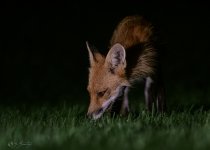
Auto-capture, motion trigger, 1/500, f/2.8, ISO 8000, artificial light.
But one in particular was by a professional sports photographer, and promoted by Nikon; where he showed a snowmobile doing jumps, and a skateboarder in low light. However, on closer viewing I noticed that none of the example footage showed the Z9 actually taking in focus pictures while using Auto-capture. They all showed red AF points (out of focus) or grey AF points (not focusing at all).
Sure, they all had example photos showing good focus… even a blind squirrel finds a nut every once in a while. I have many images over the years that are in focus and where the camera's AF system disagreed (was off subject/behind/etc).
Here’s a few things I found have after a fair bit of use and testing the Z9's auto-capture:
The camera is not focusing during auto-capture standby. Therefore something has to be enough in-focus to activate auto-capture; and then it will attempt to focus. Low light tends to demand large apertures, which means much less is in-focus enough to trigger it.
The camera’s auto-capture is not utilizing the output viewfinder stream in the same way the camera normally does for stills. Therefore activating “starlight view” or “adjust for ease of view” does not improve auto-capture activation. Low light, low contrast, low depth of focus means the camera doesn’t see much, and therefore auto-capture isn’t triggered in a large number of cases.
(but I have not been able to definitively determine if, once auto-capture has been activated, either of those settings improve the low light AF speed/accuracy the same as they do normally)
Motion triggering alone is most likely to activate auto-capture… particularly the more sensitive settings. But then even tiny things like fireflies may trigger it. And it can even be triggered just by image noise (ISO); low light also tends to require higher ISO’s.
Subject detection triggering is also working with limited information initially (defocused regions, no viewfinder stream, etc). So, to be generous, I’ll just say it is also less accurate. During testing, and with my camera set to animal detection only; auto capture was triggered by my wife, and by a small flower pot sitting on the shelf. But it was not triggered by a red fox just after sunset (low light, but not below normal AF capability). At least when set to people only it wasn’t triggered by the flower pot… so that's something.
In all cases AF is delayed; and even more-so in low light, so expect A LOT of out of focus pictures. You can set the release priority to "focus" or "focus + release" to limit that, with the risk of getting no images.
I’m rather surprised the auto-capture feature does not have focus as one of the variables. Especially since they recommend using pre-release capture in many situations... nothing like recording an extra 30 out of focus frames (or more) before the out of focus images auto capture recorded on it's own (most Nikons can be setup for remote release burst photography based on focus, including the Z9).
For now at least, the only semi reliable answer for lower light (and backlight) scenarios is to avoid them… or add more light on your subject. You’ll still get plenty of out of focus images, but at least it will activate and there’s a fair chance at least a decent percentage will be acceptably in focus. By that I mean maybe 60-70% will be "in focus," but many of those are likely to be ruined by motion blur unless you add a lot of light… because something has to change in order to activate auto capture; and that means motion. And you can’t effectively use flash in this scenario either, so adding enough light is much more difficult.
And be happy, the camera has not replaced the photographer yet!
Auto-capture, motion trigger, 1/500, f/2.8, ISO 8000, artificial light.
Last edited: