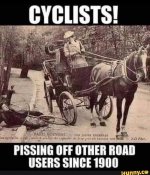
Will This Make Cycling Safer?

Finally, someone that knows the Highway Code (as it has always been in my 50+ years of using it anyway). :clap:

Cyclists have always been a PITA for car drivers (and most other road users), but mostly for the ones that don't look, indicate or consider other people's vulnerability.

The biggest problem I see coming from this change is the 'empowering' of pedestrians and cyclists into taking the attitude that 'it's my right of way - don't you dare knock me down'. The trouble is they will still get knocked down, so I think these new changes will put them in even more danger for that reason alone.
Playing devils advocate, didnt the situation prior to the recent changes empower motorists to have the attitude that they have the right of way over pedestrians and can run them over without consequence?
 
Had a mobility scooter cross right in front of me as I was about to exit a roundabout this afternoon. Didn't look to see if there was anything coming and being in the Leaf, I doubt he would have heard me. Slammed on and had the car behind me leaning on his horn.
 
Playing devils advocate, didnt the situation prior to the recent changes empower motorists to have the attitude that they have the right of way over pedestrians and can run them over without consequence?
If by “situation prior to the recent changes” you mean the previous versions of the Highway Code then those NEVER stated any situation where anyone had right of way - it’s a common misconception.
So on the basis that anyone thinking they have “right of way” won’t have got that from either the HC or the Road Traffic Act then they are no more or less empowered to feel that way now unless they start following the guidance and principles in the Highway Code from pretty much the beginning. All these new changes do are to try and make it more explicit and structured.
 
Last edited:
Had a guy step into the main road tonight. Dark clothing and from parked cars. Which idiot thought this was a good idea?
 
If by “situation prior to the recent changes” you mean the previous versions of the Highway Code then those NEVER stated any situation where anyone had right of way - it’s a common misconception.
This is so.

The Highway Code and the Road Traffic Acts tell people what they must NOT do, not what they can do.
 
If by “situation prior to the recent changes” you mean the previous versions of the Highway Code then those NEVER stated any situation where anyone had right of way - it’s a common misconception.
So on the basis that anyone thinking they have “right of way” won’t have got that from either the HC or the Road Traffic Act then they are no more or less empowered to feel that way now unless they start following the guidance and principles in the Highway Code from pretty much the beginning. All these new changes do are to try and make it more explicit and structured.
Are you sure? I can’t quickly find the reference in the old Highway Code , but rule 170 currently says

  • give way to pedestrians crossing or waiting to cross a road into which or from which you are turning. If they have started to cross they have priority, so give way (see Rule H2)
 
Are you sure? I can’t quickly find the reference in the old Highway Code , but rule 170 currently says

  • give way to pedestrians crossing or waiting to cross a road into which or from which you are turning. If they have started to cross they have priority, so give way (see Rule H2)
Where is the phrase “right of way” in that quote?

“Priority” is not the same as right of way.
 
This is so.

The Highway Code and the Road Traffic Acts tell people what they must NOT do, not what they can do.
I wouldn’t go so far as saying the HC just says what not to do - an awful lot of it is saying what people should/must do in various situations.

The problem is that many people see the HC as something to study to pass their driving test and then forget - it should really be seen as a “user manual” for the roads.
 
Playing devils advocate, didnt the situation prior to the recent changes empower motorists to have the attitude that they have the right of way over pedestrians and can run them over without consequence?
Not at all - because they didn't. :facepalm:
 
Had a mobility scooter cross right in front of me as I was about to exit a roundabout this afternoon. Didn't look to see if there was anything coming and being in the Leaf, I doubt he would have heard me. Slammed on and had the car behind me leaning on his horn.
i would have thought that when leaving a roundabout it is similar to exiting into a side road so it makes sense to look out for anyone who is crossing the junction or looks like they are about to cross as they will have priority
 
i would have thought that when leaving a roundabout it is similar to exiting into a side road so it makes sense to look out for anyone who is crossing the junction or looks like they are about to cross as they will have priority


I was. The scooter driver didn't slow down at all and had his back to the traffic. He only just missed the pedestrians who were waiting to cross safely.
 
The scooter driver didn't slow down at all and had his back to the traffic.
I think we'll be looking back in a few years time at the statistics showing increased collisions (shunts through sudden stopping in slow traffic), serious injury and death as a result of these changes. I hope I'm wrong, but I don't think I will be . . .
 
Where is the phrase “right of way” in that quote?

“Priority” is not the same as right of way.
I was using the language from Sky's post where his phrase 'right of way' was used as a synonym for priority. Appreciate your pedantry and highlighting the difference, so please allow me to re-phrase the original question in post 281.

Playing devils advocate, didn't the situation prior to the recent changes empower motorists to have the attitude that they have the priority over pedestrians and can run them over without consequence?
 
I was using the language from Sky's post where his phrase 'right of way' was used as a synonym for priority. Appreciate your pedantry and highlighting the difference, so please allow me to re-phrase the original question in post 281.
My answer still stands - the Highway Code has always been clear over who has priority in what situation. So any empowerment felt would have been through ignorance of the Highway Code and not because of it.

And it's not my pedantry - it is what the Highway Code ACTUALLY SAYS - if anyone bothers to read it before they make their misconceived comments. And this common but erroneous view that "I have right of way because the Highway Code says so" is one of the significant detractors from overall road safety.
 
I think we'll be looking back in a few years time at the statistics showing increased collisions (shunts through sudden stopping in slow traffic), serious injury and death as a result of these changes. I hope I'm wrong, but I don't think I will be . . .


I hope you're wrong too but I don't think you will be either.
 
"I have right of way because the Highway Code says so"


"I have right of way because the little bit of the highway code I've seen quoted on the internet says so" is probably closer to the truth - I doubt many non-motorists have ever looked at the HC.
 
"I have right of way because the little bit of the highway code I've seen quoted on the internet says so" is probably closer to the truth - I doubt many non-motorists have ever looked at the HC.
“incorrectly quoted” would be the full thing but - yes - the Internet is just as bad a way of the “right of way misconception” spreading as any other :)
 
My answer still stands - the Highway Code has always been clear over who has priority in what situation. So any empowerment felt would have been through ignorance of the Highway Code and not because of it.

And it's not my pedantry - it is what the Highway Code ACTUALLY SAYS - if anyone bothers to read it before they make their misconceived comments. And this common but erroneous view that "I have right of way because the Highway Code says so" is one of the significant detractors from overall road safety.
I sometimes appreciate pedantry, nothing wrong with accuracy in language. Though I think in this instance it was clear that Sky used the phrase "right of way" synonymous with priority.

Let's hope that the wider understanding of the proposed Highway Code changes is better than the knowledge displayed by the road users in the start of this thread.
 
... nothing wrong with accuracy in language...
That's true.

I can't help but feel that much harm would be prevented if people would, in the words of the old saw, "Say what they mean and mean what they say".
 
This is so.

The Highway Code and the Road Traffic Acts tell people what they must NOT do, not what they can do.
A short browse of the Highway Code will show that this is not correct. E.g.
Pedestrians may use any part of the road and use cycle tracks as well as the pavement, unless there are signs prohibiting pedestrians.
Clearly says what a pedestrian can do.
 
A short browse of the Highway Code will show that this is not correct. E.g.

Clearly says what a pedestrian can do.
The statement is couched in terms of a condition that they must not transgress, i.e. "unless there are signs prohibiting pedestrians".

The first part introduces the prohibition by explaining the circumstances in which it can occur.
 
I sometimes appreciate pedantry, nothing wrong with accuracy in language. Though I think in this instance it was clear that Sky used the phrase "right of way" synonymous with priority.
As a bit of a pedant myself, if I had been quoting anything I would have used quotation marks. As I wasn't, there was no need for me to use them.
 
The statement is couched in terms of a condition that they must not transgress, i.e. "unless there are signs prohibiting pedestrians".

The first part introduces the prohibition by explaining the circumstances in which it can occur.
A valiant attempt at trying to muddle the issue!
 
My answer still stands - the Highway Code has always been clear over who has priority in what situation. So any empowerment felt would have been through ignorance of the Highway Code and not because of it.

And it's not my pedantry - it is what the Highway Code ACTUALLY SAYS - if anyone bothers to read it before they make their misconceived comments. And this common but erroneous view that "I have right of way because the Highway Code says so" is one of the significant detractors from overall road safety.
Agreed. Exactly the point I was trying to make.
 
Is there a section in the HWC, that cyclist have to use hand signals when overtaking, turning etc. to allow other road users know their intension?
 
Well, let's see.- no there isn't! What there is, is a guide to signals for all road users and guidance for signals for all drivers and riders where it says "Signals warn and inform other road users, including pedestrians, of your intended actions. You should always....",. should being advice rather than instruction. Which is just as well, as otherwise there would be thousands of drivers daily thrown in the clink for the same misdemeanour, And yes, as a cyclist it does make more sense to be more careful but no, it doesn't make any sense for cyclists to have more onerous rules than drivers, given the comparative responsibility and damage potential.

Good to see you are fully au fait with the highway code as it applies to drivers, though.
 
Is there a section in the HWC, that cyclist have to use hand signals when overtaking, turning etc. to allow other road users know their intension?
i don't think motorists take any notice of cyclist hand signals - my old commute used to have a right turn at a roundabout and i would often get several motorists continue to overtake me while i was signalling right on the approach to the roundabout
 
Well, let's see.- no there isn't! What there is, is a guide to signals for all road users and guidance for signals for all drivers and riders where it says "Signals warn and inform other road users, including pedestrians, of your intended actions. You should always....",. should being advice rather than instruction. Which is just as well, as otherwise there would be thousands of drivers daily thrown in the clink for the same misdemeanour, And yes, as a cyclist it does make more sense to be more careful but no, it doesn't make any sense for cyclists to have more onerous rules than drivers, given the comparative responsibility and damage potential.

Good to see you are fully au fait with the highway code as it applies to drivers, though.
Obviously I've been to safety conscious with my observation and signalling over the past forty years. No wonder the roads are full of arseholes.
 
Obviously I've been to safety conscious with my observation and signalling over the past forty years. No wonder the roads are full of arseholes.

I was certainly not commenting on your driving, I have no idea how good or bad it is. Instead I was highlighting that you choose to single out cyclists for their failure to signal where a simple reality check would confirm that car drivers as a whole are as bad if not worse - failure to signal is common, improper signalling after a manoeuvre has started even more so. And this, despite the responsibility that comes with piloting a tonne of metal at speed. It is this imbalance in attitude that the Highway Code redrafting seeks to alleviate,
 
There used to be mention of only giving hand signals when safe to do so. Many drivers ignore this when communicating with cyclists.
 
nothing much will make cycling safer in the UK
drivers have a universal hatred of them we despise people who are getting to where
they want to get without paying thousands of s***e pounds with leather seats and AC
BOSE sound systems, integrated blutooth so they can chat to there "insert random people" while sat in traffic
with there garbage diesel engines chugging pollution......
 
nothing much will make cycling safer in the UK
drivers have a universal hatred of them we despise people who are getting to where
they want to get without paying thousands of s***e pounds with leather seats and AC
BOSE sound systems, integrated blutooth so they can chat to there "insert random people" while sat in traffic
with there garbage diesel engines chugging pollution......

Whatever the seriousness of that post, it does highlight the issue, even though I couldn't disagree with it more. The issue is there is no such thing as "Drivers" and "Cyclists" just people who happen to be in a car or on a bike. As more people either cycle or have someone close to them who cycles that understanding will deepen.

As far as your counsel of despair, you are just wrong. I am both a cyclist and a petrolhead, I've been cycle commuting into central London since the 80's (and if you want my petrolhead palmares, I've built cars from the ground up and driven round in circles). In the bad old days, it was really carnage on the streets, not a month went by without seeing a bad accident on the main arteries. As a cyclist you were treated like a second class human (despite having a BMW parked at home, and a parking space in town) and each journey felt like jousting with death. As you got into town, the conflict increased. No matter what your personal riding style, others would take risks that had you clenching in dread. It felt like nothing was ever going to improve, as if it could never improve. Take the Whitechapel Road in Aldgate, part of a complex junction where I had seen many accidents with only two lanes and a narrow pavement, I could not see that ever getting better. But then, the "cycle superhighways" arrived and now you could ride into central London from almost any point in an 8 mile radius in perfect safety. At Aldgate, one of the two lanes was given over to bikes, astonishing. Over a fairly short period cyclists and drivers have come to accommodation for the most part and cycling in London can now be as safe as anywhere, almost, if you choose it to be so.

So, yes, cycling has got much safer in the UK and there's no reason for it not to continue to do so. Fact is, there are knobheads everywhere, some are in cars, some are on bikes (I must resist the impulse to say a lot are on electric scooters) and that won't ever change, as an individual your contribution is to realise that, accommodate it, and stop reinforcing the divide between "Drivers" and "Cyclists". That'll help.
 
  • Like
Reactions: Sky
London. ^
 
If you're suggesting that London is an exceptional case, and proves nothing about the UK as a whole, that too is wrong. London accounts for a significant proportion of cycling and driving, and shows what can be done when the will is there. Not all cities are as suitable for cycling (who said Sheffield?), but many are, and are following London's example. Normalising cycling as a mode of transport, something that anyone can do, is where we should be headed and something that electric assist should help with.

ETA: London also has unique issues with historic street layout that a newer built town has fewer to deal with when creating a shared transport network. There is an issue that the political landscape has made it almost impossible to have an integrated travel policy, but that's another matter.
 
Last edited:
If you're suggesting that London is an exceptional case, and proves nothing about the UK as a whole, that too is wrong.
Black and white.

London is different because of the size. And the political control. Initiatives with loads of bikes visible on dedicated lanes work. When there’s a bike every 15 minutes, not so much. A bike evey hour? Let’s give tham a friendly shout and hand signal as we close pass the lycra clad menaces.
 
You're conflating too many aspects there. The main difference is between cities and country.

In cities there is a universal issue of traffic congestion. there is a fixed amount of road space through which large numbers of people need to travel. Surprisingly enough, prioritising personal travel in cars results in more cars on the road, nobody getting anywhere and the air getting foul for everyone. Moving to public transport or a travel mode that uses less roadspace, causes less pollution, is quicker and more assured is a no-brainer. London leads in this, but it isn't an outlier, other cities are following to a greater or lesser degree. In each of these cycling becomes safer, which accounts for a very large proportion of miles cycled every year,

Outside urban conurbations, the situation is different. Traditional country dwellers have long been accustomed to sharing the road, with tractors, horses and bikes. Housing pressures and changing lifestyles have fundamentally shifted attitudes, with people disconnected from their environment and developments springing up for which the car is essential for almost every journey.

The original statement to which I responded said "nothing much will make cycling safer in the UK" that is wrong, black and white, as it is generally much safer cycling now than it was 20 years ago, there is no reason why that cannot continue to improve, whether or not it does. Embedding the ideas of ascending responsibility on the road according to the mode of transport as the Highway Code sets out is a good basis for continued improvement.
 
The main differences are between London, Cities, Towns, Villages and the country, is a better way of putting it.

The main driver in disconnection from environment has been private transport. (Unless you want to call Private medical care Personal medical care)
 
Back
Top