Wide angle legacy lenses on film...

ChrisR

I'm a well known grump...
Suspended / Banned
Messages
11,730
Name
Chris
Edit My Images
Yes
I've been using my 35mm and 28mm lenses (Pentax-M SMC f/2 and Vivitar Wide Angle Close Focus respectively) for a year or two now, and I'm pretty comfortable with using them, and with the quality of the results. I've noticed a lot of folk on the landscape section and elsewhere banging on about how wider is better, so I thought I should investigate. The wider Pentax lenses are expensive, but I was lucky enough to get a Pentax-A 24mm f/2.8 for a reasonable price. Cursory investigations didn't suggest anything much different from the 28mm experience, so I wanted to go wider. I watched the Pentax 20mm lenses (M and A) on fleabay for a while, and they seem to be going for two to four hundred pounds, a bit much for an experiment, so in the end I bought first a lovely near mint Vivitar 19mm f/3.8 and later a Tamron Adaptall-2 17mm f/3.5, also in pretty nice condition.

This was the first shot that made me think they could be really useful, first the Vivitar 19mm, then the Tamron 17mm:


This shot with the Tamron 17mm at Warwick Market alerted me that distortion was an issue that had to be thought about:


However, it was this shot with the Vivitar 19mm that most worried me:


I think this is wide open, on a pretty murky day, but there seems to be a serious combination of softness and distortion in the vegetation anywhere near the corners. It was this shot that caused me to buy the Tamron 17mm, hoping it would be better:


I think that is better...

I hasten to add that, in decent light, the Vivitar 19mm is not at all bad (I'm sure it would be excellent on APS-C ;) ):


I've now done a comparison test of the same subject using the Tamron 17mm, Vivitar 19mm, Pentax-A 24mm and Vivitar 28mm... but that film is still in camera.

I'm not really sure what I'm asking here... basically is this what I should expect from cheaper wide angle lenses?
 
Don't think I have any examples from my Cosina/Vivitar 19-35 zoom (which I used on my F65 and 80 before going d*****l let alone FF!) but I seem to remember it being better than that in the corners, especially stopped down a little. TBH, I rarely used it anywhere near wide open since I was usually after as much DoF as possible! I also have a Tamron 14mm f/2.8 which I have used wide open for wide field star shots. A bit soft and elongated in the far corners on FF d*****l but useable. The Sigma 8mm does distort a lot as well - as you'd expect from a fisheye! At least the corners are uniform(ly vignetted out.)
 
My wide wide angles are OM 16mm and 21mm and a Tamron Adaptall 17mm (snap).

A very wide field of view does make demands on a lens and corner softness (compared to the centre) isn't unexpected. Stopping down should help, and if the soft photo was taken on a murky day the lens probably wasn't stopped down much.

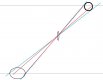
Distortion is a separate question. Any three dimensional object will be distorted as it moves further away from the optical axis - I can demonstrate this with diagrams if you like. It's a function of distance from the axis, not the field of view of the lens, although obviously a wide angle lens will inevitably have objects further from the axis than a lens with a narrower angle of view. It also applies to standard and long focal length lenses, if you use the off axis part of the image (as happens with a view camera). Ansel Adams demonstrates this in one of his books (The Camera?) with a water tower. I did the same thing with plant pots and a diagram for mine.
 
Last edited:
From my book. But I see that the diagram has turned out bigger than expected...

Geometrical distortion


When we looked at aberrations, we saw that lens could bend straight lines with pincushion
and barrel distortion. These are genuine lens faults that can be corrected. Geometrical
distortion is a problem inherent in "the way things are". Take a look at this diagram.
GeometricalDistortion.jpg

Figure 46 Geometrical distortion


The circle at the top right represents a three dimensional object which is being viewed
obliquely; at the bottom left is the resulting image.

First, look at the red lines, which show what would happen if the three dimensional object
were in fact a flat object such as a window frame. If we arrange the diagram so that object
and image are the same size for a flat object, the separation of the red lines where they meet
the image plane will be the same as their separation at the subject.

Now look at the blue lines. At the subject, they just touch the edges, and at the image plane
this oblique view has resulted in their separation being greater than the width of the subject.
The net effect is that a circle is distorted to become an oval. Any three dimensional object will
become wider as it moves further away from the lens axis.

This geometrical distortion can be seen to be a purely natural and inevitable effect; and it can
also be seen that if you were photographing a flat object (and the lens had no aberrations)
that the drawing would be perfect.

The amount of distortion is related to the amount that the object lies off axis, and therefore
although present in all lenses, it will be most noticeable as the angle of view increases, and
therefore is something that you should bear in mind...
 
Last edited:
Chris,

That 17mm looks really quite good, the market shot shows it off quite well. The previous shot looks pretty sharp too, although the underexposure makes it hard to judge.

My preference on 35mm is to shoot wide, with 24mm often being the longest focal length I use. I have been using a Nikon fit Cosina 19-35mm for several years and really like it at 19mm, although stopped to 5.6 or below. The Cosinas are cheap as chips. I also have a much more expensive Tokina 20-35mm, which I really should sell as I rarely use it. With all super wides some distortion is just part of the deal, although I have correction profiles loaded into Lightroom to manage some of the distortion. There is some variation in these lenses, I had a Canon EF one that although OK was not as sharrp as the Nikon fit. Also it died after just two excursions, although this has been my experience with more than one cheap EF fit lens.

A few shots with the Nikon fit Cosina at 19mm, there is some distortion and edge sharpness, but I still like it.

9600622946_5f1225b7f3_b.jpg


9645379740_07d159e195_b.jpg


8729119396_dc3b73d11d_b.jpg


10124403094_7777a7ca50_b.jpg
 
Last edited:
@Jao - that second shot is absolutely stupendous.

Nothing more to add, other than I have a Canon 20mm FD waiting for a test roll at some point (and this is a good nudge to do so!).
 
  • Like
Reactions: Jao
If you want to reduce distortion you could always use a 28 or 35 or 50mm lens and do a pano.......nearly all 50mms are very good lenses and probably the best choice as it's more realistic when seeing a scene and panning with your eyes...... best results would be at least 9 shots stitched together and the other advantage is some are good a f1.8 so less problem in dim conditions h'mm well except DOF.
 
Last edited:
Thanks for the guidance, folks! That Cosina zoom seems fantastic, @Jao ; barely a trace of softness even at the extreme edges. @StephenM thanks for those diagrams; I guess the question is how to deal with the distortion, although @Jao shows his way. I suppose in a landscape context the distortion would not be so noticeable.

One interesting thing I noticed doing that comparative testing was how, with relatively stable light, the metered exposures differed with different lenses. In particular, the settings for the Pentax would apparently have meant half a stop under-exposure for the Tamron. I've come across this before with a Tamron 28-50 zoom, only it was a couple of stops with that one, IIRC (since sold). I guess this is something to do with the glass used, and bears on the difference between f stops and t stops...
 
that Tamron doesn't look bad to me, i think it can be easy to get caught up in looking for faults rather than just excepting a pleasing image warts and all
 
Don't think I have any examples from my Cosina/Vivitar 19-35 zoom (which I used on my F65 and 80 before going d*****l let alone FF!) but I seem to remember it being better than that in the corners, especially stopped down a little. TBH, I rarely used it anywhere near wide open since I was usually after as much DoF as possible! I also have a Tamron 14mm f/2.8 which I have used wide open for wide field star shots. A bit soft and elongated in the far corners on FF d*****l but useable. The Sigma 8mm does distort a lot as well - as you'd expect from a fisheye! At least the corners are uniform(ly vignetted out.)

I can confirm having owned both, that yes the Cosina zoom is better than the prime. A non legacy lens that can be used is the Tokina 11-16mm f2.8, which functions just fine as a 16mm prime on film...

Cwt Y Bugail (Ektar 100) by Alan Jones, on Flickr

and makes for some fun at 11mm...

10 Feet Tall (CMS20) by Alan Jones, on Flickr
 
that Tamron doesn't look bad to me, i think it can be easy to get caught up in looking for faults rather than just excepting a pleasing image warts and all

I think you're right. The trouble is, my heart is with the Vivitar as it's in smashing condition and is small, light and just, beautiful! The Tamron is clearly better, at twice the price, but is comparatively massive... Oh well, IQ rules I guess!
 
I think you're right. The trouble is, my heart is with the Vivitar as it's in smashing condition and is small, light and just, beautiful! The Tamron is clearly better, at twice the price, but is comparatively massive... Oh well, IQ rules I guess!

Surprised about the Vivitar as last week came across a site and they put a list of lenses that are worth getting and yours was included...mind you, you have to be careful as I would guess a lot of sites just parrot from others and don't actually test the lenses themselves.
 
I think you're right. The trouble is, my heart is with the Vivitar as it's in smashing condition and is small, light and just, beautiful! The Tamron is clearly better, at twice the price, but is comparatively massive... Oh well, IQ rules I guess!
whats the vivitar like with the f.stop closed a couple of notches?
 
whats the vivitar like with the f.stop closed a couple of notches?

I'll know more about that when I finish this film and get to look at the comparison shots... but the "stone wall" shot above would have fit in that category, and it's pretty nice. You can still see a bit of softness at the extreme edges but it's not objectionable.
 
I'll know more about that when I finish this film and get to look at the comparison shots... but the "stone wall" shot above would have fit in that category, and it's pretty nice. You can still see a bit of softness at the extreme edges but it's not objectionable.
look forward to updates on that,
 
A hidden gem for any Nikon users - the 20mm F3.5 UD Nikkor - usually very reasonable to buy, but superb sharpness, minimal distortion, incredibly low propensity to flare - even straight into the sun. It's a non-AI lens, but I have become used to stop down metering with it.
 
A hidden gem for any Nikon users - the 20mm F3.5 UD Nikkor - usually very reasonable to buy, but superb sharpness, minimal distortion, incredibly low propensity to flare - even straight into the sun. It's a non-AI lens, but I have become used to stop down metering with it.

h'mm one on the bay is £170 + £10 postage..:eek: .anyone with fat wallets interested.
 
h'mm one on the bay is £170 + £10 postage..:eek: .anyone with fat wallets interested.

I just spent £170 on a film back for my Mamiya 645AFD, so £170 on a lens is entirely reasonable!
 
When you say "legacy" lenses do you just mean old?
 
When you say "legacy" lenses do you just mean old?

Well I always assumed it was the older lenses by the main camera makers e.g. Canon.................. all the others are 3rd party
Anyone agree with that?
 
I don't think I'd go along with the "third party" part, since I'm used to cameras where the camera maker didn't make lenses. I started with an Exakta, and Ihagee didn't make lenses - the lenses came from Zeiss, Meyer Optik, Steinheil etc. etc. These days I use LF and the same applies.

Cynically, I think that the distinction between "old" and "legacy" is that "old" means "not recent, and had at least one owner already", and "legacy" means "not recent and we'll charge a lot because legacies are valuable".
 
When you say "legacy" lenses do you just mean old?

I mean the lenses I have, for film cameras although not exclusively. Old but cheap. IIH I was trying to find a title that wouldn't be link-bait to the digerati when it popped to the top of the forum...

Cynically, I think that the distinction between "old" and "legacy" is that "old" means "not recent, and had at least one owner already", and "legacy" means "not recent and we'll charge a lot because legacies are valuable".

Well, it's certainly true that some wide-angle lenses cost a lot, a whole lot. Pentax-A 20mm f/2.8 getting on for £400! You'd need a legacy for that. :)
 
Those have come out really nicely, @Alan Clogwyn . Very little if any sign of softness or stretching even in the corners. Interesting! Not cropped?
 
Those have come out really nicely, @Alan Clogwyn . Very little if any sign of softness or stretching even in the corners. Interesting! Not cropped?

No cropping that I can remember, maybe very slight rotations to correct straightness.

@Alan Clogwyn Slow Wave is very nice indeed.

Thanks, twas taken on an old Pentax MX trying to do long exposures in a howling gale and intermittent torrential rain with terrible old Adox film and a wobbly tripod, yet somehow it worked!
 
If any Canon fans are interested in a WA lens.....the Canon FL 19mm f3.5 R is a VG lens, but buy from a reliable source in case of any OOF problems. h'mm but just noticed on the bay the cheapest is from the US at £300 but I've seen them as low as £125.
 
Last edited:
i must admit i would love to try the fd 20mm f2.8 at some point
 
arrrr dont i am skint but easily led

Go on splash out.....can be used on any camera up to T90

FL 19mm F3.5R

World's highest quality super-wide-angle lens with the fastest lens speed of f/3.5 in its class. Because it is a retrofocus type, through-the-lens focusing can be performed, and the entire 96-degree field of view can be recorded on film. Optically, the various aberration compensations are excellent. It is especially free of astigmatism and image distortion is held to less than one per cent. Therefore, clear and sharp images are possible to the outermost edges, and overall sharpness is superb. It is a lens that is regularly used by professional photographers.

From Photo.net
5378226-lg.jpg
 
Last edited:
Go on splash out.....can be used on any camera up to T90

FL 19mm F3.5R

World's highest quality super-wide-angle lens with the fastest lens speed of f/3.5 in its class. Because it is a retrofocus type, through-the-lens focusing can be performed, and the entire 96-degree field of view can be recorded on film. Optically, the various aberration compensations are excellent. It is especially free of astigmatism and image distortion is held to less than one per cent. Therefore, clear and sharp images are possible to the outermost edges, and overall sharpness is superb. It is a lens that is regularly used by professional photographers.
were is the "you evil man" smilly when you need one!
 
were is the "you evil man" smilly when you need one!

"snigger" as I have one :banana:but erm it has faults, but can confirm it's very sharp and lack of distortion is very good.
 
I'll know more about that (*) when I finish this film and get to look at the comparison shots... but the "stone wall" shot above would have fit in that category, and it's pretty nice. You can still see a bit of softness at the extreme edges but it's not objectionable.
* "whats the vivitar like with the f.stop closed a couple of notches?"

So, I've finally got the film back and have spent a couple of hours staring at the shots. First up, I'm annoyed with myself: don't undertake comparative lens tests in highly variable lighting conditions, Chris! It was one of those "cloudy bright" days with sun and shade varying quite a lot. Second, those trees in the early black and white shots were good for seeing the softness and distortion; now the trees are more like blocks of shade and detail is harder to discern.

I tested the Tamron 17mm, Vivitar 19mm, Pentax-A 24mm and Vivitar (Series 1 Wide Angle Close Focus) 28mm. I made corner crops of all of them, and at first glance they are all somewhat soft. However, the longer ones both show significant improvements in sharpness as they stopped down, as you'd expect. The Tamron does as well, to a lesser extent, but it's not too bad in the first place, compared to the Vivitar 19mm. The corner softness is visible right through to f/11, and the distortion is greater as well. In addition, there's significant corner CA. However, the 19mm does very well in the middle parts of the frame, so I reckon it would be a reasonable lens ona crop digital body, about 30mm equivalent I guess. Physically, it's a lovely lens, so I think I should sell it.

Can't tell anything useful about the colour rendering from this test.
 
* "whats the vivitar like with the f.stop closed a couple of notches?"

So, I've finally got the film back and have spent a couple of hours staring at the shots. First up, I'm annoyed with myself: don't undertake comparative lens tests in highly variable lighting conditions, Chris! It was one of those "cloudy bright" days with sun and shade varying quite a lot. Second, those trees in the early black and white shots were good for seeing the softness and distortion; now the trees are more like blocks of shade and detail is harder to discern.

I tested the Tamron 17mm, Vivitar 19mm, Pentax-A 24mm and Vivitar (Series 1 Wide Angle Close Focus) 28mm. I made corner crops of all of them, and at first glance they are all somewhat soft. However, the longer ones both show significant improvements in sharpness as they stopped down, as you'd expect. The Tamron does as well, to a lesser extent, but it's not too bad in the first place, compared to the Vivitar 19mm. The corner softness is visible right through to f/11, and the distortion is greater as well. In addition, there's significant corner CA. However, the 19mm does very well in the middle parts of the frame, so I reckon it would be a reasonable lens ona crop digital body, about 30mm equivalent I guess. Physically, it's a lovely lens, so I think I should sell it.

Can't tell anything useful about the colour rendering from this test.
thanks for the update
 
Back
Top