Why are people buying electric cars?

  • Thread starter Thread starter Deleted member 68495
  • Start date Start date
I live near Aberdeen, the main shopping mall is just across the road from the ship quay.
The road is UlEZ and a main route to the shopping mall.
The ships and boats at the quay start up and expel lots of smoke which blows across the road.
And also get this, the shopping mall car park has another entrance which is a very short way from the ULEZ, which any one can use.
The car park costs quite a bit £3.50 for the first hour.
Its all a money grab by local government, the poor motorists and being hammered,
Electric cars are being now dropped by major manufacturers, so the supply will run out, the second hand value will be nothing.
Lots of the components to produce them have to mined, which is not green or eco.
I live in a new town, no charging points are installed, we did have one but it has been removed.
Some electric cars have serious problems and the car becomes totally immobile, resulting in it having to be dragged with its wheels locked on to the back of a recovery truck and it has a diesel engine !
So for the majority of us electric wont work, its unaffordable, unreliable, and too costly to maintain and they have no secondhand value..
The Jetsons is a modern-day fairy tail.
Now winter is looming, good luck for the electric car owners, reduced range etc, which means more charging which means more power has to be produced to keep up with demand.
Green, never in a million years.
Just goes to show, how propaganda really can work in reality.
On top of that electric cars are very expensive, and if they cost more than £40,000, the buyer is hit with a wealth tax, which I am led to believe is £400.
There is more, they are now subject to road tax, because the goal posts have been moved, its not about emissions, its about weight, and electric cars weigh a lot more than real cars.
They also go through brakes and tyres a lot more than normal cars, and all the brake dust and microscopic bits of rubber get to the water table and sea eventually, causes pollution and fish deaths, studies in Canada have shown. I know ordinary cars also produce that stuff, but electric cars do it more.
All I see is a massive con.
I am at the point that I would bet money on JLR will halt production of electric and go back to the ICE.
The other major players have, Ford just announced it last week.
Government's and politician's in general will say anything, but in real word how do they know more than us, what qualifies them to tell us.
They are not science savy or car manufacturers, don't for a moment think that because you see them on TV with a yellow jacket and a safety hat on that they really know anything about where they are or even what is being done there.
Walking through a factory or building site or a shipyard or a hospital means nothing, its just a show.

You made some points there which are questionable. - shopping mall car park not likely to be council owned so not a money grab by them.
Components for an awful lot of things have to be mined, it's got something to do with them being underground. EV batteries are however moving away from Lithium and on to less toxic materials.
I've been driving 800-1000 electric miles a week for coming up 5 years, summer and winter and I've never run out of power yet.
200,000 miles and never had to change a brake shoe. In fact they'd be good for another 200,000. Whatever study you saw in Canada was nonsense if it said that.
Average electric cars are no more expensive than ice cars, mine personal car will do 300 miles on a charge and cost less than 24k, that's the same price as many new mid level ice cars.
EVs are subject to road tax because the government need the money.
The notion that manufacturers are going back to ice is pure bunkum, there are some renewed models true but that's because the ice cut off was pushed back 5 years. Come 2035 no manufacturer will be allowed to sell an ice car anywhere in Europe.
You said "all you see is a big con" the con artist my friend is whoever sold you that mixture of outdated, fabricated, nonsense you seem to believe.
 
Trying to have a proper discussion here but will not post on this thread anymore
Just mute and keep posting, it works wonders.
 
There's a generational point too, it's reported that 25% (up from 7% 10 years ago) of new drivers only have a Category B auto licence, of course there are ICE autos, but it's said that many new drivers say they will only ever drive EVs so why have a Cat A licence.


The price convergence of EVs to ICE is happening far more quickly than anyone predicted, partly due to the fall in EV prices but also in the rise of ICE prices.
 
How accurately, if at all, can we assess the rate of change before the current era?

I disagree with the first part of that statement, because the evidence seems to show that many wild bovines roamed the planet before humans began to domesticate them. It's possible that the bison herd, in what is now north America, was a major cause of deforestation as it grazed in its millions across what is now prairie land. It's also possible that other large wild bovine herds had a similar effect in eastern Europe.

I agree with the second part of your statement - excessive human deforestation cannot be a good idea but, on the other hand, how do we prevent it, outside of our own small island?

If I understand it correctly up to now most changes have been gradual for example the ice ages
In prehistoric periods there have been catastrophic changes in the climate/environment which resulted in mass extinction

Good point about the wild bovines hadn’t thought of that
 
If I understand it correctly up to now most changes have been gradual for example the ice ages
That's just one interpretation of what data there is.

Those who "popularise" science tend to oversimplify, even when they are making an attempt at accuracy. Most research on subjects that are past, it seems, are touted as being more accurate than any sensible person would believe possible. There's also a worrying amount of "you haven't studied this as much as I have so you cannot know if I'm right or wrong".
In prehistoric periods there have been catastrophic changes in the climate/environment which resulted in mass extinction
There have been mass extinctions but it doesn't seem realistic to work out how sudden or gradual they were, in most cases. The evidence for something that happened 60 million years ago isn't really susceptible to accurate dating, because so many later events may have distorted the evidence since then.
 
There's a generational point too, it's reported that 25% (up from 7% 10 years ago) of new drivers only have a Category B auto licence, of course there are ICE autos, but it's said that many new drivers say they will only ever drive EVs so why have a Cat A licence.


The price convergence of EVs to ICE is happening far more quickly than anyone predicted, partly due to the fall in EV prices but also in the rise of ICE prices.


Cat A is motorcycles, isn't it? Automatic cars are "B auto" IIRC.
 
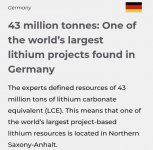
Since it's topical, this news just appeared. 43 million tonnes of Lithium discovered in Germany.

1000019312.jpg
 
I think it's more than that but it depends how the lithium is extracted. Shame for them they found it just as Lithium was going to be phased out in EV batteries.
 
I think it's more than that but it depends how the lithium is extracted. Shame for them they found it just as Lithium was going to be phased out in EV batteries.

That's the mass of carbonate left, proportionately, when the Lithium is removed, but yes, it would be more than that.
 
You made some points there which are questionable. - shopping mall car park not likely to be council owned so not a money grab by them.
Components for an awful lot of things have to be mined, it's got something to do with them being underground. EV batteries are however moving away from Lithium and on to less toxic materials.
I've been driving 800-1000 electric miles a week for coming up 5 years, summer and winter and I've never run out of power yet.
200,000 miles and never had to change a brake shoe. In fact they'd be good for another 200,000. Whatever study you saw in Canada was nonsense if it said that.
Average electric cars are no more expensive than ice cars, mine personal car will do 300 miles on a charge and cost less than 24k, that's the same price as many new mid level ice cars.
EVs are subject to road tax because the government need the money.
The notion that manufacturers are going back to ice is pure bunkum, there are some renewed models true but that's because the ice cut off was pushed back 5 years. Come 2035 no manufacturer will be allowed to sell an ice car anywhere in Europe.
You said "all you see is a big con" the con artist my friend is whoever sold you that mixture of outdated, fabricated, nonsense you seem to believe.
All the info is out there, if you would look for it, I am not perhaps 100% correct but nor are you..
 
I think it's more than that but it depends how the lithium is extracted. Shame for them they found it just as Lithium was going to be phased out in EV batteries.
I have never heard that Lithium is going to be phased out! what are they going to use instead? I am intrigued! Hydrogen is the obvious course to take but making enough and storing it under compression is the biggest problem.

I have just google it and there is no mention of it (lithium) being phased out! If it were a fact then why has it not been reported in the news?
 
I have never heard that Lithium is going to be phased out! what are they going to use instead? I am intrigued! Hydrogen is the obvious course to take but making enough and storing it under compression is the biggest problem.

I have just google it and there is no mention of it (lithium) being phased out! If it were a fact then why has it not been reported in the news?

The very latest battery technology uses Sodium (I think). It's lighter and can be sourced more easily.
 
The very latest battery technology uses Sodium (I think). It's lighter and can be sourced more easily.
I googled Sodium as a replacement for Lithium and it appears not entirely.

Here is the complete reply.

No, sodium is unlikely to completely replace lithium in car batteries, but it is expected to become a complementary technology. While sodium-ion batteries offer advantages like lower cost and a more abundant supply chain, they currently have lower energy density, meaning they store less energy for their weight and size, making them less suitable for high-performance EVs. Sodium-ion batteries are more likely to be used in specific niches, such as low-range EVs, micro-mobility, or stationary energy storage, while lithium-ion batteries will likely continue to dominate the market for longer-range electric vehicles...........

To add my take on current electric vehicles. They are mostly responsible for the overall larger size of the cars because it is required to have a physically larger vehicle to be able to accommodate the size of the battery needed to give it respectable range. Just look at the size of a New Mini (BMW) they are about the size of a petrol driven Vauxhall Astra.

ICE Cars today are in general far cleaner than they were 10-15 years ago but very little has been said about the pollution created by Large Goods Vehicles up to 42 tonnes. When they sort them out to be electric I may start to think about it, but they have not been mentioned anywhere in the dirty vehicle tables.
 
Last edited by a moderator:
IICE Cars today are in general far cleaner than they were 10-15 years ago but very little has been said about the pollution created by Large Goods Vehicles up to 42 tonnes. When they sort them out to be electric I may start to think about it, but they have not been mentioned anywhere in the dirty vehicle tables.
Alternatively, look at what LGVs are used for and see about reducing that. Maybe by using rail, or, heaven forbid, buying less.
 
...or, heaven forbid, buying less.
There are many, many millions of people, who need a great deal more than they currently possess, to get to the point where they have as much as our poor people have.

It could be argued that we'll need those big HGVs, if we are to get those poor people to the point where they're as well off as our poor people.
 
There are many, many millions of people, who need a great deal more than they currently possess, to get to the point where they have as much as our poor people have.
Need. You’ll need to expand on that.
 
All the info is out there, if you would look for it, I am not perhaps 100% correct but nor are you..
I didn't ask you for info, I corrected your wrong info.
 
I have never heard that Lithium is going to be phased out! what are they going to use instead? I am intrigued! Hydrogen is the obvious course to take but making enough and storing it under compression is the biggest problem.

I have just google it and there is no mention of it (lithium) being phased out! If it were a fact then why has it not been reported in the news?
Salt! It's been in the works for a few years, Mercedes among others have been investigating it's potential.

Look up info on sodium Ion batteries, already coming on stream from BYD and should begin to take over from Lithium as the production ramps up.

/Edit, I see you already did, I know that Sodium isn't as energy dense as Lithium yet but it has other qualities i.e. it can charge much faster and is considerably cheaper. Sodium Ion was not even heard of except by a few researchers five years ago. They overcame the biggest hurdle which was it could not be charged as often. There are cars on the market now using S-ion batteries and in ten years the EV technology is evolving Lithium should be on the way out. (This is of course supposition but the writing is on the wall).
 
Last edited:
I googled Sodium as a replacement for Lithium and it appears not entirely.

Here is the complete reply.

No, sodium is unlikely to completely replace lithium in car batteries, but it is expected to become a complementary technology. While sodium-ion batteries offer advantages like lower cost and a more abundant supply chain, they currently have lower energy density, meaning they store less energy for their weight and size, making them less suitable for high-performance EVs. Sodium-ion batteries are more likely to be used in specific niches, such as low-range EVs, micro-mobility, or stationary energy storage, while lithium-ion batteries will likely continue to dominate the market for longer-range electric vehicles...........

To add my take on current electric vehicles. They are mostly responsible for the overall larger size of the cars because it is required to have a physically larger vehicle to be able to accommodate the size of the battery needed to give it respectable range. Just look at the size of a New Mini (BMW) they are about the size of a petrol driven Vauxhall Astra.

ICE Cars today are in general far cleaner than they were 10-15 years ago but very little has been said about the pollution created by Large Goods Vehicles up to 42 tonnes. When they sort them out to be electric I may start to think about it, but they have not been mentioned anywhere in the dirty vehicle tables.

My own take on the future of HGV is that they are likely to go with Hydrogen, for the biggest heaviest vehicles a decent sized tank isn't going to be a problem. That said, this year a company, Ember has begun running national bus services the length and breadth of Scotland with 100%.electric buses. I spoke to one of their drivers at Fort William a few weeks back where they have a 300kw charger and he gave me a tour of his bus. It takes about 30 minutes to top off the batteries.
 
HGVs are already going electric. Hydrogen is useless. Unreliable vehicles and unreliable filling stations. Energy from solar is far cheaper than hydrogen will ever be.

 
I have never heard that Lithium is going to be phased out! what are they going to use instead? I am intrigued! Hydrogen is the obvious course to take but making enough and storing it under compression is the biggest problem.
I'm not an expert on this but hydrogen seems unlikely. As you mention distribution and storage is challenging. That's the beauty of electricity - we already know how to distribute and store it. Any problems we have are really problems of scale not inventing new things.

Also, if you have too much electricity, you can use it for other stuff. If you don't have enough there are several different ways of making it. It's a much smoother adoption curve.

I suspect there will be newer, better battery materials soon. Similar to when NiMH took over from NiCad which was then eclipsed by Lithium tech. But for a long time, they will still plug into a type 2.
 
HGVs are already going electric. Hydrogen is useless. Unreliable vehicles and unreliable filling stations. Energy from solar is far cheaper than hydrogen will ever be.


Do you know that for certain or is it a personal opinion?
 
To add my take on current electric vehicles. They are mostly responsible for the overall larger size of the cars because it is required to have a physically larger vehicle to be able to accommodate the size of the battery needed to give it respectable range. Just look at the size of a New Mini (BMW) they are about the size of a petrol driven Vauxhall Astra.
Cars were getting bigger long before the EV revolution. Mainly due to safety standards going up. You mention the Mini, I have had 4 of them, plus a Clubman variant, and they are smaller than an Astra of the same age. The Clubman is about the same size as a Golf, a little longer but not as tall. You can still buy small cars, VAG do a whole range of "City" cars, Hyundai & Kia do the I10/Picanto, there are others.It's not battery technology that makes the cars bigger, (I mean, look at the BMW I3) it's manufacturers making them bigger so they fit into the more luxery end of the market. You can have a small car with a battery as it's power plant.
 
The UK is lagging behind with Hydrogen generation and storage compared to Europe and it would take a long time and a lot of investment to catch up. My thinking on its use in HGVs is purely a range issue. Big heavy trucks that have to travel 300 plus? miles a day will need big batteries. This adds to the weight and cuts down on carrying capacity. Possibly sodium batteries will help solve this problem in a few years.
 
The UK is lagging behind with Hydrogen generation and storage compared to Europe and it would take a long time and a lot of investment to catch up. My thinking on its use in HGVs is purely a range issue. Big heavy trucks that have to travel 300 plus? miles a day will need big batteries. This adds to the weight and cuts down on carrying capacity. Possibly sodium batteries will help solve this problem in a few years.
Hyundai Inster, Renault 5/Nissan Micra are new model small cars, small outside but big inside and they have a decent range too, 230-250 miles.
 
  • Like
Reactions: Nod
My own take on the future of HGV is that they are likely to go with Hydrogen, for the biggest heaviest vehicles a decent sized tank isn't going to be a problem. That said, this year a company, Ember has begun running national bus services the length and breadth of Scotland with 100%.electric buses. I spoke to one of their drivers at Fort William a few weeks back where they have a 300kw charger and he gave me a tour of his bus. It takes about 30 minutes to top off the batteries.
Busses are not HGV's and weigh a whole lot less even with a full load so really there is no comparison. When compared to HGV a 2 ton car with lithium batteries with a range of perhaps 300 miles is a different prospect compared with a 42 ton HGV. What is weight of the actual vehicle likely to be if it were encumbered with Lithium batteries the weight of which |I can not even guess at. Then consider how long would it take to charge up? Also in the time the vehicle is on the charger the driver is still being paid so costs will go up cancelling out those savings made by going over to electric.

In theory it all makes sense but the way they have gone about it is not practical. Say, for a lorry travelling from Newcastle to London where it is mostly motorway (except a section in Nottinghamshire) That is around 300 miles and takes with stops about 6 - 7 hours. It could almost double if they have very large batteries to charge and what would the range be? Not as much as a diesel engined lorry with 200 gallons on board is a fair assumption I think.
 
I don't think anybody has mentioned charging roads yet. Hannah Fry has a program on the BBC that demoed this a couple of years ago. Drive along and charge the vehicle.

We could do that with the M2 and M6. Maybe that big road that goes to Fife. Hgvs sorted.

Yes, I'm aware that this is basically a train :)
 
Alternatively, look at what LGVs are used for and see about reducing that. Maybe by using rail, or, heaven forbid, buying less.
With our current rail network, increasing in rail traffic has limited validity. They have recently opened a rail head to a quarry on the Settle-Carlisle line, Whilst it has cut down on HGV's leaving the quarry. Most of the stone still gets moved to it's "final" destination by HGV's Added to that the train(s) often have to travel in stages (waiting in sidings) to reach their destination.

As for buying less, that is a non starter, we live in a consumer society. You and I can buy less but unless everybody else does it makes no difference.
Unless of course the government taxes us even more, so we can't afford anything other than the basics, but that would hit the poorest the hardest.
 
Busses are not HGV's and weigh a whole lot less even with a full load so really there is no comparison. When compared to HGV a 2 ton car with lithium batteries with a range of perhaps 300 miles is a different prospect compared with a 42 ton HGV. What is weight of the actual vehicle likely to be if it were encumbered with Lithium batteries the weight of which |I can not even guess at. Then consider how long would it take to charge up? Also in the time the vehicle is on the charger the driver is still being paid so costs will go up cancelling out those savings made by going over to electric.

In theory it all makes sense but the way they have gone about it is not practical. Say, for a lorry travelling from Newcastle to London where it is mostly motorway (except a section in Nottinghamshire) That is around 300 miles and takes with stops about 6 - 7 hours. It could almost double if they have very large batteries to charge and what would the range be? Not as much as a diesel engined lorry with 200 gallons on board is a fair assumption I think.
We could perhaps go back to the coaching horses day and park the wagon up to be charged and just take another wagon to continue the journey.
 
Perhaps it would be better never to rely on any single power source.

Encouraging people to use different fuel sources for their vehicles would improve the country's resilience, in case anything fails.
 
Weird how the story changes depending on the audience. We Scots were assured 11 years ago that NS oil was going to run out by now. That's not the point however, burning oil is killing the planet, that's why we should stop using it.
We were told burning coal is killing the planet so we stopped mining it(and put me out of a job) China was/is opening coal fired power stations at an incredible rate, they need the electricity for all their ‘good for the planet’ electric vehicles, logical?
 
Here is some data for you.


You do know some people believe the world is flat - no matter what the evidence, they will maintain their deluded views!
 
Explain the historical evidence then. Changes in climate have happened since year one there was no petrol cars then.

It is complete nonsense.

Simple - its the scale and pace of change. Temps will always vary.

But in year 50,000 BC no-one cared about it as it was a slow change and we could evolve, a family would just move to higher ground if flooding happened. There were not huge cities then!
 
We were told burning coal is killing the planet so we stopped mining it(and put me out of a job) China was/is opening coal fired power stations at an incredible rate, they need the electricity for all their ‘good for the planet’ electric vehicles, logical?
Don't know about the coal fired power stations but they are ramping up their green energy sector very fast. China has the fastest growing renewable energy sector in the world.
 
Back
Top