

White Balance Problems

68lbs

Suspended / Banned
Messages
5,450
Name
April 2008
Edit My Images
No
As I briefly mentioned in a previous thread, I had some WB problems last night at my portrait class. Unfortunately I can't post pics as we're not allowed, so I'll try and explain the problem.

I always shoot RAW, and usually Auto WB and I just correct through ACR when I import the images. Last night I tried one of the standard settings... for overhead fluorescent lighting. However, I got some VERY random results. Some were fine, whilst others had a yellow gradient. Sometimes at the top, sometimes at the bottom. The same also happened when I switched to Auto WB halfway through.

I've looked at the exif and there's nothing there to explain the issue. ISO 1600, 70-200L lens in the 80-100 range, f/2.8, shutterspeed 1/320 or 1/400.

We're talking about a VERY pronounced yellow gradient. If it's any help, here's a section from two images. Both are the full height of the frame, simply with the left side cut off so you can't see the guy's face. I think I can get away with posting this...

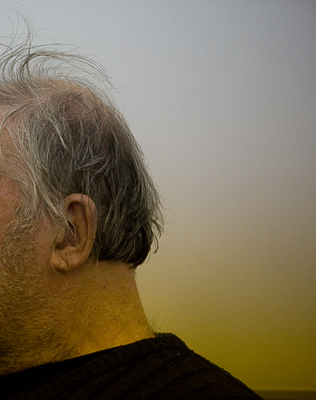


Would it be something to do with the wavelength of the light? Like when you used to try taking a photo of the TV? Or am I speaking out of my arse?
 
The problem is caused by using AWB. The camera measures the light at a given moment of time and this will always create inconsistent results with any flickering light source. This isn't a problem with pro fluorescent lights as used in TV studios because they're made with a ballast sytem that avoids the problem, but amateur equipment is very different.
 
The problem is caused by using AWB. The camera measures the light at a given moment of time and this will always create inconsistent results with any flickering light source. This isn't a problem with pro fluorescent lights as used in TV studios because they're made with a ballast sytem that avoids the problem, but amateur equipment is very different.

Is there a way round this then such as shutter speeds?
 
The problem is caused by using AWB.

But the problem was more common at the start of the shoot when I had the WB set fixed (the little fluorescent overhead light symbol).

But still, it seems to be down to the cycle/flickering of the lights?
 
Flickering I'd say as it turns itself on/off very quickly it obviously heats up/cools down enough to alter the WB as it does it

Slower shutter speeds should sort it - but do you really want to do portraits in yukky greeny lighting? :D

DD
 
fluorescent lights do flicker
DD

Light flicker at 50 times a second in UK

Ballast are the way fluorescents work with out on it will not work so ALL have one.
The problem is caused by using AWB.
This has nothing to do with it as he has said he shoot in RAW and this can be set in PP so this can not have any effect and as it is only part of the image this also says its not that.
I looked to see the EXIF but it not with your images so hard to tell 100% what it is
If you on a course why have you got fluorescents any how? Have you not got flash lighting?
 
Light flicker at 50 times a second in UK


Ballast are the way fluorescents work with out on it will not work so ALL have one.

This has nothing to do with it as he has said he shoot in RAW and this can be set in PP so this can not have any effect and as it is only part of the image this also says its not that.
I looked to see the EXIF but it not with your images so hard to tell 100% what it is
If you on a course why have you got fluorescents any how? Have you not got flash lighting?

Of course all fluorescent lights have ballast - but the ballasts fitted to the very expensive pro lights produce a stable light that doesn't flicker, amateur and houshold ones do flicker.

A longer shutter speed won't remove the problem but will mitigate its effects.

Shooting in raw has nothing to do with it, the way that the information is recorded/processed doesn't affect the quality of the light itself.

I do agree though that you should be taught to use flash on a course, not continuous lighting.
 
Lights in the UK flicker 100 times a second, the supply frequency is 50Hz and you get 2 peaks each cycle - if the flourescent has a magnetic ballast.
If it has an electronic ballast, which most modern fittings have, it will operate at 10kHz or even higher.

For the older lights try using a slower shutter speed.
 
If you on a course why have you got fluorescents any how? Have you not got flash lighting?

It's a £14 adult ed course... probably very basic, interacting with the people you're taking pics of, etc.

We were just taking portraits of some of the people on an art course in the room next door.
 
Lights in the UK flicker 100 times a second, the supply frequency is 50Hz and you get 2 peaks each cycle -

You have ONE peak and one Dip per cycle that is why it’s called cycles........ so the strobing effect is 50Hz not 100 as you say
hertz (symbol: Hz) is a unit of frequency. It is defined as the number of complete cycles per second. It is the basic unit of frequency
 
You have ONE peak and one Dip per cycle that is why it’s called cycles........ so the strobing effect is 50Hz not 100 as you say
hertz (symbol: Hz) is a unit of frequency. It is defined as the number of complete cycles per second. It is the basic unit of frequency

You have TWO peaks per cycle, one negative and one positive, that is why it is called alternating current. At the start of each cycle the current is zero, it then reaches a peak in one direction, goes back to zero, reaches a peak in the other direction and finally back to zero.
You have called the two peaks - one peak and one dip?
Whatever you call them there are two points where the current is at a maximum each cycle, albeit in different directions, therefore a 100Hz strobing effect.

Have a Google or look at Wikipedia.

If you want to continue discussing it a new thread may be better :)
 
You have TWO peaks per cycle, one negative and one positive, that is why it is called alternating current. At the start of each cycle the current is zero, it then reaches a peak in one direction, goes back to zero, reaches a peak in the other direction and finally back to zero.
You have called the two peaks - one peak and one dip?
Whatever you call them there are two points where the current is at a maximum each cycle, albeit in different directions, therefore a 100Hz strobing effect.

Have a Google or look at Wikipedia.

If you want to continue discussing it a new thread may be better :)

I was an electrician when I left school in 1965 and then went back to collage in 1976 to study electronics. Worked in radio communications
I know what I am saying; you have ONE Peak in One Cycle.
I not comment any more as there are many people on here who read something on the internet and take it as gospel truth. This is not the case you
We are talking about Voltage not current which flows.
The Voltage starts at zero and rise to Aprx340V the n to -340V and back to zero in a sine wave it is the 0 to -340 volts when the light will go out and this happens 50 times a sec the other 50 times a sec the light will be ON as it is 0 to +340V
So you see you get peaks at 50 times a sec.
My Last comments on this subject.
 
I was an electrician when I left school in 1965 and then went back to collage in 1976 to study electronics. Worked in radio communications
I know what I am saying; you have ONE Peak in One Cycle.
I not comment any more as there are many people on here who read something on the internet and take it as gospel truth. This is not the case you
We are talking about Voltage not current which flows.
The Voltage starts at zero and rise to Aprx340V the n to -340V and back to zero in a sine wave it is the 0 to -340 volts when the light will go out and this happens 50 times a sec the other 50 times a sec the light will be ON as it is 0 to +340V
So you see you get peaks at 50 times a sec.
My Last comments on this subject.

I was an electrical engineer from 1964 until 2002. I have City & Guilds, HNC and an OU 1st class Hons. degree (Technology, Science & Maths). :)
I know what I am saying; you have TWO Peaks in One Cycle, a positive voltage peak and a negative voltage peak.
The peak is equal to the square root of 2 multiplied by the RMS voltage. At present the RMS voltage is nominally 230v so the peak is about 325v
The light does not go out when the voltage goes from 0 to -325 it lights up.
Try connecting a battery to a torch lamp with the positive from the battery going to the centre contact of the lamp - it will light up.
Now connect it so that the negative goes to the centre contact - it will light up.
I did not need to read anything on the internet about this, and have not done so yet, but I know that any reputable source will confirm that the strobing effect is 2 times the frequency, in the UK that will be 2 times 50 Hz or 100.
My last comments also and apologies for hijacking the thread.
 
Did you try setting the WB with a white card?

Nope... I didn't want to fart about and tbh have never experienced anything like this before. Now that I am aware of a potential problem, I'll be wary of fluorescent lighting. :suspect:
 
For what its worth; both of you are saying the same thing - just using 2 different terminology. Some call it PEAK and TROUGH; some others call it PEAK and PEAK ( positive peak and negative peak).


And I haven't done electrical engineering in 1964/65, due to the slight inconvenience of not having born then...ha ha ha ( just kidding, dont get upset)
 
Back
Top