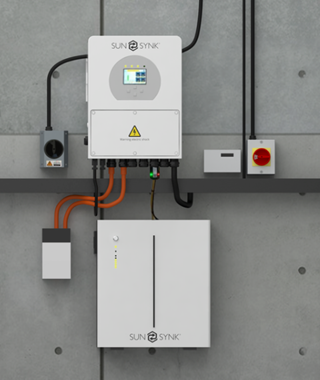
Which / what Solar?

lindsay

Admin
Messages
8,060
Name
Lindsay
Edit My Images
Yes
At the risk of starting something that will become an argument - and it won't because I'll exercise my Admin rights to delete anything that is both off-thread and unhelpful - I am seriously considering installation of solar panels on the roof, to gain resilience against power cuts. We have a roof facing due south and another facing east/west, so alignment for best capture is straightforward, and from what I read, inverters are now very much cleaner in terms of RF splatter (electronic noise) than they were so shouldn't interfere with my ham radio setup. Any installation will obviously include a power wall/bank/battery to store spare energy.
I'm 68, my wife 53, so I know there is an argument about payback period or amortisation of the investment, but as I've mentioned elsewhere, given that I expect to be working at home for a few years yet, any day without power is money lost to set against the investment, in addition to any gains through bill savings and sale back to the Grid. So I'm not looking for comments about the financial side as I'm pretty astute and literate on that score.
What I'm interested in here is real world experience in having such installations done, and the best features to look for when any salesman comes to visit, please?
 
About to go into a mtg so I'll be brief...

1. Solar on its own won't protect you against power cuts. Solar panels and batteries cut off when there's a power cut (for safety reasons). You can circumvent this by either buying a very expensive battery (I think it may only be the Tesla ones) or have some work done on the hot side of your electrics to instal a divert. There are other cheaper methods depending what you want to run. Batteries to run the house off grid for a whole day can be pricey depending how much power you use.

2. We're in a fairly crazy period ATM where financially you are better off NOT charging batteries from solar. Depending on your tariff, it may well be better to sell the solar power to the grid and buy power at night to charge the batteries. Madness, huh?

More batteries than you need and a good inverter are things to prioritise.
 
Depending on how much power you need to run your work equipment, might a bank of 12V batteries and an inverter be an option?
 
I had no idea that solar would cut off in a power cut. I assumed they would switch like a UPS, or at least would keep producing electricity to power the house. If that is the case, it makes the idea more tenuous, although I was allowing for £5-7k for a power wall (Tesla at the expensive end of that range, I believe). I think I understand the logic of cutting off though, it's rather like why they switch off the windmills in a storm.
After the latest storm with a power loss for circa 54 hours, I've got two UPS's on order for the router, and with about 5 laptops to choose from, I should be able to keep going for a few days in the worst case, allowing for going to the company office every third day to recharge everything (if they have power). But for domestic use, especially freezers, I had hoped for a resilient solution.
However, if the solution I'm looking for proves unrealistically expensive, I'll spend £1500 on a reasonable generator and get some jerrycans for the diesel!
Thanks @JonathanRyan ! @Nod, I'm already thinking along those lines, I have a chunky leisure battery in the camper van to run my mobile ham radio setup, I could get a few more...and an inverter.
 
Yes. If I needed to ride out 54 hours of power loss at any time of year then my option would either be a generator or to be able to travel somewhere that had power.
 
I know little about it but google tells me the solar systems that shut off are the ones that feed power back into the grid. If you install a purely solar to battery storage option or a feed in system with battery storage that can be switched to in a power cut, this need not be the case.
 
If it's power cuts your worried about I'm not sure solar is the best bet. Theres no little or power produced for a fair part of the day in winter, and even with battery back-up working from home still may not work. If your power is off, so might the local area, internet, phones may be out too.
"Er indoors" has been looking at getting solar and from what she's been told, the house can be more or less bill free in the summer months (I'm not convinced as a neighbour who has it only saves a few pounds a month off his bill)
Depending on where you live wind power might be a better bet?
 
...I'll spend £1500 on a reasonable generator and get some jerrycans for the diesel!
If you're looking for emergency power, I think that your best bet would be a generator. Neither sun nor wind can be relied on in most of Britain and the yield per £ spent is nothing like a good generator.

A friend, admittedly a trained mechanic, made his own system, using the engine from a Mini and the onboard generator from an old airliner, which was enough to keep his repair business going through any cut!
 
We had a solar system installed last March. Only a month away from being able to look back over a full year!

First thoughts are.......

I should have sought more quotes from local installers. Not because our installer was a problem, but we really did not have enough to compare. When starting out, we sought quotes from main stream engergy suppliers together with a local solar company. The energy companies were helpful and submitted good illustrative quotes, but wanted £500 for a site survey. Yes, it would be refunded if we went ahead, but getting detailed quotes would mean spending £500 with each on. The local company was prepared to come and complete a survey. They were local!

Something that I'd not expected was that the installer had the panels shipped directly to me. You may need space to store the panels. Worth checking with your chosen installer.

Buy a battery that has a capacity that is enough to meet your daily household needs. That way, you can charge the battery overnight and power the house on low cost electricity.

As @JonathanRyan said above, by default solar installations do not power a house during a power cut. This is because your house would be acting as a generator and there would be a risk of making the cables live while engineers are working to restore power. If you live where power outages are a risk then it is worth considering a system that includes something like the GivEnergy Gateway. I don't have one myself, but I do have GivEnergy equipment and it works well.

We have benefitted from the inclusion of a solar diverter (a smart device that senses when power is being exported and diverts power to heat a hot water cylinder). Even in winter on a bright day the solar can ensure hot water is heated.

That's all that comes to mind. Hopefully helpful. Good luck.
 
@4tea2 hanks John, that's really useful info. I'll investigate the local offers and definitely get more than one survey/quote.
@AndrewFlannigan I have considered wind power but you need planning permission and they are not a cheap option if bought; also the noise of a spinning windmill plus the turbine is rather intrusive, not loud but uncomfortable. I like the idea of repurposing an aircraft generator though - I may know where I can get such things, that could be a little project for the future.
Noise is the reason I'd prefer not to use a generator - one of the nice things about our location is its peacefulness although I know we are only talking about an occasional, as rare as possible, utilisation.
Lots to think about.
 
Plenty of very quiet car engines around should you decide to go the home-brewed genny route! £1500 should buy you one hell of a domestic genny set up, even including some batteries and an inverter.
 
The more I think about your requirements, the more I think a battery such as a power wall without solar might be a good solution.

Spend the money you save on the panels on a bigger battery and get a fancy one that works with cheap tariffs and power cuts.

If I were doing mine again, I'd probably buy a power wall. They are now cheaper and more available than they were and have inverters that can supply everything at once. Mine is 3kw so if the house draws more than that at once I pull the extra from the mains.
 
I have solar PV and a Tesla Powerwall. The gateway for the powerwall allows it to supply the home during a grid failure and when I had it installed six years ago was the only system that did. The others all cut the supply to the home during a grid failure as they can't stop the 240V going back up the incommer to electrocute the person working on the grid failure. There may be alternatives to the Tesla solution now, I haven't looked.

It basically works like a massive UPS, though it is not "pass through" like the standalone UPS units you can buy, so there is a small failover time (perhaps a few tens of milliseconds) which is too long for some devices to prevent them resetting. As a consequence I have a UPS behind my server and the work desktop. Any solar will be used by the house or if there is excess to charge the battery during an outage.

You can configure the amount of storage to be kept back as backup provision, so that amount never discharges while the grid is supplying. You can also have it run "backup only" so it is always 100% full while the grid is available.
 
I had no idea that solar would cut off in a power cut. I assumed they would switch like a UPS, or at least would keep producing electricity to power the house. If that is the case, it makes the idea more tenuous, although I was allowing for £5-7k for a power wall (Tesla at the expensive end of that range, I believe). I think I understand the logic of cutting off though, it's rather like why they switch off the windmills in a storm.
After the latest storm with a power loss for circa 54 hours, I've got two UPS's on order for the router, and with about 5 laptops to choose from, I should be able to keep going for a few days in the worst case, allowing for going to the company office every third day to recharge everything (if they have power). But for domestic use, especially freezers, I had hoped for a resilient solution.
However, if the solution I'm looking for proves unrealistically expensive, I'll spend £1500 on a reasonable generator and get some jerrycans for the diesel!
Thanks @JonathanRyan ! @Nod, I'm already thinking along those lines, I have a chunky leisure battery in the camper van to run my mobile ham radio setup, I could get a few more...and an inverter.

54 hours must have been challenging for the fridge/freezer?

I've been mulling over solar myself, so this is an interesting thread and I came across this which on the face of it seems to fit the bill (although maybe not literally! lol), but I'm currently not well informed when it comes to solar.

 
@gman We managed pretty well, all things considered. Battery radios, a mix of candles and battery torches, and kept phones running using the telescope big battery supply. The two fridge/freezers stayed pretty cold, the fridges not so well but in the freezers most things stayed frozen, just a few items at the top of the drawers went a little soft so went in the bin. I guess it helped that the air temperature was only just above freezing during that period.

That UPS Solar thing looks perfect actually. When I get people round I'll ask them about doing that, if they can.
 
Some additional thoughts that have come to mind....

If power cuts are your concern, then definitely consider a decent size battery with equipment that will disconnect from the mains in the case of a power cut. Assuming you can get a low overnight tariff, you will get both protection from power cuts and the ability to power the house during the day on low rate electricity. As mentioned above GivEnergy supply these products as well as Tesla.

If you want to benefit from solar then add panels. Additional cost, but you will earn during summer months and bright winter days.

Get what you need and interests you. Don't get trapped into the "when will it pay for itself?" mentality. In life we mostly do not worry about "when will it pay for itself?". We buy a car, we buy a new kitchen, we buy a new camera - our decisions are based on does it make our life a bit better. Get a system that makes things better for you.
 
I'm pretty convinced by the battery and GivEnergy box approach, with the solar panels being an optional extra now. I'll have to see what tariffs the suppliers in NI offer for low rate and so on though. I'll have a chat with my friendly electrician as I know he was thinking of getting into this area to diversify his business, I might be able to get a deal on installation with him.
 
I have had solar for almost 10 years now, around 8 years on its own, 1 year solely with vehicle-2-home (using EV as home battery) and last few months with an additional Powerwall 3. I have feed-in-tariff with assumed/deemed export (not SEG), so finances work out differently to recent install. Solar PV as technology works great, but without FIT it doesn't make much financial sense for my small W-E roof.

From my experience, I personally think a battery by itself right now (since start of 0% VAT last year) is a better buy than with solar and miles better than solar by itself. You can get on a time-of-use tariff and could save money all throughout the year.
Eg. 7p off-peak vs 26p peak = 19p/kWh price difference. 8 kWh a day usage means £550 a year saving, With 10+ years warranty on the battery they should last many years beyond that. Battery also carry enhancements such as enabling silent off-grid self power and easily particiapte in grid events (free or saving sessions).

A few of questions I'd ask for solar install are: shading factor, micro-inverter or string inverter, how to claim and/or work out those really long panel efficiency guarentee, string inverter install location, any solar company generation guarentee for the system.

A few of questions I'd ask for battery: most importantly install location (much cheaper alternatives if installed indoors, pretty much only GivEnergy and Tesla for outdoor I think), for off-grid you need to ensure inverter size can cover your largest appliance (electric shower?), app ease of use and intergration with tariffs, whether you want possibly future EV to draw from home battery, battery chemistry (LFP are better for stationary application and more cycle life).

For both, make sure your installer will be able to provide the manufacturer warranty. Both Tesla and GivEnergy have installer requirements. Install by a random electrician may invalidate the warranty.


I would echo above, Tesla Gateway 2 does have half second or so of switchover time, so I still needed UPS on my home server. GivEnergy gateway, however, datasheet said will switchover after just 20ms to detect grid outage, so possibly does not need UPS.
Do think about how long you need to cover for power cuts, is 52 hours the extreme rare case or happen often enough you feel you need to have the capability? Installing enough battery capacity to cover for this does not make financial sense.

However, tech such as Vehicle-2-home for future cars may enable even 100 hours off grid living. Right now I could be off-grid and then plug in the 18 kWh Nissan Leaf to gain additional day of off-grid use if it were fully charged. A 40 kWh Leaf would allow more than 2 additional days off grid use. I said future cars because Leaf's Chademo are outdated but current CCS vehicles does not have V2H enabled.
 
as @wyx087 says 100% its all about cheap electricity from the grid at the moment, solar is good but using off peak charging 11pm to 5am as an example then using all that during the day will save you a heap AND have cover for power outages if configured well, the thing to look at is solar hot water as well.
 
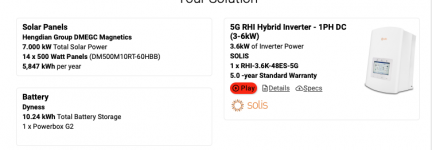
OK so I've had a good quote from a local/national company to install 20 panels, inverter, 10kWH battery, with automated switching into/off grid to cover outages. They are a Duracell supplier, apparently, though:

Screenshot 2025-04-30 at 15.03.03.png


I'm wondering if those in the know have any feedback/advice/info I should consider regarding these specific elements of the proposed system.
I'm getting other quotes and will explicitly look for one that supplies GivEnergy kit as well.
 
OK so I've had a good quote from a local/national company to install 20 panels, inverter, 10kWH battery, with automated switching into/off grid to cover outages. They are a Duracell supplier, apparently, though:

View attachment 452013


I'm wondering if those in the know have any feedback/advice/info I should consider regarding these specific elements of the proposed system.
I'm getting other quotes and will explicitly look for one that supplies GivEnergy kit as well.

I'd be asking where the other 6 panels are first? :D
 
I'd be asking where the other 6 panels are first? :D
:headbang: I didn't notice that on first reading! The survey guy said he thought 16 to 20, but this does indeed say 14. I'll go back to them on that if I decide to go with them, as they've only designed it for the south-facing roof but we have east and west facing roofs as well, so I'd have thought we could have 4-6 panels on each of these too so as to get all-day sun, but then we are fairly high in the northern hemisphere so maybe not necessary. I'll make note of sun visibility from that south facing roof in early morning and late afternoon.

It was more the battery and inverter specified that I was wondering about though. and they apparently use a Duracell app to interface with the inverter.
 
That's a big roof you got there, I'm jealous. Also these new panels sure generate a lot compared to my 10 year old tech, double jealous :)

3.6 kW inverter power means you'll need to be careful not exceed that if you want to stay always consuming from the battery/solar and extra careful not exceed it during grid outage. 3 kW is what a kettle or oven would use.

Make sure the battery input can take full panel output. It says 7 kW theoretical peak output for the 14 panels, but if battery can only take 5 kW, you'd be exporting other near 2 kW during days like today. So make sure the battery can take most of solar generation then you would minimise exporting to the grid...... if self-sufficient what you want to do.

If fastest return is what you want, then export solar at 15p SEG makes more sense. In that case, simply make sure battery input + inverter power is below what is capable from the panels. (eg. 5 kW battery input + 3.6 kW inverter < 7 kWp panels).

Also, I'm sure survey person did their job. Looks like a string inverter setup, so make sure no shading on the panels throughout the year.
 
It appears to be a hybrid inverter, I'm not sure what that means but google suggests that might be better than a string one?
I specified to the guy that my requirements were, in order of priority:
1. Hot water (to avoid using electric immersion heater we currently have)
2. Reduce electric bill
3. Resilience in power cuts to maintain basic services (freezers, router, a couple of laptops or phones being charged)
4. Feed in to grid (least important / not really bothered)

Your points are welcome @wyx087 for when I go back to them/if I go back to them to query etc. I'm not bothered about kettle or oven when we have a power cut (we have bottled gas for the hob here). I'm not concerned about a quick return on investment - I don't plan to move or die for at least 20 years!! In any case, Mrs Lindsay is 15 years younger than me so will probably outlast me handsomely. If it doesn't need any updating for at least 10 years, then I think it will be amortised comfortably.
 
If fastest return is what you want, then export solar at 15p SEG makes more sense.
If mains electricity costs more than 15p/kWh (spoiler alert, it currently does) then surely this plain wrong advice. Maximum self-consumption is the answer.

Sure, export surplus at 15p/kWh though.
 
String inverter vs micro inverter are how solar panels connected, whether in serial strings or micro inverters on panels straight to AC. The hybrid inverter approach will definitely mean a string panel configuration. The downside with string configuration is that any shading on small portions of panel will massively drop overall output.

Hot water immersion heater diversion is easily done. But the kit has to be installed, is that included in another part of the quotation?

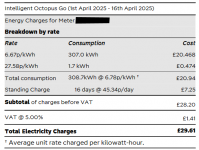
With 10 kWh battery and target to reduce electricity bill. After the install, you should really consider time-of-use tariff. I'm on Intelligent Octopus Go at 7p/kWh. You should be able to push down your imported electricity price greatly. For example, I'm averaging 7.12 p/kWh inc tax.
1746043087746.png

If mains electricity costs more than 15p/kWh (spoiler alert, it currently does) then surely this plain wrong advice. Maximum self-consumption is the answer.

Sure, export surplus at 15p/kWh though.
This is very valid. Due to having EV and home battery, I was only thinking about night time rates which is 7p/kWh for me on IOG. In that case, not self consuming and exporting at 15p/kWh gives better return. So in that situation, battery is only there to avoid importing at 20-odd-pence.
 
Looks a pretty impressive setup. If you can afford it I'd say go for it. Definitely so if you can get a cheap overnight tariff. Then you can charge batteries at night and export all day.

Even with that power inverter you will probably hit the grid occasionally because it takes a moment to switch. Cheap induction hobs are notorious for this.

I have the Solis inverter and there are many times I've wished I waited for a different one. It's "fine". Works pretty well but can be annoying to reprogram and the app is fairly poor.

Maybe look at getting the inverter installed somewhere that has easy access. Mine's up a ladder with a twist because of some steps which makes it awkward if I need to change the settings.
 
Really useful comments, thanks.
The battery and inverter are to be installed (under this quote anyway) in our garage which is integral in the house, at one end of the house (it's a chalet bungalow L-shaped). So the inverter and electrics are easy to access; the app they use is apparently from Duracell, although I may have not got the whole detail there.
Regarding tariffs, I need to research what's available. We don't have the range of choices in Northern Ireland that you have in England, eg Octopus don't supply here. But there are lots of houses with solar here in the countryside especially, as most people have oil for central heating and electricity for cooking, although some like us have bottled gas for the hob and a gas fire in the living room / log burner in a kitchen or second living room (not uncommon here to have separate lounge and sitting room - no idea why but it is nice to have one as a "snug").
FYI price on that quote is £7600, which seems quite good. Two more quotes are incoming though.
 
FYI price on that quote is £7600, which seems quite good. Two more quotes are incoming though.
Whaaaaaaat????

I may be out of touch but I would expect that quote to be 15k+. I guess bungalow saves a bit bit that looks very cheap to me.

What have I missed?
 
That's SUPER cheap. Perks of not living in S half of England I suppose.

I spent £7000 for 10 panels and a 2-string inverter about almost 11 years ago. Then £7000 again for Powerwall 3 last year.

The key for tariff is getting a time-of-use tariff with cheapest off-peak period you can find. Then only import from the grid during cheap off-peak times. Check how often you exceed 3.6 kW and decide if upgrading that is worth the price increase. Or wait a little bit and spread out your load?
 
Whaaaaaaat????

I may be out of touch but I would expect that quote to be 15k+. I guess bungalow saves a bit bit that looks very cheap to me.

What have I missed?
I've just had a second quote that has 13 panels with the same inverter and battery, for £7300. It sounds like it will be good value, but I want to verify a couple of things and confirm the hot water installation and gateway facility for switching off grid connectivity; plus I want a quote that uses the GivEnergy kit to compare with.
 
We have a GivEnergy system with 5kW Hybrid Inverter, Solar panels (18) on two elevations (south and west) plus 9.5kWh battery with limited UPS in the event of power failure. Great system and we’ve had zero issues.

The AIO with larger battery (?13kWh) and ability to have a gateway with full house back up wasn’t available when we ordered ours. I would advocate a large(r) battery as this is where you will see the real benefit, particularly in winter. Depending upon tariff you can really optimise charge/discharge irrespective of solar production.

That price you have quoted also seems very good as I know prices have come down but worth checking the detail. I’d also recommend bird guard i stalled to prevent future issues.

Happy to answer any questions if you have them.
 
Thanks @Buck that's interesting. There's a local firm advertising a GivEnergy system with 13KwH battery and I think 14 panels plus the usual inverter for circa £12.5k, quite a bit more that the two other companies but I'll get them to quote anyway, as GivEnergy has had some good recommendations.
 
I thought I'd update this thread. We had our solar installation done a couple of days ago, 20 panels split between S and W facing roofs, Duracell 3.6Kw inverter, two Duracell 5kWh batteries, plus hot tank immersion heating, total cost £9k. So far I'm very pleased with it, all of our electricity is coming either from the panels or the battery, except if we really hammer it with both ovens on in the evening, but even then the grid requirement is trivial. I was getting 3kW power off the panels this afternoon and it was cloudy! It's made me start thinking about getting an electric car tbh, to replace the diesel estate, as we have excess energy available for charging.
 
I thought I'd update this thread. We had our solar installation done a couple of days ago, 20 panels split between S and W facing roofs, Duracell 3.6Kw inverter, two Duracell 5kWh batteries, plus hot tank immersion heating, total cost £9k. So far I'm very pleased with it, all of our electricity is coming either from the panels or the battery, except if we really hammer it with both ovens on in the evening, but even then the grid requirement is trivial. I was getting 3kW power off the panels this afternoon and it was cloudy! It's made me start thinking about getting an electric car tbh, to replace the diesel estate, as we have excess energy available for charging.

That sounds like an absolute bargain for what you've ended up with. Very tempted myself now.
 
I'd recommend the company Graham, but they only operate here in Northern Ireland
 
I thought I'd update this thread. We had our solar installation done a couple of days ago, 20 panels split between S and W facing roofs, Duracell 3.6Kw inverter, two Duracell 5kWh batteries, plus hot tank immersion heating, total cost £9k. So far I'm very pleased with it, all of our electricity is coming either from the panels or the battery, except if we really hammer it with both ovens on in the evening, but even then the grid requirement is trivial. I was getting 3kW power off the panels this afternoon and it was cloudy! It's made me start thinking about getting an electric car tbh, to replace the diesel estate, as we have excess energy available for charging.

Getting an EV once you have solar is a no brainer. Not many estate models. There's the MG5 and I think the BMW i5 at vastly different price points!
 
I'd recommend the company Graham, but they only operate here in Northern Ireland

Thanks. That's a pity, maybe I can coax them over somehow lol
 
Back
Top