When does film cease to be film?

Steve

Suspended / Banned
Messages
1,685
Name
.... Steve
Edit My Images
Yes
Following on from a couple of recent threads on PP, when does a film photograph cease to be film and become something digital?

Is it as soon as it is scanned and digitised? Although converted to digital, the film shots on this forum I see still retain enough character to be identifiable as film. But as the amount of digital PP increases, does the photograph become less a film image and more a result of digital manipulation?

I use a mixture of digital and film cameras, depending on the subject matter and what I want to achieve. I took the picture below on my digital camera of my daughter in fancy dress as a zombie tinkerbell, as I knew that I could not achieve the result I wanted with film.

Zombie Tinkerbell
by SteveGam, on Flickr

Out of interest I took a film photo at the same time, and this is the straight scan of the film:


Film scan
by SteveGam, on Flickr

The straight scan is some way from the desired vision of the digital photo.

But with extensive digital PP, it can get turned into:


Film edit
by SteveGam, on Flickr

This is the kind of end result I was after, but required a lot of PP. To me it's no longer film....it's too far removed from what I can achieve in film. It's become something else...digital art?...I'm not sure but it's not film.

But some people say that any amount of PP is fine on a film. So at what stage does scanned film cease to be film (if ever)?
 
Following on from a couple of recent threads on PP, when does a film photograph cease to be film and become something digital?

Is it as soon as it is scanned and digitised? Although converted to digital, the film shots on this forum I see still retain enough character to be identifiable as film. But as the amount of digital PP increases, does the photograph become less a film image and more a result of digital manipulation?

(...)

But some people say that any amount of PP is fine on a film. So at what stage does scanned film cease to be film (if ever)?

I think that the more pertinent question is, does it really matter?

I mean for example, there are Italian tempera paintings that have oil paint in some areas, but no one considers them less of a tempera painting. The artist intended them as a tempera painting and therefore that is how they are seen.

I think it is very much down to the artist to decide how their work is labeled. If I shoot an image on film and then hugely manipulate it in digital, but then label my materials as 'film, with digital media' then no one needs to question me at all. That's what I say it is, it's a film shot.

But in my experience, the only people who *really* care are camera club judge types, who seem to want everything to be 'perfect' with no manipulation at all.
 
To me, your film edit is no longer film either. To me (and it is personal opinion of course), it stops being film when the photo you upload is no longer identifiable when held up next to the negative.

(great photos btw!)

And no, it doesn't really matter. But it's interesting to talk about, being on a forum and all :)
 
Last edited:
As Mr Snap calls it, it's 'figital'.

I think once you get away from the adjustments available in a traditional darkroom it becomes something else, I'm not sure what but it's not film anymore.
Also, if the original aim is something like you've achieved then TBH I don't think I'd even consider using film in the first place, digital is a great tool and would be my first choice for something like this.
 
Well, we live in a world of compromises. In fact, we couldn't really join and use this forum if we were film absolutists, as we couldn't share our pictures. "Well, I've got this shot, see, of my daughter in zombie makeup and wings blowing stardust, and the colours and contrast don't look right to me. Come round to mine and have a look? Or PM me your address and I'll post you a print?" We have to live in both worlds to make this work. The compromise works for me.

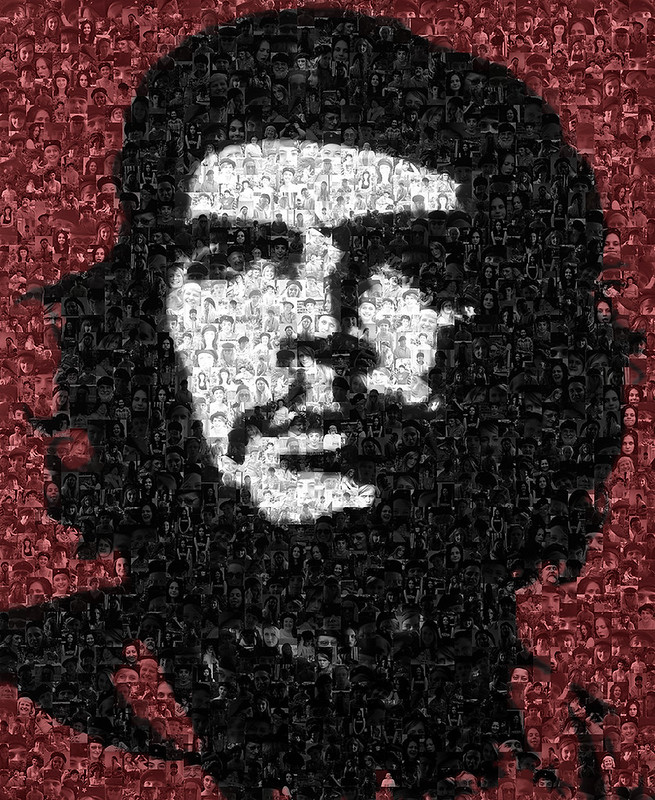
As an example of extreme PP, check out Steve's entry in the poster round of POTY13... no question in my mind that's film, even though it has none of the look of film.
 
I think that the more pertinent question is, does it really matter?

I mean for example, there are Italian tempera paintings that have oil paint in some areas, but no one considers them less of a tempera painting. The artist intended them as a tempera painting and therefore that is how they are seen.

I think it is very much down to the artist to decide how their work is labeled. If I shoot an image on film and then hugely manipulate it in digital, but then label my materials as 'film, with digital media' then no one needs to question me at all. That's what I say it is, it's a film shot.

But in my experience, the only people who *really* care are camera club judge types, who seem to want everything to be 'perfect' with no manipulation at all.

Thanks Charlotte,

I really wish I knew more about art history. And of course you are right it really doesnt matter. Which is actually a very liberating perspective.

I've probably been a bit 'precious' about film as a medium, probably as for me I get satisfaction and enjoyment from the process so the technique is in some ways a large factor in what I do.

As Chris says it's a compromise and one that I guess works for all of us or we wouldn't be here.

This is the poster that Chris referes to. To give it context, it's made up of hundreds of film photos of my family and friends all wearing a Che Guevara beret, and all taken on a Leica M2 (same camera Korda used to capture that iconic photo)


Che mosaic
by SteveGam, on Flickr
 
Well my thinking is:- It just makes film more versatile in that you have a choice of the film "look" be it chemicals or digital manipulation......but a digital user is stuck with digital and program software to get as close to the film "look".....anyone tried to put a memory card in dev and fixer :lol:
 
Well my thinking is:- It just makes film more versatile in that you have a choice of the film "look" be it chemicals or digital manipulation......but a digital user is stuck with digital and program software to get as close to the film "look".....anyone tried to put a memory card in dev and fixer :lol:

Now that is an interesting idea for a project. I wonder if I left an old memory card in developer long enough it would affect the chemical in some way to result in a distored image, as a statement on how digital photography is corrupting film.
 
To me, your film edit is no longer film either. To me (and it is personal opinion of course), it stops being film when the photo you upload is no longer identifiable when held up next to the negative.

But you could say that about film photographs. My grandfather used to manipulate film images in the darkroom. Changing stuff, importing bits from one picture to another, changing skies, putting people into different scenes. Is it not film just because it is not identifiable when held up next to the negative?
 
I suppose strictly speaking a photograph printed conventionally but from a glass plate negative isn't a film photograph...

The obvious examples of prints made on conventional paper but without using a conventional negative are ruled out of court by not involving film (or plates) at all (e.g. photograms)

We're on a sloping ground. A negative scanned straight (acccepting all the imperfections of the first attempt at a scan and making no scanning adjustments) printed via an inkjet with no corrections in Photoshop to boost contrast (acceptable in a darkroom via paper grades or developer choice) or brightness (acceptable in a darkroom by altering the exposure) is presumably still a hybrid. Anything beyond that and we're moving even further away. In passing - if inkjet prints using the modern pigment inks had been available to Fox Talbot et al, I doubt anyone would have worked towards silver gelatine, given all the early efforts to produce archival prints and attempts to use carbon pigments...

Personally, I don't care. I start out with an idea of what I want to see in the print, and do whatever it takes to achieve that. I can understand the reasoning that says "you must get it right in camera" but regard it as a modern aberration of thought.

The idea that it "stops being film when the photo you upload is no longer identifiable when held up next to the negative" means that Jerry Uelsmann (working with film and using only a darkroom) didn't actually produce many photographs, since his characteristic work falls outside this definition.
 
The idea that it "stops being film when the photo you upload is no longer identifiable when held up next to the negative" means that Jerry Uelsmann (working with film and using only a darkroom) didn't actually produce many photographs, since his characteristic work falls outside this definition.

Indeed. Likewise with Ansel Adams, who made countless different interpretations of a single negative - I doubt these would be identifiable next to the negative in some case.

I also tend not to care about this kind of thing. For me, it's about taking advantage of the characteristics of film when producing a final image. This final image started out in my head, whereby the characteristics of 'film' are accounted for. When it comes to editing, how well I set up and took the photograph will determine how much work I do on the photograph after developing. In the vast majority of cases, it is usually to get the final image looking like how I remember the scene as (and taking the argument full circle) I generally won't take the photo unless the scene looks like it did in my head initially.
 
But you could say that about film photographs. My grandfather used to manipulate film images in the darkroom. Changing stuff, importing bits from one picture to another, changing skies, putting people into different scenes. Is it not film just because it is not identifiable when held up next to the negative?

I'm talking about digital manipulation, not darkroom manipulation. For me, that's different.
 
I'm talking about digital manipulation, not darkroom manipulation. For me, that's different.

But the aesthetic is the same, that was my point. If a film photo stops looking like the original negative then it ceases to be film. But if you say that, then you have to apply it to both digital and analogue post processing. There's no difference except one is chemical and one is electrical.
 
For me, it's about taking advantage of the characteristics of film when producing a final image.

For me it's also as much about the experience of using a film camera - that's a difference that I can't ignore when enjoying the size of a medium format viewfinder or the tactile qualities of winding forward a frame on a 35mm body (which may be why one reason I'm not so keen on motorised film winders).
 
But the aesthetic is the same, that was my point. If a film photo stops looking like the original negative then it ceases to be film. But if you say that, then you have to apply it to both digital and analogue post processing. There's no difference except one is chemical and one is electrical.

I don't have to do anything - it's just my opinion :)
 
As much as I appreciate this is a discussion forum, and we do like talking about such things... does it truthfully matter? If you enjoyed making the image, and you enjoy the end result, does it matter what category it falls into?
 
It is interesting but, I agree, I couldn't care less what people choose to call an image.

I am interested in how it was created though.
 
I care what peeps choose to call their.....output.

But for me it isn't a film v digital thing, film will always be film, prints will always be prints and digital file can't be anything but a file, you can't be confused about what things are actually made of physically.

When you scan a film frame, its no longer film, its a digital file, it hardly matters in this context how much digital alteration you apply to it, the film has gone, its a facsimile of a film frame, nothin else you can do about that its the way things are..:)
 
And, presumably, when a negative is printed it becomes a print and is no longer film...

Film (considered as a negative) is just as much an intermediate stage as a digital file - the midpoint in tangible terms between the photographer's idea/vision and the final print. The only difference is that you can look at a piece of film and admire the image in a way few do when contemplating a memory card. Though how many people choose to be purists and evaluate photographs only in the form of a relatively small (or very small!) negative I don't know.
 
I admire, appreciate and value more the effort and skills it takes to craft a good print in the darkroom
 
This question has parallels with an early assignment to philosophy undergraduates.
I start off with a woollen sock and over a period of time the sock becomes worn and holes appear that I always darn with cotton. At what point does my woollen sock become a cotton sock?
 
I care what peeps choose to call their.....output.

But for me it isn't a film v digital thing, film will always be film, prints will always be prints and digital file can't be anything but a file, you can't be confused about what things are actually made of physically.

When you scan a film frame, its no longer film, its a digital file, it hardly matters in this context how much digital alteration you apply to it, the film has gone, its a facsimile of a film frame, nothin else you can do about that its the way things are..:)


Oooooh ooh I got one - What would you call the image a slide projects on a screen/wall whatever? :naughty:
 
As much as I appreciate this is a discussion forum, and we do like talking about such things... does it truthfully matter? If you enjoyed making the image, and you enjoy the end result, does it matter what category it falls into?

Well it does in a way as if I was a newbie or digital guy wanting to try film, I'd be confused reading this thread and think "why use film"...of course no question mark (and is rhetorical) as we will cover old ground again. ;)
 
It is what it is...
 
Photos that originated on film were being digitally edited before digital cameras ever really took off, but since digital cameras weren't a big thing there was no need to differentiate between "digital" and "analogue" photography. The photos in this post could be oil paintings for all I care, what matters is the output and to some degree, technical achievement. With that in mind, I prefer both the look and the composition of the first, "all-digital" image.
 
That's fair enough. We all have our own take on the matter. I just can't help wondering why you care.
What difference does it make?
My thread would be, At what point does a photograph cease to be a photograph.

But I suspect F+C is heartily sick of reading my mumbo jumbo.....:schtum:

lol..
 
Not at all @joxby, I suspect F+C is rather more fed up of threads like this one. Sorry @Steve, no disrespect intended at all, just threads like this kind of tick me off - everyone harping on about their half baked philosophical point of view about what an image is.

Sorry, but massive yawn from me :D
 
Its a nice reflection of the numbers of new visitors posting in F+C, that this type of thread or a derivative of it merits regular discussion.......:)
 
Not at all @joxby, I suspect F+C is rather more fed up of threads like this one. Sorry @Steve, no disrespect intended at all, just threads like this kind of tick me off - everyone harping on about their half baked philosophical point of view about what an image is.

Sorry, but massive yawn from me :D

Just wait until my next thread on Nietzsche and whether film transcends the mereological nihilism of digital photography :)
 
  • Like
Reactions: Jao
Just wait until my next thread on Nietzsche and whether film transcends the mereological nihilism of digital photography :)


I think i'm hibernating on that day!...(because i'll be seriously clueless more than i am already) :banana:
 
I think I'll just keep pointing the bit with some glass in it and press the clicky button thingy. :)
 
  • Like
Reactions: PMN
Just wait until my next thread on Nietzsche and whether film transcends the mereological nihilism of digital photography :)
This should be the shortest thread ever as presumably according to Nietzsche's mereological nihilism both film and digital cameras are but a product of human misperception. I'll get my coat...:)
 
Last edited:
This should be the shortest thread ever as presumably according to Nietzshe's mereological nihilism both film and digital cameras are but a product of human misperception. I'll get my coat...:)

Ah, that explains the results I get... :eek::thinking:
 
This should be the shortest thread ever as presumably according to Nietzshe's mereological nihilism both film and digital cameras are but a product of human misperception. I'll get my coat...:)

Oddly, I find that interesting. Might have to read some Nietzsche.

God help me. :gag:
 
Damn....busted :)
 
Back
Top