

You are using an out of date browser. It may not display this or other websites correctly.
You should upgrade or use an alternative browser.
You should upgrade or use an alternative browser.
When does a photograph become an image.
- Thread starter Studi0488
- Start date

Pookeyhead
Suspended / Banned
- Messages
- 11,746
- Name
- David
- Edit My Images
- No
When what you've added changes the initial meaning of underlying lens based image. That's the tipping point for me.
Pookeyhead
Suspended / Banned
- Messages
- 11,746
- Name
- David
- Edit My Images
- No
My own definition is when you add a component from another image, it's then no longer a capture of a moment in time.
I have to disagree with that. For instance, I'm working on a series at the moment that mix wide field astro photography landscapes and live models... as the long exposures total around 3 hours per image, the models have to be shot in the studio. Are these not photographs as a result? It's true to what the concept was in my head, and everything is lens based in origin.
Isn't thinking of a photograph as merely a capture of a moment of time rather limiting creatively?

treeman
Suspended / Banned
- Messages
- 4,094
- Name
- Mark
- Edit My Images
- No
Isn't thinking of a photograph as merely a capture of a moment of time rather limiting creatively?
Yes you could say that, but why shouldn't you limit the creativity of a something if not doing so then turns it into something it isn't?
iMHO what you're creating is digital imagery, and there's nothing wrong with that, but its not a photograph
It's a bit like if an artist painted a picture on a canvas then stuck a clay sculpture onto it, is that still a painting or is it a sculpture? IMO it's neither, it's a 3D artwork.
Pookeyhead
Suspended / Banned
- Messages
- 11,746
- Name
- David
- Edit My Images
- No
Yes you could say that, but why shouldn't you limit the creativity of a something if not doing so then turns it into something it isn't?
iMHO what you're creating is digital imagery, and there's nothing wrong with that, but its not a photograph
Would you say Ansel Adams produced photographs? Alexander Rodchenko? Man Ray?

Pookeyhead
Suspended / Banned
- Messages
- 11,746
- Name
- David
- Edit My Images
- No
Quite true, but treeman is suggesting that an image that does not strictly and accurately represent the very moment in time the shutter opened in not a photograph... which is patently not true. A montaged photograph is still a photograph.. or more strictly, photographs (plural). It doesn't by any kind of definition become something else.
I know where his idea is coming from.. that the entire "thing" has to be captured in one exposure... but that's a rather limiting concept if you ask me.
Nothing is a true representation of life or reality, whether it was captured in a single exposure or not.
I know where his idea is coming from.. that the entire "thing" has to be captured in one exposure... but that's a rather limiting concept if you ask me.
Nothing is a true representation of life or reality, whether it was captured in a single exposure or not.
joescrivens
Suspended / Banned
- Messages
- 15,052
- Name
- Joe
- Edit My Images
- Yes
I agree with treeman.
If you substitute something that wasn't in the scene into it then it is no longer a photograph. That's not the same thing as it being in one exposure. If the scene in front of you is unchanged with regard to features i.e. you arent compositing a tree in there that wasn't in the scene, then you are creating digital imagery.
Taking a photograph of a person in the studio and then putting them into a different background is creating an image not a photograph
If you substitute something that wasn't in the scene into it then it is no longer a photograph. That's not the same thing as it being in one exposure. If the scene in front of you is unchanged with regard to features i.e. you arent compositing a tree in there that wasn't in the scene, then you are creating digital imagery.
Taking a photograph of a person in the studio and then putting them into a different background is creating an image not a photograph
treeman
Suspended / Banned
- Messages
- 4,094
- Name
- Mark
- Edit My Images
- No
Would you say Ansel Adams produced photographs? Alexander Rodchenko? Man Ray?
Yes they all produced photographs, (though I've always considered Man Ray as an artist rather than Photographer) but if they produced an image that was a combination of more than one negative, then IMO they produced an image not a photograph.
This is just my opinion of what constitutes a photograph, and I'm quite happy for anyone to disagree.
treeman
Suspended / Banned
- Messages
- 4,094
- Name
- Mark
- Edit My Images
- No
I know where his idea is coming from.. that the entire "thing" has to be captured in one exposure... but that's a rather limiting concept if you ask me.
Nothing is a true representation of life or reality, whether it was captured in a single exposure or not.
Why shouldn't it be limiting, where are you going to draw the line?
I'm not for one second suggesting the image should have to reflect reality, it just should be done in one exposure.
Pookeyhead
Suspended / Banned
- Messages
- 11,746
- Name
- David
- Edit My Images
- No
Why shouldn't it be limiting, where are you going to draw the line?
I'm not for one second suggesting the image should have to reflect reality, it just should be done in one exposure.
Well.... Ok.. perhaps limiting is the wrong word. If you think that something that combines more than one capture is not a photograph, whether it is limiting depends on whether you would stop yourself from doing it because you feel that it's less pure, or less worthy. If you would, then it has limited you.

Pookeyhead
Suspended / Banned
- Messages
- 11,746
- Name
- David
- Edit My Images
- No
If a tree falls in the woods.... LOL
You see something in your mind... you use a camera to create it and put it on a piece of paper. Sometimes what you see can't be done in one take... it's still just as much a photograph as the one you did in one take, because you've created an image using a lens.
For me, the lens is key. If the image was formed with a lens, then it's a photograph.
You see something in your mind... you use a camera to create it and put it on a piece of paper. Sometimes what you see can't be done in one take... it's still just as much a photograph as the one you did in one take, because you've created an image using a lens.
For me, the lens is key. If the image was formed with a lens, then it's a photograph.
Pookeyhead
Suspended / Banned
- Messages
- 11,746
- Name
- David
- Edit My Images
- No
well its nothing until its printed,,,but i thought a photograph was an image that was created on light sensitive material along with the various chemicals ,,,,etc
So a photograph with a digital camera is not a photograph? I'm fairly certain the defining characteristic of a photograph is one formed by focusing light with a lens or created by an aperture.
Last edited:

Musicman
Suspended / Banned
- Messages
- 9,866
- Name
- Rob Telford
- Edit My Images
- No
treeman said:I'm not for one second suggesting the image should have to reflect reality, it just should be done in one exposure.
How would you place a diptych or triptych (for the sake of argument printed together onto one sheet) in your model?
Or an HDR image combining three exposures taken 0.2 sec apart? Is that no longer a photograph?
Just exploring the boundaries...

gramps
Suspended / Banned
- Messages
- 44,805
- Name
- 'Gramps'
- Edit My Images
- No
The word "photograph" was coined in 1839 by Sir John Herschel and is based on the Greek φῶς (phos), meaning "light", and γραφή (graphê), meaning "drawing, writing", together meaning "drawing with light"
wikipedia (for what it's worth).
Interesting definition which implies creativity but I wonder what he envisaged when he coined the definition? Surely not the sort of manipulated image we sometimes see today?
For me, if it's what you see, though enhanced (HDR etc) it's a photograph but if you are adding to what is seen (replacing a background etc) then it's a created image.
treeman
Suspended / Banned
- Messages
- 4,094
- Name
- Mark
- Edit My Images
- No
Well.... Ok.. perhaps limiting is the wrong word. If you think that something that combines more than one capture is not a photograph, whether it is limiting depends on whether you would stop yourself from doing it because you feel that it's less pure, or less worthy. If you would, then it has limited you.
Yes but I like limitations, it's those limitations that separate a photographer from a digital artist, and I'd like to be known as a Photographer
treeman
Suspended / Banned
- Messages
- 4,094
- Name
- Mark
- Edit My Images
- No
How would you place a diptych or triptych (for the sake of argument printed together onto one sheet) in your model?
Or an HDR image combining three exposures taken 0.2 sec apart? Is that no longer a photograph?
Just exploring the boundaries...
Good points, and TBH it's not something I'd thought about, or at least certainly not coming up with a list of what is and isn't acceptable. I'd say though that the triptych/diptych would still be a photograph as its just a way of presenting the individual images. The HDR, I'm not so sure...........
Pookeyhead
Suspended / Banned
- Messages
- 11,746
- Name
- David
- Edit My Images
- No
wikipedia (for what it's worth).
Interesting definition which implies creativity but I wonder what he envisaged when he coined the definition? Surely not the sort of manipulated image we sometimes see today?
For me, if it's what you see, though enhanced (HDR etc) it's a photograph but if you are adding to what is seen (replacing a background etc) then it's a created image.
But an HDR (or more accurately, a tone mapped image) is not seen. It bears little resemblance to reality. So you are adding to what is seen, surely?
Yes but I like limitations, it's those limitations that separate a photographer from a digital artist, and I'd like to be known as a Photographer
Fair enough. I like to be known as a photographer to, but I still sometimes composite images. I fail to see why I should stifle my creativity because what I see in my mind requires more than one exposure. The resulting artwork was created by focusing light with a lens... it's a photograph.
Good points, and TBH it's not something I'd thought about, or at least certainly not coming up with a list of what is and isn't acceptable. I'd say though that the triptych/diptych would still be a photograph as its just a way of presenting the individual images. The HDR, I'm not so sure...........
Well.. I'm glad you're not so sure, because it's not as straight forward you would suggest it is.
HDR images are composites. They are a construct of more than one exposure. They not photographs? Triptychs and diptychs are more than one exposure put in the same frame. What about in-camera multiple exposures? They not photographs either? Multiple flash bursts during a long exposure? They not photos either?
You do realise what thin ice your argument currently rests upon I hope.
joescrivens
Suspended / Banned
- Messages
- 15,052
- Name
- Joe
- Edit My Images
- Yes
the lens thing is no argument either.
Just because the starting point was using a lens, everything that happens after can be completely altered.
By your reckoning, if the image i'm looking at was put through a cutout filter of photoshop it is still a photograph.
really?
is this a photograph
http://morpheus.cc/myworld/gallery/fx/photoshop/cutout.jpg
I mean it was taken with a lens originally, so it must be right? Nope
Just because the starting point was using a lens, everything that happens after can be completely altered.
By your reckoning, if the image i'm looking at was put through a cutout filter of photoshop it is still a photograph.
really?
is this a photograph
http://morpheus.cc/myworld/gallery/fx/photoshop/cutout.jpg
I mean it was taken with a lens originally, so it must be right? Nope

- Messages
- 9,836
- Edit My Images
- No
Personally, I'll do whatever I want with a camera. I'll leave it to others to decide what they want to call it.
I sometimes wonder if people are aware that a photograph has little in common with the scene it represents.
After all, a photo is rather small, rather thin and rather flat.
I sometimes wonder if people are aware that a photograph has little in common with the scene it represents.
After all, a photo is rather small, rather thin and rather flat.
Pookeyhead
Suspended / Banned
- Messages
- 11,746
- Name
- David
- Edit My Images
- No
I also said right at the top of the thread.
What you just linked to is clearly truying to replicate a traditional painting process (albeit badly) so by definition, is no longer a photograph, because it is TRYING to be something else.
How about this.. I've already posted this on here, and no one suggested it wasn't a photograph.
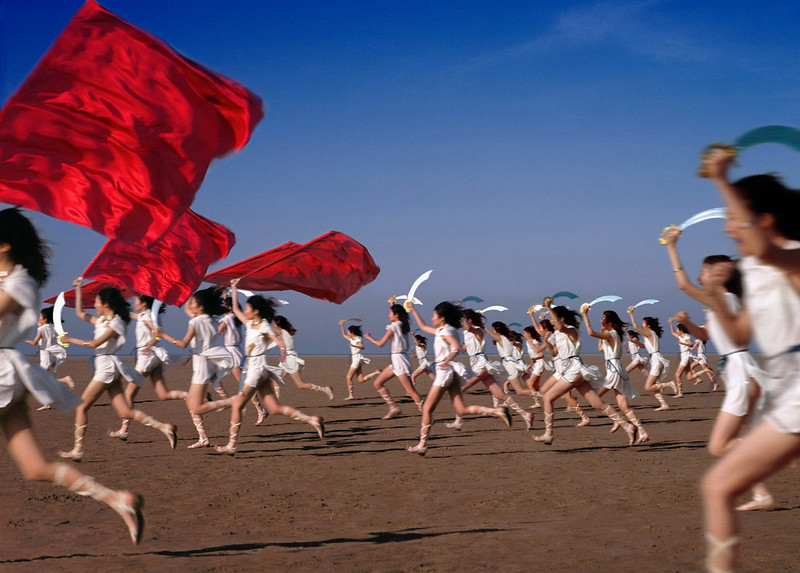
The whole premise is that the women are all the same... that was the idea. Does it become less of a photograph because of that? How does this differ from an HDR image, which is several exposures layered over one another? They both take more than one exposure, and create a single finished product. No one thinks of HDR images as not being a photograph.
I just think this whole thing is a little bit elitist... the whole decisive moment/cartier-bresson mindset. I don't see that there's any validity in the argument, because it's hypocritical.
When what you've added changes the initial meaning of the underlying lens based image. That's the tipping point for me.
What you just linked to is clearly truying to replicate a traditional painting process (albeit badly) so by definition, is no longer a photograph, because it is TRYING to be something else.
How about this.. I've already posted this on here, and no one suggested it wasn't a photograph.
The whole premise is that the women are all the same... that was the idea. Does it become less of a photograph because of that? How does this differ from an HDR image, which is several exposures layered over one another? They both take more than one exposure, and create a single finished product. No one thinks of HDR images as not being a photograph.
I just think this whole thing is a little bit elitist... the whole decisive moment/cartier-bresson mindset. I don't see that there's any validity in the argument, because it's hypocritical.
gramps
Suspended / Banned
- Messages
- 44,805
- Name
- 'Gramps'
- Edit My Images
- No
But an HDR (or more accurately, a tone mapped image) is not seen. It bears little resemblance to reality. So you are adding to what is seen, surely?
It certainly does bear resemblance to the scene, albeit 'adjusting' it, but the scene is not essentially changed - nothing is essentially added or removed ... so it is recognisable as the scene.
If a different background is added, for example, then it is no longer recognisable as the scene so that is where I personally would draw the line ... all open to interpretation of course.
treeman
Suspended / Banned
- Messages
- 4,094
- Name
- Mark
- Edit My Images
- No
But an HDR (or more accurately, a tone mapped image) is not seen. It bears little resemblance to reality. So you are adding to what is seen, surely?
Fair enough. I like to be known as a photographer to, but I still sometimes composite images. I fail to see why I should stifle my creativity because what I see in my mind requires more than one exposure. The resulting artwork was created by focusing light with a lens... it's a photograph.
Well.. I'm glad you're not so sure, because it's not as straight forward you would suggest it is.
HDR images are composites. They are a construct of more than one exposure. They not photographs? Triptychs and diptychs are more than one exposure put in the same frame. What about in-camera multiple exposures? They not photographs either? Multiple flash bursts during a long exposure? They not photos either?
You do realise what thin ice your argument currently rests upon I hope.
It's not an argument at all, I'm just stating my opinion on what is and isn't a photograph
Presumably by your opinion pinhole photography does not produce a photograph?
Pookeyhead
Suspended / Banned
- Messages
- 11,746
- Name
- David
- Edit My Images
- No
I think people just hang on to this premise of "purity" because it makes them feel better. I don;t think it's from any true conviction. I see no distinction between composite images, HDR layered tone maps, multiple exposures in camera, multiple strobes... they're all technically more than one exposure, just different techniques to produce different results.
Like I said. I'll be damned if any half assed prescriptive rule is going to stop me from creating what I see in my mind. If anyone thinks it's not a photograph, then so be it.
Of course it does. I said earlier on.. if its' made by a lens focusing light, or by an aperture, then it's a photograph.
Like I said. I'll be damned if any half assed prescriptive rule is going to stop me from creating what I see in my mind. If anyone thinks it's not a photograph, then so be it.
It's not an argument at all, I'm just stating my opinion on what is and isn't a photograph
Presumably by your opinion pinhole photography does not produce a photograph?
Of course it does. I said earlier on.. if its' made by a lens focusing light, or by an aperture, then it's a photograph.
Last edited:
joescrivens
Suspended / Banned
- Messages
- 15,052
- Name
- Joe
- Edit My Images
- Yes
I also said right at the top of the thread.
What you just linked to is clearly truying to replicate a traditional painting process (albeit badly) so by definition, is no longer a photograph, because it is TRYING to be something else.
you also said
Sometimes what you see can't be done in one take... it's still just as much a photograph as the one you did in one take, because you've created an image using a lens.
For me, the lens is key. If the image was formed with a lens, then it's a photograph.
and further clarified this with
if its' made by a lens focusing light, or by an aperture, then it's a photograph.
In the image I linked to, maybe the person who owns that image saw it that way in their mind, they certainly then formed it with a lens so by your definition it is a photograph
The whole premise is that the women are all the same... that was the idea. Does it become less of a photograph because of that?
Yes, in my opinion it does. It's not a photograph, it's an image
Last edited:
Pookeyhead
Suspended / Banned
- Messages
- 11,746
- Name
- David
- Edit My Images
- No
(shrug).
LOL
Not sure what else to say. Then I'm not a photographer in your mind. It changes nothing in mine
LOL
Not sure what else to say. Then I'm not a photographer in your mind. It changes nothing in mine
treeman
Suspended / Banned
- Messages
- 4,094
- Name
- Mark
- Edit My Images
- No
Like I said. I'll be damned if any half assed prescriptive rule is going to stop me from creating what I see in my mind. If anyone thinks it's not a photograph, then so be it.
.
David, I think you're taking my opinions a little too seriously
Pookeyhead
Suspended / Banned
- Messages
- 11,746
- Name
- David
- Edit My Images
- No
David, I think you're taking my opinions a little too seriously
LOL... you'd be surprised how much I am not
treeman
Suspended / Banned
- Messages
- 4,094
- Name
- Mark
- Edit My Images
- No
LOL... you'd be surprised how much I am not
Good
no one normally ever takes any notice of me.BTW the Sir Ken Robinson link you posted in the other thread is excellent, going to look him up, thanks.
joescrivens
Suspended / Banned
- Messages
- 15,052
- Name
- Joe
- Edit My Images
- Yes
(shrug).
LOL
Not sure what else to say. Then I'm not a photographer in your mind. It changes nothing in mine
I didn't say you weren't a photographer.
A photographer can produce images and photographs. Are you saying that everything you produce is taken from multiple images or exposures? I'm sure you have produced content that is not a composite etc.
In fact I know you have because I have seen it
Pookeyhead
Suspended / Banned
- Messages
- 11,746
- Name
- David
- Edit My Images
- No
Well... no one takes any notice of me either, so that's fine
Of course. I do what needs to be done. Sometimes, one exposure just don't cut it is all.
I didn't say you weren't a photographer.
A photographer can produce images and photographs. Are you saying that everything you produce is taken from multiple images or exposures? I'm sure you have produced content that is not a composite etc.
In fact I know you have because I have seen it
Of course. I do what needs to be done. Sometimes, one exposure just don't cut it is all.

AJQS
Suspended / Banned
- Messages
- 7,314
- Name
- Alan
- Edit My Images
- No
A photograph is an image made with light, so it's always an image. Although I'd say it stops being a perfectly true photograph as soon as you hit clone though.
If you wanted to get really stupidly pedantic you could argue that it stops being a photograph the moment the pixel values are read off a digital sensor, or in film terms the second development begins as there's now extra process going on...but that's just ridiculous really.
If you wanted to get really stupidly pedantic you could argue that it stops being a photograph the moment the pixel values are read off a digital sensor, or in film terms the second development begins as there's now extra process going on...but that's just ridiculous really.
Pookeyhead
Suspended / Banned
- Messages
- 11,746
- Name
- David
- Edit My Images
- No
A photograph is an image made with light, so it's always an image. Although I'd say it stops being a perfectly true photograph as soon as you hit clone though.
Bit harsh!.. LOL So if I clone out zit from someone's face, it's not a photograph any more? You do realise that retouching is not a new thing?
http://www.museumofhoaxes.com/hoax/photo_database/image/lincolns_portrait
Musicman
Suspended / Banned
- Messages
- 9,866
- Name
- Rob Telford
- Edit My Images
- No
gramps said:wikipedia (for what it's worth).
Interesting definition which implies creativity but I wonder what he envisaged when he coined the definition? Surely not the sort of manipulated image we sometimes see today?
Herschel was a friend of Fox Talbot, who, IIRC was driven to invent his (as dubbed by Herschel) 'photographic' process as a result of his frustration at his inability to draw.
Though that does does raise the question whether the ability to draw is, of itself, a creative process. I can think of some spectacular draughtsmanship I have seen which is utterly mechanical. I fear these debates have been raging since the nineteenth century
philwillmedia
Suspended / Banned
- Messages
- 463
- Name
- Phil
- Edit My Images
- No
Can...
Worms...
Open...
Worms...
Open...
I agree with treeman.
If you substitute something that wasn't in the scene into it then it is no longer a photograph. That's not the same thing as it being in one exposure. If the scene in front of you is unchanged with regard to features i.e. you arent compositing a tree in there that wasn't in the scene, then you are creating digital imagery.
Taking a photograph of a person in the studio and then putting them into a different background is creating an image not a photograph
Harking back to the early days of photography, you can have a photographic document representing a moment in time and art photography.
What do you think of photographs which are taken in camera but represent the subject in a way the human visual system can never see them?
