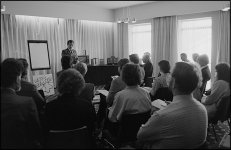
I ran them for a few years at a local night school 'till COVID killed it and the feedback was well received.
Some things I learned. I have no idea what your teaching experience is, so forgive me if this is a bit egg-sucky.
For many people this will be their first formal education since school. They may be nervous and anxious about meeting new people and being in an unfamiliar environment. Don't be nervous. Put them at ease. Learn their names and use them. That way they learn everyone else's name and they become a group rather than a bunch of individuals.
Everyone is there for a different reason. You'll get gifted and talented beginners who just want to know how to take nice pictures off auto because someone told them that's what they needed to learn, old blow hards who are going 'cause it's free and they can teach the teacher a thing or two as well as everyone else in the class. Some people want critique, some people don't want critique. Some people who've been gifted a nice camera by their spouse and have no clue how to use it but feel like they should even though they are happiest with their phone... The list goes on. On the 1st lesson, have them tell you why they are there and what they want from the course. Make notes and adapt your lesson plans accordingly.
Don't get too technical with beginners. Not all of them will be there for that. Aperture, shutter speed, ISO, focal length and maybe white balance and that's about it. On the beginners course, about half the class would glaze over when I started talking about stops so I left that for intermediate. If you've been working with the exposure triangle for years it's easy to forget how confusing it can be to someone who doesn't know. I once had to try and explain how 1/4 second was half of 1/2 second because someone just didn't understand it.
Stress in the course blurb that students need their camera manual with them. You will be surprised at the age and variety of cameras they bring and when they don't know how to change the shutter speed, or set auto ISO, or some other setting, they'll be looking to you. If it's Canikon you'll probably be good, but someone will eventually give you a camera that will make you pause. On Advanced it'll be worse. Trying to turn off exposure preview on an unfamiliar camera, during sessions with flash is frustrating and just gobbles time.
Have a goal. I set my students a project based on themes and by the end of the course, they had to produce an A1 mountboard with their images stuck on it (example:
https://www.flickr.com/gp/harlequin565/10724j3664) It keeps students focussed, and forces them to practise. On the last lesson, it shows them how good they are because these boards always looked great. Fired them up for the next course too.
Have a good mix of theory vs practical. I broke my lessons down into theory for the 1st hour, then a 30min practical with a 30min review of their memory cards using their own images to reinforce what had been taught in the beginning.
I got really good feedback for hitting a balance of technical vs creative and it was something I strived for. The techy people liked the creative stuff and the creative people struggled with the techy stuff.
My lesson plans:
Beginners
1 - Intro: Different types of cameras, different parts of a camera, what makes a good photo. Task: Introduce themselves, "Notice things" challenge. Homework: Upload icebreaker to Flickr
2 - Project & Research: talk about themes, image review of pro photographer work around those themes to give ideas. Task: Class review of icebreakers
3 - Shutter Speed & ISO. Task: ICM 1 second exposures. Homework: Bring a portable subject next week.
4 - Aperture, Focus & DoF. Task: photos of portable subject with different apertures. Group review of "where you are" with your project.
5 - Exposure & metering. Explain how cameras meter, exposure compensation, lightmeter app. Task: Bag of themes game (pick a theme, shoot it, class has to guess the theme)
6 - Lenses, focal length & composition: crop factors, compositional tools (not rules), Task: Use a compositional tool, class has to guess what it is.
7 - Gear & Critique: Tripods, filters, software, apps. Crit vs feedback. Task: Class gives feedback on images - what they like, what they don't like.
8 - Review: Discussion of the different genres (portrait, landscape, street, documentary etc). Task: Project board reviews
OK, I've really gone on a bit with this... The Intermediate & Advanced courses were really just building on the blocks from the beginners course. I had one session on studio lights, one session on night photography and a lot more focus on research and creative thinking. A bit more detail too like raw vs jpeg, software workflow, the benefit of contact sheets etc.
Hopefully you can take what you like from this lot. Good luck. It's hugely rewarding - especially when you get those beginners who are clearly far better than you and begin to create some fantastic work.
Shutting up now...