What to buy?

You could save money buy buying good one in the first place.
Just to put the other side of the discussion: how bad is "bad"?

Many applications of photography, possibly most, don't require pin sharp A0 prints. Moreover, technology is always evolving and today's "cheap zoom" was yesterday's "wonder lens". The popularity of the cameraphone and its use for many purposes, which would previously have required an expensive specialised camera, is one example of the changes to expectations and desires in photography.
 
Just to put the other side of the discussion: how bad is "bad"?

Many applications of photography, possibly most, don't require pin sharp A0 prints. Moreover, technology is always evolving and today's "cheap zoom" was yesterday's "wonder lens". The popularity of the cameraphone and its use for many purposes, which would previously have required an expensive specialised camera, is one example of the changes to expectations and desires in photography.
That'll be down to the individual, some might be happy with the image the OP posted, others won't. I'm in the latter category (y)
 
Last edited:
If cost is a factor, why not get an EOS 90D and maybe a used 5D4. At least with the EOS DSLRs you are familiar with their modus operandi.

My OH has seller's regret; when she bought her R6 she also sold here 100-400 Mk2, then bought an RF100-500, She misses the 100-400
 
If cost is a factor, why not get an EOS 90D and maybe a used 5D4. At least with the EOS DSLRs you are familiar with their modus operandi.

My OH has seller's regret; when she bought her R6 she also sold here 100-400 Mk2, then bought an RF100-500, She misses the 100-400
What's wrong with the 100-500mm?
 
Not as 'robust' as 100-400Mk2, wasn't getting the quality at the long end and felt wieldy, plus the 2/3 stop deficit at the top. It was the same with the Sigma 150-600 C she bought about 5 years ago. The 100-500 went in favour of the EF 300/2.8 Mk2. She still wants the flexibility of a zoom but without having to go back to EF, but nothing has quite got to the level of the older 100-400, yet.
 
Just to put the other side of the discussion: how bad is "bad"?

Many applications of photography, possibly most, don't require pin sharp A0 prints. Moreover, technology is always evolving and today's "cheap zoom" was yesterday's "wonder lens". The popularity of the cameraphone and its use for many purposes, which would previously have required an expensive specialised camera, is one example of the changes to expectations and desires in photography.
As you say it's all down to a persons requirements, and standards. There are plenty of perfectly good cheap lens, but all the superzooms I've tested are all lacking at the long end, some are so bad your better off shooting with say a 50mm and cropping. Others are passable for blogs or display small like facebook and so on.
 
The reason I said it didn't look like a particularly slow shutter speed had been used is there's not a deal of 'movement' in the background, can you remember what you used?

F8, 1/400, pattern metering, at 260mm with IS.
 
F8, 1/400, pattern metering, at 260mm with IS.
@harper yeah so not particularly slow, that being said even though it's not slow it's still 'slow enough' to introduce some softness if panning isn't your strong point (y)
 
I don't see how I can improve my panning as the subject is more or less in frame and centralised?

Anyway I've pretty much decided on a Sony A7 iv with possibly a FE 24-70mm f2.8GM. I have considered the FE 28-135 G OSS, FE70-350mm f4.5-6.3 and
FE24-105 mm f4 G OSS.

I'm a bit disappointed with the zoom range and available lenses. I can the f2.8 G Master being beneficial over the f4 G lens.

Is the Sony FE 200-600 mm f5.6-6.3 G OSS as good as/ better or worse than the Canon RF100- 500?

I have some old Minolta lenses, 50mm f1.7, 28mm f2.8, 100-300 f4.5-f5.6 APO Tele zoom, Sigma Macro lens, plus a Dynax 500si super, Dynax 4(+28-50mm kit lens) ,cable shutter release and Cobra 700AF flash plus hand grip.

Not sure if it would be worth getting an adapter to use those lenses?

As for sticking with Canon I have yet worked it out as it seems to be a two horse race. Maybe wait for a R7 mark 2 and pair it with the RF100-500?

Most of the images I have taken range from 130mm -600mm , mostly around 250-300mm range.
 
@harper yeah so not particularly slow, that being said even though it's not slow it's still 'slow enough' to introduce some softness if panning isn't your strong point (y)
I can increase the speed and widen the aperture.
 
I don't see how I can improve my panning as the subject is more or less in frame and centralised?

Anyway I've pretty much decided on a Sony A7 iv with possibly a FE 24-70mm f2.8GM. I have considered the FE 28-135 G OSS, FE70-350mm f4.5-6.3 and
FE24-105 mm f4 G OSS.

I'm a bit disappointed with the zoom range and available lenses. I can the f2.8 G Master being beneficial over the f4 G lens.

Is the Sony FE 200-600 mm f5.6-6.3 G OSS as good as/ better or worse than the Canon RF100- 500?

I have some old Minolta lenses, 50mm f1.7, 28mm f2.8, 100-300 f4.5-f5.6 APO Tele zoom, Sigma Macro lens, plus a Dynax 500si super, Dynax 4(+28-50mm kit lens) ,cable shutter release and Cobra 700AF flash plus hand grip.

Not sure if it would be worth getting an adapter to use those lenses?

As for sticking with Canon I have yet worked it out as it seems to be a two horse race. Maybe wait for a R7 mark 2 and pair it with the RF100-500?

Most of the images I have taken range from 130mm -600mm , mostly around 250-300mm range.
Panning is not just about getting the subject in the centre of the frame, you can have something in the frame and still be blurred. The aim of panning is to move the camera in one plane (i.e. side to side and not up and down) at exactly the same speed as the subject. The slower the shutter speed the more critical it is that the camera is moving in one plane and at the exact speed of the subject.

I don't know how you can be disappointed in the available lenses for Sony, they have by far the most selection of native lenses of any full frame mirrorless system, they have everything covered from 9mm to 800mm :thinking:
 
Anyway I've pretty much decided on a Sony A7 iv with possibly a FE 24-70mm f2.8GM. I have considered the FE 28-135 G OSS, FE70-350mm f4.5-6.3 and
FE24-105 mm f4 G OSS.

I'm a bit disappointed with the zoom range and available lenses. I can the f2.8 G Master being beneficial over the f4 G lens.

Is the Sony FE 200-600 mm f5.6-6.3 G OSS as good as/ better or worse than the Canon RF100- 500?

I have some old Minolta lenses, 50mm f1.7, 28mm f2.8, 100-300 f4.5-f5.6 APO Tele zoom, Sigma Macro lens, plus a Dynax 500si super, Dynax 4(+28-50mm kit lens) ,cable shutter release and Cobra 700AF flash plus hand grip.

Not sure if it would be worth getting an adapter to use those lenses?

OK, I've mentioned I've an A7III - my walk-about lens is the 24-105 G f4. Compared to DSLR zooms of this range lenses I've generally founf image quality excellent, with decent resolution, evenness, and fast focus. Weaknesses are vignetting at 24mm and the slightly short range at the long end, plus what can sometimes be a slightly hard look which seems typical of many Sony lenses. If you need a bigger superzoom range then the Tamron 28-200 has a good reputation and isn't expensive, especially grey.

I also use my older Minolta and other A mount lenses on an LA-EA4 adapter - focusing is the equivalent of your A77 because it's basically the semi-mirror and AF system of an SLT camera. There is an LA-EA5 adapter now that uses the in camera AF, and that will give a better focus experience. I find some older lenses still good, like the Beercan, Sigma 12-24 and a Tamron SP2 90mm macro lens. Your 50, 28 and 100-300 should all be OK, and will perform better than they did on crop because of the larger sensor. Native lenses will be better generally, but are fairly expensive.

Avoid the very cheap native Sony FE mount lenses like the 50 f1.8 - the AF is very unreliable, even though the optics are OK. If you need a cheapish standard lens the look for a used Zeiss 55 f1.5, which is a good lens with very neutral performance, and a real workhorse where you need a lens that will get it right pretty much every time, even though it's not exciting.
 
@snerkler
I can't see an equivalent or something close to my Tamron or something I replace it with.
As for panning, I tend to keep the subject central whilst panning. Personally I don't think that's the issue, the last
clay pigeon competition I did I ended up in a third place "shoot off". I was competing against professionals and hit
my "shoot off" clay but the other chap did a slightly better job with his, I gave it too much "lead".
I will work on my panning next month.
 
Last edited:
@snerkler
I can't see an equivalent or something close to my Tamron or something I replace it with.
Your Tamron 18-270mm is effectively a 28- 450mm lens, I’m not aware of any mirrorless lens with that range, the closest you’ll get on Sony is probably the Tamron 28-300mm.

The problem with these all in one zooms is there’s often a big sacrifice in image quality that’s why people prefer to have at least two lenses such as the 24-70mm and 70-300mm or similar. That’s probably why all in one zooms are limited these days. Plus, with the higher res cameras you can crop more heavily to give you more effective reach.

If you bought the A7IV which is 33mp, you could use it in crop mode and a 300mm will then give you the effective reach of 450mm. In crop mode the A7IV is still a reasonable 14.7 megapixels.
 
I don't see how I can improve my panning as the subject is more or less in frame and centralised?

Anyway I've pretty much decided on a Sony A7 iv with possibly a FE 24-70mm f2.8GM. I have considered the FE 28-135 G OSS, FE70-350mm f4.5-6.3 and
FE24-105 mm f4 G OSS.

I'm a bit disappointed with the zoom range and available lenses. I can the f2.8 G Master being beneficial over the f4 G lens.

Is the Sony FE 200-600 mm f5.6-6.3 G OSS as good as/ better or worse than the Canon RF100- 500?

I have some old Minolta lenses, 50mm f1.7, 28mm f2.8, 100-300 f4.5-f5.6 APO Tele zoom, Sigma Macro lens, plus a Dynax 500si super, Dynax 4(+28-50mm kit lens) ,cable shutter release and Cobra 700AF flash plus hand grip.

Not sure if it would be worth getting an adapter to use those lenses?

As for sticking with Canon I have yet worked it out as it seems to be a two horse race. Maybe wait for a R7 mark 2 and pair it with the RF100-500?

Most of the images I have taken range from 130mm -600mm , mostly around 250-300mm range.
I have the Sony A7iv and the LA-EA5 adaptor for my various A-Mount lenses.
I have 1 native lens, the Sony 200-600 G - it's a lovely lens, AF in combination with the A7iv is good - but it's quite heavy, and I usually use a monopod with it to take the weight.
My experience is that all the newer A-Mount lenses with built in AF motors (Sony CZ16-35 f/2.8, Sigma 24-70 f/2.8 IF HSM, Tamron 70-200 f/2.8 USD, Sony 70-300G SSM) work superbly on the A7iv.
The two lenses I have that rely on the camera body motor (or adaptor motor) to power AF via the screw-drive system are noticeably slower than on my A900, and even occasionally hunt as they 'overshoot' (Sony 50f/1.4, Minolta 85 f/1.4 G RS) - still usable for portrait, but not as responsive (The A900 did have a very powerful in body AF motor, so you may not notice as large a difference coming from the A77)
I think the Minolta 50 f/1.7 and 28 f/2.8 should be OK (as you can work without super fast AF), the Sigma Macro you would probably want to use manual focus anyway, so that should be fine. I'd suspect the 100-300 might be a bit frustrating to use, particularly with fast moving subjects (my first telephoto was the cheaper 75-300, and the difference in AF when I switched to the 70-300G was incredible).
 
It's looking like two lenses or a third but carrying two camera bodies four lenses is going to be a mammoth task in itself before I take any snaps.
I don't think my present camera bag is going to be up to the job, do Billingham a bag big enough?
 
Panning is not just about getting the subject in the centre of the frame, you can have something in the frame and still be blurred. The aim of panning is to move the camera in one plane (i.e. side to side and not up and down) at exactly the same speed as the subject. The slower the shutter speed the more critical it is that the camera is moving in one plane and at the exact speed of the subject.

This ^ and with large objects you have to take into account (depending on your position relative to the target), that parts of the target object may be moving at different relative speeds to yourself ie it’s perfectly possible to have the centre of a plane in focus and sharp but the front and the rear are blurred - you have to decide which part of the target needs to be in focus and nice and sharp.

As @snerkler says the slower the shutter speed (though this again is relative to the target), the harder it is to- more megapixels can also work against you
 
It's looking like two lenses or a third but carrying two camera bodies four lenses is going to be a mammoth task in itself before I take any snaps.
I don't think my present camera bag is going to be up to the job, do Billingham a bag big enough?
Why do you need to take 2 cameras and 4 lenses? I usually know what I’m going out to shoot and will often just take the one body and the most suitable lens. If I’m doing motorsport I’ll take the one body and two lenses. I don’t take all my gear out all of the time.
 
This ^ and with large objects you have to take into account (depending on your position relative to the target), that parts of the target object may be moving at different relative speeds to yourself ie it’s perfectly possible to have the centre of a plane in focus and sharp but the front and the rear are blurred - you have to decide which part of the target needs to be in focus and nice and sharp.

An example would be this, the effect exaggerated by using a wide angle lens:

Copenhagen cyclist-7774 by Toni Ertl, on Flickr
 
Nikon have a 28-400mm on Z-mount which is the widest range full frame mirrorless lens I'm aware of.
 
This ^ and with large objects you have to take into account (depending on your position relative to the target), that parts of the target object may be moving at different relative speeds to yourself ie it’s perfectly possible to have the centre of a plane in focus and sharp but the front and the rear are blurred - you have to decide which part of the target needs to be in focus and nice and sharp.
This is the big difference between panning a racing car on a straight and a rally car cornering.
Each corner of the rally car is moving at a slightly different speed and in a different direction.
I don't see how I can improve my panning as the subject is more or less in frame and centralised?
Practice, practice, practice.

I get that you believe that you’ve got transferable skills from shooting.

Sorry but you’ve posted an image that clearly shows a failure of technique and no amount of new gear will improve that.
 
This is the big difference between panning a racing car on a straight and a rally car cornering.
Each corner of the rally car is moving at a slightly different speed and in a different direction.

Yes, but in most situations you are not quite square on to the target, so it applies in many situations (especially if you're pixel peeping!!)
 
Your Tamron 18-270mm is effectively a 28- 450mm lens, I’m not aware of any mirrorless lens with that range, the closest you’ll get on Sony is probably the Tamron 28-300mm.
The Nikon 28-400 is close, and does well in the reviews. Judging from a few wildlife photographers who use 400mm f2.8 and 600mm f4 lenses, who also have this lens, or have had one to test, it seems to perform better than you would expect. from a super zoom.
The problem with these all in one zooms is there’s often a big sacrifice in image quality that’s why people prefer to have at least two lenses such as the 24-70mm and 70-300mm or similar. That’s probably why all in one zooms are limited these days. Plus, with the higher res cameras you can crop more heavily to give you more effective reach.

If you bought the A7IV which is 33mp, you could use it in crop mode and a 300mm will then give you the effective reach of 450mm. In crop mode the A7IV is still a reasonable 14.7 megapixels.
 
I presently use a Canon EOS 700 D which is permanently on a Canon 100-400 mm ES L lens and a Sony a77 11 with a Tamron 18-270 mm.
I take photographs of most things but mainly airshow photography, vehicles such as cars, trains, tractors, bikes with some portrait, landscapes and wildlife as well.

I would like to upgrade what I have, I find having two cameras are useful at airshows, I couldn't cope with a third. I have looked at the Canon 5D (latest model, iv) and the Sony a9 (latest model, 111(?))
There doesn't seem to be too many full frame new lens options for the 5D as there's a definite switch to mirrorless. I also own a Fuji S602Z bridge camera, I think the autofocus on it is quick enough for fast moving jets but the viewfinder/ screen is far too sluggish, same issue with the a7. I have always like the idea of going Nikon.
Nikon (if you go mirrorless) has the advantage of a good quality (full frame) 28 - 400mm super zoom. Maximum aperture is only f8 from about 200mm, which isn't the disadvantage it might seem, as most super zooms max out at around f6.3 anyway.

The big problem with Nikon for fast actions is that you really need a Z mount body with the Expeed 7 processor: ie a Z9, Z8, Z6III or Z5II (maybe a Zf but handling less than ideal for action) or dropping down to a cropped sensor, a Nikon Z50II. And, among them, only the Z9, Z8 and Z6III are competing with the "best" of the Canon/Sony equivalents.

Going with a Nikon DSLR, you again are a bit limited to specific bodies. D4/D5/D6 and D850, or by going cropped a D500 or maybe a D7500. For their DSLRs, Nikon offer a 28-300mm, which is meant to be optically perfectly useable, and I am aware of professional sports. wildlife and even landscape photographers who use his lens when an "all in one" is needed.

But, having said all that, and in spite of what you have said, I think you might be underestimating how difficult panning is, even if the clay pigeon shooting will be giving you an advantage.

Getting a "precise" match between pan and the subject moving including the follow through after the exposure so that the speed of your pan and the subject stay in synch during the exposure is difficult. As an experiment I would try using a range of much faster shutter speeds and see how that affects sharpness.
 
The Nikon 28-400 is close, and does well in the reviews. Judging from a few wildlife photographers who use 400mm f2.8 and 600mm f4 lenses, who also have this lens, or have had one to test, it seems to perform better than you would expect. from a super zoom.
Sounds like a good option for the OP (y)
 
Sounds like a good option for the OP (y)
To summarise the reviews, it seems it's not a "good" choice for anything, but a "good enough" choice for everything. I think it might be my next buy. I mainly use primes, but this seems small enough, light enough and good enough, to carry with me as a "just in case lens". Especially for grabbing shots of Dragonflies to help with later identification. Or even on rare occasions my only lens. I used to use a 12-200 on an OM1.3 for this, and I miss the capability, but never really gelled with m43.
 
To summarise the reviews, it seems it's not a "good" choice for anything, but a "good enough" choice for everything. I think it might be my next buy. I mainly use primes, but this seems small enough, light enough and good enough, to carry with me as a "just in case lens". Especially for grabbing shots of Dragonflies to help with later identification. Or even on rare occasions my only lens. I used to use a 12-200 on an OM1.3 for this, and I miss the capability, but never really gelled with m43.
Yeah I've had a look on numerous pages of Flickr at examples with the 28-400mm, it looks OK for general record shots (y)
 
Why do you need to take 2 cameras and 4 lenses? I usually know what I’m going out to shoot and will often just take the one body and the most suitable lens. If I’m doing motorsport I’ll take the one body and two lenses. I don’t take all my gear out all of the time.
At the lower end of the zoom you can't fit an aircraft such as a C17 Galaxy in the frame. I use two cameras rather than change lens and one, usually the Sony gets used for static shots. Sometimes I need the wide angle of the zoom and at other time I need more magnification. I tend to put the Canon away at the end of the flying display and walk round with the Sony. Perhaps the 24-105mm will cover my needs?
 
I do realise panning isn't easy but I'm not sure if I can improve my technique, I was hoping technology will overcome my shortfalls rather than magnify them.
I only mention clay pigeon shooting as it's a similar transferable skill to panning with a camera.

There's an issue with propeller aircraft using a shutter speed of above 1/320 second, it will freeze it. You need some blur to give a sense of movement, however multi blade props such as on an A400M you can go higher.

Would changing the autofocus zone avoid front and rear blur?
 
I think panning is very much a skill, rather than something technology can sort out for you.

As others have said, lots of practice and experimentation is the way to improve. More so than any other photographic technique I can think of, the 'keeper' rate is very low, especially early on.
 
I do realise panning isn't easy but I'm not sure if I can improve my technique, I was hoping technology will overcome my shortfalls rather than magnify them.
I only mention clay pigeon shooting as it's a similar transferable skill to panning with a camera.

There's an issue with propeller aircraft using a shutter speed of above 1/320 second, it will freeze it. You need some blur to give a sense of movement, however multi blade props such as on an A400M you can go higher.

Would changing the autofocus zone avoid front and rear blur?
As above camera gear can't help with panning, it's all down to technique. You're right that you need 1/320 or slower to show prop motion so if you want to do this then you just need to knuckle down and practice.

With regards to certain parts being blurred and certain not you can't really avoid it if the subject is at any sort of ankgle as it's just physics, however it's not something I tend to worry about unless I'm using extreme shutter speeds.

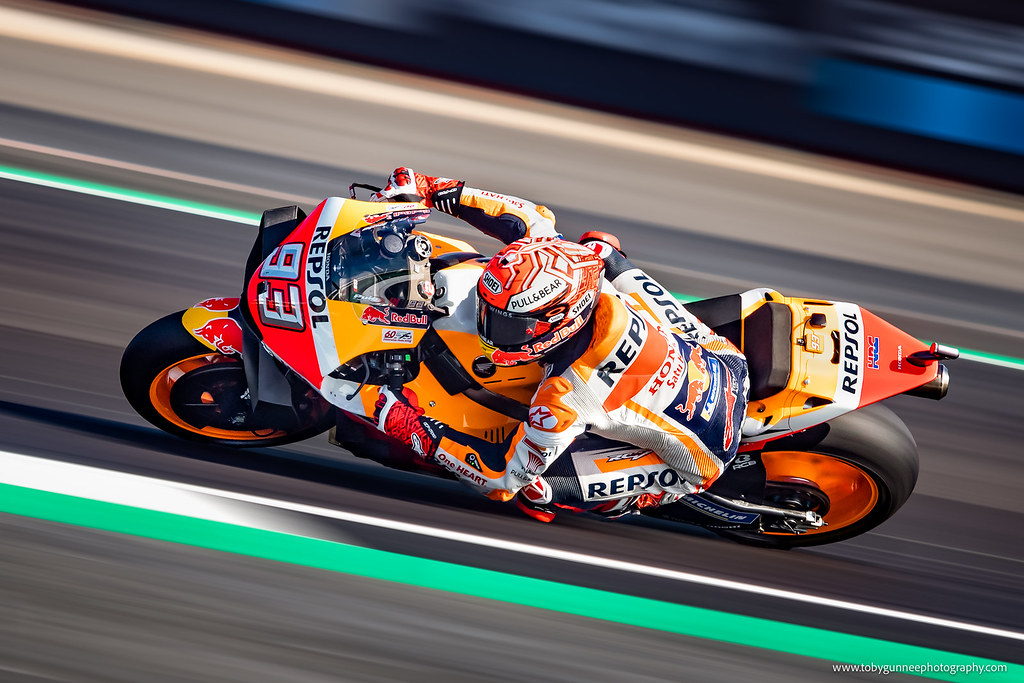
For example, I shot this at 1/30 and as the subject is pretty much perpendicular the front of the bike is as sharp as the rear. Other considerations at this shutter speed are things like vibrations of the machine itself, and undulations in the track surface.


A1_04022-Edit by Toby Gunnee, on Flickr

Compare that with this that I shot at 1/50, even though the bike is only at a very slight angle you can see that the rear of the bike is very slightly blurry compared with the front. It looks fine though so it's not a concern. If it had been the other way around so the front was blurrier than the rear it would probably have looked wrong. If I'd have shot this at 1/30 like the first example the blurriness at the rear would have been more apparent, likewise if the bike was more at an angle.


A1_03946-Edit by Toby Gunnee, on Flickr


Toni demonstrated a more extreme example above with the cyclist photo, however this again looks OK, well far more than OK, as the rider is in focus. If he'd shot this so the front wheel was in focus but the rider wasn't it again would probably have looked wrong.
 
Last edited:
I do realise panning isn't easy but I'm not sure if I can improve my technique, I was hoping technology will overcome my shortfalls rather than magnify them.
I only mention clay pigeon shooting as it's a similar transferable skill to panning with a camera.

There's an issue with propeller aircraft using a shutter speed of above 1/320 second, it will freeze it. You need some blur to give a sense of movement, however multi blade props such as on an A400M you can go higher.

Would changing the autofocus zone avoid front and rear blur?
I'm not sure if this in response to my post, but my suggestion was to try higher shutter speeds as a learning tool to check out how good your panning is.

The better your panning, the less benefit (in terms of sharpness) you will get from using faster shutter speeds.

In the days before autofocus, and when I was photographing aircraft and racing cars/rally cars. I learned with faster shutter speeds and then, after lots of practice, reduced the shutter speed to get better prop movement and blurred/streaked backgrounds. I only do wildlife now..

I can't answer the autofocus question, I tend to mix and match AF options depending on circumstances (I'm still learning). Subject detecton is useful, but I find even with my Z8, I use a single AF point a lot.

For something with a predictable path, I would be trying an off centre single AF point and try to keep it on the driver with cars, and the cockpit with planes. But I would take that advice with caution.
 
@myotis
Not really, I did mention increasing the shutter speed myself but thanks.
Searching the internet I have come across a few folk that turn the image stabiliser off, apparently it is to slow?
Hey-ho my panning is crap so I will take up knitting instead.:)
 
Last edited:
@myotis
Not really, I did mention increasing the shutter speed myself but thanks.
Searching the internet I have come across a few folk her turn the image stabiliser off, apparently it to slow?
Hey-ho my panning is crap so I will take up knitting instead.:)
Panning is a technique that requires practice but the principles are straightforward.......keep at the technique and your results with get better :)

If you could practice on a predictable subject e.g. a friend riding a bike ?
 
@myotis
Not really, I did mention increasing the shutter speed myself but thanks.
Searching the internet I have come across a few folk her turn the image stabiliser off, apparently it to slow?
Hey-ho my panning is crap so I will take up knitting instead.:)
I tend to leave stabilisation on, some GM lenses (and maybe others) actually have a panning OS mode.
 
@myotis
Not really, I did mention increasing the shutter speed myself but thanks.
Searching the internet I have come across a few folk her turn the image stabiliser off, apparently it to slow?
Hey-ho my panning is crap so I will take up knitting instead.:)
Image stabilisation is designed around compensating for small low frequency hand movements at slower shutter speeds, Above around 1/500 it isn't as effective at stopping the effects of camera movement as using a faster shutter speed is. I still find it useful at faster shutter speeds as it's easier to keep the subject in the frame if you don't have to deal with a "jittery" viewfinder.

But my suggestion of "testing" and "practising" with faster shutter speeds to see if that improves your results still holds good.
 
Panning is a technique that requires practice but the principles are straightforward.......keep at the technique and your results with get better :)

If you could practice on a predictable subject e.g. a friend riding a bike ?
When I was a teenager, I used to walk the couple of miles down the lane from our village to the main road to practise panning.

It was in the days of film and often I didn't have film in the camera with trick being to try and have the car in the same position in the viewfinder, after the SLR (initially a Zenit B) mirror clunked back up, as it was in when I pressed the shutter.

I also used to get the bus along to our local RAF base, in the days when planes were always flying (in fact you could phone the base and they would tell you much activity to expect).

Of course it wasn't always with an empty camera, but I couldn't afford to practise with film all the time or waste film when i was photographing cars or planes for real.

This is one of the exciting things with digital, So many aspects of photography are so much easier to learn because you can spend so much more time practising and learning things, with so little cost..
 
Hey-ho my panning is crap so I will take up knitting instead.

Don't take it personally, in any case you probably have better panned pictures than this one. But also take a look at the quality of @snerkler 's panned pictures to see if he knows what he's talking about (I don't recall seeing panning shots from @myotis ). That may help you decide whether it's equipment or technique.
 
Don't take it personally, in any case you probably have better panned pictures than this one. But also take a look at the quality of @snerkler 's panned pictures to see if he knows what he's talking about (I don't recall seeing panning shots from @myotis ). That may help you decide whether it's equipment or technique.
If the OP thinks my panning's OK then I can say 100% that equipment doesn't play much part, I've shot motorsports with Olympus M4/3, Nikon FF DSLR that 'only' shot at 6.5fps and Sony mirrorless and they're all pretty much the same quality. In fact two of my favourite ones were shot with Olympus m4/3.


P6302247-Edit-Edit by Toby Gunnee, on Flickr

P8246787 by Toby Gunnee, on Flickr

However, with comments like "Hey-ho my panning is crap so I will take up knitting instead" it sounds as like the OP is not willing to put the practice in so it won't matter what they shoot with. I don't mean any offence by this, but there's no short cuts you just have to practice (y)
 
Back
Top