What is your favourite creative tool for in camera compositions

Are you sure? If you think about what goes through your head when taking a photograph doesn't it include most of what's on that list.

I can see you not checking depth of field, for example, but I'm on a tripod taking landscapes and I enjoy the "ritual" of taking photographs, probably because of my history with 5x4, even though I'm now on digital. But at least once week I can hear my 5x4 pleading with me from the cupboard to be taken out.

I've never shot 5x4 but I still approach digital photography in the same way I did film.
Not sure if thats the best approach. I suppose I'm gradually changing to reap the benefits of "new" technologies. Some people may take 100 shots while walking the dog, I might take one. :D
 
Isn't that "seeing" happening before any "in-camera-compositions"?
Absolutely. That is why some of the responses to this post do not fit. Another reason is that some responses talk of equipment and that is not what I meant talking about creative tools. For me tripod and its bits can not be creative, although arguably it could be used creatively.
 
Absolutely. That is why some of the responses to this post do not fit. Another reason is that some responses talk of equipment and that is not what I meant talking about creative tools. For me tripod and its bits can not be creative, although arguably it could be used creatively.

Maybe it would help if you made it a bit clearer.
 
Maybe it would help if you made it a bit clearer.
@Bryan, at your suggestion I am clarifying what I meant when I posed this question:
1) In my mind in camera composition starts after a potential photographic opportunities are identified
2) As funny as it may seem, I was not thinking of brain, eyes fingers or any other part of human anatomy as a creative tool and and the creative tool applies to photography only and not to any other fun and potentially creative activity (welcome or otherwise).
3) Although equipment can be used creatively, I was thinking of creative tools similar to those listed at the original post

I hope Bryan that this clarifies what the intent behind the post was
 
Ok. My favourite is using telephoto to isolate a subject, but that involves perspective, background, aperture, focal length and exposure. So although I put telephoto as my favourite, it by default involves all the rest to get the effect I want. The characteristics of telephoto lenses just make is easier.
 
Are you sure?
Oh, quite sure.

To be honest, that's because my original background was commercial and press and I've always found the press style more to my taste: shoot fast, work around the image and decide what to keep when you have the contact sheet.

Digital is Nirvana for me - I just keep recording images and throw away the failures. Interestingly though, I delete fewer and fewer images these days, so either practice is making perfect or my standards are dropping.

I leave that for others to decide :naughty:
 
Oh, quite sure.

Fair enough, the approach I described isn't the one I use for wildlife or indeed going back many decades now, the one I used for press pictures either (we used to cover local news stories for several newspapers).

But the question was about compositional tools, and even when I'm working fast, I'm still thinking about the background, whether the depth of field will work, etc etc, but in a more subconscious way than the considered approach I described.

As a total aside, when I was probably 15 I met my first full time professional press photographer. While he was talking to us, and without looking down, he rewound and unloaded a film from his Nikon and put it in one jacket pocket , took another film from the other jacket pocket and loaded it into the camera.

I didn't see him look at the camera once during this procedure, and on getting home I got out my Zenith and began practicing while watching the television, and I carried on doing this for years as part of my TV watching routine, with my eventual Nikons (Canons, Mamiyas and Hasselblads). I'm not convinced I was ever able to do it "blindfolded" but I got very fast and competent at it.
 
I've never shot 5x4 but I still approach digital photography in the same way I did film.

I have different approaches for different things, which are psychologically linked to the camera I'm using. I treat my D750 like a 5x4 or roll film camera and it's nearly always on a tripod using prime lenses. I work very slowly and may not take any pictures at all.

I have a d500 with long lenses for wildlife and I take advantage of it being digital and rattle through images. But I'm still fairly selective, and where as I read of people taking thousands of pictures in a day of wildlife shooting, my frame count is in the hundreds for a day.

I also have Fuji X100s and recently a Lumix TZ100, and these are cameras for more relaxed photography (though I do occasionally try and fail to make "serious" street photographs with the X100s). With these cameras I've seen me take 100+ images in a day, but its more likely to be around 30 to 50.

But I like the freedom of digital, I like being able to try things out, I like not having to think about the costs of film, and the time I would need to spend in the darkroom processing and printing it. Something always in the back of my mind with film: is this photo going to be worth all the effort and costs involved.

So it's also great to do a Garry Winogrand at times and feel free to take photographs of things just to see what they look like as photographs.
 
I have different approaches for different things, which are psychologically linked to the camera I'm using. I treat my D750 like a 5x4 or roll film camera and it's nearly always on a tripod using prime lenses. I work very slowly and may not take any pictures at all.

I have a d500 with long lenses for wildlife and I take advantage of it being digital and rattle through images. But I'm still fairly selective, and where as I read of people taking thousands of pictures in a day of wildlife shooting, my frame count is in the hundreds for a day.

I also have Fuji X100s and recently a Lumix TZ100, and these are cameras for more relaxed photography (though I do occasionally try and fail to make "serious" street photographs with the X100s). With these cameras I've seen me take 100+ images in a day, but its more likely to be around 30 to 50.

But I like the freedom of digital, I like being able to try things out, I like not having to think about the costs of film, and the time I would need to spend in the darkroom processing and printing it. Something always in the back of my mind with film: is this photo going to be worth all the effort and costs involved.

So it's also great to do a Garry Winogrand at times and feel free to take photographs of things just to see what they look like as photographs.

I'm earlier on the journey. Although I had a TZ90 for years I'm still learning to exploit the digital freedom. My head is still 'film'.
 
While he was talking to us, and without looking down, he rewound and unloaded a film from his Nikon and put it in one jacket pocket , took another film from the other jacket pocket and loaded it into the camera.
I think most press people could do that. Harder was reloading rollfilm that way. It was just about doable with a Rolleiflex Automat but definitely not recommended with a Hasselblad! :naughty:
 
I think most press people could do that. Harder was reloading rollfilm that way. It was just about doable with a Rolleiflex Automat but definitely not recommended with a Hasselblad! :naughty:
Yes, but it was my first encounter of someone being that familiar with their camera, and it changed my relationship with my equipment.

I won't argue about the Hasselblad loading, for as I said I never felt I would be able to load one blindfolded, but it was my go to camera for many years and I must have loaded thousands of films into one, and my practice made a tremendous difference to the speed and confidence of loading the magazine, especially when pushed for time, or in a difficult physical location.
 
The problem I found with Hasselblad magazines was the sheer number and weight that you needed for a location shoot. As an assistant, my "day job" was keeping the operator supplied with magazines.

In my copious free time I kept the models on schedule. moved the props as required, persuaded curious citizens to stay out of our working area and made sure the generator wasn't running out of petrol, so that our flash guns would continue to work.

I have no idea how I stuck it out for a whole six months! :wideyed:
 
The problem I found with Hasselblad magazines was the sheer number and weight that you needed for a location shoot. As an assistant, my "day job" was keeping the operator supplied with magazines.
A different world to mine. Our irritation with Hasselblads was that we never had all our magazines available; some were always away being repaired.
 
Although I like the viewfinder I find I am looking at the large display more and more. It seems to help me check composition as a whole. The viewfinder can trick you into looking at individual elements.
Yes I often miss things when looking through the viewfinder that I notice afterwards but am trying to train myself
 
No doubt you all use a mixture of many tools, but no doubt some are your favourites.
By tools I mean things like aperture, camera height and angle, background selection, focal length, exposure...

I've not replied in here 'till now, as i've been rather busy with work up, but I find myself with a little free time and thought I'd try and answer.

For me, most of my photography is either on film, or "digital shot as film" - i'm an old dog, and of recent shoot far to rarely to be breaking my habits acquired over 30+ years of film work, both personal and professional.

Historically, I used to shoot mainly 5x4" and occasionally 10x8" - usually either B&W for personal work, or E6 for commissioned commercial stuff... As such, shooting multiple exposures wasn't really particularly viable - if the client was amenable, and the image was potentially "troublesome" in terms of contrast, there'd be a spare frame or two of "bracketed" exposures - purely because E6 isn't massively tolerant of incorrect exposures, and even with drum scanning, there'd be times you couldn't "dig out the details". For those of you used to "fixing it in post" with modern RAW exposure lattitude, consider i'm talking taking 3 frames at +/- 1/3 of a stop increments here - damn it was intolerant of incompetence.

I explain all the above for a reason. Put simply, the above way of shooting dictates a few things...

  1. you're going to be on a tripod or studio stand for the camera
  2. you're going to be working on a upside down and back to front image on the ground glass
  3. you're going to be under a blanket if you're out and about - possibly even if you're in a studio.
  4. you're going to be looking at the details on the ground glass with a jewellers loupe.
  5. every time you pressed the shutter you were spending £10-£30 - so very wasted frame ate into the profit margins - 3 duff exposures and you're working for free that day. So, you didn't hit the button until you were completely sure of things. Test, test and test again.
  6. and this one's probably the most important. You had to know that what was on the ground glass was what you wanted to get as a final result - especially with E6 because the transparency was the product. At least with B&W you'd got a bit of a chance of fixing stuff in the darkroom.

So - frankly, for me - none of the "in camera" or "in studio" stuff is actually part of my creative process. The WHOLE creative process is in my head before I even reach for the camera. For a still life, I'll have sketched out a rough composition, i'll have considered the props and the lighting, and most importantly, i'll have decided what I want the image to say when it's exhibited/shown. Now, for commissioned work, it's a matter of translating the clients Art Directors image into a photo - but hopefully they're arty, they'll have the pre-viz sketches and roughs to work with - and of course, if it's an Advert, the "hero prop" is going to already be set, so it's a matter of translating someone elses vision onto E6 for them - to me, that's certainly craft related rather than artistic, though no less valuable for that. But the important take away is that all this happens before even selecting which camera I'll be shooting it on, never mind what film it'll be on - and indeed often "which studio space will I have to try and hire to build the set"...

But - in the process of that translation, obviously i'll consider aperture (though there's an element of f64 and forget it with larger format cameras unlike the sub-miniature 35mm stuff that people call "full-frame" today ;) - Ditto Camera Height and Angle for viewpoint control, Front and rear Movements for perspective control (and DoF manipulation via amending the plane of focus) - Focal Length being less of an issue when you only had maybe 2-3 lenses on hand anyway - Exposure - well, that's a given, but frankly, in a studio, you've all the light you need, and all the tools to put it where you want so, again it's a craft thing. What I'm getting at here is simple. For me, nothing whatsoever to do with the craft of manipulating the camera in terms of location, setting, orientation or configuration is part of my creative process - it's all simply spun off by-products of the actual creative process of "creating the picture in my mind beforehand" - it's that "pre-visualisation" step that's the important thing, and for me, it's the only real part where the creative comes in for me. At the risk of being labelled a pretentious t***t, the mechanical process of achieving that look via whatever photographic kit is just part of my technique not my art...

Maybe that's because thinking creatively doesn't generally come natural to me, and I need to take that pause, and think about things, then re-think, then scrap the whole thing and start again (often 3-4 times over) before I get something that lights a spark for me. I don't know.

I know that any picture have made, that I find "satisfying" from a creative point of view, always began in the above process. I've also taken lots of less structured, less over-thought stuff - things that many people like, and often i'm quite proud of them too, but the satisfaction there comes more from a "well - you got lucky there Mark" or even a "you did well to realise the potential of that one"... maybe I'm not a lost cause completely... or maybe I just find a distinction between pictures i've made and pictures i've taken...

 
Last edited:
I've managed to avoid the whole sheet film thing for most of my involvement in photography. The only time I felt at all comfortable with it was when a reflex viewfinder arrived in the studio and I was given the "side of the desk" job of making sure it fitted our assortment of 5x4 cameras. It meant that I "had" to make various test exposures to ensure that the eyepieces were focussing on the screen correctly and the screen wasn't shifting when the back was fitted.

A dirty job but someone had to do it... :naughty:

Meantime, this brought back memories...

View: https://youtu.be/3T_kYKAcqXc
 
Last edited:
Composition for me is an instinctive activity. It’s the organising the elements in the scene in front of me so that there relationship / juxtaposition feels right in the frame, so the only tools I use for this are zooming in or changing lenses.

Looking at it a different way, to help develop my eye for composition, I looked at thousands of other images in books, the internet and in exhibitions. So maybe these are also tools?
 
frankly, for me - none of the "in camera" or "in studio" stuff is actually part of my creative process. The WHOLE creative process is in my head before I even reach for the camera. For a still life, I'll have sketched out a rough composition, i'll have considered the props and the lighting, and most importantly, i'll have decided what I want the image to say when it's exhibited/shown.

I know that any picture have made, that I find "satisfying" from a creative point of view, always began in the above process. I've also taken lots of less structured, less over-thought stuff - things that many people like, and often i'm quite proud of them too, but the satisfaction there comes more from a "well - you got lucky there Mark" or even a "you did well to realise the potential of that one"... maybe I'm not a lost cause completely... or maybe I just find a distinction between pictures i've made and pictures i've taken...

@TheBigYin, studio work is very different from what I do. In a studio, the process is essentially additive, similar to that of a painter. You start with an empty space, just like painters start with a blank canvas. The closest thing to such additive process in my photography are collages. In a studio, a camera sees only what you place in front of it and the way you arrange it. You control what is visible, what is not, where it is placed and how it is lit. Clearly, there is a lot of thought needed to not only to arrange the scene itself but also the lighting to control both the hue and the tonality. Studio work can be an extremely creative process, as evidenced by the photos I have seen both on the walls and online. The lights in studios work in a somewhat analogous way to painter's brushes.

A lot of people answered something to the effect that the photographer's imagination is their primary composition tool. You say it well: What I'm getting at here is simple. For me, nothing whatsoever to do with the craft of manipulating the camera in terms of location, setting, orientation or configuration is part of my creative process - it's all simply spun off by-products of the actual creative process of "creating the picture in my mind beforehand" - it's that "pre-visualisation" step that's the important thing, and for me, it's the only real part where the creative comes in for me. At the risk of being labelled a pretentious t***t, the mechanical process of achieving that look via whatever photographic kit is just part of my technique not my art...

What I was trying to get at is not some single magic bullet tool that replaces your pre-visualisation, your planning, your intent and your creativity. Still, some tools play greater role in implementing your vision than others. You list off tools that I would not have thought matter a great deal in large format studio photography, like aperture. I never did any studio photography, but lighting is very important to me (although I have minimal control over it) in my "hunt and gather" type of photography. So, if I imagine myself as a studio photographer, I would probably vote for lights/lighting as an answer to my OP question.

My photography is very different from yours. Most of my photos are taken in unfamiliar locations and I will most likely never visit these locations again. The weather and the time of the day is what it is and at present, about 15 km/day with my gear is my max cruising range (I am 72+ and big). I have to choose what I wish to photograph from infinite options that are available at any given spot at that particular time. Typically, I can arrange little or nothing (perhaps on rare occasion drop an autumn leaf or 2 of remove a dead branch). I usually start with some combination of something that attracted my attention (noticing/seeing - read Freeman Patterson) and the intent of what I wish to show. There are numerous (craft) tools to my disposal (DOF, height, angle, exposure, position relative to light and to background). For me the first choice I make is the focal length, as it often influences many other decisions.

In the early days, I was a landscape photographer. Very early on, I realized that the background is just as important to a successful photo as as the visual focus. Many times I wanted to have something small in the foreground look big enough but still have something in the background look realistically big. Take for example flowers in the meadow with massive mountains in the background. Wide angle gives you nice big flowers, but the mountains loose their majestic size. A telephoto gives you flowers that are big enough, but you get only a snippet of the mountains. Focal length obviously plays a huge role in such composition. How far can you go in the location where you are and how close to the ground do you need to be to use the longest lens possible that still gives you enough of the mountain range and good foreground flowers? The same issue replays itself when photographing people in the streets among highrises, when you wish to isolate a single tulip in a bed of tulips by size, rather than by shallow dof etc. These days, I photograph a lot in the cities. Indoor there is usually little space to back off and yet sometimes you wish to capture entire room (staircases, circular rooms,,, Many of my more recent photos select a detail from something much larger. Most of my more recent images tend to be drifting towards minimalism, without quite getting there. A telephoto is usually more convenient way of capturing these images. Ultra-wides and telephotos see the world very differently and require very different vision and composition. In order not to miss anything, when I am in an area with a lot of photo opportunities, I scan for photo opportunities separately with my telephoto mindset on and ultra-wide mindset on. I find that doing that makes me notice much more than I would without doing that. So for me the focal length is the most important (craft) tool in composing my images.
 
So for me the focal length is the most important (craft) tool in composing my images.
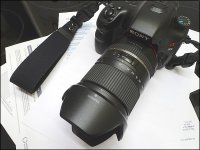
So, all you need is a wide range zoom lens. I find I can do a lot with one of those...

Camera Sony A65 and Tamron 16-300 on papers DSC01407.JPG
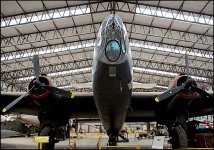
Halifax bomber at Yorkshire Air Museum A65 DSC02648.JPG DSC02648.JPG
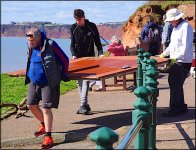
Three men and a door A65 DSC00323.JPG
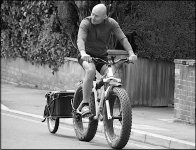
Bicycle with big tyres and trailer in Exeter A65 DSC02564.JPG
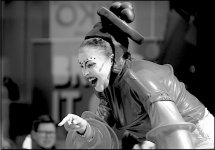
Stilt dancer in Princesshay Exeter A65 DSC00353.JPG
 
So for me the focal length is the most important (craft) tool in composing my images.
I think you are probably mistaken and not giving yourself enough credit... there is no major difference between pre-visualization and visualization; visualization being the "art of seeing" that Freeman writes about. Visualization is recognizing the potential image that exists and then finding/creating that; it is not simply "seeing." The only difference between them is that, w/ pre-visualization, the inspiration for the image comes earlier and you've had time to plan it out. And hopefully you have the control to make it happen, because otherwise it takes forever; I have pre-visualized images that took several years to come together, and I some that have not yet come to fruition even after decades (being dependent on mother nature/chance sucks in this aspect).

That's why I said perspective is first... because it dictates the relationships of everything, it emphasizes/de-emphasizes, etc. Finding the perspective is the act of finding the image you visualize; and it's fairly easy to do because you already have an idea of what you want (but experience influences that I think).
Then the focal length comes next, because it determines what is included in (excluded from) my image from this perspective. I've already created/arranged the composition, the lens just frames it... it's not even really required to be the right lens if I can crop in post.
And those two things together (perspective and FL) then determine everything else... the aperture required for the desired DOF/sharpness, the shutter speed, etc.

IMO, if you are not visualizing/pre-visualizing an image to any extent, then you are simply documenting... there's nothing wrong with that; but it's not really artistic/creative, it's technical... TBH, I am probably a better technician than I am an artist. But even most of my wildlife photography is visualized/pre-visualized to some extent... e.g. if I find a bird I want to photograph I will find a location/perch/background/angle and hope the bird cooperates. I might take other pictures given the opportunity, but they are seldom the good ones.
 
Last edited:
then you are simply documenting... there's nothing wrong with that; but it's not really artistic/creative, it's technical...
As you say yourself: there's nothing wrong with documenting - but that's to damn the whole point of photography with faint praise.

The essence of photography is to show the truth. We all know that photographs can tell lies but if there is any art in photography, it's the art of revealing the truth of a moment.
 
In the early days, I was a landscape photographer. Very early on, I realized that the background is just as important to a successful photo as as the visual focus.

One trend in recent times seems to be to use a f1.x lens to blow out as much as the background as possible, and possibly much of the subject too.

Looking at the pictures I like from the past (not mine, famous stuff...) zero dof shots are probably not there at all although I do take some wide aperture pictures myself.

The original question, I don't think I'm particularly creative as I more often tend to want to record rather than create but I suppose depth and perspective come to mind with occasional creative use of shutter speed when taking pictures and processing once they're taken as processing can offer creative possibilities and the possibility of creating a more accurate picture than the camera initially presents.
 
I think you are probably mistaken and not giving yourself enough credit... there is no major difference between pre-visualization and visualization; visualization being the "art of seeing" that Freeman writes about. Visualization is recognizing the potential image that exists and then finding/creating that; it is not simply "seeing." The only difference between them is that, w/ pre-visualization, the inspiration for the image comes earlier and you've had time to plan it out.
Steven, the difference between how you see things and how I see things comes from the fact that you are primarily bird and wildlife photographer and I am not. I am guessing, but I would imagine that for a wildlife photographer the knowledge of the birds and animals, their habitat, their behaviour is crucially important and also of course you need a specialized gear. I imagine that if you wish to photograph a deer (say), you would go to the right location at the right time for that time of the year, find a spot to hide and wait for the deer to show up. There is a lot of planning and preparation and it is then up to the deer to show up or not and "perform" for you or not. I do not think it gives you a huge amount of room to implement Freemans ideas. That is perfectly OK in my book. I am more of a hunter/gatherer. I often go to places I have never been before and do not know what to expect to find and my preparation can be only very generic (have my gear in good order and my mind clear and open and my experience to help). I try to notice things things hidden in plain sight. So I do not preplan and previsualize until I noticed something. Only then comes the stage of planning how best to photograph what I found. In my type of photography, the discovery is the most valuable part, the creative part. Of course planning how to take the photo matters, but that is often (but not always) more of a matter of experience and craft. When photographing series, it is a bit different. There you have already identified your visual interest and when you see it while you hunt/gather, you are drawn to the likely photo opportunity to expand the series. I imagine that that would be similar to your photographing similar birds in a similar habitat.So when I create series, your approach and mine comes closer together.
That's why I said perspective is first... because it dictates the relationships of everything, it emphasizes/de-emphasizes, etc. Finding the perspective is the act of finding the image you visualize; and it's fairly easy to do because you already have an idea of what you want (but experience influences that I think).
Then the focal length comes next, because it determines what is included in (excluded from) my image from this perspective. I've already created/arranged the composition, the lens just frames it... it's not even really required to be the right lens if I can crop in post.
And those two things together (perspective and FL) then determine everything else... the aperture required for the desired DOF/sharpness, the shutter speed, etc.

IMO, if you are not visualizing/pre-visualizing an image to any extent, then you are simply documenting... there's nothing wrong with that; but it's not really artistic/creative, it's technical... TBH, I am probably a better technician than I am an artist. But even most of my wildlife photography is visualized/pre-visualized to some extent... e.g. if I find a bird I want to photograph I will find a location/perch/background/angle and hope the bird cooperates. I might take other pictures given the opportunity, but they are seldom the good ones.
Here I think that we are caught in 2 things. One is linguistic and the other is what we photograph. Let us start with the second. I imagine that most of the time you use only telephotos. You wish to have your subject big enough and at the same time you may wish to provide habitat context. I routinely use lenses from 15mm to 420mm (FF equiv.). For me the word perspective means something different. Perspective massively changes the captured photo. Imagine a flower taken with a telephoto (like the one below)

View: https://www.flickr.com/photos/pavel_photophile2008/3764579217/in/album-72157611060652901/


and compare it with another flower taken with an ultra-wide.

View: https://www.flickr.com/photos/pavel_photophile2008/5704221549/in/album-72157611060652901/


The blooms are roughly the same size on the photo, and both are shot from roughly similar angle and yet the photos are completely different. Shooting with telephotos and ultrawides create an entirely different world on a photo. The perspective (the relationship in size of your subject to the surrounding) is very different. So I agree with you that focal length is an important early decision. You use the word "perspective" in a way not used in physics and so I do not know exactly what you mean by that. I think that I would call the relationship and placement of object within the frame and the relationship between the content and the frame is a matter of composition.

I am not quite sure that I understood the point that you are making here. about perspective or what exactly you mean by preplanning. These terms mean different things to different people and perhaps if you were a bit more specific so that we can get on the same page?
 
Looking at the pictures I like from the past (not mine, famous stuff...) zero dof shots are probably not there at all although I do take some wide aperture pictures myself.
I see shallow DOF images just one of the many options in creating a photo. It is not my personal favourite these days. I actually like the background and I use other ways to emphasize what I wish to emphasize and de-emphasize what I wish to de-emphasized.
 
I see shallow DOF images just one of the many options in creating a photo. It is not my personal favourite these days. I actually like the background and I use other ways to emphasize what I wish to emphasize and de-emphasize what I wish to de-emphasized.

I suppose state of mind can influence what pictures we take especially for amateurs who are perhaps freer to indulge themselves, one way or another. Thinking back to when I took more shallow DoF pictures they were of flowers and I've no doubt that was influenced primarily by my state of mind at that time. In that sense the picture taking and production process is perhaps less creative than it initially appears and maybe more reactive.
 
@Pavel M I like the hunter/gather analogy for taking pictures of new places. I quite like going to a new place for the first time - I approach this differently - I arrive early - check out compositions, angles I would think work - consider the light and how it will fall, is it a morning or evening location and in that is it restricted to certain seasons. Shooting a south facing subject works better in the darker months and a north face subject works better in the lighter months (in the Northern Hemisphere anyway).

I often find though my best compositions come from repeatedly visiting a place - you learn what to include, and more importantly exclude as time goes on.

This might make this a very technical approach to creating "artwork" but it is how I do it.

Sometimes though I will just grab and go depending on light fall and atmospherics. You just have to keep an open mind to what is around you.
 
The idea of making pictures as art, it seems to me, denies the the primary aspect of photography: its immediacy. My mantra probably comes down to "see, grab, go" and this is what, I'll hazard a guess, 99.9999% of camera users want to achieve. The ideal camera then, is the simplest and quickest to use...

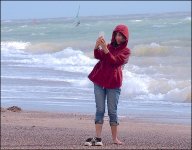
Anorak girl taking picture with phone Exmouth beach E-PL5 P9240027.jpg
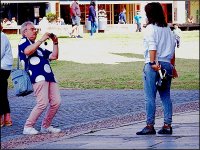
Man leaning backwards to frame picture P8040003.jpg
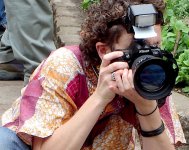
Photographer at Swinon Mela.jpg
 
Last edited:
The blooms are roughly the same size on the photo, and both are shot from roughly similar angle and yet the photos are completely different. Shooting with telephotos and ultrawides create an entirely different world on a photo. The perspective (the relationship in size of your subject to the surrounding) is very different. So I agree with you that focal length is an important early decision. You use the word "perspective" in a way not used in physics and so I do not know exactly what you mean by that. I think that I would call the relationship and placement of object within the frame and the relationship between the content and the frame is a matter of composition.
While most of what I do/share now is wildlife photography, I also have extensive knowledge and experience with studio (product/people) and journalism photography. About the only two things I haven't done extensively is advanced astro and underwater.

I use the word perspective as it applies to art (is defined for drawing/photography). And in that sense perspective includes your distance from the subject... One could also use the other definition of perspective which is simply "point of view;" as in "viewed in this way" (from my position).

In fact, the difference in perspective (distance) is what made the primary difference between those two flower images; the lenses had (next to) nothing to do with it.
 
Last edited:
The essence of photography is to show the truth.
Is it? For journalistic photography, sure.

We all know that photographs can tell lies but if there is any art in photography, it's the art of revealing the truth of a moment.

And what is the truth of a moment? Your truth/experience?
 
And what is the truth of a moment? Your truth/experience?
Obviously.

Why would you even need to ask such a question, given that the answer is self evident?
 
Last edited:
Obviously.

Why would you even need to ask such a question, given that the answer is self evident?
Because what is the truth (what the subject experienced), what you experienced (saw/perceived), and what the image conveys (viewer experiences), are quite possibly three entirely different things.

It's why snapshots/pretty pictures so often fail... because it takes "something more" to convey the actual emotion of the experience (or something akin to it).
 
It's why snapshots/pretty pictures so often fail.
Please supply a reference to the ISO document which specifies the characteristics of a good picture. I seem to have missed it... :tumbleweed:
 
Back
Top