What IS Lomography?

I'm wondering if this thread is to actually assertain the basis of lomography or simply to cause a heated debate......
There's nothing wrong with debate. I don't see it being heated, myself. It's interesting to me.

Is it merely the philosophy or practice, of experimenting with imperfection?
Here I think it's useful to distinguish between art and craft. The practice of Lomography is a craft which parallels the rustic fashion, particularly popularised in the US, of "distress". Furniture, ornaments, even pairs of jeans.. now photography. The longevity of its popularity, right now, is obviously uncertain. But my point is that it is a fashionable craft, which is not automatically inherently artistic.

Is it merely a 'style'?
I suppose the word "style" can be problematic because completely different emphases can be inferred from it. I'm going to stick with "craft". :)

Can you really make Lomo-photos in a digital dark-room?
Because Lomography is quite specifically a craft, in my view, it can't be done digitally. I'll christen the digital version "Instagraphy". ;)

Or should they really be created ONLY with a low-tech, aboration riden camera?
Certainly, yes.

Are 'good' photo's taken with a lomo camera devoid of significant aborations, STILL 'lomo'?
I think "good" is in large part superfluous in this precise context. A good photo is a good photo, and I don't argue that a photo cannot be good if it has aberrations.

So there is capacity in Lomography to achieve good results, but I think you yourself hinted at the window of opportunity to become a form of art in identifying the "philosophy or practice, of experimenting with imperfection?" Therein, the juxtaposition of imperfection and expression is the route by which the craft of Lomography *might* find artistic merit. But I think it's a narrow window, and if I'm honest, I haven't seen it done yet.
 
When I think back to doing weddings not that long ago using a Nikon FM2, I wonder how we managed it - manual everything

If you read some posts on other forums (mainly Photo.Net) you would think that wedding photography was impossible without auto focus, auto exposure and ISO ratings in the thousands.

Probably like you, my father used to photograph weddings with Nikons and ISO 160 and 400 film.

Before that he used Rolleiflexes and for his first wedding, was given a camera and ten glass plates and told not to waste any of them.


Steve.
 
David Burnett, one of the world's best known journalistic photographers uses an old Speed Graphic 5x4 camera and sometimes, a Lomo/Holga camera. I think he had them both at last year's Olympics but was mainly seen with the Speed Graphic

http://www.davidburnett.com/

a photo of Al Gore on the stump that Mr. Burnett took with a Holga won a top prize at the 2001 White House News Photographers' Association's Eyes of History contest.

http://www.nytimes.com/2005/06/08/technology/circuits/08schiesel.html?pagewanted=all&_r=0


Steve.
 
Last edited:
For quite a few people I know 'Lomo' was something that got them into film photography. They like the easiness and carelessness but then they moved onto 'real' film cameras.

For example one of my friends went from Diana that was a x-mas present onto Canon AE1 and now enjoys film a lot.

I'm generally enjoying the movement as I'm 18 and I want film to be produced for many years to come so I can enjoy the hobby and movements like Lomography only extend the life of film photography.

However I don't like people who don't really care for photos but just fashion. A Diana is sometimes used as a necklace which to me is a bit silly :P

Live long the mighty film.
 
Last edited:
"you would think that wedding photography was impossible without auto focus, auto exposure and ISO ratings in the thousands" - made me smile - I'd used the FM2s for some time and had a good relationship with my local camera shop - I was somewhat disparaging about the "plastic monstrosities" such as the new Canons, and one day, with the collusion of the Canon rep was lent an EOS5 and 420 dedicated flashgun to "play" with - much to my disgust it really did make life easier - the autofocus worked well, the dedicated flash was a revelation, the auto exposure was very accurate, it even rewound automatically at the end of each film, and set the film speed automatically..........Best of all it was loads lighter than my old gear - needless to say I bought one and used it for many years.......
As I said, I'm happy to use a film camera occasionally "for the fun of it" and a trip down memory lane, but would be deeply insulted if someone called my images "Lomography" - in their days the cameras I used were damned good, and able to produce top notch results - "Lomos" were used by the same sort of people who nowadays are happy with £30-worth of grot digital device (in a few years time, will we have people raving over the awful results from early el cheapo digital cameras?)..........
 
Lomography = mistakes & imperfections masquerading as art.......................


But if it keeps film in production, keep on shooting.

Mart
 
I'm wondering if this thread is to actually assertain the basis of lomography or simply to cause a heated debate.......
The purpose of the thread, was to stimulate discussion, on what is a very nebulous and debatable topic, and see if any answers floated out of it.

The term 'lomo' is undoubtedly 'trendy'; lots of people are using the term, and seemingly slapping the label randomly on whatever they like....

Questions posed were more than the five relatively direct ones offered with some degree of rhetoric, provided by final two....
Does any one have any strong opinions?
Does it really matter, as long as pictures get taken?​
Seems that there are a lot of strong opinions, for or against whatever is the opinion holders idea of lomo... Yet, what actually is or might be lomo, is still rather amorphous and ambigiouse.....

Maybe better questions (for the moment) might be;
- Is the term lomo used too indiscriminately
- is a better definition of lomo required?
- If so, what?

Backing up, your earlier comment implied that anything that wasn't 'seriouse' photography is lomo.... which by inversion raises the question, "So what's seriouse photography?"

So there is capacity in Lomography to achieve good results, but I think you yourself hinted at the window of opportunity to become a form of art in identifying the "philosophy or practice, of experimenting with imperfection?" Therein, the juxtaposition of imperfection and expression is the route by which the craft of Lomography *might* find artistic merit. But I think it's a narrow window, and if I'm honest, I haven't seen it done yet.

An opinion that hints an almost polar point to Ash, in that lomo MIGHT be 'seriouse' photography, if the oportunity for artistic impression is exploited. But sticking some brackets around it, suggesting its a craft, and one that ought to be restricted to using chemical media, not digital, to effect some sort of distressed, or imperfect 'style'.

Which poses a dichotamy; on the one hand we have a camp suggesting its any non serious, non 'art' photography, another that it is firmly in the realms of 'art' photography, that's its actual aim!

Without getting heated, its a good debate!

But to find common ground.... I think that there is a common feeling that 'crap' photo's are crap photo's, and whether you label them lomo to try and justify them or not, they are still crap.... from which stems certain resentments, whether the label is justifying perhaps even stifling 'better' photography, while promoting or at least stimulating the chemical media.

.... ooooh GODD! I've stepped back in time twenty years to C&G class and critiquing each others pics of the week!:lol:

(in a few years time, will we have people raving over the awful results from early el cheapo digital cameras?)..........
I already am... see pics earlier in thread! Those three were taken with a Jenopik 1.3Mp, that was a 'cheapie' in 2003 at i think £70!

It was a cheap convenience, and starting a family, any-photo was better than none. Fact that devoid of process & print costs, it was almost free to use, it got me taking a lot more photo's and trying stuff I wouldn't really have considered with film.

In that regard, despite being digital, I was applying a fair bit of lomo-thinking, and would agree on that score, with Ash, that might allow the lomo-tag to be applied to them. But.....

Doing the technical photo's for Land-Rover or motorbike mechanics started basically through using that little digi-pact to take snaps to illiustrate answers to questions on the Land-Rover forum... re-writing the Haynes manual..... was a progression from that; Had I been restricted by having to shoot film, I would have never even attempted... bad enough I was 'wasting' so much time and money messing with heaps of old junk in the first place, according to then missus, without spending even more money to take pretty pictures of such 'scrap'!

That little camera? Limited as it was, still made files with a pix width I still have to re-size for most display purposes, and I liked the fact that it had an optical view-finder, when things got a bit awkward to see on the screen or I needed to save battery life. And the picture from it, though technically not wonderful, were, for the most part 'fit for purpose' as far as family snaps, recording off-road adventures, and illustrating mechanics.

It's not 'analogue'.... and it was for a large part fairly 'serious' photography. Maybe not setting out to make 'art' or create stunning images worthy to hang on my wall... but photo's fit for purpose.

So yes, and in the none too distant future, I can see people hunting out early second hand digi-cams, and praising them for variouse merits, whether to do with inherent aborations, or the levels of control, or even restrictions in control, in a similar way to people playing with old chemical-cameras now.

But I think a linch pin in the debate is the matter.... "Fit for Purpose!

And the debate is drawing out another question; that of 'ART' photography....

Old debate. IS making images worthy to hang on a wall the type of photography that has most merit, or even the only form that has any!?

I wrote this, originally as a post on the Land-Rover forum, ten years ago. the Lake Vynwy Adventure!, having finished renovating my first Land-Rover... proving that there WAS some benefit to SWMBO, we took it to Wales and had a go at 'Off-Roading'. And I wrote article on the experience, using photos to illustrate it. Its not worthy of publication in National-Geographic; and even Land-Rover Monthly probably wouldn't have considered a submission, even if they were truly stuck to find column inches about diff-locks, ball-joint gaiters and transmission brake seals! But worthy of a 'club' news-letter or web-site. Which in essence is what it was for.

The pictures are not 'fantastic'; but they were fit for purpose. They showed some Land-Rovers doing some fairly interesting stuff, what they were built for; driving rough roads, and some of the wonderful scenary you could get to see exploring such roads by Land-Rover.

You may not have much interest in Land-Rovers, or Green-Laning; might even have some pretty dire objections to the persuit; but, besides the point; the photos has a purpose, and were fit for that purpose, and were interesting to people who like that kind of thing; and response from the original post, encouraged me to photo-document other green-laning adventures... long before 'Blogging' became 'in-vogue'....

They aren't art; I wouldn't really want to print any to stick on my wall, and I took them, and they have my family in some of them! Easy to deride them, then as mere 'snap-shots'... and being honest, YES they are 'mere' snap-shots, for the most part. But lets think where that takes us?

Define 'art' as a picture you would want to put on your wall, and suggest that such 'art' is the most meriteouse form of photography, the pinicle of the craft.

We've taken a tangent off talking about wedding photos....... a dangerouse topic... so forgive be using a broad brush fairly indescriminately! Wedding photo's are probably THE most often framed and hung photo's taken. Give or take school-portraits.

[broad brush alert] Large proportion of wedding / school photo's are not particularly wonderful examples of the photographers craft, and despite being the ones most often hung, suggesting they are 'art', an awful lot of them, are peculiarly production line pictures; made to a tried and trusted formula, without an awful lot of insight or creativity. Off the shelf poses, off the shelf groupings, out the manual lighting, focus, etc etc etc.

There isn't necesserily a lot of creativity or imagination in the genre... and probably wouldn't be expected, or even apreciated if it was applied! Bride wants to see smiling groom, happy dad, and bunch of flowers, in front of church. Nice and tidy, nice soft focus, no bizare colours wiered angles, JUST the routine every day regulation wedding photo.... Hung on the wall, framed and on the matle-piece it may be.... art it probably isn't.

Or have I just struck on the exception to the rule? I dont think so. I dont think that the hang it on the wall idea works to define 'art' photography. If it did? then the glamour/soft porn photo's from the Pirelli Calender on the wall in the Tyre fitters, to the torn centre folds from Razzle in the porta-loo on the building site would be 'art'....

So, hanging on the wall, probably doesn't give us the bracket to define art photography, and we have already demoted one genre of specialty photography... even though, it Is a craft, it does take skill, and the photo's are fit-for-purpose, viewed and cherished.

People go running back into burning houses to save wedding photos!

Sod the Vangaugh on the wall! Thats insured, we can buy another..... OK, maybe not the same.... but how many times can you look at the same picture of a bunch of flowers before you get bored with it! Wanted to re-decorate anyway.... think we'll have a Picasso next!

Which takes us off at yet another tangent, about values, and where we place the value in a photo... any photo..... what about that photo is of real value, real merit and real importance?

Fitness for Purpose.

Lomo-movement was concieved long before digital photography existed, and there was any question of the merits of 'Chemical' vs 'Digital'. So, to my mind, lomo cannot be defined purely by the medium of film. Maybe a division that the lomo-movement have latched onto; and may be a populoar contemprary view of lomo, as strictly 'analogue'.... but it existed before there was an alternative, so that cant be the be all and end all to it? So where did it start? Maybe if we look at the oragins, we may find some leads.

Term coined in the early 90's as the iron curtain fell, and 'cheap' low tech, low quality, soviete 'family' snap-shot cameras, appeared on the Western market, in counter-point to the ever more spohisticated, ever more precice and perhaps clinical cameras commonly available.

So lomo came out of a pre-existing movement, a back-lash to, for the sake of a better word, 'pretentious' photography, ever more concerned with the technical merit of making a clearer, more precise better controlled image, rather than capturing something 'more'.... possibly the best word 'emotive'.

I mentioned fitness for purpose. A crux. If a photo is taken for a purpose, then its 'quality' irrespective of technical merit, may be assessed by whether it fulfills that purpose.

Lomo-Pholosophy, latched on to taking photo's for their own sake; Always carry your camera; dont think, just shoot. Grab whats happening around you.

On that basis; an alwful lot of quite serious; very pretentious photographers, taking pictures, for thier own sake, WITHOUT an original purpose.... are going lomo..... the only difference is that they are taking the camera with them.. to FIND something to take a photo of... which is 'un-lomo'.... and may be inverted, in so far as an awful lot of supposedly 'lomo' photographers are following the same path, actually thinking of taking photo's and then going looking for them....

And in either case, HOPING that they will find a purpose for the photo's they take AFTER the event, and looking for any merit in them to justify having taken them.....

And getting to a nub... if its possible.... very fact that the debate is envoking strong feeling, and people are taking it rather seriousely and being pretentiouse about it...... is this mere irony?

Or has Lomo evolved to be something different, that is more seriouse, that is more than a rebel yell to consider more than the mere mechanics?

.... and if so..... we are back to the beginning!....... What IS lomo?

And trying to answer that, does the thinking to get there, influence in any way, the way we look at our own photography.... and the point... beyond accademic interest.... having pondered the variouse arguments eminating from the debate, will that influence us in any way, well we look at our own work any differently, will we re-consider, perhaps the value we put on different aspects of our photography? If so... without any-one being right or wrong, we might all benefit.

 
Does anybody actually care what it is, so long as people are shooting film and having fun that's all that matters in my book!
 
for me, it's a convenient irrelevance...

convenient, in that it's helping keep film and associated stuff in circulation

irrelevance, in that I've 2 cameras that are "from that movement" - one of which I'm still waiting for people to decide if there are any re-shoots required from the travelling holga project, before sticking the camera up as prize for whoever's image gets the most votes. The other is the pinhole holga panoramic, which I've done as much as I can to to ensure minimal "lomo-ish-ness" (cleaning out the pinhole, countersinking the area arounf the pinhole/shutter assembly, de-shining the internal plastic surfaces) so I can simply treat it as a lightweight pinhole camera.

As to what the Kool Kidz are doing or saying, can't say it bothers me either way...
 
Teflon-Mike - I mean this in the most polite way possible, stop being so anal. I don't think any of your posts within this thread really have a point to them other than to be abnormally pedantic for the sake of being pedantic...

Lomography / photography is meant to be fun which is why I go out and shoot. reading reams of drivvel on the internet isn't, hence I had to avoid your last post.

I think the more important question is, "Does it really matter?".

As has been said above, the 'Lomo' brand has made people continue to buy/shoot film for whatever they want and that's a good thing. The spin off sales are bound to happen as a result of any fashionable brand. The same idea also spreads across to digital with apps like Hipstamatic (which was originally a Lomo-style film) and obviously Instagram but it's all still photography.

Too many people get hung up on the almost snobby attitude that Lomo devalues analogue film photography. To the masses, a 'classic' film camera does probably look like an antique and added to the fact they can be bought for less than a tenner I can see where the comparison to Lomo is made. The fact is, you're camera means something to you because of who's it was so you should just keep shooting with it and not worry about how or why.

Cheers
Steve

I agree completely :)

"continue to buy/shoot film for whatever they want and that's a good thing" - why is that a "good thing?" - having learnt photography the hard way, and made my living with film for many years, I'm unconvinced that keeping film alive by taking awful photographs is actually a good idea, especially as most people are going to scan the negs anyway....
When I think back to doing weddings not that long ago using a Nikon FM2, I wonder how we managed it - manual everything - weighed a ton, pray that you've got results until the processing results come back.........

There is also the other point about film - it's expensive stuff to make and process, and somewhat of an eco-disaster - digital is far "greener".........

To be completely honest, you just sound annoyed because people don't spend years in the darkroom to take photographs these days.
 
Last edited:
"you just sound annoyed because people don't spend years in the darkroom" - you've missed the point completely - darkroom - been there, done that, got the chemical stained t-shirt - having watched gobbets of used chemicals flushed away down the drain, along with the often boring hours spent on processing, I'm glad to see the back of it - it's not in the least eco friendly, it takes a lot of time and effort, and I'm very glad for all the advantages of a modern digital camera - my beef is with yet another manifestation of what I'll call the "cokin fallacy", that a good picture can be made by degrading the image in some way, either by using bits of plastic in front of the lens, use of frankly awful cameras (Lomos), or by over-application of the dreaded Photoshop.
If people want to use Lomos and their ilk, that's up to them, but please don't try to call it "art", and please don't try to confuse photographs taken with "classic" cameras with "Lomography"

Having got used to "the modern way", it is quite a shock to the system to pick up my old FM2, and remember "using it in anger", and quite how complex an operation it was... (which WAS the point of that post!)
 
If people want to use Lomos and their ilk, that's up to them, but please don't try to call it "art", and please don't try to confuse photographs taken with "classic" cameras with "Lomography"

Martin, I do not think that anyone has tried to do that, what people are suggesting is that the raise of the activity called LOMOGRAPHY which after all is just making the owners of the camera production rich, has also given the Film manufactures more business and therefore encouraged them to continue there products and in some cases increase and bring back lines.
Now if you do not care about film that,s OK, but some of us do and we are please that this comparatively new genre has helped us.
 
I shot a "366" last year to record at least one shot per day. Even though I own a selection of Canon/Sony NEX/Analogue cameras, the majority of my shots were actually taken on my Iphone. That wasn't because I wanted to look hip or shoot with specific Apps but because it was the camera I had in my pocket most of the time which is the point of photography on the whole. If I'm not shooting for a client, I should be shooting just for the enjoyment of it, however I choose to do that.

Although the Lomo-style cameras are deliberately not the highest quality glass (or plastic..) lenses, they're designed and sold to meet a demand. Whether that demand is for 'artistic' merit or just fun, there's still a demand.

I think it's dangerous ground individually stating what is and isn't 'Art' considering some of the "best" or at least most regarded artists deliver such classic work like these;

tracey-emin-my-bed.jpg


bricks.jpeg


Artist-Tracey-Emin-new-ex-007.jpg


Martin-Parr1.jpg


artwork_images_911_204414_martin-parr.jpg


Also, I'm not sure exactly what the "Cokin Phalacy" is? Are you saying that photographs taken using filters are lesser quality than those without? That's an odd statement if it's true considering the majority or landscape photographers will at some point use at least grads to deliver shots of any quality.

Not sure if you saw the "Take Your Box Camera to Work" thread but I'm guessing the people who shoot with Brownies don't do it because of the ease of use, high quality images and to look cool to their friends....maybe it's just for fun?

Steve
 
Last edited:
I think it's dangerous ground individually stating what is and isn't 'Art' considering some of the "best" or at least most regarded artists deliver such classic work like these

It's quite easy. Photography isn't art, painting isn't art, sculpture isn't art.

They are all mediums which can be used to create art. They can also all be used to make utilitarian, non art products too.


Steve.
 
Many moons ago I used to help out in a friend's camera shop which served the great British public, at that time, a great many "hobbyists" got hold of the false idea that they could "improve" their non-existent photographic skills by using the worst excesses of Mr Cokin (not nd filters, or even "grads") but the real hardcore "effects" filters - all the filters in the world couldn't make a silk purse out of a sow's ear - I'm afraid I view "Lomography" in the same vein (and over use of photoshop, HDR and all the other "gimmicks")

The old adage was to always carry a camera in case that "once in a lifetime" shot happened - I can only view the fact that most mobile 'phones have an inbuilt one as a good thing - (but clutter all to do with "Lomography"), which seems to be the glorification of the downright poor.....
 
Does anybody actually care what it is, so long as people are shooting film and having fun that's all that matters in my book!

Another vote for this
 
a great many "hobbyists" got hold of the false idea that they could "improve" their non-existent photographic skills by using the worst excesses of Mr Cokin (not nd filters, or even "grads") but the real hardcore "effects" filters - all the filters in the world couldn't make a silk purse out of a sow's ear

I agree with that feeling towards Star/Mirror/Soft filters but that's no different to in-built digital filters on pretty much every digital camera now which you can choose to use or don't use for your own personal photographs.

However, I don't believe that Photoshop or Lightroom etc should be viewed as works of the Devil simply because they are available. I'm assuming that when shooting weddings entirely on film you never dodged/burned the print by hand with a lamp in the darkroom? If you simply delivered every photograph as it was shot and your clients were happy with them then that's fine for your requirements but it doesn't make everyone else wrong.

Steve
 
I don't view Photoshop or Lightroom per se as "works of the devil" (Photoshop is certainly the work of someone with a sick sense of humour as it is completely unintuitive, but that's a different topic), but I do view "over processing" and use of "effects" filters usually to be an attempt to make a silk purse out of a sow's ear.....
As for weddings shot on film, I used to shoot "reportage", and left my processor to do her work (slightly warm, slightly dense please), then checked through the prints - if it was soft or they'd blinked, they went in the bin, otherwise the prints had to stand on their merits - it worked for me! At that time, many local photographers were of the "40 proofs with a socking great logo through them, all of them "softed", choose 12 to be blown up to 8x6 and mounted in a poxy Spicer Hallfield album":D
 
Fair call but if we look specifically at photography, there are many ways to go to extremes outside of Photoshop with the likes of cross-processing, pushing film, running 35mm in MF cameras to include sprocket holes, 'spinner' cameras to get ultra-wide angles etc.

Anything can be done to extremes and although HDR is one classic example of awful looking results, the people who create those images are probably happy with them although others will hate them. I guess that's the beauty of photography and nobody being right or wrong.

For example, these are a couple of my HDR shots that I think are pretty restrained but effective;


Meols Boats by Steve Lloyd, on Flickr


Meols Boats by Steve Lloyd, on Flickr

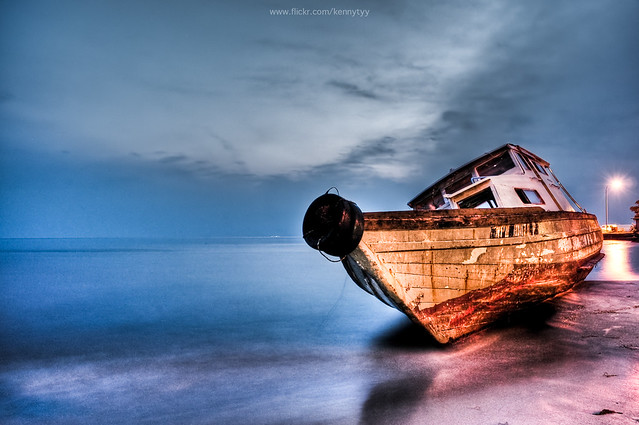
This shot on the other hand to me looks overdone but whoever the photographer is who took it probably likes it (as their whole photostream contains similar shots) but that's not to say I'm right and they're wrong.


Port Dickson HDR by kennytyy, on Flickr

Steve
 
At risk of being pedantic, are they still "photography", or have they crossed the boundary into "computer manipulated digital pictures"? - (I never liked "over darkroomed" shots either........):D
 
At risk of being pedantic, are they still "photography", or have they crossed the boundary into "computer manipulated digital pictures"? - (I never liked "over darkroomed" shots either........):D

I guess they're both the same so nothing new really other than the way the image is manipulated. Photographers have used darkroom 'cheats' for years so is a considerable amount of photography over the last 100 years fraudulent too? This recent post from David Hobby (Strobist.com) highlights this;

http://strobist.blogspot.co.uk/2013/02/how-we-got-here-analog-photoshop.html

Steve
 
There are a lot of opinions in this thread, a lot of people bouncing ideas back and to. In fact you could say that this is a mass debate........

All art is subjective, if you thinks its art its art, if you think its crap its crap. Lomography helps keep film production going so its good. Tracy Emmin is bad.

Andy
 
It's quite easy. Photography isn't art, painting isn't art, sculpture isn't art.

They are all mediums which can be used to create art. They can also all be used to make utilitarian, non art products too.


Steve.

Nicely put. Wish I could write concisely like this.
 
This thread is in danger of going down the film vs digital route!

There's a gallery round these parts that has always sold lomography films and cameras. Last week they started stocking all Ilford films for the first time, including Delta and FP4. They told me that there was such a demand for small amount of lomography film they stock that they have decided to stock Ilford. Now there is a place for me to go to buy Delta on the high street for the first time in years in this city. All because a load of people have been introduced to film through lomography.

Who knows, a few of the 'lomo kids' might want to go through their parent's cupboards and find that old Praktica that everyone's parents had and put a roll of Delta through it. And when they see the results they get from that and the Helios 44 then forget about it! Obsession time.

EVERYONE WINS!

Except for my bank balance as I just bought four more rolls of FP4 today :bonk:

Oh, they sell Ilford now, I will be taking a trip their tomorrow! :)
 
There's a gallery round these parts that has always sold lomography films and cameras. Last week they started stocking all Ilford films for the first time, including Delta and FP4.

Could you please say where it is? I'm moving back to Liverpool after many years away. I was wondering where to buy film.
 
Back
Top