

Well, I never thought I'd approve of the Pirelli Calendar

Quite a brave move for Pirelli, but guaranteed to get them a lot more attention on social media then another 12 perfect posteriors.

Some of those need a good straighten and crop.:D
:)

Liebowitz has a striking and distinctive voice and really understands composition - but I remain somewhat perplexed by some of her framing decisions, in this series and elsewhere.
 
Typically Liebowitz, but why the need for nakedness? There's some powerful portraits in there without the need to remove clothes. It's almost as if she's constantly using it for the shock or guarenteed interest factor, look at this celebrity with no clothes.
At the launch of the calendar on Monday, Leibovitz explained that none of these photographs had been conceived with the male gaze in mind. Williams’s photo was “not a nude but a body study”, she said, while Schumer’s was a comic conceit: “The idea was that she was the only one who had not got the memo about wearing clothes.”

If she wanted to get away from the traditional Pirelli calendar, then why shoot unclothed? There's some really strong images in there without the need for that gimmick.
 
Is that first picture of a bloke?
I can see from your comment that you've led a very sheltered life and that your contact with women appears to be minimal. I know this is a strange concept for you but it's true mate, women of lots of different shapes, sizes and appearance inhabit this lovely little planet of ours.
 
If she wanted to get away from the traditional Pirelli calendar, then why shoot unclothed? There's some really strong images in there without the need for that gimmick.

I disagree with your comment in a way..
I thought the nude ones were as strong as any other. Why should an image of a person clothed or not, be any less worthy of inclusion?. Why can't females be looked at 'as a person' in their own right, and be recognised for their achievements regardless of whether they are clothed.
Why should it always follow that if you are nude, all of a sudden you have less worth?.

Can't imagine that being hung up in many garages/workshops though ;)
And... In this day and age, should a 'pin up' have a 'place' to be pinned? ...I was amused by your comment(whether tongue in cheek or not) that perhaps an 'all female - non nude one' would not be well received in a workshop/ garage...these places are no longer male only territories.

I liked the calender anyway...
 
Liebowitz has a striking and distinctive voice and really understands composition - but I remain somewhat perplexed by some of her framing decisions, in this series and elsewhere.
I've seen some of Liebowitz's compositions broken down and analysed in detail, she seems to be able to "see" very high level compositional elements in a scene and works with those at the expense of some of the more conventional but simplistic "rules". It tends to result in a lot of cropped limbs, etc. in her images. The Serena Williams image is classic Liebowitz when you start to look at the relationships between angles in the frame.

If she wanted to get away from the traditional Pirelli calendar, then why shoot unclothed?
Have you seen the quote under the Amy Schumer image on the second link? it seems that there's a conceptual joke running through the twelve images when taken as a sequence, "It's as if she didn't get the memo [about not having to be naked].."
 
Not sure the joke works since Serena Williams is wearing less than Amy Schumer.
 
And... In this day and age, should a 'pin up' have a 'place' to be pinned? ...I was amused by your comment(whether tongue in cheek or not) that perhaps an 'all female - non nude one' would not be well received in a workshop/ garage...these places are no longer male only territories.

I liked the calender anyway...

It was very much tongue in cheek (hence the winking smiley), and i suppose it's been a long time since the Pirelli calendar was actually given out to car garages as a freebe (perhaps it still is, i'm not too sure), but i can't see any of the car garages i frequent hanging this on their wall ;)
 
Have you seen the quote under the Amy Schumer image on the second link? it seems that there's a conceptual joke running through the twelve images when taken as a sequence, "It's as if she didn't get the memo [about not having to be naked].."

Yup, which is why I included the comment about it ;) My point being though that a lot of her shoots tend to be getting the client naked, to an extent, especially if the client is famous.
It rather seems to play to the celebrity culture and for something different to the normal Pirelli calender, well it isn't really, there was no need for those shots when the clothed ones are powerful images.
 
I disagree with your comment in a way..
I thought the nude ones were as strong as any other. Why should an image of a person clothed or not, be any less worthy of inclusion?. Why can't females be looked at 'as a person' in their own right, and be recognised for their achievements regardless of whether they are clothed.
Why should it always follow that if you are nude, all of a sudden you have less worth?.

It's not less worth, its about doing something different to the normal Pirelli calendar. As for the 'didn't get the memo' that rather feels like an after thought, an excuse.

I think the Serena Williams image works well, shows her power.
 
I think the Serena Williams image works well, shows her power.
Several commentators are only considering the Schumer image to be unclothed, and I can kind of understand why - the Williams image is very much about power and musculature, with a nod to the Vogue cover on the floor (I missed that detail and only found it in a commentary).

serena-vogue-032315spgcn.jpg
 
I've seen some of Liebowitz's compositions broken down and analysed in detail, she seems to be able to "see" very high level compositional elements in a scene and works with those at the expense of some of the more conventional but simplistic "rules". It tends to result in a lot of cropped limbs, etc. in her images. The Serena Williams image is classic Liebowitz when you start to look at the relationships between angles in the frame.

I have too. I'm not convinced that the cropped limbs and wonky horizons are a result of her composition process so much as a stylistic choice.
 
I have too. I'm not convinced that the cropped limbs and wonky horizons are a result of her composition process so much as a stylistic choice.
A lot of the blog is pay-walled now, but this Liebowitz analysis isn't.. http://www.ipoxstudios.com/annie-leibovitz-analyzed-photo-1/

There's a lot of useful information on Tavis's blog, but I do think he sometimes gets lost in minutia and forgets to step back. For example the way her cropped limb images work, despite breaking the established rule-of-convention - which I think harks back to conventions of painted portraiture and is part of the norm defined by an entrenched photographic conservatism.
 
A lot of the blog is pay-walled now, but this Liebowitz analysis isn't.. http://www.ipoxstudios.com/annie-leibovitz-analyzed-photo-1/

There's a lot of useful information on Tavis's blog, but I do think he sometimes gets lost in minutia and forgets to step back. For example the way her cropped limb images work, despite breaking the established rule-of-convention - which I think harks back to conventions of painted portraiture and is part of the norm defined by an entrenched photographic conservatism.

Yup, that's where I saw it - and others. A slightly wider frame wouldn't break the angles & dynamic symmetry stuff and would leave the limbs uncropped - in fact it would work better - which is why I think it's a stylistic choice.
 
I think she just likes pushing into the bleed when it comes to images for glossy fashion magazines, but for me it works.

Unfortunately Tavis has taken all the other Leibovitz analyses behind the paywall, but I see he now has a book out to compliment the blog.
 
It's a bit heavyweight and daunting at first look, it makes more sense if you follow the blog through (or it did, most of what was available for free now isn't).

But I have to agree with Tavis, it knocks the Rule of Thirds on the head once you get your head around it.
 
It's a bit heavyweight and daunting at first look, it makes more sense if you follow the blog through (or it did, most of what was available for free now isn't).

But I have to agree with Tavis, it knocks the Rule of Thirds on the head once you get your head around it.

I completely agree. It makes the rule of thirds look utterly embarrassing - though sticking to any set of rules is bound to be problematic.
I was following the blog before he put the good stuff behind the paywall. I decided not to pay as he was getting a bit repetitive but the book might be worth a look.
 
I think its very ermmmm ironic that's all I can say really the style is a bit marmite tbh
 
It's a bit heavyweight and daunting at first look...

"These people are designing their photos, just like the old master painters and guess what? They aren’t telling anybody this secret!"

b*****ks! :LOL:

I have a secret method of 'designing' pictures too - you can all have it for free: If it looks right, it is right. :)
 
the book might be worth a look
It's a bit steep, even the Kindle/PDF versions are over a tenner.

I suspect a lot of it is based on Charles Bouleau's The Painter's Secret Geometry but the modern reprints of this have been criticised for their reproduction, and Tavis's analysis of modern photographs are what makes his approach interesting.
 
Several commentators are only considering the Schumer image to be unclothed, and I can kind of understand why - the Williams image is very much about power and musculature, with a nod to the Vogue cover on the floor (I missed that detail and only found it in a commentary).

Whose the naked person wrapped in a curtain carrying a naked baby? Very Leibovitz

So the other clothed people are shown as normal people, relaxed, personal portraits.
What do the naked images add to the set?

I suggest they don't fit. The others are clothed, based around a chair, very relaxed, intimate and personal portraits.
Leibovitz again has gone for the impact shot for the publicity, that she can get famous people to pose nude.
 
Last edited:
"These people are designing their photos, just like the old master painters and guess what? They aren’t telling anybody this secret!"

b*****ks! :LOL:

There's a bit of hyperbolae there :). I'm sure some great photographers have studied composition in a formal way. Others will have developed an instinct which happens to tie in with a lot of what Tavis says.

I have a secret method of 'designing' pictures too - you can all have it for free: If it looks right, it is right. :)

That's not sufficient for me, though. It's often said that either you have an eye for composition or you don't, that it can't be taught and that if you try really hard for years you might just develop the ability. Tavis Glover's blog does a lot to break that myth. He explains why some compositions work and which elements we can look for to enhance a composition; it demonstrates that composition can be learnt, even if the skills to use the theory take a lot of practice.

You don't have to take his 'designed photograph' mantra to the extreme he does to get value from his approach.

Dynamic symmetry is just one element of his material.
 
Last edited:
It's a bit steep, even the Kindle/PDF versions are over a tenner.

I suspect a lot of it is based on Charles Bouleau's The Painter's Secret Geometry but the modern reprints of this have been criticised for their reproduction, and Tavis's analysis of modern photographs are what makes his approach interesting.

As well as Hambidge's 'Elements of Dynamic Symmetry' and Henry Rankin Poore's 'Pictorial Composition'
 
He explains why some compositions work and which elements we can look for to enhance a composition; it demonstrates that composition can be learnt, even if the skills to use the theory take a lot of practice.

I guess some people want to know why things work in minute detail and have fancy names for the theories, others couldn't give a toss so long as they do work. Just like some people like being in control of their pictures to the nth degree and others value the element of chance in the creative process.

"The real world is infinitely more interesting than anything you try to invent in a studio."
Paul Reas

:D
 
I guess some people want to know why things work in minute detail and have fancy names for the theories, others couldn't give a toss so long as they do work
It depends what your objective is. If you're looking to create or reproduce a classical style of image you need to know the underlying theories. If you're aim is more individual,spontaneous or freestyle it's not going to be as interesting to you.
 
It depends what your objective is. If you're looking to create or reproduce a classical style of image you need to know the underlying theories. If you're aim is more individual,spontaneous or freestyle it's not going to be as interesting to you.

Tom Hunter is the first that springs to mind
http://www.tomhunter.org/
 
It depends what your objective is. If you're looking to create or reproduce a classical style of image you need to know the underlying theories. If you're aim is more individual,spontaneous or freestyle it's not going to be as interesting to you.

Leave it to the theoreticians and historians. It's boring as f***! :LOL:
 
Why is it so f*****g impossible to have a serious discussion about art or art theory on this forum? Without fail any thread on the subject turns up some twunt intent on wrecking it before you reach the end of the first page.
 
I guess some people want to know why things work in minute detail and have fancy names for the theories, others couldn't give a toss so long as they do work. Just like some people like being in control of their pictures to the nth degree and others value the element of chance in the creative process.

"The real world is infinitely more interesting than anything you try to invent in a studio."
Paul Reas

:D

In the case of the article, that's a lot of people to pose meaning it would have a lot of preplanning, thought, possible sketches, communication to each person. Then there's the lighting and finally getting the image. Why not reference an old painting for examples, a number of problems and issues have been overcome and resolved by artists before.
 
Strangely no. Looking at Tom Hunters work and the influences behind it takes it to another level. It's not just about pretty pictures getting 'likes'.

Tom Hunter is an interesting example. His pictures are not conventionally pretty but they are often beautifully lit and composed as well as being a rather personal take on a challenging subject.
 
Why is it so f*****g impossible to have a serious discussion about art or art theory on this forum? Without fail any thread on the subject turns up some twunt intent on wrecking it before you reach the end of the first page.

In my personal opinion... It's Largely because there's a high proportion of people in the membership who simply can't understand that there can be more to taking a photograph than the Craft aspect. And, as often happens - empty vessels make the most noise.

I find it annoying myself, as to be honest I gain and learn far more from these discussions ("noise" notwithstanding) than any technical discourse on the forum. Perhaps if people weren't so blinkered, they may also actually learn something...
 
Tom Hunter is an interesting example. His pictures are not conventionally pretty but they are often beautifully lit and composed as well as being a rather personal take on a challenging subject.

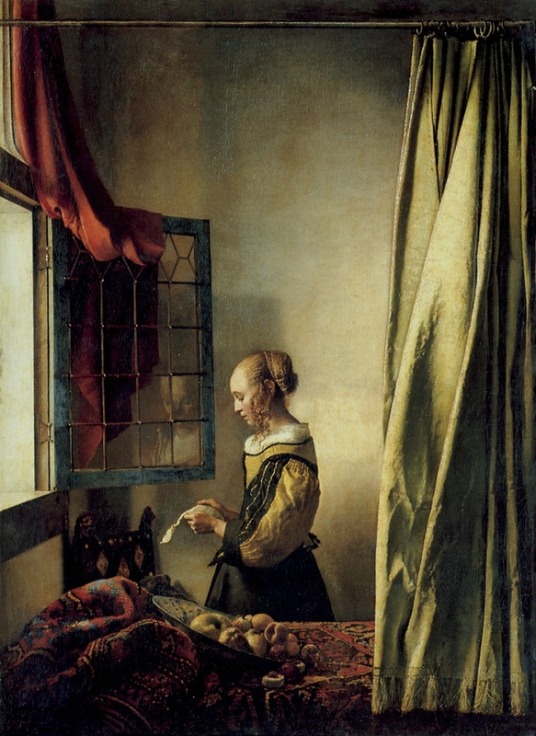
And the link back to the historical paintings. He became well known for a portrait of a young mother, which referenced Jan Vermeer’s 17th century painting, A Girl Reading a Letter by an Open Window, except that his subject was reading an eviction notice from the council, and instead of the bowl of fruit in the original picture, a baby lies on the bed in the foreground.
vermeer.jpeg

woman-reading-possession-order.jpg


Hunter followed up with Life and Death in Hackney in 2000, another series that drew on painterly references to depict life in the London borough, and then Living in Hell and Other Stories, which used lurid headlines from the Hackney Gazette (such as “Gang Rape Ordeal”) to re-stage scenes from art history.

Whilst not identical modern reproductions, Hunter has referenced painters in his work such as Vermeer, Caravaggio, Millais, Wyeth, Delacroix, Velázquez, Waterhouse and Ingres, copying the poses into modern interpretations of the locations and gestures.to inform his pictures and even though they are not faithful reproductions of these famous paintings they do, nonetheless, reinvent the classic gestures and symbols in poignantly contemporary settings.

If these were simple documentary images, without the historical references, I doubt they’d have had the same gravitas and longevity. It’s easy to document a local area but to do it in a way that not only produces interesting images but to add an additional layer of interest is very clever.
 
I do wonder what a single mother with child would need to do to be evicted by the council.

As a picture I think it works and stands alone without the historical context but as a piece of social commentary I think it's less effective.

Back to the pirelli calendar, much of what I've seen of it doesn't work for me.
 
Back
Top