


Bend The Light
Suspended / Banned
- Messages
- 2,619
- Name
- Craig
- Edit My Images
- No
I have a Shepherd Light Meter which I intend to use in the studio. I just want to be sure I am using it properly.
So, here is it:
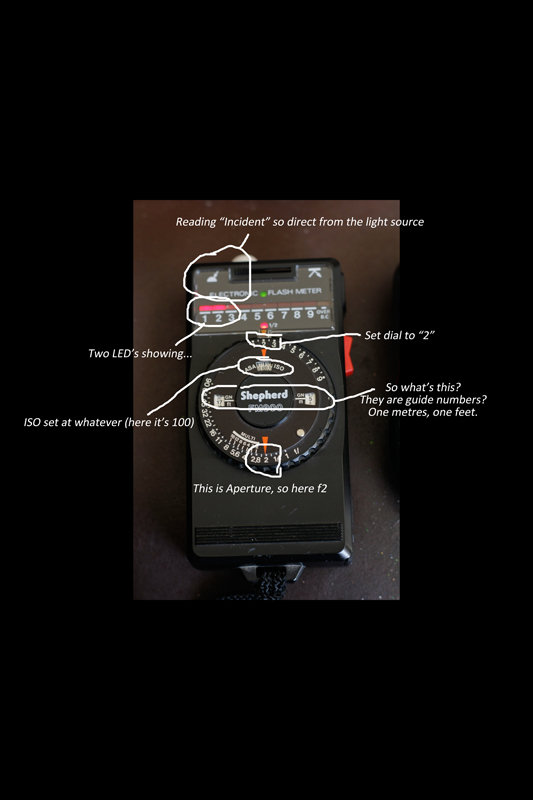
How to use light meter small by http://bendthelight.me.uk, on Flickr
So, I decide to read the light coming directly from the studio light, and so set the meter to "incident" with the little dome covering the sensor.
I set the ISO, in this case to 100.
I press the flash button on the side which triggers the flash (I have it plugged in to the unit).
I read 2 LEDs.
I turn the dial to "2"
I read off the aperture below (in this case, f2). (measurements are given as 1/125 seconds for shutter)
If I have shutter at 1/250 I need to open up by a stop (which would mean going to f1.4?)
If I set the shutter at 1/60, say, I need to stop down by a stop (going to f2.8?)
So does that sound right? So what if I have 2 lights?
Another thing - what if I want to read reflected light? I set it to the reflected setting, but this time read the light coming from, say, a person's face. This would read a combination of more than one light?
Another question - If I make a measurement of the face, reflected light, and then make a reading of reflected light from clothing, for instance, and they are different...what do i set?
Hopefully there are some folks who can help...I HAVE read the manual, but the manual is about how to take readings, not what to take readings of, or why.
So, here is it:
How to use light meter small by http://bendthelight.me.uk, on Flickr
So, I decide to read the light coming directly from the studio light, and so set the meter to "incident" with the little dome covering the sensor.
I set the ISO, in this case to 100.
I press the flash button on the side which triggers the flash (I have it plugged in to the unit).
I read 2 LEDs.
I turn the dial to "2"
I read off the aperture below (in this case, f2). (measurements are given as 1/125 seconds for shutter)
If I have shutter at 1/250 I need to open up by a stop (which would mean going to f1.4?)
If I set the shutter at 1/60, say, I need to stop down by a stop (going to f2.8?)
So does that sound right? So what if I have 2 lights?
Another thing - what if I want to read reflected light? I set it to the reflected setting, but this time read the light coming from, say, a person's face. This would read a combination of more than one light?
Another question - If I make a measurement of the face, reflected light, and then make a reading of reflected light from clothing, for instance, and they are different...what do i set?
Hopefully there are some folks who can help...I HAVE read the manual, but the manual is about how to take readings, not what to take readings of, or why.
