depends on what you shoot
5dsr is crap if you’re pushing the iso beyond 400
but it’s far and away canon’s best camera is you do landscapes or long exposures
and I’d recommend chopping in your 17-40for 24-70 and 16-35 f4s as the next thing to do
and do remember the bit with the biggest influence on image quality is you
my signifiant other still uses a mk2 in preference to any of my 6 mirrorless bodies
and I must confess takes better photos
dave
Definitely the lens first unless the body is literally falling apart to bits. The 70-200 the OP has will be stellar as long as it as good copy. 100 is best for closeup work on 5Ds.
I'm not sure it is 'best' canon for everybody but if you need 50MP then it clearly is. For
studio work that's 100% and it beats all EVF for usability hands down. Plenty of people stick within 400. I barely need 1600 5-10% of my typical use. Sports or wedding shooters are better served with R3, R6, etc.
I did in fact use it yesterday with client instead of my usual mkIII for some lifestyle shots and at ISO640 it help up absolutely fine. These were good exposures without pushing anything too far. At 3200 you have to do some seriously cleaning up and expose well but if you play file size advantage right it is give or take in the game against 20mp cameras. Now you have all kinds of denoise AI, and LR now allows aggressive NR only for deep shadows selectively (or anything you define) so it is in fact a lot better than bare 5ds 7 years ago.
Obviously for general use mkIV would be better allrounder / less headache. I've got 5Ds so that is that. No point paying 2x cost for beaten up example now. But so would be D810 with Sigma primes. I hear Nikon wideangles are as bad as 17-40. So that's that.
is there another lens I should consider instead of the 16-35 that is on the same budget?
Tamron 15-30 if you are mega lucky. No filters can go on that. Realistically NO.
Never used them but have 24-70mm F/2.8 II

How do you find your edges particularly at wider settings? Center-midframe is excellent on these but 50 STM obliterates this overpriced garbage.
I have never had to resort to photograph at such extreme
maybe I should give it a try to see if it is that bad.
For example Milky Way shots: one for sky and one foreground. there is no other way around it really. I've looked at these specifiic example from R5 on dpreview (RAW files) and these were also DREADFUL. at 100%.
Also, if you are doing a lot of night time photography, look for a lens with a wider aperture such as f2.8 to help the camera with the low light challenges.
ART primes f/1.4 straight away. That's 2 stops brighter, and presume you may need to stop down both a good stop to get better sharpness and clean up vignette. Its a big difference. So you could possibly do MW on 5Ds at ISO1600 on one of these and get away with it. Just... You are looking at 20mm or 24mm.
There isn't much point discussing whether you bracket or not because I will say the opposite to you and you will say the opposite to me and its all subjective which ends nowhere.
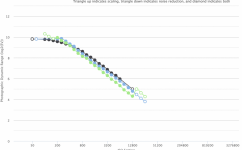
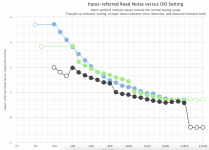
OP asked about dynamic range and ISO performance for shooting landscapes and night time. I have simply tried to give him the independent information that is available freely for everyone to look. And by all accounts I'd say its better for him to buy the EOS R with an adapter. If he/she or you choose ignore it or interpret it differently that's up to the individual.
#1 the cameras are just tools. We either learn to live with shortcomings or we don't. There is no avoiding of bracketing for many landscape shots. Sunset scene has DR well over 20 stops. No sony will get that in 1 shot and I don't want bad example to say otherwise. You need 5 frames or you have false colour blown out rendering. Period. Maybe Sony can do that in 3 but that still same process with the same tripod and software.
Now EOS R is not a bad choice but not brilliant one either. Dated EVF (as bad as they STILL are, unless you just buy SONY A1) and single card slot are the worst ones. If you can live with that it is a third cheaper than mkIV and is a bit better for video but already miles away from new ones.
there is no issue with ISO/noise performance with R5 or A7RIV. they are actually really good and also better than 5DSr (then again so are most sensors).
Higher MP doesn't mean more noise, that's a fallacy
[Incremental] Improvements are clearly there but when the most widely used test uses scaled down 8MP image as a reference point I find it hard to base my conclusions on that alone. Spend an hour with RAW files from DPREVIEW (and other) reviews, unless you have your own and you will see what I saw = no miracle. You can more easily push R6 vs R5 files without any need of post-treatment. And for DR I don't know how they calculate that, but consider this. They shoot colour charts and at some stage colour start to bleach. Better cameras have less bleaching at each step over say +1EV but they all have it. To me that frame is good as binned already on all of them. Now shadow noise is different part if you try to recover detail back. 20-24MP cameras look a lot cleaner at 100%.
Oh and by the way. Any of these 45-50MP cameras easily "revert" to basic 12-20MP effective resolution image due to even slightest lens defect, misfocusing or most minute shake or tripod vibration with only the drawbacks of noise and and large file sizes. Very few lenses are capable of corner to corner 50MP resolution and only at select apertures.