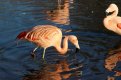
Ultra Vivid Colours

Ryewolf

Suspended / Banned
Messages
1,833
Name
Geoff
Edit My Images
Yes
This is a shot taken today, Canon EOS 100D, Canon EOS 24-105mm F4 L, f8, iso 400, 1/1250, focal length: 105mm, -1/3 ev, taken 14:08 20th Jan 2016

It's not been edited other than to resize, just wondered if anyone had had the same thing happen?

flamingo.jpg


It's just the colours look way, way, way too over the top
 
Hi

Firstly at that time I surmise there was bright daylight/sunshine and you have underexposed by a 1/3 stop

Secondly, raw or jpeg......and of the latter what picture style? If raw what converter software? Answers to this may 'inform' why the colours look more vivid.
 
At the time it was late afternoon (14:08 20th Jan 2016) but quite an orange sunset (I did consider ths), foramt was jpeg, no processing, no picture style, just striaght out of camera. Yes choice -1/3rd ev as it was still quite bright, so choose that to avoid over-exposing.
 
At the time it was late afternoon (14:08 20th Jan 2016) but quite an orange sunset (I did consider ths), foramt was jpeg, no processing, no picture style, just striaght out of camera. Yes choice -1/3rd ev as it was still quite bright, so choose that to avoid over-exposing.

My initial thought is that the underexposure plus on the surmise you were using matrix metering the camera was 'exposing' for the darker water and emphasing the underexposure on the flamingos. On smartphone so cannot see the histogram to see that spread and positioning.

As for 2:08pm being late afternoon and sunset.......just where was this taken if that time is so close to sunset??? Depending where in/if UK sunset on the 20th was 4:27pm, so more than 2hours after you took the picture.
 
Last edited:
Just a rough & ready trip through PS with an auto adjust to the levels..............not as vivid, more natural???


flamingoEDIT.jpg

Yes, some blown highlights but though the sun was past the zenith it will be harsh but with this tweak I do think the underexposure is the primary cause of the strong colours in that harsh light. And your original image does show that there is detail such as in the head of the bird at the right hand edge of the frame, so with more intense PP'ing on the SOOC file you can likely do more with it :)
 
Last edited:
It was taken in Southport, Sefton UK, so at 14:08 at this time of year it is late afternoon, so sunset includes those hours, given that sunset is only two hours later, I know I could see the sun setting in my rear view mirror as I left at 4pm
 
Well, yes I could have done the same thing, what I was looking for was an explanation, rather than a fix in photoshop. Sorry for what might seem an abrut answer.
 
Well, yes I could have done the same thing, what I was looking for was an explanation, rather than a fix in photoshop. Sorry for what might seem an abrut answer.

I await those with more know how than me but as I mentioned above the explanation is due to:-
Underexposed
Harsh light
Possibly the Metering mode exposing for the water not the bird(s)

IMO All the above have contributed to the "vivid colours" you have reported...........my rough & ready kick at the levels AFAIK aid that conclusion!

Perhaps @Kodiak Qc will come calling to to give a more accurate explanation?
 
Last edited:
Actually I might have been a bit harsh with your reply, so you think the under-exposing by -1/3rd ev coukd have been the problem?
 
There may be an issue with artificial flamingo feed, if they are in the UK and so presumably captive birds... ISTR something about flamingo's not being naturally pink, but white, its the shrimp they feed on in Africa that gives them the colour; not feeding on the same shrimp in captivity, they get food supplements with artificial coloring's in them, possibly saturating the colour, err., artificially naturally.. err. homeopathically? Err... well, non electronically and in the subject you see! However!

The Problem'?!?! You know what? I don't think there really IS one!

At first glance, my reaction was its nicely exposed. Exposure, you seem to be implying is 'serendipitous', to my eye, is what I would have been aiming for, possibly a tad less under, but in that region, to get the detail in the water and the plumage of the bird while avoiding blowing high-lights in reflections, and saturating the colours in the subject against an otherwise rather monochrome back-ground.

I LIKE the shot as is. I don't think it looks particularly 'over vibrant' or un-natural.. I would be very pleased and be calling it an 'effect' and hoping I could do it again, rather than calling it a 'problem' and trying to avoid it!

I think the <s>'problem'</s> effect is most probably the quality of the low angle light, raking across the texture in the water, and 'golden-hour-hue' tinting the plumage, and I'd struggle to replicate without that, just on 'settings', but I would have been well chuffed to have got that <s>'problem'</s> effect clean in camera without a polarizer giving me a dilemah between getting colour saturation and flattening the water reducing reflections from it.

There's no such thing as a 'correct' exposure, only more or less pleasant ones.. and this is a pretty pleasant one, I think.

 
Our eyes (and brain) have phenomenally good white balance correction. You may have had the experience of bring in a room with very strongly coloured curtains which are drawn, but let enough light through to see clearly. When you first walk into such a room the colour hits you in the face, the room seems practically monochromatic, but quite soon it fades away as the brain adjusts to being only slightly tinted. Old fashioned tungsten room lighting is actually pretty strongly coloured, as can be seen by taking a photograph with auto white balance off and white balance set to neutral cloudy.

My suspicion is that your flamingo photograph isn't too vivid, it's simply strongly coloured by the low orange light of the time. The birds got the direct orange sunlight, whereas the water was reflecting the blue sky. The winter sun approaches the horizon at a shallower angle, so making the golden "hour" a lot longer. In other words, your camera got it right, in the sense of the colours there at the time in terms of physical wavelengths, but wrong, in the sense that it was failing to do as good a job of white balance correction as your eye and brain did at the time.
 
It was taken in Southport, Sefton

Martin Mere? Burscough, LANCASHIRE. :D

I reckon Chris has nailed the 'problem'. :)

This was taken at MM yesterday at 14:49, and there's a slightly warm tint to the swan.

 
As Mike says above
There's no such thing as a 'correct' exposure, only more or less pleasant ones.. and this is a pretty pleasant one, I think.


Though I do beg to differ, in purely technical terms there is a correct exposure or at least one as correct as achievable using the technology to hand.

The way an image is presented falls IMO into two camps either or both of which are down to aesthetics?

Does it please you?
Does it please the viewers other than you?

Within that range of personal choices there are logically two choices of pp'ing ~ naturalistic or interpretive. Personally in the case of wildlife I prefer naturalistic (actually in almost all cases ;) ) and in the case of the OP's original it seems that bit overcooked for my taste but as posted by others they like it. So I return to my two premises above?
 
Back
Top