Tip's for shooting landscapes...

Little Man

Suspended / Banned
Messages
1,062
Name
Sean
Edit My Images
Yes
For those of you who like to shoot landscapes, have you any tips in terms of camera set up?

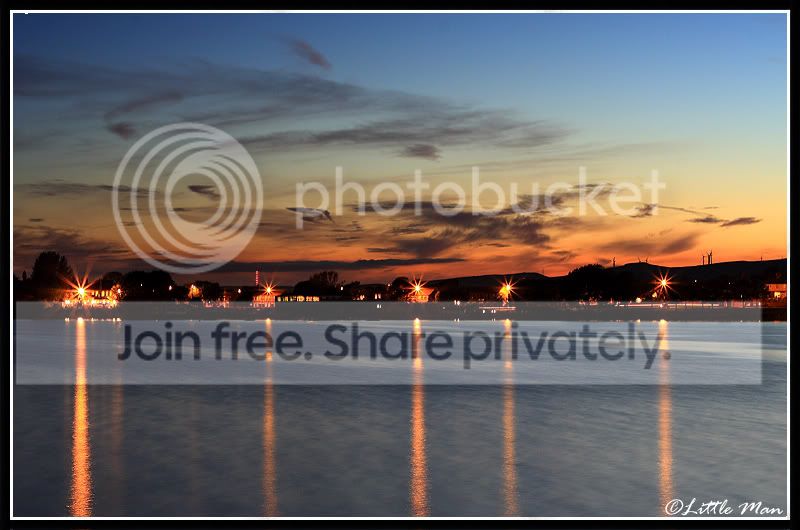
I've tried to put more thought into the set up of the camera these last few months, and it's shown me some better results. I recently took some landscape shots of a sunset over a lake, I shot at around 25s's @ f/22 and it produces some shots that I was happy with.

Is there anything else you can do to add that extra 'wow' factor, something that brings out the colours, and completely captures the moment?

I've read about 'infinate focusing', anyone care to go into brief detail as to what this is, and how it helps with landscaping?

Any help will be appreciated, hopefully going out trying to shoot a few landscape shots within the next hour or so, so i'm gunna try a few different things.
 
It's not strictly about camera set-up, but my suggestion would be to consider HDR when taking your landscape shots.

I've only just started using HDR processing and it's totally transformed my landscape images. Single exposure landscapes just haven't felt the same since!

All of my landscapes on Flickr so far have been shot with HDR in mind and subsequently processed as such.

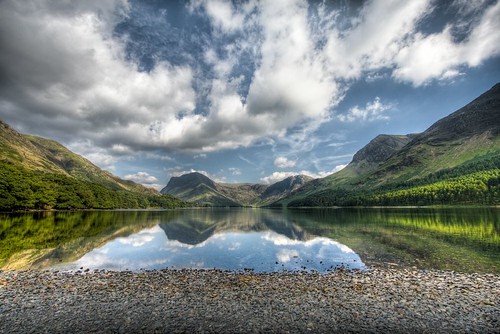
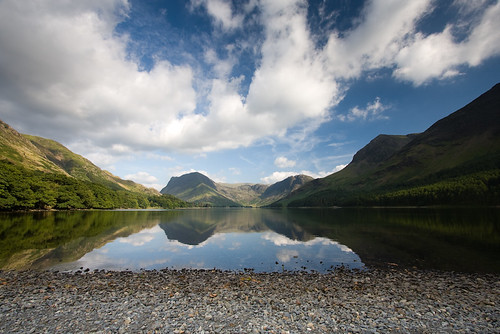
An example of an HDR composite representing what I saw at the time more accurately than a single exposure:

HDR


Single exposure
 
Cheers mate.

My HDR's never come out how I want them, certainly nothing like that one above.
 
That's come out really good Digitalrelish. I'm rarely impressed with HDR but you've hit a nice balance there. Well done
 
Not sure whether shooting at F22 is always going to help. You won't get the optimum image quality from the lens. Also you will have pretty long exposure times unless that's what you're aiming for?

I found this article online (it might have come from this forum originally even) and found it quite useful when trying to decide on what Aperture to use when shooting landscape:

How to optimise sharpness in lanscape photos
 
Thanks mate, will give it a read.
 
F11 produces the optimum sharpness of most lenses, though very little difference with F16 - F22 is softer. Try using ND Graduated filters to hold back the sky - Cokin allegedly produce a magenta cast, Lee are clean.
I've seen very few HDR's that don't seem overcooked to me. If all the data in a landscape fits on the Histogram (it often does) then there is surely no need to use HDR. Clipping the highlighlights a little is recoverable with the 'Recovery' tool in Photoshop to a small degree.
 
It's such a shame, but so many good photos seem to be ruined by HDR. I have seen some examples where it works, but they seem to be far and few between. Architecture and buildings seem to be the ones which HDR help, but to my mind it ruins the natural beauty of landscapes.
 
i argree with stan the man chasing the light is very good,
 
Much appreciated guys, will check everything out.
 
Just my opinion, but I am not a fan big of HDR....seen far too many overcooked examples...but in the right hands it can look good.....(and yours does look quite good). However, I think that if you set up carefully, using ND grads where necessary, or CP's; shoot RAW; use a judicious bit of highlight/lowlight tweaking and some careful dodging and burning, you can achieve a more realistic look.

When done well (Pete, for example), HDR is brill..........but not many seem to do it well.
 
I'd say the single biggest tip for landscapes is nothing to do with the camera or how it's set up, or the lens. It's to get the right composition and the right lighting. In other words, to be in the right place at the right time.

My best-ever landscape is probably this one.


Click to see larger version (1750 x 800 pixels, 541 kB) in my SmugMug gallery.

I didn't really pay much attention at all to the settings.
  • I used my Sigma 18-200mm lens, because that's usually what's on the camera, especially when I'm out hiking.
  • The aperture was probably about f/8, because that's what I use unless I have a good reason not to.
  • The camera was probably set on ISO 200, because it usually is.
  • The shutter speed was whatever the camera gave me. Probably about 1/400th to 1/800th.
But I was in the right place at the right time, and that's what mattered.
 
Is there anything else you can do to add that extra 'wow' factor, something that brings out the colours, and completely captures the moment?


Yes, try and understand light, what it does, what it doesn't do, what are the best times, etc etc,

For example, around sunrise and sunset are excellent times to capture landscapes, quite often the quality of light is so good you could eat t.

Often right after heavy rain, light is sometimes luminous, misty mornings another example.

Agree with Stan regarding 'Chasing the Light', David Noton explains the concept of understanding light far better than I ever can.

I'd forget about HDR, I've yet to see a good landscape that has cut the mustard with HDR processing.
 
That's fine shot, Stewart, and I agree that conditions and timing can make or break a landscape.

I'd also suggest that a polarising filter to be a very useful piece of kit where there are unwanted reflections or clear blue sky involved (as long as the sun is in a position where the polariser will have an effect).
 
But I was in the right place at the right time, and that's what mattered.

Someone famous once said "1/125 second @ f8, and be there."

My guess is his exposure would have been wrong, but they got the last bit right!

And don't forget the people whose pics you see in the magazines probably have half a lifetime's experience behind them.;)
 

I've just read this and really intersting it is too. But I'm confused about his advice regarding focussing? He suggests that you should focus just beyond the point which you wish to be sharp so that the dof just in front and behind will mean that the image is sharp. This makes sense to me. But doesn't that contradict the rules of hyperfocal distance where at a given focal length and aperture you should focus on a set distance taken from a chart? Or am I misunderstanding the rules of hyperfocal distance? I wouldn't be the first!
 
He's saying that by shooting in front means you won't have wasted hyperfocal distance wasted by it going beyond infinity. Obviously if you focus too close the distant landscape won't be in focus, so you need to be careful.

As for the hyperfocal charts, these are theoretical. In practice you will just have to guesstimate what the focus point should be unless you're very good at judging distances or have a long tape measure.
 
I'd forget about HDR, I've yet to see a good landscape that has cut the mustard with HDR processing.

Oh Les. Honestly you need to change that record. Its so old that we've gone through CD's and are onto mp3s now.

1 is a treat, excellent composition, 2 is good but needs another element in the scene to bring it alive, 3 is crap, and 4, I like the layered effect, with good mood, but the sharpening artefacts around the FG trees distract a touch.

For this image by Jimmy_Lemon in this thread. The mustard has been cut, now lets move on.

StewartR, stunning.
 
I've just read this and really intersting it is too. But I'm confused about his advice regarding focussing? He suggests that you should focus just beyond the point which you wish to be sharp so that the dof just in front and behind will mean that the image is sharp. This makes sense to me. But doesn't that contradict the rules of hyperfocal distance where at a given focal length and aperture you should focus on a set distance taken from a chart? Or am I misunderstanding the rules of hyperfocal distance? I wouldn't be the first!

I just set my aperture to f8 or f11, and give up on worrying about the hyperfocal distance. On a wide angle lens it doesn't seem to make much difference. Some folks just try to make everything difficult, and the link on optimising sharpness shows he really knows how to make the article difficult to read. Instant migraine.:bang:
 
Be very careful using the hyperfocal distance, I've used it accurately and had bad results - soft/blurry backgrounds, and the lens is 'L' series glass and is faultless. On a 5D the hyperfocal distance with a 24mm lens at f16 is 4 feet!!!! That means from 2 feet to infinity is sharp (acceptably)....I belive in the tooth fairy as well.
 
I just set my aperture to f8 or f11, and give up on worrying about the hyperfocal distance. On a wide angle lens it doesn't seem to make much difference. Some folks just try to make everything difficult, and the link on optimising sharpness shows he really knows how to make the article difficult to read. Instant migraine.:bang:

But it's so easy to follow...

Next, calculate or estimate the depth of field. This is defined as the distances before and after the focal plane within which the image is "acceptably sharp", that being the circles of confusion cast by the lens are smaller than a criterion based on the intended viewing distance.

:thinking:

I've no reason to doubt the article is accurate, but it reminds me of why I dropped physics!
 
Oh Les. Honestly you need to change that record. Its so old that we've gone through CD's and are onto mp3s now.


.


Pete, it is relevant, and I'm not just banging the drum regarding (how bad) HDR is, the guy asked how to put some 'wow' factor into his images, and the first response was to use HDR, so myself (and others) suggested that HDR was not the way to go, the guy appears relatively new to the landscape genre, has obviously put some thought into the direction he wants to go, I'd hate to think he was pushed in the HDR direction, landscape photography is about understanding light, not about manipulating pixels.

And for your information, since I made my rather strong points about how naff HDR (or tone mapping) was (and is) I haven't bothered (or needed) to re-iterate them, HDR seems to be dying a death anyway, as folk realise it isn't what some togs crack it up to be.

And I still listen (and enjoy) LP's
 
HDR is dying a death? Sure it is... I appreciate and understand what landscape photography is all about and I hate it when people run off and HDR bad photos just cos they can. But for you to popup yet again (and it is yet again as you have bothered) to say "HDR is evil. I have always hated it and never seen a good photo" is just silly because you have. You should just admit that in the right hands, as Jimmy has proven to you, HDR can indeed work.
 
Rather than dictating what landscape photography is or isn't for everyone why not just let the OP take what's been posted and then make their own mind up?

Where's the harm in letting people try different things and learning what's good for them?
 
Is HDR dying a death though? From what I've seen cameras seem to be becoming more capable of capturing a wider dynamic range with more advanced sensors etc and I guess will eventually be able to shoot HDR images (or near HDR) straight from the camera in one shot! Or maybe I'm just talking complete nonsense but then isn't Nikon's Active D-Lighting thingy meant to be heading down that road? :)
 
My tips:

1. Understand the basic rules of composition.
2. Understand your camera, ISO, aperture, shutter speed
3. Understand that pointing and shooting at everything, having a quick look the display and then re-shooting is not the way to shoot landscapes...
4. and then wait - for the light :)

Along the way pick up a good wide angle lens, a great polariser, some ND grads and a Tripod and you'll do just fine.
 
Greetings all. Since I seem to be linked from this thread, thought I'd pop in and say what-ho.

a) The optimum aperture depends mostly on the format of camera you're using. If you're using a dSLR, make that f/8 maybe even f/5.6 for lens sharpness. Given that this will increase the shutter speed, enjoy the lack of motion-shake hand-held into the bargain. My G9 only goes down to f/8, and f/4.5 probably suffices. Medium-format, f/11 going f/16. Large-format, f/32 give or take.

b) Keep the ISO low (100ish) to avoid noise

c) The hyperfocal distance is the point at which you should focus if you want everything from half that distance to infinity to be "sharp", for some value of sharp, using a given lens, aperture and image-diagonal. If your lens doesn't have DoF scales, you can't realistically do it, so guesstimate. Stop-down the aperture enough, shoot wide-angle, etc. There's an old chestnut of "focus 1/3rd into the scene" which doesn't always hold but might help on occasions.

d) Use a tripod whenever the shutter-speed goes below 1/focal length (35mm equivalent; so for a dSLR shooting at 70mm, make that 1/125th).

e) I second what chewyuk says: understand the rules of composition and then break them where needed in order to get a harmonious image. Experiment with weirdo rules like portraits 5 parts sky to 1 landscape along the bottom, or rectangles-within-rectangles, whatever. Ultimately it's the light that makes it - get a pattern of light & shadow, there's nothing nicer to look at. Light and sense of distance (recite "near, mid, far" if you must).

f) Grad-ND and circular polariser are the top two essential filters. For those of us shooting film as well, warmup for mornings and evenings.

g) Read David Ward "Landscape Within" for a good philosophy. Don't just take huge wide-angle vista landscapes, take intimate landscapes of the pebbles or ferns around your feet as well. Think: message.

h) Just so my position on HDR is clear from the start: HDR is fine if the scene needs it. Given that clipped highlights are an abomination, if exposing to retain highlight detail means you're going to lose shadow detail then by all means HDR it. Note that tonemapping is a different kettle of fish. HDR without tonemapping is just low-contrast; with tonemapping you have choice of ways to re-introduce the contrast/saturation and there's no need to go overboard with it.
 
h) Just so my position on HDR is clear from the start: HDR is fine if the scene needs it. Given that clipped highlights are an abomination, if exposing to retain highlight detail means you're going to lose shadow detail then by all means HDR it. Note that tonemapping is a different kettle of fish. HDR without tonemapping is just low-contrast; with tonemapping you have choice of ways to re-introduce the contrast/saturation and there's no need to go overboard with it.

Thats not entirely accurate as HDR without tone mapping is something you can't really view without a specific display. Tone mapping is always needed to compress the data down into something viewable. It doesn't quite re-inroduce contrast / saturation. Its entirely possible you know this but the way it sounds to others is that you can HDR an image and save it for web, or if you want you can tone map it for added contrast. Thats not really what you do.
 
Some fantastic pointers in this thread, thanks to all who have chipped in.

I managed to go out, as planned, to the lake not far from me, just in time for the sunset and i'm happy with the results I got, allthough I am going to go back time and time again, to get some different shots throughout the rest of this year (autumn, winter).

This was my favourite from the lot, I shot this with the nifty fifty, 20 second exposure @ f/11, ISO100.

HollingworthLakeSunset2-1.jpg


Thanks again for the tips & tricks.
 
Thank you very much :)
 
Cheers matey.
 
Back
Top