Tips for no light meter?

myshkin_

Suspended / Banned
Messages
52
Name
Alex
Edit My Images
No
I borrowed a Bronica for the holidays, but don't have a light meter. I decided therefore to use my 35mm EOS or my Fuji X10 as light meters. However, they seem to give different results, close to two stops difference.

Any idea which would be most accurate? The 35mm battery is apparently full.

Cheers
 
Use an exposure computer, you'll be surprised how close you can get judging the exposure by eye given the right hints about what to look for. Combined with a film like Portra 400 which has a huge latitude for exposure and some judicious bracketing, and you're good to go.

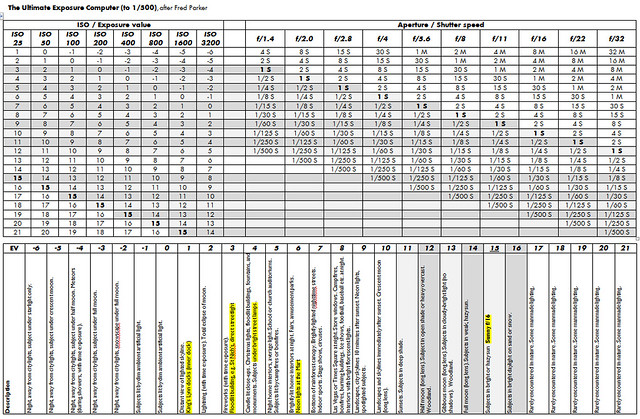
I have a printed exposure computer that lives in my Mamiya bag, it's based on the one published by Fred Parker (www.fredparker.com/ultexp1.htm) but tweaked to my needs (max. shutter speed 1/500 to match the RB67, descriptions calibrated to my experiences). It takes Sunny-16 to the next level.

This is a slightly older version of the printed one I carry. My current one has slightly more descriptive EV text. The bottom part is used to determine the EV, which you then use with the top part to generate an exposure setting. With Portra 400 I might bracket a couple of stops either side.

 
If you have a smart phone, look for free exposure meter apps on the App store, or the store for your camera. They turn your camera phone into a very capable meter. The most expensive ones are only around £1.00.
 
Thanks for the replies. I tried a light meter app on my smart phone. But, since the light meter is dependent on the sensor in my cheap smartphone I couldn't see how this would be any better than the light meter in a purpose built Fuji X10. The results seemed even less accurate.

The exposure computer looks interesting. It'd be great to train the eye enough to get decent results.

Anyone have any idea why the two cameras may have such different results? I haven't tried in broad daylight yet.
 
Are the readings you're taking of 100% identical scenes and in the same metering mode? Try a blank wall and see if they agree. Have to say that my X-10 rarely got the exposure wrong and would certainly be close enough for negative film.
 
Thanks for the tip Nod. I tried a view out of the window instead of a dimly lit room, and made sure the frame and metering were the same - yep, almost identical readings now.

Thanks for that, my X10 will be my portable light meter.
 
You do understand that your phone would be used as an incident meter, it's not a complex calculation like the matrix type reflective metering that your camera does.

You just hold it at the subject position and it measures how much light is falling on the subject.

Incident metering is the simplest and most effective (most time consuming) method of metering.
 
I can't imagine a smartphone light sensor being very accurate though unless you have the option to calibrate against a proper meter?
 
I have a light meter app on my iphone, it was free. I rarely even use it, I take a tester and usually get the exposure right after at least 2-3 testers tops.
 
I have a light meter app on my iphone, it was free. I rarely even use it, I take a tester and usually get the exposure right after at least 2-3 testers tops.

The problem with using that method with a Bronica is that by the time you've developed the film to check the first two or three exposures, the light will undoubtedly have changed. ;-)
 
I can't imagine a smartphone light sensor being very accurate though unless you have the option to calibrate against a proper meter?


The app on my iPhone is pretty accurate as a light meter. I've never used it in anger but it seems to get within 1/3 stop when I tested it. The light sensor must be fairly accurate just to work the camera on your phone.
 
I can't imagine a smartphone light sensor being very accurate though unless you have the option to calibrate against a proper meter?
Why, measuring incident light is a fairly simple thing to do. There's a lens with a sensor behind it, writing software to measure that amount of light is simple compared to say;
A game
An email app
GPS
Social media app
Camera app
Photo processing app
PVR
video camera
Video processing

All of which my phone has.

Really? You think making an accurate light measurement is tricky? Have you ever used an old camera with a selenium cell, or hand held meter with one?
 
I get that but it needs to be calibrated, surely? Easy to measure relative brightness but we're taking about absolutes. My ancient selenium cell meter was presumably carefully calibrated by the factory.
So whilst I'm sure it can measure light changes accurately, I'm not sure how that translates to a precise lux reading. Decibel meters on phones suffer the same problems. They'll do relative measurements but if you want dbA then they struggle. I could be wrong here but I'd need convincing!
 
I get that but it needs to be calibrated, surely? Easy to measure relative brightness but we're taking about absolutes. My ancient selenium cell meter was presumably carefully calibrated by the factory.
So whilst I'm sure it can measure light changes accurately, I'm not sure how that translates to a precise lux reading. Decibel meters on phones suffer the same problems. They'll do relative measurements but if you want dbA then they struggle. I could be wrong here but I'd need convincing!

I'm confused if you think that how does the light meter on said phone meter for the camera on said phone?. Why do you presume its not calibrated at factory?
 
Sunny 16, adjusted to Sunny 11 for the UK, works pretty well and doesn't require any extra bits and pieces. Most colour negative and monochrome films have quite a bit of latitude too, it's only colour slide film that's critical.

I couldn't afford a meter, or a camera with one, when I was a kid and just used the guidelines printed on the film box. These were actually based on Sunny 16, although I'd never heard of it at the time, and I can still guestimate exposure under anything approaching reasonable lighting conditions fairly well.
 
The problem with using that method with a Bronica is that by the time you've developed the film to check the first two or three exposures, the light will undoubtedly have changed. ;-)


True, sorry, I just threw in what I do, with digital of course. But the apps on phones these days are pretty good. Worth a shot at least.
 
The app on my iPhone is pretty accurate as a light meter. I've never used it in anger but it seems to get within 1/3 stop when I tested it. The light sensor must be fairly accurate just to work the camera on your phone.

Exactly. They meter extraordinarily well in poor light, and for the best part, so does my freebie light meter.
 
For those with an android phone, try LightMeter (free or paid for) by a guy called David Quiles. Haven't really had chance to use it, but the reviews are quite good.
 
Back
Top