

You are using an out of date browser. It may not display this or other websites correctly.
You should upgrade or use an alternative browser.
You should upgrade or use an alternative browser.
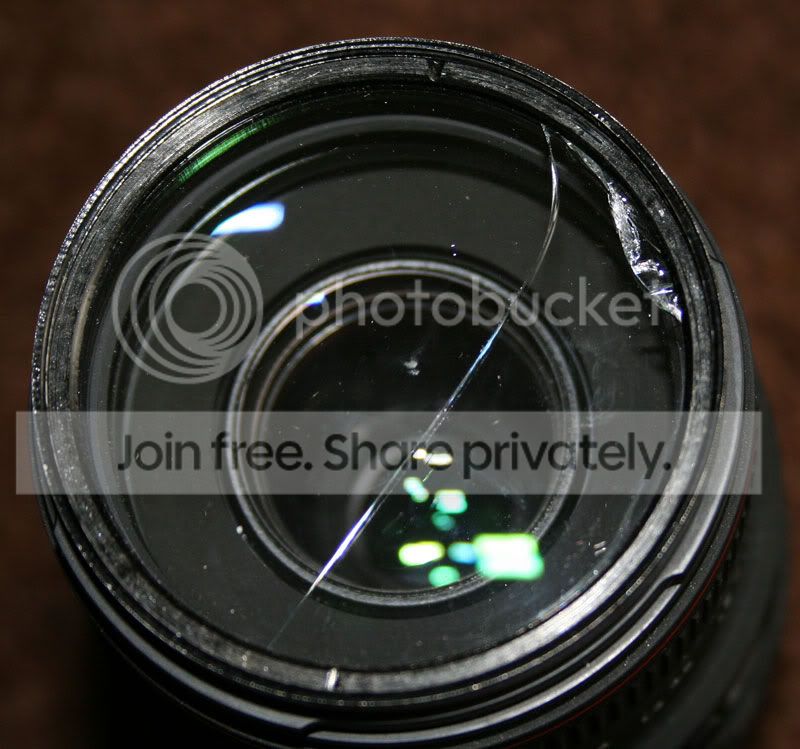
this is why we buy uv filters
- Thread starter peterc4
- Start date

seriousrikk
Suspended / Banned
- Messages
- 5,881
- Name
- Richard
- Edit My Images
- Yes
Didn't you have a hood on? Looks more like an edge impact to me that a hood would have saved.
Sorry, but I would never spend a couple of quid on a filter to put on the front of my multi hundred pound optics
Sorry, but I would never spend a couple of quid on a filter to put on the front of my multi hundred pound optics
oh yeah, baby...lol
I'm on my third UV filter out here now on my 24-80 f/2.8...
Just ordered a load more off Amazon...they're going at half-price at the mo'...
I was 'rotating' the best ones onto the 24-80 lens from the other lenses I have - now they're all looking fubar'd...
I'm on my third UV filter out here now on my 24-80 f/2.8...
Just ordered a load more off Amazon...they're going at half-price at the mo'...
I was 'rotating' the best ones onto the 24-80 lens from the other lenses I have - now they're all looking fubar'd...

Davec223
Suspended / Banned
- Messages
- 3,110
- Name
- Dave
- Edit My Images
- Yes
Didn't you have a hood on? Looks more like an edge impact to me that a hood would have saved.
Sorry, but I would never spend a couple of quid on a filter to put on the front of my multi hundred pound optics
although filters are excpensive in relative terms it isd just a "couple of quid" comparedd to the value of the lens.


- Messages
- 1,489
- Edit My Images
- Yes
Just ordered a load more off Amazon...they're going at half-price at the mo'...
Linky?


Linky?
You idle [PLEASE DON'T TRY TO BYPASS THE SWEAR FILTER]...here you go:
http://www.amazon.co.uk/s/ref=nb_ss...ield-keywords=hoya+pro1+77mm&sprefix=hoya+pro
OP

peterc4
Suspended / Banned
- Messages
- 180
- Edit My Images
- Yes
Sorry, but I would never spend a couple of quid on a filter to put on the front of my multi hundred pound optics
i dont understand, do you not have one, or do you but a really expensive one which does exactly the same job, as quoted by various monthlys and a few pros, i was speaking to a pro at donnington park a couple of years ago who had 15 grands worth of kit round his neck and said he would never spend more than a fiver on a protective filter as he goes through one a weekend in the racing season
Davec223
Suspended / Banned
- Messages
- 3,110
- Name
- Dave
- Edit My Images
- Yes
i dont understand, do you not have one, or do you but a really expensive one which does exactly the same job, as quoted by various monthlys and a few pros
There have been plenty of threads with examples of filters cheap and not so cheap affecting image quality, also with cheap filters there is a higher risk of ghosting and also light reflecting between the lens and the filter causing image problems, these are partly caused by the cheaper grade of glass being used and also by the filter not being coated as well.
There have been plenty of threads with examples of filters cheap and not so cheap affecting image quality, also with cheap filters there is a higher risk of ghosting and also light reflecting between the lens and the filter causing image problems, these are partly caused by the cheaper grade of glass being used and also by the filter not being coated as well.
I'd rather use a sawn-off milk bottle than no filter at all...

Craikeybaby
Suspended / Banned
- Messages
- 7,590
- Name
- Lewis
- Edit My Images
- Yes
Thanks for the link, I'm in need of a new filter after a skier landed on me the other week, there was no glass left in the filter at all, just the ring attached to the lens (yes I did have the lens hood on too).
Hopefully this image from my phone shows it well:

Hopefully this image from my phone shows it well:

Davec223
Suspended / Banned
- Messages
- 3,110
- Name
- Dave
- Edit My Images
- Yes
I'd rather use a sawn-off milk bottle than no filter at all...
very true for where you are. hope you are keeping safe.
very true for where you are. hope you are keeping safe.
No... suffering a Crisis of Enthusiasm today...

- Messages
- 16,666
- Name
- Ade
- Edit My Images
- Yes
No... suffering a Crisis of Enthusiasm today...

Be careful over there Rob.....

Davec223
Suspended / Banned
- Messages
- 3,110
- Name
- Dave
- Edit My Images
- Yes

- Messages
- 6,283
- Name
- Chaz
- Edit My Images
- Yes
Didn't you have a hood on? Looks more like an edge impact to me that a hood would have saved.
Sorry, but I would never spend a couple of quid on a filter to put on the front of my multi hundred pound optics
There are times to use a filter and times not to. You don't use a flash on every shot because you understand its purpose and its limitations. Filters are just another accessory which have their uses when required.
Windy day at the beach? Put a filter on. Working in the desert with helicopters etc (Arkady) then use a filter. Photographing Motorcross - depends on where you are but generally you are going to use filter.
Photographing the kids in the front room then leave it off.
Personally I rarely use them and only when needed. The lens hood does a far better job of stopping the usual accidental knocks. What the lens hood cannot protect against is fine hard particles blowing directly at you. You sacrifice a bit of image quality to protect the lens in these circumstances. For general walkaround use if I smack the lens and a filter cracks there is more danger of putting a serious scratch on the lens from the hard glass splinters.
As with most things in life it is finding that balance between the risk of damage from not using one and the risk of damage from using one. For most of what I shoot it is a wasted piece of glass waiting to get broken but for others it is an essential piece of glass protecting an even more expensive piece of glass (again Arkady is the good example here).
Yes, I have a few in the bag but I only use them when I need them. Pretty simple really.
John
Windy day at the beach? Put a filter on. Working in the desert with helicopters etc (Arkady) then use a filter. Photographing Motorcross - depends on where you are but generally you are going to use filter.
Photographing the kids in the front room then leave it off.
Personally I rarely use them and only when needed. The lens hood does a far better job of stopping the usual accidental knocks. What the lens hood cannot protect against is fine hard particles blowing directly at you. You sacrifice a bit of image quality to protect the lens in these circumstances. For general walkaround use if I smack the lens and a filter cracks there is more danger of putting a serious scratch on the lens from the hard glass splinters.
As with most things in life it is finding that balance between the risk of damage from not using one and the risk of damage from using one. For most of what I shoot it is a wasted piece of glass waiting to get broken but for others it is an essential piece of glass protecting an even more expensive piece of glass (again Arkady is the good example here).
Yes, I have a few in the bag but I only use them when I need them. Pretty simple really.
John
I'm very sure that I always have a filter on my lenses - my freind thankfully had her hood and filter on, and woke up one morning to find a 2k lens had somehow smashed, but the filter took all the slack. was a £30 filter but she said its much MUCH cheaper than paying 2k for a new lens
yes there are the occasional times i leave a filter off, but I don't really like doing it.
yes there are the occasional times i leave a filter off, but I don't really like doing it.

Jayst84
Suspended / Banned
- Messages
- 5,092
- Name
- James
- Edit My Images
- No
Thanks for the link, I'm in need of a new filter after a skier landed on me the other week, there was no glass left in the filter at all, just the ring attached to the lens (yes I did have the lens hood on too).
Hopefully this image from my phone shows it well:
How much shock absorption do you reckon that filter has? Would having no filter have meant that you got a smashed front element, or would it have meant you had a front element that didn't get a crap load of broken glass flung at it?
PS> That's a question, not a loaded statement.
How much shock absorption do you reckon that filter has? Would having no filter have meant that you got a smashed front element, or would it have meant you had a front element that didn't get a crap load of broken glass flung at it?
PS> That's a question, not a loaded statement.
This has happened a few times to me - once the filter ring was so badly bent that it had to be carefully sawn off the lens - no amount of 'wrenching' would shift it...
The glass shards aren't an issue as they only lie on the front element as opposed to being 'flung' at it and as long as you brush them off carefully there's virtually no chance the coating will be damaged. Unless you try and wipe them off with a finger or cloth, that is...
A lens hood will do more to protect from impact-damage to the body of the lens, but a filter will do more to protect against flying debris, dust and water-spots - anyone who's had to try and scrub off salt-water rings will know that it can be impossible to remove all the drying residue...
I still say - and I've been at this for 30 years now - that any filter is better than none when outdoors - even kids indoors tend to spit, dribble and otherwise eject substances you'll not be wanting on your lenses...
Preferably a lens hood and a GOOD Pro-filter from Hoya or Nikon, but at a pinch, anything is better than nothing...
If you only do studio work, disregard all I've said.
Agree to a large extent with Arkady (but then we shoot different things in different places) so our experience will be different. When I do use a filter it is a top of the range Hoya Pro series. My experience of cheap filters is that they have a far higher tendency to get stuck, they can cause some very weird effects (circular rings around any direct light in the composition for example), they scratch easily and generally have the build quality of the kit lens they were intended for. I suppose I have been fortunate but the last time I had to replace a filter was over 3 years ago and that was so badly scratched all the coatings had been worn off.
On a side note, it is surprising how little effect a badly and extensively finely scratched filter will have on the image. A loss of contrast is typical but other than that you will be hard pushed to find a significant difference in quality between a brand new unmarked filter and a well used one. Obviously, this is only true to a point and because the change in image quality is gradual (usually) and most photographers will adjust to the quality change until they switch the filter for a new one and then wonder how they shot with the old one at all.
John
On a side note, it is surprising how little effect a badly and extensively finely scratched filter will have on the image. A loss of contrast is typical but other than that you will be hard pushed to find a significant difference in quality between a brand new unmarked filter and a well used one. Obviously, this is only true to a point and because the change in image quality is gradual (usually) and most photographers will adjust to the quality change until they switch the filter for a new one and then wonder how they shot with the old one at all.
John
Craikeybaby
Suspended / Banned
- Messages
- 7,590
- Name
- Lewis
- Edit My Images
- Yes
How much shock absorption do you reckon that filter has? Would having no filter have meant that you got a smashed front element, or would it have meant you had a front element that didn't get a crap load of broken glass flung at it?
PS> That's a question, not a loaded statement.
It was the edge of one of the skis that caught the lens (the other one caught my head :bonk: ) I'm pretty sure the front element would have more than a slight nick right at the edge if it wasn't for the filter.
On a slightly related note what is the best way to test if these nicks are going to effect IQ, I guess it would be the same was as testing if a filter effects IQ. I suppose I should also check that it is focusing OK too...

Flash In The Pan
Suspended / Banned
- Messages
- 27,793
- Edit My Images
- Yes
This has happened a few times to me - once the filter ring was so badly bent that it had to be carefully sawn off the lens - no amount of 'wrenching' would shift it...
The glass shards aren't an issue as they only lie on the front element as opposed to being 'flung' at it and as long as you brush them off carefully there's virtually no chance the coating will be damaged. Unless you try and wipe them off with a finger or cloth, that is...
A lens hood will do more to protect from impact-damage to the body of the lens, but a filter will do more to protect against flying debris, dust and water-spots - anyone who's had to try and scrub off salt-water rings will know that it can be impossible to remove all the drying residue...
I still say - and I've been at this for 30 years now - that any filter is better than none when outdoors - even kids indoors tend to spit, dribble and otherwise eject substances you'll not be wanting on your lenses...
Preferably a lens hood and a GOOD Pro-filter from Hoya or Nikon, but at a pinch, anything is better than nothing...
If you only do studio work, disregard all I've said.
What would you do in the case of something like a Nikon 300 f/28 that doesn't take a filter? I know it has a built in protector over the front element, but still a right few quid to replace. Mind you I'd imagine a 112mm filter wouldn't be cheap either....

mrtoad
Suspended / Banned
- Messages
- 18,182
- Name
- Geof
- Edit My Images
- Yes
got to be the best couple of quid you will ever spend
i think you need crash bars old chap...
What would you do in the case of something like a Nikon 300 f/28 that doesn't take a filter? I know it has a built in protector over the front element, but still a right few quid to replace. Mind you I'd imagine a 112mm filter wouldn't be cheap either....
The kind of work I'd be using for a heavy old beast like that would be sports, so less liklihood of serious trauma resulting from falls, helicopter crashes or incoming artillery-fire...


dong_allen
Suspended / Banned
- Messages
- 176
- Edit My Images
- No
this would also happen even you put a uv on the lens, just depend on how hard is the hit

HoppyUK
Suspended / Banned
- Messages
- 23,200
- Name
- Richard
- Edit My Images
- No
this is why we buy UV filters
This is why we don't!
http://www.talkphotography.co.uk/forums/showthread.php?t=130960
Shame some of the best examples are no longer hosted, but it's an interesting thread.
This is why we don't!
http://www.talkphotography.co.uk/forums/showthread.php?t=130960
Shame some of the best examples are no longer hosted, but it's an interesting thread.
hahahah...
OK, so the one time you definitely don't put a filter on is when you do some tired old shots from a Motorway bridge...or anything else when point-light sources are shining directly into the lens...
But for practically everything else...

leaky5
Suspended / Banned
- Messages
- 1,824
- Name
- Richard
- Edit My Images
- Yes
Woot...
My Remembrance Parade pics are all over the PA website...
Feeling much better now...

Oh yes...three bananas good...lol
Rob
Have you got a link ? I have looked on the PA website and can't find them or do you need to register first ?
Richard

Byker28i
Suspended / Banned
- Messages
- 21,339
- Edit My Images
- Yes
There are times to use a filter and times not to. You don't use a flash on every shot because you understand its purpose and its limitations. Filters are just another accessory which have their uses when required.
Windy day at the beach? Put a filter on. Working in the desert with helicopters etc (Arkady) then use a filter. Photographing Motorcross - depends on where you are but generally you are going to use filter.
Photographing the kids in the front room then leave it off.
Personally I rarely use them and only when needed. The lens hood does a far better job of stopping the usual accidental knocks. What the lens hood cannot protect against is fine hard particles blowing directly at you. You sacrifice a bit of image quality to protect the lens in these circumstances. For general walkaround use if I smack the lens and a filter cracks there is more danger of putting a serious scratch on the lens from the hard glass splinters.
As with most things in life it is finding that balance between the risk of damage from not using one and the risk of damage from using one. For most of what I shoot it is a wasted piece of glass waiting to get broken but for others it is an essential piece of glass protecting an even more expensive piece of glass (again Arkady is the good example here).
Yes, I have a few in the bag but I only use them when I need them. Pretty simple really.
John
Pretty much spot on IMHO
Rob
Have you got a link ? I have looked on the PA website and can't find them or do you need to register first ?
Richard
I think you might - I was looking at the 'Board' where images that make the cut are posted for customers to download...making the board is the frst step for a Phot, because he gets paid regardless of further sales...
I have images in today's Times and The Sun...
HoppyUK
Suspended / Banned
- Messages
- 23,200
- Name
- Richard
- Edit My Images
- No
hahahah...
OK, so the one time you definitely don't put a filter on is when you do some tired old shots from a Motorway bridge...or anything else when point-light sources are shining directly into the lens...
But for practically everything else...
It's wider than that.
At night - don't.
If there are bright light sources, eg sun, in the frame or close to it - don't.
For the other five minutes of the day left - do.

- Messages
- 19,708
- Name
- Darren
- Edit My Images
- Yes
My take on it is this....
IF I am somewhere really dusty/sandy etc I will use a UV filter and hood otherwise I will use a hood.
The front glass in most lenses is actually quite cheap to replace maybe £50 or so but that is how much you might pay for a quality filter.
Any more and I have house insurance.
IF I am somewhere really dusty/sandy etc I will use a UV filter and hood otherwise I will use a hood.
The front glass in most lenses is actually quite cheap to replace maybe £50 or so but that is how much you might pay for a quality filter.
Any more and I have house insurance.

Flash In The Pan
Suspended / Banned
- Messages
- 27,793
- Edit My Images
- Yes
The kind of work I'd be using for a heavy old beast like that would be sports, so less liklihood of serious trauma resulting from falls, helicopter crashes or incoming artillery-fire...
You've never been to a Rangers v Celtic match then
I recently had the opportunity to photograph mountain skate boarders. Basically, these are usually 'intelligent young men' who have specially modified long skateboards with large wheels (about 8 inch), very high quality wheel bearings, steel under skids, carbon fibre braking systems fitted and snowboard boots and retainers. They climb to the top of a steep hill or mountain path and then skateboard down it. Extreme sport is not the word for this as it is far beyond anything I have ever seen. They will get to speeds of 60mph on a skateboard on a winding mountain path and the only thing between them and a long stay in hospital is body armour and a helmet. Everyone I spoke to had bits pinned and scars that would have stopped most people even trying it.
When they are coming down the mountain the stones and pebbles that come with them are flying in all directions and are of a good size. To photograph them I bought a high quality 4mm perspex sheet which I could sit behind and photograph from behind.
It was decided on the day that due to some erosion of the path it would be unsafe (both for myself and themselves) and we would re-arrange the shoot. After I had packed everything away one of them did a short run just to show me what to expect. I ended up looking at my 4mm of perspex and wondering if I too should be wearing body armour and a helmet.
In the above example a filter would have been useless as lens protection, it may have stopped some dust but that was about all it would have stopped. When I do photograph them I will use a filter for the dust and to make the whole lot easier to clean and will probably use a aquatech cover as well for the camera body.
Like I said in an earlier post but worded a little differently, a filter is just another tool in the bag that should be used when it is needed. Some need one every day and others could probably never use one. Camera salesmen probably rub their hands as soon as someone comes in and mentions the magic 'f' word.
John
When they are coming down the mountain the stones and pebbles that come with them are flying in all directions and are of a good size. To photograph them I bought a high quality 4mm perspex sheet which I could sit behind and photograph from behind.
It was decided on the day that due to some erosion of the path it would be unsafe (both for myself and themselves) and we would re-arrange the shoot. After I had packed everything away one of them did a short run just to show me what to expect. I ended up looking at my 4mm of perspex and wondering if I too should be wearing body armour and a helmet.
In the above example a filter would have been useless as lens protection, it may have stopped some dust but that was about all it would have stopped. When I do photograph them I will use a filter for the dust and to make the whole lot easier to clean and will probably use a aquatech cover as well for the camera body.
Like I said in an earlier post but worded a little differently, a filter is just another tool in the bag that should be used when it is needed. Some need one every day and others could probably never use one. Camera salesmen probably rub their hands as soon as someone comes in and mentions the magic 'f' word.
John