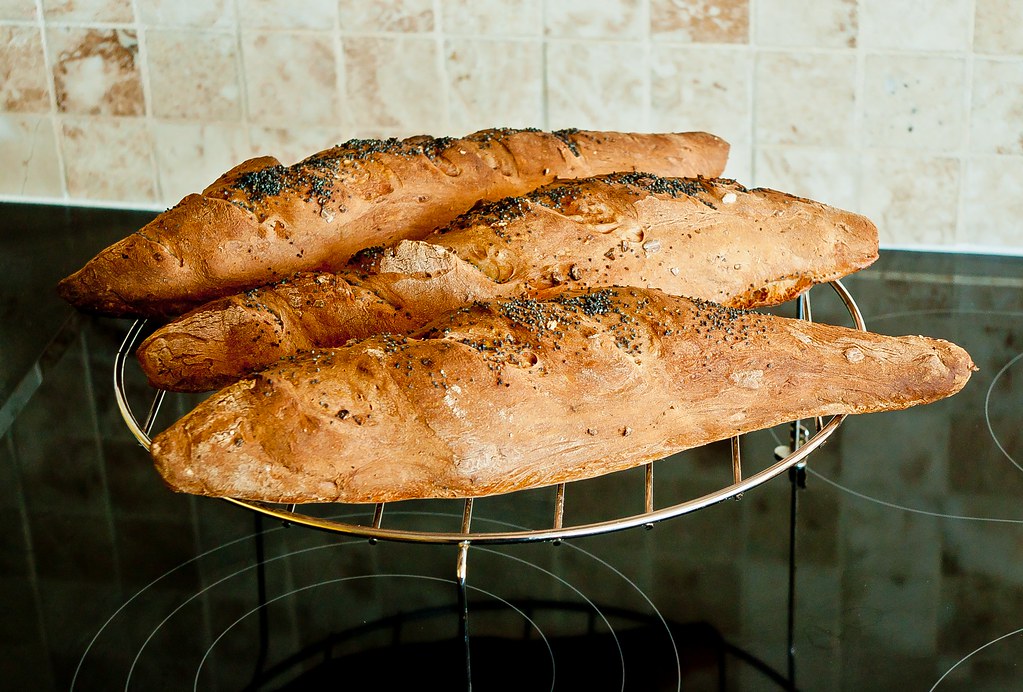
I baked some more bread on Wednesday, and decided on the long fermentation method for the first proving - 20 hours in this case. This all started back in the Summer when we stayed in France, and we ate some of the best bread we have ever tasted from a little artisan boulanger in Corcelles en Beaujolais. The crust on their bread could actually do you some damage, and the texture of the crumb was lovely and chewy. After doing a bit of research, I now use the following ingredients and proving/cooking times.
550g strong white bread flour (Lidl 59p 1.5 kilo bag)
100g Allinson's country grain flour
500ml warm water (50/50 boiling and cold)
2tsp sugar
2tsp salt
1 7g packet instant yeast
I mix the water, sugar and yeast in a pyrex bowl, stirit well, then cover and leave it for 20 minutes to activate - you will see a frothy head appearing on the liquid.
I have two large plastic bowls, one of which I grease lightly and put to one side. In the other bowl I mix the flour and salt. Once the water, sugar and yeast has activated, I empty it into the flour mix and then combine thoroughly with a large spoon, finishing off by using one hand to mix and clean the bowl of dough mixture. I then turn the dough out onto a well floured surface and knead for five/ten minutes.
NB. This is a wet mix so you cannot keep kneading it for a long time, because you will have to add more flour and that is not what we want.
Transfer the wet dough mix to the greased bowl, cover with the other bowl, leave in a cool place, and go and enjoy yourself for 20 - 24 hours

Assuming that you have not forgotten that you have started to make bread, the next stage is the one which can be a bit messy and intimidating.
When you are making ordinary bread, the mixture is fairly easy to work with and shape on a lightly floured surface. This however is a bit sticky and loose to say the least.
I flour the surface well, and turn the dough out, and then quickly roll it into a long sausage shape, taking care not to press it down too much. I then quickly divide the roll up into six equal parts with a very sharp knife. You may bneed to put a little more flour down to stop the dough sticking, but you do not want to incorporate it into the mix if you can help it.
You then gently roll out the dough, working from the centre out, to create a bulge in the middle and pointy bits at the end.
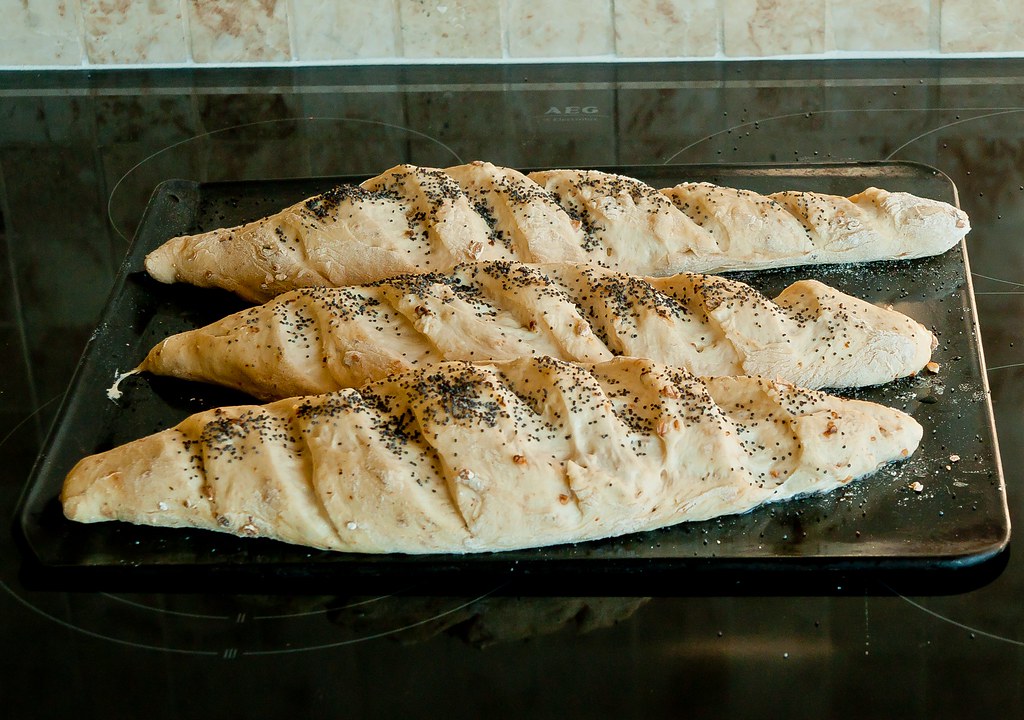
I use two baking trays, and put three of these Ficelles on each. When they are on the tray, I score them with a knife - you can do one slice right down the middle or several slashes diagonally. During this final proving process, I brush them gently with a little water, and sprinkle poppy seeds or sesame seeds on the top. This second proving usually takes around 30 minutes to 1 hour.
Preheat the oven to 220C and put a shelf in the middle. Just before placing the first tray of Ficelles in, I half fill a standard loaf tin with cold water and place it in the bottom of the oven (this will create steam and make the crust very crunchy).
I then bake the Ficelles for 25 - 30 minutes and then let them rest on a wire tray.
Before baking
After baking
We very rarely buy bread nowadays, because this is so easy to make, it is so cheap, and IMO it tastes better than anything available from the supermarkets and most bakeries.