The Natural Light Thread

cj if you could have a look at this shot for me i would be grateful . it was taken in my garage about 12 noon. next to a window. i would like to learn alot more about natural light usage .
great thread by the way..
best-freinds-copy.jpg

thanks dave :thumbs:
 
J, thanks for the wonderful compliment. Much appreciated! I see you're in Brighton; I did a workshop there at the Friends Meeting House this past March. We had such a great time there!

Dave, very nice moment caught. Your lighting is very soft -- as mentioned above in the critique of Steve's shots, you can tell this light is quite soft because the shadows have no distinct outlines. So, you're working with a large/close lightsource. Additionally, the white walls of your garage are working to reflect the light around, making it even softer.

Let's look at the direction of the light, though. Look closely at the catchlights in your subjects' eyes. Are there any? Where are they located? The girl at camera right has just a tiny hint of catchlight in both eyes as she's looking slightly upward at the camera. From the position of the catchlights, we know that the light is coming from a high angle at left. Typically, you want the light a little lower, coming in from slighly above and to the side of your subjects's faces, which allows the light to brighten the eyes and fill the shadows under them. You get away with it somewhat in this image because the light is so soft and is bouncing around, but you'll want to watch that angle in future shots.

Steve, I haven't forgotten your questions. Just need a bit of time to finishing answering them thoroughly.

- CJ
 
thanks for that i will angle them alittle more towards the window in future and use a reflector ..
 
Dave, I wouldn't break out the reflector in this situation. Modeling shadows are what give the image depth and dimension; adding a reflector here (in addition to the light already reflecting) will make your light flat. Simply angling them a bit more toward the light and having them look up at you a bit more (taking the shot from a slightly higher angle) will fix the lighting direction issue and maintain good modeling shadows.

I've attached the following image to show how having the subjects look up can compensate for overhead light. I could've introduced a reflector rather than waiting for them to look up, however I'd have lost the beautiful shadows that give the image its glow.

bathsmpk3.jpg


- CJ
 
You're welcome C. Friends Meeting House in Brighton is great for staging exhibitions, it is very central and reasonably priced too. Great folk working their too. Let me know if you run another, I would be v interested in attending.
Thanks,
Jim
 
Also, portraiture - most of your pictures (that I have seen, ie in your gallery) are of kids/young people. How do you go about taking them - do you set up a place, then try to get them to feel happy in it, and with you, or do you let them choose, or what ? I seem to take a fair few of my kids and a few of other peoples kids - getting them to relax and not pose in any way is pretty hard for me, and normally they have the best expressions at times when they are in the worst place for light. As you use film, I guess you don't shoot hundreds of pictures in a session, so you must have developed some 'technique', or is it that you are just a really lovely person that has the knack - if so, I hate you.

Now, now, you're not allowed to hate me for any reason. ;)

You're very correct that I don't shoot hundreds of images per session. Part of that is definitely because I'm a film shooter, and an even bigger part of that is because I'm a medium format film shooter. That means that after each shot, I have to bring the camera down and wind it to the next frame. For me, there's no such thing as shooting fifteen shots rapid-fire in hopes of getting "the shot." It may sound like a handicap, but in reality, it's forced me to learn how to anticipate the shot, rather than trying to react to it or "spray" it. ("Spraying" means shooting continuously in hopes of hitting something. ;))

The problem with shooting hundreds of shots in a short portrait session is that it necessitates the camera being continuously in front of your face. That means all your subject sees is a black box. It's asking a lot for your subject to give meaningful, natural expressions when they have only a camera to bond with. By keeping my camera at the ready but NOT in front of my face, I give my subjects someone to interact with, and I allow myself to really see my subject. I shoot only when there's a reason to.

I typically do my sessions at my clients' homes, where they're the most comfortable. When I arrive at the home, I have the kids give me a tour of the house so I can scope out light. I always tell my clients that I'm looking for great light regardless of where it might be. Could be a bedroom, the laundry room, the kitchen, wherever. I find the light first, then make the environment work. By getting my subjects into great light before I start the session, I ensure that I won't be stuck in the situation of having a great expression in hideous light. ;)

The key to getting relaxed and meaningful expressions of your subjects is to find a connection with them. Typically, photogs assume that asking their subjects lots of questions helps their subject relax. Not necessarily true. I've seen countless numbers of photogs try to engage their subjects like this:

photog: What's your favorite color?

4-year-old: Red

photog: What's your favorite TV show?

4-year-old: Teletubbies

photog: Do you have brothers or sisters?

4-year-old: A big brother

photog: What's your favorite food?

yada yada yada.

It's true that the photog has gotten the child to talk, but are you really likely to forge a great connection over those questions? And what has the child learned about the photographer? So often, the photographer is simply flinging out questions and not listening to the answers. Frankly, the photog is too busy coming up with the next line of questioning in his photointerrogation . And wondering if his exposure is right. And wondering why all of his shots feature the kid's mouth wide open in mid-word.

Instead of firing out questions solely designed to get the subject talking, use your questions to find something meaningful that you have in common with your subject. Don't ask questions that are boring to you (the photog) because you're not going to care or pay attention to the answer. Never ask a question without answering it yourself as well. And remember that the ideal time to hit the shutter is when YOU are speaking and the child is listening.

An example of me interacting with a child subject:

me: Do you have brothers and sisters?

4-year-old: A big brother.

me: Really? Do you like having a big brother?

4-year-old: Yeah, but sometimes he's mean to me.

me: You know, I have a big sister, and sometimes she was mean to me, too.

4-year-old: Sometimes he doesn't share his toys with me.

me: My big sister didn't share her toys with me, either. But you know what?

4-year-old: What?

me: Now that we're grown up (click) we share with each other all the time.

And so on.

The point being, you need to find something to connect with your subjects, so you can have a conversation instead of an interrogation. Keep in mind that kids couldn't care less about you getting good pictures -- so why should they cooperate with you? Think about it: you, the photog, are getting paid to shoot, and the parents are getting the portraits. What is the child getting out of it?


Hope this is making some sense, as I've only just started my first cup of coffee. I'll hit on metering a little later today.

Forgive me for posting first and proof-reading later. LOL.

- CJ

 
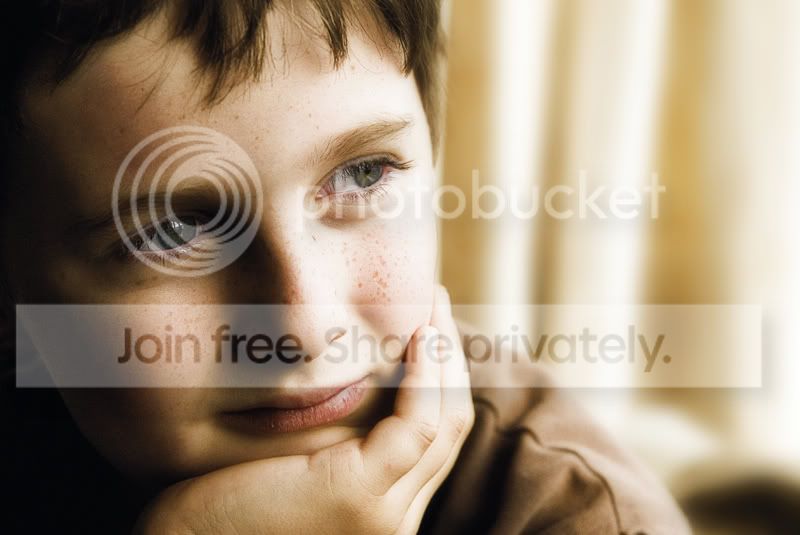
CJ, some great advice on here and I'd appreciate a critique on this natural light picture of my son.


James-13th-April009mono6.jpg
 
Thanks CJ,
The more I read and see youre pictures, the more you owe it to me to come to the Uk asap, but please make sure I know way ahead to book in some time...
Another lovely picture of yours of the kids in the bath, and loads of sound advice - I try to have my camera away from my face so I can talk to whoever, and either use a remote release or just hold it and hope..
When I am done working and have more time to think, I'll be asking many more questions and posting more pictures for you to comment on, so please keep on checking..!
Thanks again, and for giving me something to aspire to !

PS Hacker - a lovely picture !!
 
Sorry for the long delay between posts -- crazy busy week, and I'm trying (in vain!) to catch up.

Hacker, that's a gorgeous shot. You've used the light very well, and the light suits the mood of the shot. The composition is also just right, tight enough to be very personal, but well balanced and with great use of negative space. The shadows add definition but are kept very soft to not ruin the mood. If I HAD to find a fault (and it would be a fairly petty one) it would have been nice to get his chin just a touch higher so as to allow a catchlight in his left eye and keep the shadow of his nose from crossing his lip. That's a very minor technical point that doesn't at all detract from the impact of the shot. Well done.

Handheld metering info still to come. It's turning into a book that needs editing. ;)

- CJ
 
I have a question CJ.

Found out today, the wedding I am going to shoot, at the reception dinner the B&G + Best man + parents' table is in front of the window. So there will be strong back lighting, as a Photog of available light yourself, what would your advice be? I am thinking putting the camera in manual just in case it'll get fool by the backlight and do a test shot or 2 til exposure is right while using spot metering for focus.

Thanks :)
 
Raymond,

Finally getting back to you on this one. Sorry! Keep thinking I'll have a bit of time to sit down and type something coherent, but I keep having to put out small fires....

Yes, in the scenario you describe, you're much better off putting your camera in manual mode to avoid it being fooled by the backlight, which almost certainly would happen. If I were in your position, I'd use my handheld meter placed in front of the subject's face pointed toward the camera and use that reading, letting the light behind them fall where it may. If you don't have a handheld meter, then, yes, it would work fine to take a test shot or two to find your exposure. As far as focus, you may find that your camera doesn't autofocus easily with strong backlight. In those situations, I prefer to focus manually so I know precisely what will be in focus. (Actually, since I shoot mostly MF gear, I always have to manually focus anyway. Even with 35mm gear, though, I can manually focus much faster in lowlight than my camera can autofocus.)

That answer it for you? It sounds like you have a pretty good grasp on it, really.

- CJ
 
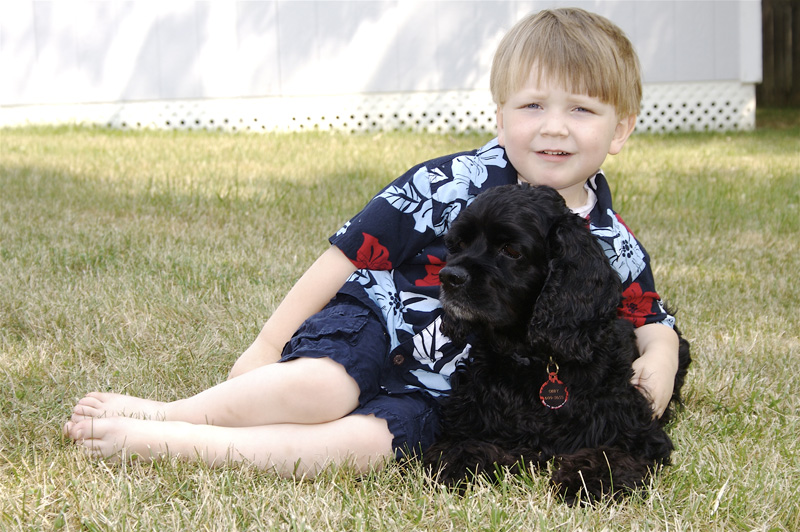
OK CJ since you've allowed to have your brain picked, I'm going to take you up on it. I have tried to get a decent pic of my son and our dog together with natural light. But the dog's eyes just disappear. So end up using fill flash and then everything looks flat... HELP?

Where should the light be to make this easier. Should I be using reflectors? Sorry if this is a really basic question. Thanks in advance.

Here's an example (feel free to pick it apart)
1128821716_fc42294821_o.jpg
 
No problem! Tell me first, though, if you will, what time of day was this shot taken? Can't tell with the flash.

- CJ
 
..and CJ, if you have time on your hands, how about a few moments to point me your way with these shots - my first meeting with my first wedding couple, and he is a photrographer (No, I am not planning on marrying him..!)

MG_5064_copy_resized.jpg


MG_5034_copy_resized.jpg


Not in the same league as your stuff, and a bit of fill-in flash was used on the second, but you seem to have a way of pointing my otherwise empty mind towards what I need to look at and think about..
As always, many thanks,
Steve
 
No problem! Tell me first, though, if you will, what time of day was this shot taken? Can't tell with the flash.

- CJ


I'm not sure myself but I'm guessing by the light on the shed that it was about 10 or 10.30. My camera time isn't set correctly!
 
Another for you to comment on CJ, if and when you have time - Jessie again, but hopefully I have got the lighting slightly better...?

Jessie_edit_resized_2.jpg
 
OK CJ since you've allowed to have your brain picked, I'm going to take you up on it. I have tried to get a decent pic of my son and our dog together with natural light. But the dog's eyes just disappear. So end up using fill flash and then everything looks flat... HELP?

Where should the light be to make this easier. Should I be using reflectors? Sorry if this is a really basic question. Thanks in advance.

Here's an example (feel free to pick it apart)
1128821716_fc42294821_o.jpg

What you were dealing with here was a simple lighting direction issue. The reason the dog didn't have catchlights in its eyes is because he wasn't looking in the direction of the light. Rather than popping a flash (which, as you pointed out only serves to flatten the image) simply getting the dog and boy to look in the direction of the light would have fixed the majority of the lighting issue. As long as you are standing with the light behind (or nearly behind) you, having the subject looking at you will mean having the subject looking toward the light. If the light is coming from top down (as well may have been the case during the summer at 10:30 AM) try shooting from a slightly higher angle, which will cause your subjects to look slightly upwards into the light.

(Am I making any sense? Late night last night and coffee's still brewing.)

If you didn't want to change the direction of your subjects' gaze, a reflector would definitely work, without flattening the image as the on-camera flash has. You'll need a large reflector situated as close to the subjects as it can be without getting into your frame. When you use the reflector, watch the catchlights and shadows as you position it. If you're not getting catchlights from the reflector, it isn't positioned where you want it. Move it until it does. Hope that helps! I'll try to reread this post a little later to be sure it was coherent. LOL.

- CJ
 
Another for you to comment on CJ, if and when you have time - Jessie again, but hopefully I have got the lighting slightly better...?

Jessie_edit_resized_2.jpg

Steve, well done on the light! Nice job. On your last images, I mentioned looking at the shadows to judge the softness or harshness of the light. In this latest shot, you'll notice that the shadows are very gradual without definite lines (i.e. can't outline them with a pencil) so your light source was much bigger in relation to your subject than it was last time (i.e. your subject was closer to the window.) The lighting direction is also very well done, lighting the mask of her face and providing nice catchlights.

Compositionally, be careful of centering. Here eyes are dead-centered vertically, which serves to de-emphasize them. Generally speaking, you'll want to compose so that the eyes are in the top third of the frame. Don't worry about cropping off the top of the head.

- CJ
 
OK, Steve, the beach shots....

So you were dealt a fairly overcast day, which is great in terms of portrait lighting. It allows you a lot more lattitude to shoot in places you might not have been able to otherwise, as direct sun wouldn't have been so kind.

It's quite easy to meter in overcast weather, as demonstrated in the first shot. With no real bright and very dark areas, the in-camera meter can do its thing without being confused. In the second shot, however, the camera WITHOUT flash would've likely read the brighter sky behind the couple and as a result rendered their faces a bit dark. You resolved this with fill flash which, although it has resulted in a fairly correct exposure, has also flattened your subjects a bit. Next time, try metering the faces specifically and shooting without flash, letting the sky go a bit brighter. If you REALLY still need more light on the faces, a reflector will do the job with a lot more definition, still allowing the modeling shadows to give dimension to the shot.

What will make a world of difference in shots like the second one will be getting your subjects to touch each other. While their faces look relaxed, their body language implies that they really don't want to be close together. ;) Remember the two "rules": everybody has to be very close together, and everybody has to touch each other.

- CJ
 
Does that mean me too - Can I touch all the people I photograph.... (please..!)
Seriously, I am a touchy type of person, and not in a dirty old man kind of way - It means contact, which is just what you are saying. I did take a few shots when the sun was poking out from the clouds, and the contrast in the waves was so high that to me, it seemed to distract from the subjects, despite being a nice enough pose.
In the picture of Jessie, I was tempted to cut of more of her head, to focus more on her eyes, and had not noticed that the eyes were so central.
I will read through what you have written again tomorrow, and many thanks for taking the time to write - very much appreciated !
Cheers CJ

Steve
 
No specific questions, just wanted to butt in and add that I am enjoying this thread and finding it very useful. Hopefully I will have something useful to add at some point but in the meantime I shall read on with interest..
 
CJ - Thank you very much. Now I need to wait for a decent day, get the dog and boy dressed up again and try try try! It is just remembering everything all at the same time for teh same pic!
 
Raymond,

Finally getting back to you on this one. Sorry! Keep thinking I'll have a bit of time to sit down and type something coherent, but I keep having to put out small fires....

Yes, in the scenario you describe, you're much better off putting your camera in manual mode to avoid it being fooled by the backlight, which almost certainly would happen. If I were in your position, I'd use my handheld meter placed in front of the subject's face pointed toward the camera and use that reading, letting the light behind them fall where it may. If you don't have a handheld meter, then, yes, it would work fine to take a test shot or two to find your exposure. As far as focus, you may find that your camera doesn't autofocus easily with strong backlight. In those situations, I prefer to focus manually so I know precisely what will be in focus. (Actually, since I shoot mostly MF gear, I always have to manually focus anyway. Even with 35mm gear, though, I can manually focus much faster in lowlight than my camera can autofocus.)

That answer it for you? It sounds like you have a pretty good grasp on it, really.

- CJ

First, thanks for the explaination CJ, I guess it'll be like this pic from Jeff, let the back blown out. Question is how does it adjust his metering so quick from pic to pic ?

peekriggott021vj7.jpg
 
Raymond, if you're using a handheld meter, you can simply take a reading for when your subjects are facing the window, and another for when they're backlit. With those two readings in mind, I can simply flip back and forth between the settings with ease. Bear in mind that when you're using a handheld meter, your subjects don't have to be in the light in order to meter. You can meter in advance for approximately where your subjects will be.

The more you get used to using a handheld meter, the more you learn about light and the faster you get comfortable in these situations.

- CJ
 
I've been struggling to upload pictures for the last few hours, as they are all too big, I am told (if only the women in my life...No, you don't need to know that sort of detail...)
Anyway, a picture of Jessie that may (CJ, tell me what you think..) be showing something of what I might be trying to show (how vague is that, but it might make sense to one or two of you....)
IMG_6352edit_for_tp.jpg


Any comments ?
 
CJ, Here is one I posted in the portrait section and would love to here your thoughts on it.

Amy.jpg


Also, As I am sure you are now aware, rooms in british houses are generally quite small, especially compared to houses I have seen in the US. How do you select a suitable background against which to photograph especially if there isn't a suitable background in the light available if you know what I mean.

Super thread by the way.
 
I was tidying up my subscriptions and came across this thread - which I was really enjoying. Is CJ still around - she hasnt been on TP since January.
 
Hello, Neil,

Yes, I'm still alive, sort of. I've had some health issues and can't seem to feel good two days in a row. It's been a rough summer. I'll try to look in on this thread more often, though.

- CJ
 
Hi CJ

Sorry to hear you've not been feeling to good.

I wish you a speedy recovery and look forward to enjoying your inspiring comments and critique soon.

Best wishes

Neil
 
Hi CJ. How wonderful of you to offer help to the forum! Hope you manage to get some free time to recover fully :)

I took the following portrait using available light in the hot midday sun.

10.jpg


From your experience, do you think there enough shadow detail in the face? It was intended to be a high key shot with focus on her dark eyes, and positioned the sun over her back right shoulder (using my white tee shirt as a reflector). Should I have turned her more? Or perhaps not used my t-shirt as a reflector?

Your input would be very much appreciated as to get more from this type of shot!
 
Hi CJ,

Hope you are feeling better and all is well.

This thread is fantastic, the information is so useful.

I was wondering what your thoughts are on lenses, I am planning on getting either a Canon 35mm f2 or a 50mm f1.4. I use a Canon EOS 40D with crop factor of 1.6. This would mean the 35 would roughly be a 50 and the 50 would be closer to 85mm.

I want a lens for doing shots of my kids but also something that would serve as a general walkabout lens. What do you recommend?
 
Hi CJ :wave: Sorry to hear you've not been well. I hope you're on the road to recovery now :) You've been missed round here ;)
 
Back
Top