The Inverse Square law and photography

Some good points and a thorough test. I'll reply in detail later, must do some work now:)
Also, I can do a test with a standard (7") reflector with and without a 10 deg honeycomb, come to that I can do the test with a 5 deg honeycomb too, and can also do it with a softbox, with and without a honeycomb - will post the results when I can.
Hi Garry, If you can't do the 6m, just get the furthest point you can manage. The graph is perfectly predictable so any point should fit...
 
I did some maths on this :cuckoo:,
What assumptions did you use for the softbox? The shape and light "focusing" abilities will surely dictate the beam that comes from it. Or am I missing something (no.. don't answer that ;))
 
It's all due to the fact that a softbox is NOT a point light.

The light meter might be 0.5m away from the CENTER of the softbox, but it might be 0.6m away from the light emitting closer to the edges of the softbox - and your light meter is reading all the light emitting from the entire softbox surface area.
Sorry you've miss-read my post. The part you've quoted, that I am questioning, refers to Garry's tests with a 30cm reflector, and why the light loss is within what I'd consider to be a normal range up to 2m, and then light loss suddenly drops.
 
The difference in distance from centre to edge, at 1m distance with a 1m octagonal softbox is only about 10cm or 10% (as best you can measure these things) and half that percentage at 2m.
Agreed, it's not about the distance from the centre vs distance from the edge.

it seems that the whole 'point light source radiating in free space' thing is a bit of a red herring.
Yes it can be. For total (99.9% won't do) accuracy I've no doubt it's important, but for us the key is the size of the light source and the angle at which light comes out. If a light source is large and lets out a narrow ish beam of light, the area lit will not quadruple when distance doubles at near measurements. Going the other way, no matter how wide angled your modifier is, the area lit won't ever more than quadruple.

What drives the reduction in brightness with studio lights is the fact that when you double the distance, generally speaking the area of the light pool projected is quadrupled. Or at least is does normally, but that is clearly not quite the case with a softbox :thinking:

What may be more significant is the internal design of the softbox, which has a degree of parabolic curve about it. In other words, the light is at least partially concentrated and 'projected'.
...
This makes more sense to me than simply saying a softbox is bigger and therefore the point light source theory doesn't apply.
I don't really agree. The internal design will no doubt have an effect, but I think the (edited) size is an equal factor (but ignoring distance from the centre vs distance from the edge).

To demonstrate this, grab some graph paper - ok, I'll do it now and post it up in a bit.
 
Last edited:
What assumptions did you use for the softbox? The shape and light "focusing" abilities will surely dictate the beam that comes from it. Or am I missing something (no.. don't answer that ;))

The assumption is that the surface of the soft box is perfectly diffuse, i.e. the light from the strobe hits the diffuser and scatters off uniformly in all directions. which is clearly not the case and is dependent on the diffusion material amongst other things.

The main point I was trying to illustrate was that in the absolutely best case scenario, that is as close as a softbox (of that size) could get to the ISL.

Admitedly the calcs are 'quick and dirty' with several sweeping assumptions all of which are a little too idealised to be perfectly representative, but I don't have the time (or inclination to be honest) to start looking a emmisivities for diffusers and targets.

As a reference the numbers for a speedlight (area 120x50) would be very close to the ISL;

Distance......Light falling
.................on target%..........Reduction
250............24.19121%...........N/A
500............6.19777%............26%
1000..........1.55921%............25%
2000..........0.39042%............25%
4000..........0.09764%............25%
8000..........0.02441%............25%
 
For example, if you put a 10 degree honeycomb over a light, the light cone will be a 10 degree light cone. You can think of that as a point source somewhere behind the flash. For a 7" flash with a 10 degree reflector, that equates to a point source almost a metre behind the honeycomb (from basic trig).
...
It is the distance from the effective point source that will dictate the doubling of area.
Nicely put.
 
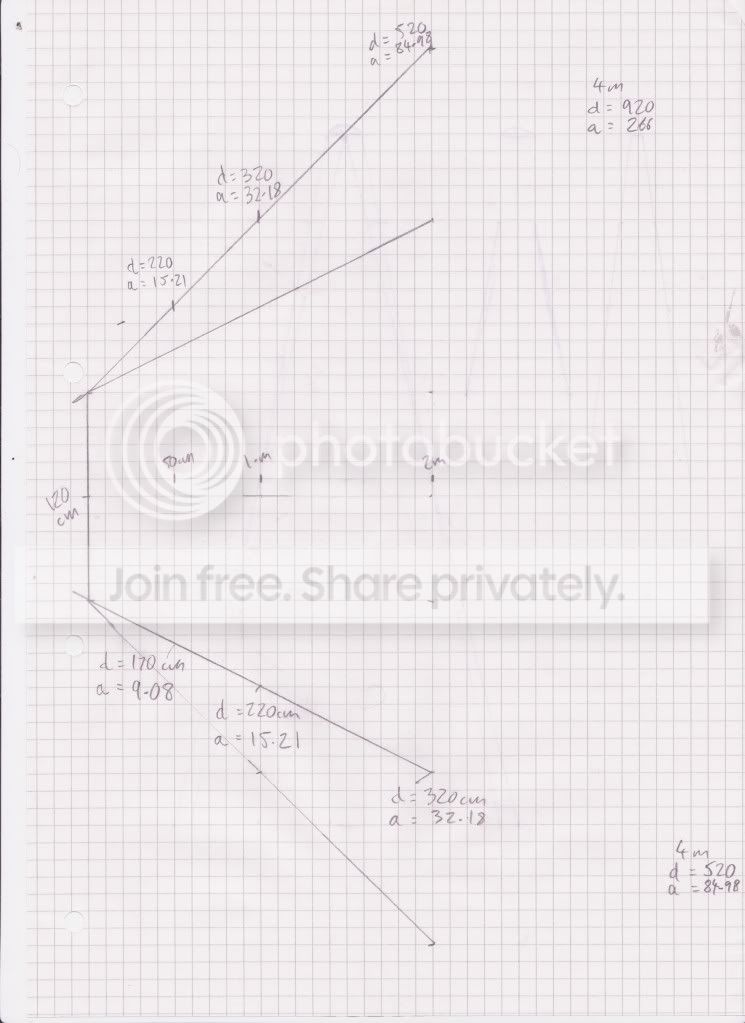
Ok, here's my graph. I drew a 120cm octobox to scale, and then showed two examples of light, the first a narrow beam, the second a little wider.

To save you reading my writing, here are the results.

Firstly, the narrow beam.
At 0.5m area = 9.08m (sq)
At 1m area = 15.21m
At 2m area = 32.18m
At 4m area = 84.98m

Secondly, the wider beam.
At 0.5m area = 15.21m
At 1m area = 32.18m
At 2m area = 84.98m
At 4m area = 266m

All this is showing is what I meant by:
2) the shape of the light - if a modifier creates a beam of light comparable in size to the source, the area lit will not increase as much over distance
or as Andy says you'd need to follow my lines back behind the softbox until they meet and measure distance from there.

In reality the beam might be a lot wider which will reduce the effect.

002.jpg
 
Agreed, it's not about the distance from the centre vs distance from the edge.

Yes it can be. For total (99.9% won't do) accuracy I've no doubt it's important, but for us the key is the size of the light source and the angle at which light comes out. If a light source is large and lets out a narrow ish beam of light, the area lit will not quadruple when distance doubles at near measurements. Going the other way, no matter how wide angled your modifier is, the area lit won't ever more than quadruple.

I don't really agree. The internal design will no doubt have an effect, but I think the main factor is the size (but ignoring distance from the centre vs distance from the edge). I can test it with a 70cm Beauty dish and I'd expect simillar results.

To demonstrate this, grab some graph paper - ok, I'll do it now and post it up in a bit.

I think it's both.

The sheer size of the light surface has an effect, and in addition the way the light is generated and partially collimated internally behind the diffusion surface also has an effect on how the light exits, and the rate of fall-off (amongst other things).

TBH I think that much is obvious, and the reason why we have differently shaped reflectors of the same phyiscal frontal area, which deliver different results - including slight changes to the way they manage the ISL. Put a diffuser on them and the result is different. Put a grid/honeycomb on them and the result is different again even though the frontal area of the light has not changed.

Equally, it is easy to see how the effect diminishes significantly with distance as the collimated component of the light diverges and becomes increasingly reduced. It is only very crudely collimated, unlike a laser or a fresnel spot.
 
I think it's both.

The sheer size of the light surface has an effect, and in addition the way the light is generated and partially collimated internally behind the diffusion surface also has an effect on how the light exits
Yes you're right. I was really thinking about those 0.5m and 1m measurements from a large softbox where the size will skew the results - ie, the results will be quite different from 0.5m to 1m than they will be from 2m to 4m. Whereas the angle the light comes out at will effect whether the area lit is quadrupled with distance, or only doubled or tripled, but that effect should last through the different measuring distances.
 
a softbox would be a line source(and therefore produce a more cylindrical light source), and become a point source after critical distance...in wave theory, theoretically...
 
Back
Top