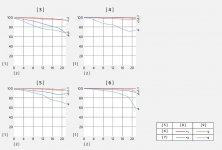
Copy variability? I'm sure Canon aren't immune.
Canon are fairly bad for this with zooms. However my mk2 was pretty bang on other than design faults. Field curvature is not something that develops, as long as it is uniform on both sides and mine was.
The mk1 I had ages ago was a very very very bad copy. Canon Elsetree tried fixing it 4x - yes 4 times - and it came back with different optical flaws one worse than the previous each time until it met its unfortunate end. I looked around online and most were very bad in some way. Very bad even if that was mostly QC.
Perhaps. I also never used it on the R6, I used it on the EF mount, 5Dmk2 to 5Dmk4, so up to 30mp. Granted I am mostly a Prime shooter so the 24-70 never really see much action but when it was needed, it did fine and yes LLP...I shoot weddings lol (isn't that obvious?)
Like I said for event work with very selective focus areas I don't expect anyone to have major problems with mk2. It doesn't have as much microcontact as newer primes wide open, but you may call this an advantage for some customers.
R6 is the most forgiving one of all the bodies, and same would go for R3, with the added benefit of more precise focusing. Mine was mostly on 5D mark III and I did a lot of work on it. At f/11 I felt it was reasonable enough, but looking back I wouldn't mind much better edges in all of them. I only kept it because it was so much better than mk1, and we didn't have the fancier Sigma glass back in the day. The short canon EF L primes, and primarily but not exclusively the mk1s were pretty poor too in the periphery; so Canon initially marketed this as a prime equivalent. You wouldn't get away with it now. So, fast forward to the near past, a brand new 50MP 5Ds lands in my possession and it makes an absolute pig of 24-70mm. 50mm STM kills it everywhere. In fact at f/6.3 you would struggle to match it period. Sigma ART glass does it too. I only had 35mm to begin with and that walked all over it despite being one of the weakest ART in the series. Now it is replaced with much better Tamron. Then of course the 50ART is another major bump and so on.
As a last ditch I threw it on R6 and still no redemption so that was it. Even 16-35 III, another so-so zoom walks all over it, particularly at 35mm or it's weakest spot.
And here is the fun part. This is perhaps the last image shot on it with R6 at 70mm f/9. It absolutely should NOT be sharp everywhere in the frame but it is. The focus is perhaps on that greenery in the right third. Field curvature makes this shot possible without stacking or stupid apertures. Of course if this is all you did, or perhaps are street photojournalist then by all means this is one of the best lenses available for you today.
P.S. It is a test image done in suboptimal light so please don't judge it on artistic merit.

For any wide focus flat field landscapes you get focus very close in on the sides with infinity left totally blurry. Frankly unacceptable. And there gone leaving two big gaps between 35 and 70... or more like 85mm if you use 8k camera.
One thing I dislike with these new 24-70 is they put the hood at the end of the lens, the Mk1 zooms inside the hood which gives better protection from knocks.
I will agree with you on that point. The old lens looked business, the newer ones are like cheap plastic kit lenses on steroids, only not cheap to purchase at all.



www.tamron.com

 dustinabbott.net



 but I'm also reminded of something Prince Philip once said... "Just take the ******* picture."