
jonneymendoza
Suspended / Banned
- Messages
- 8,530
- Edit My Images
- No


So, I don't think that this lens will suit pixel peeping landscape or f1.x flower and hedge shooting guys and girls but for other stuff it's very good. IMO.

Ffs I said I won't buy anymore gear this year. f*** you sigma


Looking at the rumor looks like they are releasing the lens for canon EF and Nikon F too. So the Sony version is just a DSLR version of the left with a permanent adapter stuck to it. Its not a lens designed for mirrorless unlike their APS-C mirrorless lenses (30mm/1.4 and 16mm/1.4).
f*** you sigma indeed, I have no interest in buying DSLR lenses for mirrorless bodies

So what other stuff is there left to shoot?





 If I was doing that and wanted the best results I think I'd use a longer lens and maybe a macro.
That's pretty much how all the gm lenses are likeLooking at the rumor looks like they are releasing the lens for canon EF and Nikon F too. So the Sony version is just a DSLR version of the left with a permanent adapter stuck to it. Its not a lens designed for mirrorless unlike their APS-C mirrorless lenses (30mm/1.4 and 16mm/1.4).
f*** you sigma indeed, I have no interest in buying DSLR lenses for mirrorless bodies

Just in case anyone is interested in the Voigtlander 35mm f1.4.
I've been pixel peeping for two hours and have decided it's about as good in the corners at f8 as the Sony 35mm f2.8.

That's pretty much how all the gm lenses are like
Watched the huff review on YouTube. it’s not a lens for me. Bokeh looked a little all over the place wide open. A mix of oval and hexagon shapes
When you’ve used the FE 85mm f1.4, it’s hard to find bokeh at that level
yes, I've probably been spoilt by using fuji and sony primes that are razor sharp wide open.
That's pretty much how all the gm lenses are like
Watched the huff review on YouTube. it’s not a lens for me. Bokeh looked a little all over the place wide open. A mix of oval and hexagon shapes









View attachment 121036
View attachment 121037
View attachment 121038
View attachment 121039
Certainly sharp at f1.4 in the central area, but may not look as sharp here as it does on my screen.
View attachment 121040
I'll have a look at bokeh balls when I get the time and subject but for this week until Friday I'll have no time to myself at all.
my mistake - i was thinking of the 40mm
but it's big and heavy and this 35mm isn't. The 40mm is more of an all rounder though and suits me for walk about stuff.
Ah, I think the FE 40mm is excellent, one of the best lenses I've ever had the pleasure to use

I disagree, while most of them bar 16-35mm and 100-400mm are DSLR size they were designed for mirrorless bodies. It's not like they permanently stuck an adapter on an a-mount version of the lens.
I don't see any evidence that Sigma are simply going to permanently stick an adapter on another mount version of this (yet to be announced) lens.
Why would they bother doing that when they could not bother with an FE mount lens and just tell people to buy the MC-11 adapter?


I don't know and that puzzles me too. Unless they are not adding any more lenses via. Firmware updates for new lenses.
Currently it's just all something I picked up from the rumour. If you believe the rumour that sigma is going to announce 105mm for Sony FE then why not believe the part that implies/says it's just a DSLR version with permanent adapter stuck to it.
I don't see any evidence that Sigma are simply going to permanently stick an adapter on another mount version of this (yet to be announced) lens.
Why would they bother doing that when they could not bother with an FE mount lens and just tell people to buy the MC-11 adapter?
Are the A7/A9 mirror less cameras? Are they better than standard DSLRs?

It could be that they can optimise the AF by implementing it specifically for FE, rather than have the MC-11 'translate' between FE protocols and EOS.
- Once the lens is released in both formats, as comparison of the two options will be possible, which may give the answer.
Another benefit could be mechanical - you remove the MC-11 / Lens link, making the whole assembly stronger (and simpler).
They may also feel that users are more likely to buy a lens which is apparently 'native'.
I guess the issue of physics still applies so if people want fast FF glass, the lens still needs to be as big so maybe it makes sense to use existing designs (with updated, ‘native’ firmware) and a physical spacer built in. Look at the new Tamron lens. Before it’s even officially announced, some people on here have written it off because it’s ‘only’ 28-75 but it appears to be smaller than existing GM lenses that are 24mm at their widest. The alternative would be for Tamron to take their existing 24-70 and bolt a spacer onto it.
I didn't say it had to be pancake size. I am well aware that such lens will be large mirrorless or DSLR. But a mirrorless design could perhaps look at eliminating the hollow 26mm tube that will be there to simply make up the flange distance.

I'm no lens designer but I'd imagine Sony would have already managed to do that if they could. The GM lenses are as big as (or lager) than equivalent CaNikon lenses;
The only way to make the lenses smaller is to slow them down (e.g. F4) or limit their focal range (e.g. 28-75 instead of 24-70). The image above shows how much smaller the FE 24-70/4 is than the FE 24-70/2.8.
Possibly but reading the articles on SAR there isn't a single mention of an adaptor?
They mean that you could use an existing Canon version of the Sigma lens and their MC11 adaptor to get the same end result. This 'new' FE lens from Sigma could just be the same Canon version with the technology from the MC11 embedded into the body instead.
Possibly but reading the articles on SAR there isn't a single mention of an adaptor?
Yes they are as big but the flange of Sony e-mount is ~26mm shorter. So there is still that advantage. The overall length of your set up is still 26mm shorter. Now if sigma simply puts a hollow 26mm tube at the end of their lens to convert it for e-mount then it'll be 26mm longer than DSLR version and hence loses that smaller flange advantage.
Well I would make that judgement based on one lens. For example GM85 is the 107mm Vs new 85L/1.4 which is 105mm. Sony is only 2mm longer in this case, not 26mm.But Sony can't mount the same optical construction 26mm closer to the body because of the physics involved in covering the full sensor (image circle).
Well I would make that judgement based on one lens. For example GM85 is the 107mm Vs new 85L/1.4 which is 105mm. Sony is only 2mm longer in this case, not 26mm.
So I think if lenses are designed specially for mirrorless they can still largely retain the benefits of smaller flange. And in case of UWA lenses they be even smaller compared to DSLR equivalents.
But they said they be making e mount lenses from the ground up else if they simply slapped on a built-in mc 11.they would have released e mount lenses ages agoThe MC-11 does 2 things
1) Physically moves the lens to the correct distance from the sensor and provide an E Mount fitting
2) 'Translate' Sony AF commands to EOS (or Sigma) commands (and vice versa, for the responses).
They MAY have simply eliminated the need for an MC-11 by extending the lens body (a purely mechanical exercise), and putting the circuit board from an MC-11 in this extra space
OR they may have replaced the circuit board from an EOS mount lens with one that 'natively' talks Sony AF.
I would imagine it should also be possible to design a lens which had a different rear element, so did not need to be as far from the sensor, and so could be a bit shorter, but that would increase the testing / design costs, so seems less likely!

Ignoring the size of the bodies;
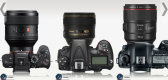
View attachment 121053
Sony GM 85/1.4 - 107.5mm Long
Nikon 85/1.4G - 84mm Long
Canon 85/1.4L - 105.4mm Long
Considering the flange depth for the Nikon mount is the longest of all current manufacturers at 46.5mm, they can still make their entire lens 23mm shorter than Sony's lens. Maybe Nikon should be designing lenses for Sony ;0)
If you look at the 3 cameras above, you can see where their sensors are positioned by the marker on the top plate. If the Sony sensor was moved back by 28.5mm to align with the Nikon and the lens mount was kept in the same place, the Sony lens would (theoretically at least) be 28.5mm shorter which brings it down to 79mm. My point is that you probably can't make the lenses any smaller and retain the same aperture/focal length.

Anyone going to the NEC photography show,
 JDR08453.jpg
 BarcelonaWinter2017-232.jpg