Hi all, is it possible to sync 2 different brands of off camera flash. I used to use a canon speedlite, but then got a gidox with wireless transmitter which is great. I'm sure I seen somewhere that I can sync the canon to flash when the godox is fired, and I would like to try this to have a 2nd flash for rim lighting etc. Can anyone advise? Thanks


You are using an out of date browser. It may not display this or other websites correctly.
You should upgrade or use an alternative browser.
You should upgrade or use an alternative browser.
Syncing 2 different flashes
- Thread starter McNyat
- Start date

realspeed
Suspended / Banned
- Messages
- 8,827
- Name
- Bazza
- Edit My Images
- No
yes I did it click on link below link
 www.talkphotography.co.uk
you have to have the same group settings and the same channel settings . don't forget to make the godox flash into a slave the canon only need to be on
Then to trigger the Panasonic cameras I used Pixel Oppillas trigger and receiver one each camera. these can be switched off without battery removal
Now the Pxel transmitter fires not only the cameras but also the flash guns as shown above
the flash sequence is Godox master to Godox flash gun (slave) to Godox x1 to in my case Nikon SB900 (on)
The camera sequence is from Pixel Oppilas trigger to both Oppilas receiver , one on each camera
this setup can be expanded for more cameras and flashguns of any make provinding the Godox receiver is for that make of camera and corresponding flashgun
At least that is how I set mine up and a lot od AA _AAA batteries
hope this helps
flash setup
The aim is to set up 2 cameras and 2 flashguns all fired from one transmitter and use a camcorder at the same time. WOW. equpment Nikon SB900 flashgun- Godox V860ii flashgun- Godox X2 master for flashguns- and Godox XC1 receiver for SB900 . To trigger the Panasonic cameras G9 and G9ii I used...
www.talkphotography.co.uk
you have to have the same group settings and the same channel settings . don't forget to make the godox flash into a slave the canon only need to be on
Then to trigger the Panasonic cameras I used Pixel Oppillas trigger and receiver one each camera. these can be switched off without battery removal
Now the Pxel transmitter fires not only the cameras but also the flash guns as shown above
the flash sequence is Godox master to Godox flash gun (slave) to Godox x1 to in my case Nikon SB900 (on)
The camera sequence is from Pixel Oppilas trigger to both Oppilas receiver , one on each camera
this setup can be expanded for more cameras and flashguns of any make provinding the Godox receiver is for that make of camera and corresponding flashgun
At least that is how I set mine up and a lot od AA _AAA batteries
hope this helps
Last edited:

Sangoma
Suspended / Banned
- Messages
- 2,951
- Name
- Steve, Coventry, England
- Edit My Images
- Yes
You could put light triggers on each flash, then use the on camera flash to trigger them, with a white card in front of it if you don't want any light from it, or you could use a radio remote on one flash, and a light trigger on the others.
Using the on camera flash as a tirgger won't work when it flashes before the main exposure (ie red eye reduction or focus assist)
Using the on camera flash as a tirgger won't work when it flashes before the main exposure (ie red eye reduction or focus assist)


swanseamale47
Suspended / Banned
- Messages
- 10,876
- Name
- wayne clarke
- Edit My Images
- Yes
Another way is to get a cheap wireless set with 2 recievers of flebay, I've got one somewhere. Works a treat, only snag is it's manual only. Think I payed about a tenner?
Peter Drought
Suspended / Banned
- Messages
- 277
- Name
- Peter
- Edit My Images
- No
They have a the X1C system that fits to the hotshoe on the Canon flash. Tried it a while back but it was difficult to set up (getting the flash gun settings right - can't remember exactly how it worked, only that it was a pain to do) and proved unreliable in practice, so ended up sending the things back. More reliable would be to fit a dumb trigger to the top of the transmitter and to the Canon flashes, but this involves manual control of the Canon flash power settings (someone else alluded to this above I think). The godox remote system is ok if you only use godox, but not so great when you start trying to get it to talk to other things. The simple answer was it was frustrating to use and didn't work well.
realspeed
Suspended / Banned
- Messages
- 8,827
- Name
- Bazza
- Edit My Images
- No
Peter
yes a bit of a pain to set up.
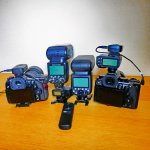
Everything has to be in the same group and and channel. In the picture above the camera on the right has the godox master flash transmitter Godox X2T(o) for panasonic and on top of that is the camera trigger receiver Oppilas . The other camera on the left only has the Oppolas receiver on the cold shoe. Both Oppilas receivers plug directly into cameras
Now the tricky part
the Godox flashgun on the right works as a" slave" triggered by the master on the camera cold shoe "Godox(X2T9(o)" that is on the right . Both on same channel and group
the second Nikon SB900 flashgun won't work unless it has a Godox receiver X1(n) underneath for Nikon cameras. This receiver also has to be in the same group and channel as the master. The Nikon flashgun is set to main.
so what happens is the oppilas transmitter in the front triggers both cameras together, as well as the flash guns.
the camera on the right can now receives a signal from the Oppilas trigger to the Oppolas receiver to the camera. This in turn sends a signal to the Godox master (X2T(o) on the cold shoe which in turn triggers the flash guns.
to understand all this needs to be read line by line or like me it gets confusing
NB
I used the Pixel Oppilas transmitter and receivers a they can be turned off without having to remove the batteries (fires the cameras)
Godox fires the flash guns
yes a bit of a pain to set up.
Everything has to be in the same group and and channel. In the picture above the camera on the right has the godox master flash transmitter Godox X2T(o) for panasonic and on top of that is the camera trigger receiver Oppilas . The other camera on the left only has the Oppolas receiver on the cold shoe. Both Oppilas receivers plug directly into cameras
Now the tricky part
the Godox flashgun on the right works as a" slave" triggered by the master on the camera cold shoe "Godox(X2T9(o)" that is on the right . Both on same channel and group
the second Nikon SB900 flashgun won't work unless it has a Godox receiver X1(n) underneath for Nikon cameras. This receiver also has to be in the same group and channel as the master. The Nikon flashgun is set to main.
so what happens is the oppilas transmitter in the front triggers both cameras together, as well as the flash guns.
the camera on the right can now receives a signal from the Oppilas trigger to the Oppolas receiver to the camera. This in turn sends a signal to the Godox master (X2T(o) on the cold shoe which in turn triggers the flash guns.
to understand all this needs to be read line by line or like me it gets confusing
NB
I used the Pixel Oppilas transmitter and receivers a they can be turned off without having to remove the batteries (fires the cameras)
Godox fires the flash guns
Last edited:
swanseamale47
Suspended / Banned
- Messages
- 10,876
- Name
- wayne clarke
- Edit My Images
- Yes
I have to admit I have wondered why OCF is quite as complicated as they seem to have made it. I get it with the different groups and channels, but in the real world how many photographers use four groups and the different channels? I suspect most dont use more than three flashes and one channel for the most part.
The same with camera makers built in OCF, in fairness I found Nikons simpler than Canons, but both seem to involve more steps than I would have thought, and none I've come across are intuitive. (I have my Canon steps written down in my bag) the reason I dont use Canons OCF!
All it should need is an OCF on in the menu and the same button on the flashgun.
The fact so many use things like Godox for off camera flash suggests the makers are missing a trick.
The same with camera makers built in OCF, in fairness I found Nikons simpler than Canons, but both seem to involve more steps than I would have thought, and none I've come across are intuitive. (I have my Canon steps written down in my bag) the reason I dont use Canons OCF!
All it should need is an OCF on in the menu and the same button on the flashgun.
The fact so many use things like Godox for off camera flash suggests the makers are missing a trick.
The godox flash is the v1c, and the canon flash is the speedlite 580exIt’d help to know which particular Canon flash, Godox flash and trigger.
The short answer is Yes, the how is more complicated

Phil V
Suspended / Banned
- Messages
- 26,303
- Name
- Phil
- Edit My Images
- No
The godox flash is the v1c, and the canon flash is the speedlite 580ex
Worst - if you have an STE2 or another Canon flash you can use Canon's near IR remote system as IIRC the Godox flashes can be controlled by that (screen goes a different colour
Simplest AFAIK the Canon has a simple optical slave setting which would work for Manual flash, so will fire when you remotely fire the Godox flash using a Godox radio trigger.
Best, as @juggler says, buy a Godox receiver to mount to the Canon flash and it can be controlled just like any other Godox flash.
Peter Drought
Suspended / Banned
- Messages
- 277
- Name
- Peter
- Edit My Images
- No
To me it depended very much on what you were using the things for. The context of how I was using it was to light interiors - several per house - so yes being able to control flash power from the top of the camera might be useful as you have to change setting a lot - ie theoretically it saves time - a little. Similar for a rapidly moving wedding I suspect. In a studio though, it is questionable whether this level of complexity is of any genuine use. Most of the time, the lights are set up once or twice and the rest of the time is spent directing the model (ie not changing anything lighting wise). It is difficult to see a genuine reason for adding that level of complexity, when simple dumb triggers will do everything that is needed.
Interestingly, I subsequently tried a fully integrated godox system later using AD200 's and, although easier to set up and operate, the time savings on normal sized jobs weren't that significant. The different shape and spread of the light from them when using the bulb attachment through diffusers is an advantage and enables you to deal with more challenging lighting scenarios - dark or high contrast - than a speed light could, but there "isn't" particularly much if any time benefit.
Interestingly, I subsequently tried a fully integrated godox system later using AD200 's and, although easier to set up and operate, the time savings on normal sized jobs weren't that significant. The different shape and spread of the light from them when using the bulb attachment through diffusers is an advantage and enables you to deal with more challenging lighting scenarios - dark or high contrast - than a speed light could, but there "isn't" particularly much if any time benefit.
Last edited:
My Minolta Dynax 9s (and 7Ds) communicate with slave flashes via their little pop-up flash units. Just dial in the power for each external flash and everything is taken care of. If you don't want the on-camera flash to fire then it can be replaced by a controller unit in the hot shoe.
It's a brilliant system which works superbly. What a shame that such an innovative manufacturer as Minolta is no longer with us.
It's a brilliant system which works superbly. What a shame that such an innovative manufacturer as Minolta is no longer with us.
swanseamale47
Suspended / Banned
- Messages
- 10,876
- Name
- wayne clarke
- Edit My Images
- Yes
You can also normally dial down the onboard flash power, as well, it's in the menu often.This is the slave mode on the lower end Neewer flashes units I had. It was quite sensitive so you heavily diffuse the on camera flash so it didn't effect the shot and they would still go off.
I've also seen a bounce gadget for onboard flash, my mate had one, no idea if they work though.
Phil V
Suspended / Banned
- Messages
- 26,303
- Name
- Phil
- Edit My Images
- No
Most Canikon cameras with built in flash have that feature. But it’s far from ‘brilliant’.My Minolta Dynax 9s (and 7Ds) communicate with slave flashes via their little pop-up flash units. Just dial in the power for each external flash and everything is taken care of. If you don't want the on-camera flash to fire then it can be replaced by a controller unit in the hot shoe.
It's a brilliant system which works superbly. What a shame that such an innovative manufacturer as Minolta is no longer with us.
In fact compared to proper radio triggers it’s frustratingly bad.
Sony kept the system with their A-Mount cameras, and also in their E-Mount cameras - for models without a built in flash, if you have a Sony flash (on older A-Mount cameras with the older hotshoe, some Minolta flash as well) then that can act as a controller for other Sony Flash.My Minolta Dynax 9s (and 7Ds) communicate with slave flashes via their little pop-up flash units. Just dial in the power for each external flash and everything is taken care of. If you don't want the on-camera flash to fire then it can be replaced by a controller unit in the hot shoe.
It's a brilliant system which works superbly. What a shame that such an innovative manufacturer as Minolta is no longer with us.
It works quite well, but does not have the same versatility of a decent set of radio triggers, and of course requires line-of-sight (this can be via reflection off walls, etc, up to a point).
+1You could put light triggers on each flash, then use the on camera flash to trigger them, with a white card in front of it if you don't want any light from it, or you could use a radio remote on one flash, and a light trigger on the others.
Using the on camera flash as a tirgger won't work when it flashes before the main exposure (ie red eye reduction or focus assist)
Any 'preflash' makes optical slaving fail...the 'preflash' happens BEFORE the shutter actually opens, which is the problem. Preflash is what happens with any digital camera nTTL, as well as during redeye reduction or focus assist.
You need to set the slave unit to S2 if there is a preflash, S1 if no preflash.+1
Any 'preflash' makes optical slaving fail...the 'preflash' happens BEFORE the shutter actually opens, which is the problem. Preflash is what happens with any digital camera nTTL, as well as during redeye reduction or focus assist.
ASSUMING that the slave unit in use has those settings! Many optical slaves existed prior to the invention of digital cameras and the need for their version of flash automation.You need to set the slave unit to S2 if there is a preflash, S1 if no preflash.
Last edited:
Phil V
Suspended / Banned
- Messages
- 26,303
- Name
- Phil
- Edit My Images
- No
TTL flash measurement predates digital by quite a way.ASSUMING that the slave unit in use has those settings! Many optical slaves existed prior to the invention of digital cameras and the need for their version of flash automation.
Yes, very old flash units, the simple optical cell add ons, or the simple optical slaves found on some studio strobes are all examples of things that lack this functionality - but in the context of the original post, referring to relatively modern units (last 10-15 years), then pretty much any camera flash with optical slave mode has S1/S2.ASSUMING that the slave unit in use has those settings! Many optical slaves existed prior to the invention of digital cameras and the need for their version of flash automation.
If you are using something that doesn't support S1/S2, then you need to switch off pre-flash on the camera - no red-eye reduction, no ttl - but if you are using simple optical triggering you won't have ttl anyway, so that's not a problem.