Studio set up for Product Photography?

Quaker

Suspended / Banned
Messages
972
Name
Quaker
Edit My Images
Yes
By accident I posted this on another thread, my apologies to the moderators!

I know, I know its one of those questions we all dread about what kit should I buy etc..

Background

I don't have a studio nor do I intend having one therefore my knowledge is extremely limited in this field.

However, the company I work for now wants to improve the quality of its product photography. In the past it has been a case of someone with a point and shoot taking an image with a piece of white A4 paper as a background.

This has perturbed me for quite a while and I decided to show them what could be done with my DSLR (Nikon D300s). I took a few basic, quick photos spent a few mins in post processing and presented an image to the CEO who has now decided he wants to hire my camera and purchase a decent lighting kit for the company.

This is where I need help!

Products I will be photographing are:

Graphics Cards
Capture Cards
Industrial PCs + Expansion Chassis
Back planes
Cables etc

I have been given a budget of somewhere in the region of £1k

I don't want cheap, unreliable kit and neither do I want top of the range kit that is way over the top for what I need.

I have done a bit of scouting around and I have been drawn into the "Bowens Gemini 500C/500C flash head kit". I will obviously need to get a stand and back drop as well.

What I want to know is am I looking at the right level of kit i.e. am I still over the top or do I need a bigger budget.

The images will be used primarily for website use and pdf datasheets etc.

My apologies for the sweeping question but I don't know where else to seek advice.

Something I forgot to mention, time is not on my side. They want me to start shooting next week!

Thanks in advance

Quaker
 
There are a lot of questions on this subject, this thread may help.

You don't need a stand and a backdrop, what you need for this type of photography is a product shooting table and an overhead boom arm. I don't know what a
Industrial PCs + Expansion Chassis
is, but if it's no wider than about 40cm then the small product shooting table I linked to above will be fine, otherwise you need a larger one such as this one - which, in practical terms, needs to be left up permanently, unlike the smaller one which folds up in seconds..

You will also need two softboxes, this one will do for either table and another one the same or this one will be fine for more or less frontal lighting. You will also need a honeycomb for some products and this 10 degree one is probably the most useful.
You will also need a low level stand and a flash meter.

As for lights, you will probably be able to manage with two, most of the time but 3 would make your life easier and should be within your budget. An extra light can be used to backlight or to provide texture to those products than need to show them, and can also be used if required to underlight or backlight the shooting table if you want to produce a pure white background - an extra low level stand will of course be needed.
The Bowens 500 kit is more than adequate but in fact is overkill and will almost certainly result in more power than you can (easily) cope with. 300ws would be better for such small products.

Equipment is of course just the start - you need knowledge and practice too.
 
Thanks Garry,

An industrial PC is a large and heavy computer that the user would fit into a purpose built rack. An Expansion Chassis is a box of similar size and weight to an IPC which contains a backplane that expands the number of PCIe slots that can be used. We link upto 3 expansion chassis to an IPC so we are talking a lot of weight and a lot of space hence the backdrop.

You advice is really gratefully received and I will look into toning down the wattage to 300.

Thanks a lot.
 
In that case I would still go with one of the product shooting tables but I wouldn't advise you to go for a backdrop, even for the larger items - lighting a backdrop will involve at least two more lights and a fair bit of time, and the lights for the backdrop will need to be more powerful than the ones used for the main subject.

The only time that I would advise using a backdrop is if there are a very large number of products that need to be photographed, it may be economically viable in this case. Otherwise, just use whatever happens to be there as a background and get the images cut out. I sub this work out to Clipping Paths Asia, they offer a very good service for very little money.
 
The more I look into this the more I am beginning to understand it.

Lastolite do a Cubelite kit (150cm) which is probably just what we are looking for I would probably invest in a table as well for the smaller products.

Interesting stuff this.

Cheers Garry, you are giving me a lot to think about.
 
Any kind of light tent will be absolutely the worst way to go - and I say that even though Lencarta make them too.

You need to be able to control the light -
 
Last edited:
Having a look through the kit you recommend, Garry takes me over budget so I will have to look at something cheaper.

I appreciate with cheaper kit the results wont be as good theoretically but I have to cut my cloth accordingly.
 
Having a look through the kit you recommend, Garry takes me over budget so I will have to look at something cheaper.

I appreciate with cheaper kit the results wont be as good theoretically but I have to cut my cloth accordingly.
Fair enough, your decision.
But my advice would be to either increase your budget - after all, it isn't a lot of money for a business to spend - or to abandon the whole idea.

Using inadequate equipment in the hope that you may be able to achieve mediocre results probably isn't the best way forward.

My own principle in business is always to spend as little as possible but as much as necessary:)
 
So are you saying its impossible to get any decent results without spending well over a thousand quid and unless we spend that amount of money we should abandon the idea totally?

That seems a bit OTT if you dont mind me saying. I am sure there are people out there creating some good images with lighting systems costing less that a thousand quid.
 
So are you saying its impossible to get any decent results without spending well over a thousand quid and unless we spend that amount of money we should abandon the idea totally?

That seems a bit OTT if you dont mind me saying. I am sure there are people out there creating some good images with lighting systems costing less that a thousand quid.
No, I'm not saying that at all.

Of course it can be done with cheaper equipment, and someone with my own level of experience could manage with very little in the way of equipment, because knowledge and experience are often a good substitute for equipment. I wouldn't though, because having the right equipment makes the job much easier, much more time efficient and allows consistent (as well as good) results to be obtained efficiently.

With the greatest possible respect, you have neither skill nor experience in this type of work and because of this equipment becomes much more important.

If it's worth doing at all then it's worth doing properly
 
Garry is 100% correct IMO

Experience can make up for lack of equipment, but that does not come easily.
 
Hi Quaker
Have a look at this, quite an old thread but its the sort of thing you are talking about taking pics of.

http://www.talkphotography.co.uk/forums/showthread.php?t=255818

Tinyspark borrowed my cheap ebay lights, which worked well, and she did the shots with a backdrop. If you feel the end result was acceptable then you can see sort of thing that is achievable at bottom end of budget.
 
Last edited:
Garry is 100% correct IMO

Experience can make up for lack of equipment, but that does not come easily.

Hmmmm perhaps we should give up the idea then as over £1000 budget is not going to happen.

Or

I could work hard, learn about it, practice, learn from my mistakes and go for it.

I am quite a determined sort so maybe I will give it a go and stay within budget.

Thanks for the encouragement and help.
 
I suspect that Garry has deliberately stayed away from mentioning Lencarta Smartflash lights which are well within your budget as a three head starter kit is around £450 (an additional head is about £100 more) add a few extra modifiers, a LL stand and a heavy duty stand with a boom arm and you should be able to easily come in below budget.

The small shooting table will be an additional £50 which should leave you enough for some white vinyl on a roll which you can mount on a wall with a couple of L brackets to make a cove for the larger bits of equipment.

Whilst I agree that a white background is not the easiest to light, with four lights you should be able to manage a reasonable attempt, and I would expect that they would almost certainly be better than your company are producing with their current method.
 
I suspect that Garry has deliberately stayed away from mentioning Lencarta Smartflash lights which are well within your budget as a three head starter kit is around £450 (an additional head is about £100 more) add a few extra modifiers, a LL stand and a heavy duty stand with a boom arm and you should be able to easily come in below budget.

The small shooting table will be an additional £50 which should leave you enough for some white vinyl on a roll which you can mount on a wall with a couple of L brackets to make a cove for the larger bits of equipment.

Whilst I agree that a white background is not the easiest to light, with four lights you should be able to manage a reasonable attempt, and I would expect that they would almost certainly be better than your company are producing with their current method.
Yep, Lencarta prices have all been revamped, some have gone up, most have gone down and the 3 head SmartFlash kit is now much better value - I didn't mention it because I just get a bit sick of being accused of all sorts of things if I even mention Lencarta on this forum...

I repeat, it isn't a lot of money for a business to spend. In the current economic climate the serious-minded businesses are spending at least as much on marketing their businesses, often more, to capture greater market share. The people who won't spend probably won't be around when things pick up...


Hi Quaker
Have a look at this, quite an old thread but its the sort of thing you are talking about taking pics of.

http://www.talkphotography.co.uk/for...d.php?t=255818

Tinyspark borrowed my cheap ebay lights, which worked well, and she did the shots with a backdrop. If you feel the end result was acceptable then you can see sort of thing that is achievable at bottom end of budget.
Yes, I remember that thread and she did well to go from terrible results to results that she personally was happy with. I think that that thread proves that some kind of results can be achieved with cheap lights, but it's much easier to get good results with good equipment, and virtually impossible to get consistent colour temperature and consistent exposure without good equipment.
 
Those lights are fine Garry, you have never used them nor seen them to comment.

They have been used alot, and I am getting consistent colour temperature and exposure from these lights. Once my shots are set-up they are consistent, and all look the same.

People on this site use all sorts of different makes and models of cameras to suit their budget, lighting is the same.

The OP can get a lighting kit to get acceptable results within his budget, Tinyspark was completely new to studio lighting, and she was happy with what she got, and so was the customer. At the end of the day, thats all that matters.

People should not be put off buying the kit they can afford.
 
No, I'm not saying that at all.

Of course it can be done with cheaper equipment, and someone with my own level of experience could manage with very little in the way of equipment, because knowledge and experience are often a good substitute for equipment. I wouldn't though, because having the right equipment makes the job much easier, much more time efficient and allows consistent (as well as good) results to be obtained efficiently.

With the greatest possible respect, you have neither skill nor experience in this type of work and because of this equipment becomes much more important.

If it's worth doing at all then it's worth doing properly

I have sent you a PM, can you get back to me asap?

Cheers
 
Hmmmm perhaps we should give up the idea then as over £1000 budget is not going to happen.

Or

I could work hard, learn about it, practice, learn from my mistakes and go for it.

I am quite a determined sort so maybe I will give it a go and stay within budget.

Thanks for the encouragement and help.


I don't think you should give up, but understand it may just take a bit of time even if you had the right equipment.

Gary may sell a brand but his advise is and always has been sound and although I have not experience with Lencarta, at you price point it maybe a good place to start.

Grab a copy of Light Science and Magic
 
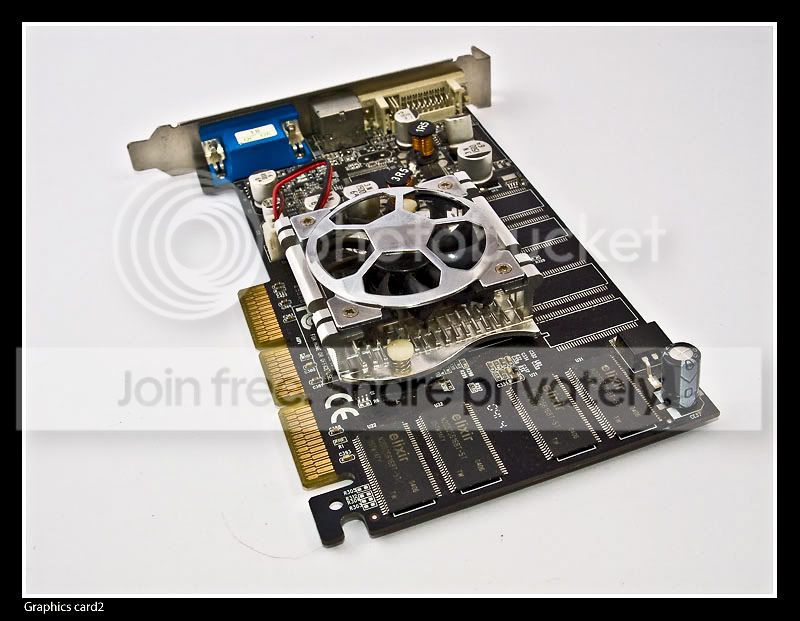
I don't have a studio nor studio flash, how does this rate in your expectations?

Graphicscard2-framed.jpg
 
A light tent tends to produce well lit but slightly boring product shots. You can generally see the product but it doesn't have the mysterious something else. Producing this something else with a light tent and a tiny budget is something I'd like to work out how to do. So far I haven't achieved it...

I've never used continuous lighting that is aimed at this market as it seems to be nearly as expensive as a cheap flash solution. Interfit do cheap portable flash kits. £150 for a twin head. I don't think you'd get the years of reliable use out of them but if you wanted something cheap that did the job and wasn't continuous lighting then they'd be suitable if your budget is small.

If you have the camera set to AWB wouldn't it compensate for variations in the lighting temperature to a degree anyway?
 
A light tent tends to produce well lit but slightly boring product shots. You can generally see the product but it doesn't have the mysterious something else. Producing this something else with a light tent and a tiny budget is something I'd like to work out how to do. So far I haven't achieved it...

I've never used continuous lighting that is aimed at this market as it seems to be nearly as expensive as a cheap flash solution. Interfit do cheap portable flash kits. £150 for a twin head. I don't think you'd get the years of reliable use out of them but if you wanted something cheap that did the job and wasn't continuous lighting then they'd be suitable if your budget is small.

If you have the camera set to AWB wouldn't it compensate for variations in the lighting temperature to a degree anyway?
Continuous lighting wouldn't be my first choice, but AWB does compensate for the different colour temperatures produced by voltage fluctuations to some degree. But AWB doesn't work with studio flash, and even if it did it wouldn't help because all that AWB (or PP) can realistically do is to change the overall colour temperature. The problem with the cheaper flash heads that produce inconsistent colour temperature is that 2 heads are just as likely to differ in different directions as in the same direction - and if 2 heads both vary by say 400K then the difference can be as high as 800K, producing a blue light from 1 and a yellow light from the other.

I say 400K of variation, I have in fact seen variation as high as 1000K!
 
Back
Top