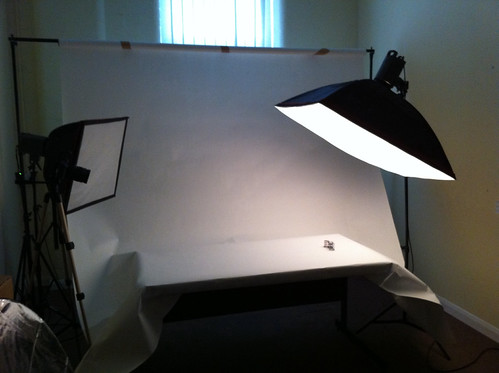
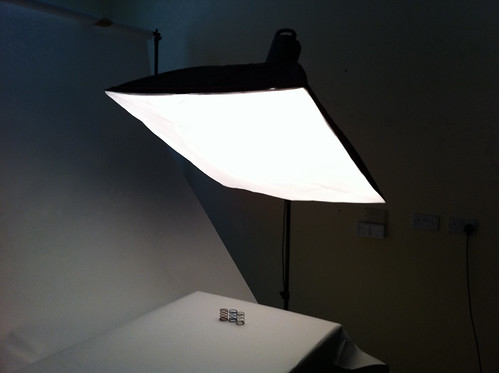
It's snowing hard outside, some kind soul drove into my Merc (didn't stop of course) so I can't drive it, not that it would go anywhere in the snow, and my 4x4 is in the garage having a new ignition switch fitted, so I'm stuck here...
So, a quick post about last Sunday's product photography workshop.
In a way, shooting products is easier than shooting people because everything is totally under our control, and the shot doesn't get ruined by a slight change of position or expression - but for the same reason, we have no excuses when we mess it up...
The first question is always 'Why?'.
Why are we taking the shot?
Who will see it?
Who is the product aimed at?
What are its benefits?
Once we know all this we can start to plan the shot, decide on the type of background and so on. And we can do the arrangement/composition.
The arty side is sometimes done by the photographer but, where advertising agencies are involved, they often send along a creature known to the agency as an art director or creative director - photographers have different names for them

Art directors are often failed photographers who, because they know nothing about lighting, don't understand the problems they create when they insist that a shot needs to be done a certain way. But that weakness is also often their strength, because when a photographer does the composition it's tempting to do it in a way that doesn't create lighting, depth of field or other problems.
Anyway, no art director here so I got the group to play art director and before we moved on to photographing the specific items that they needed to learn to light, we started on something of mine. 2 boxes of shotgun cartridges that I'd won for
getting top score the previous week. (which I thought I'd mention modestly).
I didn't expect to win them, it doesn't happen very often and I just stuck 1 box in each pocket, then slung them into the back of the car. It was only later that I thought I could use these cartridges to make life difficult for the people on Sunday, by which time they were a bit battered, breaking the golden rule that all products must be in perfect nick.
So, they arranged them prettily, trying to make even a boring subject look interesting. I kept out of it as much as I could.
Next decision is on camera height. The lower the camera, the stronger the reflection from the shooting table base and the more 'heroic' the subject, but the more difficult it is to read the info on the top of the box, or even to see the top of the box.
So, set the camera low and put the second box further back and out of focus so that people could recognise the brand (which they would if this was an ad to go in a shooting magazine).
Lighting here was very simple, it nearly always is. The job of the lighting was to make the shot look interesting, at the same time illuminating everything well enough for there to be no hidden areas. With shiny cardboard, fairly shiny plastic cartridge cases, very shiny 'brass' and so on, it's really just a decision about how close and at what angle the overhead softbox should be, as a starting point at least.
Now, on to the shots. I messed up on this one because I normally shoot tethered but assumed that everyone would want to take shots on their own cameras (they didn't) and I knew I wouldn't have the software for obscure cameras like Canon, or the time to set up tethered shooting for 6 different cameras. Cowaski Darren came to the rescue, using his own D700 for the first shot and everyone just used his camera for all of the other shots too... Darren then uploaded the photos to
here - many thanks. The photos are straight from camera.
Here's the shot of the cartridges. OK, although I will never do anything at all to a shot in terms of PP when I'm uploading them for this purpose, obviously the shot needs to be cropped and generally tidied up.
These particular cartridges are in a green translucent case. On the telly and in films shotgun cartridges always seem to be red but in fact they vary a lot, and a few of them have see through cases like these so, how can we light a cartridge to show the contents if we want to?
The answer is to backlight it and I showed how this was done, using a very expensive focusssing spotlight fitted with movable shutters that can create literally any shape of light - in this case a small vertical slit. But not everyone has one of these fancy gizmos so I showed people the slightly cheaper way of doing it, shining a flash head through a cardboard box with a slit cut into it.
All pro photographers use bodges like this and my studio is full of blu-tak, blackwrap, masking tape, gaffer tape, car spray paint and so on. People who shoot advertising/commercial for a living don't have to worry about their gear looking 'professional' in the same way that portrait photographers may have to.
We then moved on to the various things that people had brought with them - jewellery, a go faster turbo dump valve for boy racers, wedding/greetings cards, a rucksack and so on.