Beginner Street photography. harder than I thought.

Have a couple of pics, All I did was crop and resize. I have more but nothing spectacular.
View attachment 458116

View attachment 458117

Personally.... I think they are cropped way too tightly. This results in IQ suffering quite a bit & also the tight field of view eliminates the immediate environment which loses any feeling & interest & any story.
 
This..... I'm not saying it's an award winning photo. Some of you might not see anything in it at all. And some might say it isn't street because it actually has people in it instead of just a postbox :) But, I think, it sets a scene & location in an urban shopping area - Bath, btw. Sun is shining, mother in 'summer' style clothes & some funky sunglasses. She's dancing in front of/with her children. You can see the father/son buskers so you know there's some lively music in the scene. There's a few other details with people/lights through the shop windows & reflected in the shop windows. It's not framed too badly. And it's shot on film, manual focus & actually IN focus :)

** Your opinion may vary. Widely...... ;)


*** by Lee, on Flickr
 
Well done for getting back out there, confidence will build the more you do it. :)
 
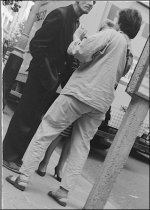
Sometimes, you happen across an incident that seems worth recording, without regard to the "artistic sensitivity" of a poterntial viewer...

Confrontation in London Rollei 35B 1991 44-11.jpg

Keeping the camera inconspicuous is probably a good idea in such cases!
 
Last edited:
Just to add that there are many, many different ideas of what constitutes 'street' - don't get bogged down with that, do what pleases you but be willing to learn from others.

Of course 'street' doesn't have to include people, it can have an implied connection with people...
Thats why the better name for what is understood as street is actually 'social reportage' otherwise its starts to blur urban architecture with 'street'. After all street photography should tell a story through a visual and not just a 'snap' taken on a street.


I have been out a few times, trying to do street, very hard to relax and actually take any decent shots.
Not realizing how much of a mental block pointing a camera at complete strangers actually is.
Trying one night to take a pics of about ten teens all sitting in a row on a breakwater with a sea scape backdrop.
I was actually too far away for it to work, but three of the males did come and object.
Asked what I was doing.
I replied "making art", do you have a problem with that, "we are in a public place".
Soon as they saw I was serious they just said cool and left me alone.
After that I was concerned about it, thinking that how can someone feel so entitled to stop me in the street to try and stop what I am entitled to.
Am I wrong, or just to uptight about this., I have spoken about this in the past but now its reality.
To overcome this I did go to a festival, where there were people taking pics all over, but I was the only person with a DSLR as far as I know.
Everyone had telephones.
I am going to keep going of course, but I would like a few pointers to keep myself safe and not upset any one else.
Thats part of the skill and art of photography that "street" tests - ie can you 'see' the finished image complete with the story you're trying to tell or invoke. Before taking the shot ask the why am I taking this / what is the intent.

The other part is being able to talk anyone down who does get confrontational - for the teens then as long as you have no malevolent intent then you can answer the question posed rather than be defensive. If they ask what you're doing then its a case of understanding what the purpose of them asking is and how to respond accordingly.

If they object because the're up to no good and don't want to be recognised then thats a them problem otherwise doing something along the lines of what you did by saying youre making art or practising your street photography and bore the hell out of them by regaling them with the whole street photography genre until they get bamboozled and walk away.

As Phil said it feels like you were getting a little defensive by suggesting they were entitled to stop and ask you what you were doing even though legally you were allowed to do what you were doing after all they are legally entitled to ask you the question (irrespective as to whether you need to actually give an answer at all - as thats also your prerogative).

There are some street photographers who's style is very much 'in the face' of their subjects ie
View: https://www.youtube.com/watch?v=HjuP527Xt2Q
. but as you'll see, whether you think him to be a good street photographer or a menace he does seem to have the art of talking people down who object to what he does and attaining the control of the situation he's initiated with his street photo actions.
 
Last edited:
After all street photography should tell a story through a visual and not just a 'snap' taken on a street.
There are, of course, many ways the phrase "street photography" could be used.

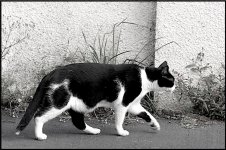
For example, here is a cat walking along Hartopp Road in Exmouth. It's taken in a street and shows something happening in that street, hence it is an example of street photography...

Cat in Hartopp Road Exmouth GM5 P1240213.JPG
 
Last edited:
There are, of course, many ways the phrase "street photography" could be used.

For example, here is a cat walking along Hartopp Road in Exmouth. It's taken in a street and shows something happening in that street, hence it is an example of street photography...

View attachment 458133
more pet photography in this case.

Its not a cat walking along Hartopp Road in Exmouth more just a cat walking in front of a wall. You can call it street but you can call it pet / nature. Theres nothing really to define it as street as it doesn't really tell or invoke any story.

Unless you actually define street photography simply as a photo taken on a street.
 
Last edited:
After all street photography should tell a story through a visual and not just a 'snap' taken on a street.
Should it?
Who says that it should?
Maybe there is no story and that is the point, maybe it makes the viewer ask questions, think ... make up their own story.
Maybe it asks a question.
Maybe it does just document an event or a situation.

'Street' photography seems to bring out the need in some to set boundaries and I think they are all too often too narrow and too restrictive.
 
I think this is where I find a lot of discussion around street photography gets a bit boring.

Just don't label your work and put yourself into a box (that way labels don't matter) - go out and take the photographs you want. If you want to take compelling candid pictures in public, then do your research and practice.

Labels are important if you insist on labelling your work, because they connote and anchor meaning to the work.

Most street photography exists as standalone photographs. I'm unconvinced they tell stories, more so, they just show you what something looked like photographed,
 
Unless you actually define street photography simply as a photo taken on a street.
In my opinion, there is no better definition than that, although many other definitions are, of course, available.
 
There are, of course, many ways the phrase "street photography" could be used.

For example, here is a cat walking along Hartopp Road in Exmouth. It's taken in a street and shows something happening in that street, hence it is an example of street photography...

View attachment 458133

No it's not. A close up photo of a cat isn't street photography. Now, if there was a person involved, and they were interacting with the cat in some way, and an interesting moment happened...... Or the cat was being carried in a pushbike basket and was wearing a hat..... Or it was watching a couple of men play chess at a table.....

Your opinion may vary :)
 
No it's not.
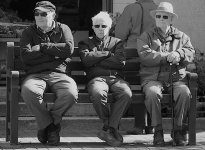
I suggest we ask a representative group, who they agree with; these gentlemen, for example, who are sitting on a bench in a street...

Three men sitting on bench outside Sidmouth market P3250009.JPG
 
Andrew, IMO, your photo in post #46 is 'street' in that it is in the street & relates to people, also there is added interest in wondering what is going on.
By contrast, IMO, your photo in post #36 is just a photo of a street and similarly your photo in post #48 is just a photo of a cat - you may not agree with that, and that is fine for you individually but it doesn't help the O/P come to terms with his issue with 'street'.
 
I'm pretty sure that if you googled what is street photography or spoke to the experts in street photography, most of the expert views would include terms like story / candid and not just about taking pictures on the streets other wise a wedding on the street and event on the street, architecture taken from on the street etc are all just in the street photography genre if the definition is so broad.
 
That's a bit more like it.

But if you do ask them, don't get upset when they agree with me re: the cat :)

To quote myself...... :)

I've just popped into Instagram on a quick coffee break. The first post is a carousel of about 7 images from @ell.ott - of those images two of them contain cats :) One is being pushed in a pram and the other is sat on a guys shoulder. Now THAT is street photography with cats done properly :)
 
...or spoke to the experts in street photography...
I find the concept of "experts in street photography" rather amusing.

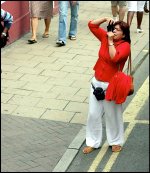
Then again, I didn't know there were examinations in street photography or recognised apprenticeships by which you learned such a skill. I've allways found that the ability to point a camera and press a button is more than adequate to take a street picture.

Woman photographer Oxford Canon 10D 4442.jpg
 
To quote myself...... :)

I've just popped into Instagram on a quick coffee break. The first post is a carousel of about 7 images from @ell.ott - of those images two of them contain cats :) One is being pushed in a pram and the other is sat on a guys shoulder. Now THAT is street photography with cats done properly :)
My half done attempt at cat street pics.

Nerja IMG_9650edit16b by Keith Hudson, on Flickr
 
I find the concept of "experts in street photography" rather amusing.

Then again, I didn't know there were examinations in street photography or recognised apprenticeships by which you learned such a skill. I've allways found that the ability to point a camera and press a button is more than adequate to take a street picture.
that comes back to the notion or belief that all street photography is, is taking photos in a street. In which case you can't be good or bad at the genre. However i'm pretty sure if you could easily spot those that aren't very good and would just be termed 'lucky snaps', from those where the photographer actually very good and has understanding, experience and can actually make a great photo. I'm also pretty sure there are lists of recognised street photographers who would be deemed experts.
 
that comes back to the notion or belief that all street photography is, is taking photos in a street. In which case you can't be good or bad at the genre.
You can't be a good photographer nor can you be a bad photographer. You can only be a photographer and people either like some of your pictures or they don't.
However i'm pretty sure if you could easily spot those that aren't very good
No you cannot. You can only dislike a picture while another person may like it.
...and can actually make a great photo.
The nearest thing to "a great photo" is a photo that gets frequently published and several people like. However, many more people will simply glance at it and just move on.
I'm also pretty sure there are lists of recognised street photographers who would be deemed experts.
You may be sure about that but I think you'd be part of a small minority.
 
You can't be a good photographer nor can you be a bad photographer. You can only be a photographer and people either like some of your pictures or they don't.

No you cannot. You can only dislike a picture while another person may like it.

The nearest thing to "a great photo" is a photo that gets frequently published and several people like. However, many more people will simply glance at it and just move on.

You may be sure about that but I think you'd be part of a small minority.
all very existential
 
all very existential

And IMO easy to disagree with. Of course you can be a bad photographer and if a bad photograph gets widely distributed to be viewed and generally appal or amuse people it's still a bad photograph. The only thing that could make it of any value would be sentimentality or rarity.
 
but, there are people who are more knowledgeable than others and their opinions have more value and weight than people who know less.
I agree.

The trick is to know who's selling gold and who's just selling the glitter ;)
 
You can't be a good photographer nor can you be a bad photographer. You can only be a photographer and people either like some of your pictures or they don't.

No you cannot. You can only dislike a picture while another person may like it.

The nearest thing to "a great photo" is a photo that gets frequently published and several people like. However, many more people will simply glance at it and just move on.

You may be sure about that but I think you'd be part of a small minority.
As you know, other views are available, and while you are perfectly free to rely on your likes and dislikes when assessing a photograph or photographer, this isn't the approach taken by many others. Overcoming personal likes and dislikes is the first step in any expert assessment of photographs and photographers.

But I know you don't agree :)
 
And IMO easy to disagree with. Of course you can be a bad photographer and if a bad photograph gets widely distributed to be viewed and generally appal or amuse people it's still a bad photograph. The only thing that could make it of any value would be sentimentality or rarity.
Doesn't this depend on the purpose of the photograph, and what you mean by good and bad. Switch those words for "important", "valuable" "successful" "effective" "historical" etc and the assessment takes on a different flavour.

The first use of an innovative approach in photography might not produce a "good" photograph, but be valuable and important because it's the "first". And, it make the photographer a "good" photographer because they have shown their innovative vision.

The comment from @benc98 about Brooklyn Beckham is another example, where in terms of advertising for Burberry, employing him for the job rather than an established photographer was a brilliant use of "photography" because the purpose was to advertise Burberry, and the advert "was" Brooklyn Beckham photographing Burberry.

Scott Chouchino reviewed the Brooklyn's photographs from the Burberry ads, and compared them to earlier ads by "professional" photographers and considered Brooklyn's pictures weren't obviously better or worse than previous campaign photographs.

I can't find the review, but if you aren't familiar with Scott, his web page is here https://scottchoucino.com/

So while I tend to agree with the idea of a good photograph being a good photograph, I think that what "good" means can change with context.

When I was making scientific photographs in a Materials laboratory, of failed mechanical components, a good photograph was one that accurately showed the nature and detail of the failure.
 
I am reading my way through this very interesting thread, and its amazing the amount of opinions that there is on the subject.
So to define street is not easy and I think it all depends on the person taking the photographs.
When I really think about it, some famous people or events come to mind, you know the photographs that get on the news, usually political or unrest or war as the subject.
There are hundreds of demonstrations on hundreds of different things all over the world, there are festivals and events all the time.
I think that they provide great opportunities for anyone who can take a good photograph and is in the right spot at the right time.
Myself, I go to small towns and villages, where there is less people and less activity, and I am not at the point of being able to say I can take a good photograph.
What I am learning is that you have to tell a story, you have to capture something that instantly people look twice when they see it.
Most of all it has to be natural and not posed, thus providing realism to the viewer.
Receiving critique helps me as much as anything, like don't crop so much, get closer etc.
Communication , which I can do no problem at all let me tell you, is now going to be a thing I will have to extend to doing while using my camera, not so easy.
I am 65 years old next month so when it come to the teenagers I don't really have a lot in common with them nowadays, its hard to explain really.
Still I am having a great time, my mind is active and I am out and about.
These three teens were nice people when I asked to take the photograph, admittedly I pressed the shutter button too soon.
What I did get out of this was that they were proper friends having a great time, the holding of each others hands was great to see, so I did capture that, we were all smiling and they did say the the water was cold. And it did build me up in confidence for the next day I go out.
I haven't decided on a genre or niche for myself, almost a year into using a DSlR, the advice I have had from a relative who has done weddings for a decade has told me to not pigeonhole myself like that, he is a photographer who takes weddings for his bread and butter and to fund his passion to travel and explore his own path to personal freedoms, that he is now starting to enjoy, he is not working 9 to 5 for any one and has a nice life.
His introduction to cameras was at my wedding where he was a guest, just goes to show.


DSC_3110.JPG
 
Back
Top