Stopping down confusion

horse.collier

Suspended / Banned
Messages
95
Name
Andy
Edit My Images
No
Reading an article and under the photo were the settings. The aperture was f8 and the person stated they had stopped down by 2 stops.

Does that mean it was 2 stops from f16 to f8 to get the exposure he wanted? Or to take the picture he stopped from f8?
 
Reading an article and under the photo were the settings. The aperture was f8 and the person stated they had stopped down by 2 stops.

Does that mean it was 2 stops from f16 to f8 to get the exposure he wanted? Or to take the picture he stopped from f8?
'Stopping down ' AFAIK means closing the aperture. So in the case you state the photographer I surmise had a lens of max aperture f4 and stopped down through f5.6 to f8
 
It's all a bit vague isn't it? :(

The first two replies are probably right, but the term "stop" goes back to Mr Waterhouse, i.e., originally Waterhouse stops, who came up with the idea of drilling holes in a piece of metal which, when slid into a slot in the lens, reduced or increased the amount of light by 100%, or 1 stop.

But language changes over time, and now a stop may be a change in aperture size, e.g. f/8 instead of f/11, or a change in exposure time, e.g. 1/100th instead of 1/200th, or a change in isio setting, e.g. iso 200 instead of iso 100.
 
Reading an article and under the photo were the settings. The aperture was f8 and the person stated they had stopped down by 2 stops.

Does that mean it was 2 stops from f16 to f8 to get the exposure he wanted? Or to take the picture he stopped from f8?

He may have meant that he had underexposed by two stops.
 
For a very long time, I've used the term "stopping" down as shorthand for reducing the light reaching the sensor and the term "opening up" for the reverse, i.e. increasing the light reaching the sensor.

The numbers involved are, in a very loose sense, reciprocal. Changing the aperture from F4 to F5.6 is "stopping down" while changing the shutter speed from 1/125 to 1/60 is "opening up". It's easiest to understand this on lenses with shutters built in, such as those for the old Hasselblad, where you could see it in practice.
 
I think stopping down can also refer to losing a stop on the shutter speed as well.
 
Reading an article and under the photo were the settings. The aperture was f8 and the person stated they had stopped down by 2 stops.

Does that mean it was 2 stops from f16 to f8 to get the exposure he wanted? Or to take the picture he stopped from f8?
As @Garry Edwards said, the term "stop" has a historical origin, and a change of "one stop" means you are doubling or halving the amount of light reaching the sensor or film. But the terminology is also used for any change in light or light sensitivity, such as shutter speeds, a film's sensitivity to light, or changes in a digital camera's gain settings (ISO adjustment)

Because f/numbers represent a ratio between the focal length of the lens and the size of the aperture, as an f/number gets bigger, the iris/aperture gets smaller, and the amount of light reaching the sensor decreases.

It is common to stop a lens down "two stops" from its maximum aperture to improve optical quality. The assumption is that most lenses perform at their best two stops down from "wide open"

In the example you have asked about, my guess is that the article writer was using a lens with a maximum aperture of f/4 (maybe a short zoom like a 24-70mm f4) and was stopping it down by "two stops" from f/4 to f/8 to improve optical quality, as well increasing depth of field. The smaller the aperture, the greater the depth of field.
 
If you really want to keep it simple, persuade manufacturers to introduce an Exposure Value (EV) mode. Then you can adjust both shutter speed and stop size at the same time...

 
"I stopped down 1 stop by pulling the development"
"I stopped up 1 stop by pushing the development.

It's just semantics, and perhaps poor semantics, but does it really matter as long as we understand what's meant?
 
... but does it really matter as long as we understand what's meant?
I agree.

The phrases "I stopped down" and "I opened up" have worked for a very long time, so why try to fix what just ain't broke?
 
I would understand that to mean the individual had a lens with a maximum aperture of f/4. To take the image they reduced the aperture (stopped down) by two complete stops - i.e. f/5.6 then f/8.
:agree:

'Stopping down ' AFAIK means closing the aperture. So in the case you state the photographer I surmise had a lens of max aperture f4 and stopped down through f5.6 to f8
:agree:

Aperture...Stop.
Shutter....Step. (y)

Back in film only days I (and everyone else I knew in the game then) would only use stopping down or opening up in reference to apertures if I was referring to getting more light on the film via shutter speed I would say increasing or decreasing the exposure (time).

You seem to have missed off ISO.

ISO is a recent (digital) addition to the variables of exposure since back when these terms were coined it was set in the film and (unless you had interchangeable backs/film sheets) was not a consideration for exposure per shot you just knew what ASA (now ISO) your film was and the other 2 variables (shutter and aperture) controlled exposure shot to shot.

Ergo, IMO the photographer stopped down from f4 to f8 for the reasons given earlier (DoF sharpness of aperture).
 
"I stopped down 1 stop by pulling the development"
"I stopped up 1 stop by pushing the development.

It's just semantics, and perhaps poor semantics, but does it really matter as long as we understand what's meant?
I think the key might lie in my post where I explained that a "stop" has become a unit of measurement, ie doubling or halving an amount of light.

Thereafter, it becomes a matter of how you phrase the comment.

So "stopping down" to 1/500 sec doesn’t feel right to me; the example given by @Musicman, but reducing my shutter speed by a stop does make sense.

And indeed your example doesn't feel right to me either, but saying "pulling development by a stop" or "pushing development by a stop" does.

ISO 400 film is "two stops" faster than ISO 100 film. And changing the ISO on a digital camera from ISO 100 to ISO 400 is increasing the gain by two stops.
 
ISO is a recent (digital) addition to the variables of exposure...
ISO was introduced in 1974 and (mostly) displaced ASA.

Before that we had a plethora of film speed measuring systems, such as Hurter & Driffield, Scheiner, DIN, BSI, Weston, GE, ASA and the (n)ever popular GOST system, which came to Britain with the Soviet cameras. You'll find far more about film speed measurement here...

 
ISO was introduced in 1974 and (mostly) displaced ASA.

Before that we had a plethora of film speed measuring systems, such as Hurter & Driffield, Scheiner, DIN, BSI, Weston, GE, ASA and the (n)ever popular GOST system, which came to Britain with the Soviet cameras. You'll find far more about film speed measurement here...

I think you misunderstood my post Andrew, I was referring to the ability to vary ISO between frames being recent rather than the term ISO, apologies if I wasn't clear enough.

That said, I personally didn't use the term ISO until digital but I'm just an old stick in the mud.
 
I think you misunderstood my post Andrew, I was referring to the ability to vary ISO between frames...
Just to be clear: are we talking analogue or digital here?

I'm guessing digital and that puzzles me, because I bought my first digital camera in 1999 and I think that allowed me to alter the ISO setting between each frame, although I don't recall feeling the need to ever do so.
 
Just to be clear: are we talking analogue or digital here?

I'm guessing digital and that puzzles me, because I bought my first digital camera in 1999 and I think that allowed me to alter the ISO setting between each frame, although I don't recall feeling the need to ever do so.
I meant that until digital came in no-one considered ISO as a variable in calculating the exposure for a shot as it was baked into the film so exposure was adjusted using aperture and shutter speeds depending on what the need was (DoF or freezing movement). When digital came in people started to talk about using it to adjust exposure "on the fly" as it were even using "auto ISO" to keep apertures at desired settings and manage shutter speeds to avoid camera shake.

I think I bought my first digital around the same time (a compact) but I still think of that as recently in terms of how long photography has been around.
 
Last edited:
I meant that until digital came in no-one considered ISO as a variable in calculating the exposure for a shot as it was baked into the film
OK, I see what you're talking about now and I agree with you.
...but I still think of that as recently in terma of how long photography has been around.
I know what you mean. I took my first "serious" pictures in 1967, when I managed to pry £19-19-6d out of the "treasury" to pay for a Pentacon FM, basically a rebadged Contax S with a better viewfinder and automatic aperture (if you had the right lenses).
 
You seem to have missed off ISO.
Indeed...because we were disscusing "Exposure" ie. how much light the film / sensor / whatever is "exposed" to , and that is governed by how much light you let in (Aperture), how long for (Shutter)and how bright the light is. The sensitivity of the recording medium isn't part of the "Exposure" ...Discuss. :exit:
 
Last edited:
Yes

“I stopped down to f/.5.6” ✔️

“I took the exposure down a stop by changing the shutter speed to 1/500” ✔️

“I stepped down to 1/500” ✔️

“I stopped down to 1/500” ❌
I changed the aperture, and changed the exposure is how I usually put it!
 
I say "stop up" and "stop down" for any doubling or halving -- aperture, shutter, ISO, development, whatever -- even though those who say it should only apply to the aperture are strictly right. I'm one of those old cranks who still uses an incident meter (my beloved Sekonic L-308S) so I tend to think in reciprocals of half a stop.
 
I say "stop up" and "stop down" for any doubling or halving -- aperture, shutter, ISO, development, whatever -- even though those who say it should only apply to the aperture are strictly right. I'm one of those old cranks who still uses an incident meter (my beloved Sekonic L-308S) so I tend to think in reciprocals of half a stop.
I’m an old crank who has some cameras that require stop down metering, which only makes sense when it is adjusting the aperture, not the shutter speed :)
 
I’m an old crank who has some cameras that require stop down metering, which only makes sense when it is adjusting the aperture, not the shutter speed :)

As a helpless fan of M42 lenses, particularly Takumars, I'm an old crank who pretty much only has cameras that use stop down metering. I'm very well aware that stopping up and stopping down only applies to the aperture, strictly speaking, but in general when talking about things I use "stopping up" and "stopping down" for any doubling or halving.:)
 
The "Reply" button at the bottom right of the post to be quoted will quote just that post; the "+Quote" button next to it allows you to quote several posts in the same reply. Highlighting a section of a post will give you those options too.
 
I had forgotten about Stop Down Metering. :ROFLMAO: :ROFLMAO:
To be honest, I seldom, if ever, use manual settings on digital cameras.

I admit to thinking, these days, that manual settings are rather a case of "keeping a dog and barking yourself". I don't recall a single instance of a digital camera giving me a poor exposure.

I've never been overly bothered by exposure considerations. I'd been using a camera seriously for two or three years, before I even bought an exposure meter. Once I had one, I didn't find much need for it, because it slowed me down too much. This may be why I still have the "Sunny 16" routine embedded in my mind! ;)
 
To be honest, I seldom, if ever, use manual settings on digital cameras.

I admit to thinking, these days, that manual settings are rather a case of "keeping a dog and barking yourself". I don't recall a single instance of a digital camera giving me a poor exposure.

I've never been overly bothered by exposure considerations. I'd been using a camera seriously for two or three years, before I even bought an exposure meter. Once I had one, I didn't find much need for it, because it slowed me down too much. This may be why I still have the "Sunny 16" routine embedded in my mind! ;)
It's moving off topic a bit, but I use Manual in two main situations.

1) When using flash as the primary light source - here the camera can't meter the light (unless using a TTL flash unit), so you need to set everything (including fixed ISO) manually

2) Occasionally I am concerned about specific values for both Aperture and Shutter speed - an example is when I was photographing my daughter learning to surf on a public beach - so wanted to control both aperture (to get specific DOF, so my daughter was in-focus, but anyone in shot behind my daughter was OOF), and Shutter speed (to get the right level of 'freezing' the motion), and let auto ISO fix the exposure (with a touch of exposure compensation to avoid too much blown highlights from the water!).
Mirrorless makes this easy, as you have both the 'live' view in the EVF, and can have the live histogram overlayed as well.
 
It's moving off topic a bit, but I use Manual in two main situations.
I don't think it's moving off topic because it's all about exposure.

Just because I do things in a particular way, doesn't mean I'm correct. Whatever works for you or anyone else is just as correct. At the end of the day all that really matters is that what you want to show is what you show.
 
It's all about the kind of shooting that you do. Though a "Well seasoned" photographer who uses Manual Mode often, it depends on the kind of photo that you are shooting. Quick pop-up shots are most always caught best in Auto mode, but there are many times when I'll start a shoot in "TTL", because it gets my settings close for the kind of shoot that I am starting to do, and I can switch to another mode using the settings that the camera used when in TTL. It will be close on that first shot and I can make changes with those as my starting point. Shooting every shot in Auto or TTL will result in level differences from one shot to another because the camera re-computes the settings for each shot. Take the first shot of a group in Auto or TTL and then have one of those in the group put on a white sweater and take the shot again. The brightness of this second shot will be different, because each time the camera is adjusting for the different average light levels. If you want the light levels to be identical for a whole group of shots, the only way is to start in TTL or Auto and then switch to manual using the settings that the camera came up with. In the case with the added sweater, every shot of that group will have the same levels as that first shot regardless of how many in the group put on white sweaters after that first shot.

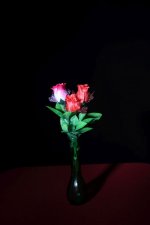
Learn the benefits of all of the adjustments of your camera, and then learn how to use them when they can best help you get the result that you are looking for. Here is a photo that can't be done in Auto mode. It was done in my photo studio with the studio ceiling lights left on during this shoot, but the camera was adjusted to see only the light from the flash and not the ceiling lights. I didn't use any kind of backdrop. Behind the table with these flowers are many pieces of photography gear, but none of it shows in the photo. I made use of the "Inverse Square Law" of light to hide my gear from the camera. The camera F-Stop setting of the camera determines the depth of focus of what is in your photo, and anything closer or farther away will be out of focus. But the F-Stop setting also sets the minimum light level that the camera sees. I adjusted the F-Stop for the best balance of both, high enough so the light from the ceiling lights would not affect the shot, and also what gave me the desired depth of the "in focus" part of the shot. You don't need to become a math expert, but you do need to understand how light works and how best to use it for the shot that you are looking for. You will become a far better photographer if you learn the benefits and limits of each adjustment on your camera and use the ones best suited for the kind of shot that you are taking. It takes a thorough understanding of the camera, and then how light works and how to use it for the results desired to become a good photographer. Something that we didn't have good control of back in film days is ISO. ISO is the sensitivity setting, kind-of a volume control of how much or little shows in the darker shadows of your photos. With film photography you could only change this by the sensitivity of the film being used. If you wanted a different ISO setting, you had to replace the film with a roll of the desired ISO sensitivity. With Digital, the ISO setting is in the camera, so we can change it for each shot taken. Turning it way up (but not maximum) lets you take photos outdoors at night using only a street light. Most cameras have a minimum setting of 100 and this produces great shots if you have plenty of light to work with, but raising the ISO number and taking the exact same shot again will let you see more detail in the shadowed parts of your shots. Still higher will almost remove the shadows from the shots. It's best to not use the maximum ISO settings of your digital camera, because there will be noise (colored confetti) in the blackest parts of your shots at these settings, but newer cameras are becoming more sensitive and allowing even higher ISO setting capabilities. Use the setting that works best for the shots that you are taking.

Charley
 

Attachments

  • Roses In Vase IMG_0002.jpg
    Roses In Vase IMG_0002.jpg
    45.5 KB · Views: 4
It's all a bit vague isn't it? :(

The first two replies are probably right, but the term "stop" goes back to Mr Waterhouse, i.e., originally Waterhouse stops, who came up with the idea of drilling holes in a piece of metal which, when slid into a slot in the lens, reduced or increased the amount of light by 100%, or 1 stop.

But language changes over time, and now a stop may be a change in aperture size, e.g. f/8 instead of f/11, or a change in exposure time, e.g. 1/100th instead of 1/200th, or a change in isio setting, e.g. iso 200 instead of iso 100.

Actually in photography goes back to Washer stops placed in the front of the lens barrel, initially with early simple Wollaston Meniscus lenses, quite a few years before 1858 and John Waterhouse's.

However, John Hyde Wollaston was using stops behind the lens in 1812, with his Meniscus lens of 1804, sold as camera obscuras to artists.

Ian
 
ISO was introduced in 1974 and (mostly) displaced ASA.

Actually the B&W film speed ISO just encapsulates both the ASA and DIN speeds, and their different methods of speed determination. Hence a film like FP4 being ISO 125/22º, so technically still 125ASA/BS and 22ºDIN

Before Kodak introduced Tmax films, in 1986, they were failing the then ASA testing, so could not be sold as Tmax100 & Tmax400, As the sole B&W film manufacturer in the US (by then) they were able to have the methodology of the ASA test modified.

Ian
 
Back
Top