Startrails?

LongLensPhotography

Th..th..that's all folks!
Suspended / Banned
Messages
18,695
Name
LongLensPhotography
Edit My Images
No
I am planning to to some startrail photography. I ran a test last night for 30min at ISO200 f/4 and got pretty washed out image :thinking: (should I post it?). It looks a little better after lots of fiddling in LR. I live on the edge of Bristol and though the virtually non-existing street lights :suspect: would do no harm but maybe I was wrong. So it seems I am a little lost in the settings.

Perhaps I could get some advise on the following please:

1) to use in camera noise reduction or not?
2) how would ISO100 f/4-5.6 work in a more remote place? I can use f/2.8 or higher ISO but don't really want to.
3) Will 40D or 1Ds2 manage to maker a longer exposure with a full charge? Which will deliver a cleaner file?
4) I plan to shoot the trails at the seaside somewhere in Somerset - maybe Clevedon or Portishead? Could you recommend any good spots please to avoid ambient light and include some rocks and waterfront?

Some example shots would be great too.
Thank you.
 
4194180215_07bea05659_d.jpg

Large

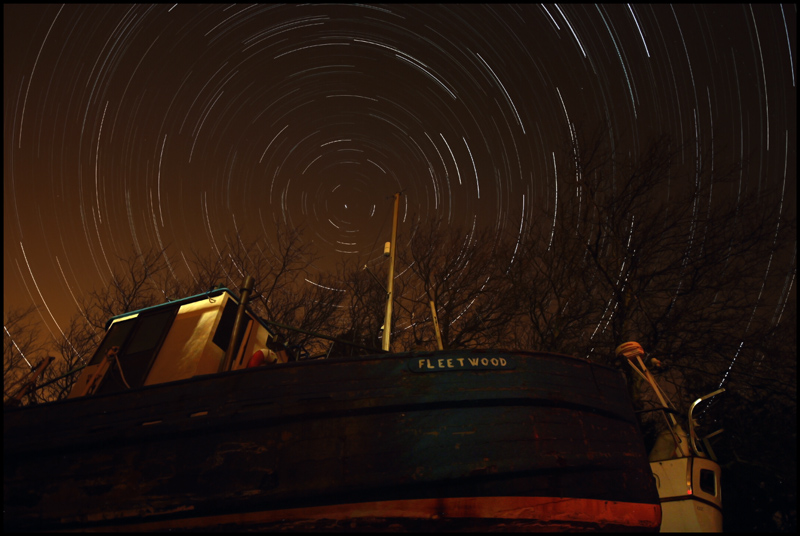
ISO100 f5.0 15min exposure with a 20D, this was a back garden experiement!

If you find the north star as in this shot you'll get more "movement" from a shorter exposure

i.e if you point south and do the same 15 min exposure you wont see much movement in the stars

that was taken with in camera long exposure nr turned off

apparently a better way of doing it is to take lots of 30 second exposures and "stack" them with Startrails

hope this helps

Chris
 
I've been discussing this with my father this evening, we plan to try it out tomorrow or Saturday night.

I like your shot, I'd be happy with that for a first attempt :)

I'm going to use 30 second exposure stacked in Startrails... but my main concern is how to focus... do I just set it to infinity, or to the focal point, which may be a tree in my case?
 
Off topic slightly, i love this type of shot, i wondered if some point it would be worth commitment at stacking 4 second shots.. would that work?

Max exposure is 4 seconds sadly :( but i have a tripod and a remote!

Obviously id be looking at 150 shots to get a 10 minute exposure.. fun!
 
Have to work with what ive got! I feel slightly liberated that with some work i may be able to achieve a decent effect with some work xD

Look forward to trying it sometime.. too much light comes into my back garden though :(
 
but my main concern is how to focus... do I just set it to infinity, or to the focal point, which may be a tree in my case?

I set mine on infinity, or boost the iso and shine a torch on an object then when focused reset to proper settings
3371713915_473ca35473_o.jpg


my first attempt, second one i did i had to much distortion and had oval trails:bonk:
 
....but my main concern is how to focus... do I just set it to infinity, or to the focal point, which may be a tree in my case?

Even when you have made this decision, focussing on something you can't see through the view finder or using live view is really hard.
I've usually rattled off a few shots at max ISO to check composition and focussing before lowering the ISO for the real shots.
But I'll admit to never really getting focussing nailed.

However, I recently picked up a top tip from another thread on TP about a technique developed by those crazy Urbex guys.
Use a laser pointer to illuminate the target and manually tweak the focus in Live View until the bright point of light becomes a dot instead of a blob.

I've tried the technique and it's 100% reliable on near to middle distance (100 yards) using a cheap slideshow pointer with a red laser.
Distant targets are more tricky as getting the dot onto the same target as zoomed in Live View can be challenging.
However, I've also got a 5mW green laser for star-pointing and this has the advantage that you can see the beam of light making it easy to precisely illuminate something surprisingly distant. I managed to obtain focus on some trees half a mile away!
This was only a test of the technique performed out of my front door, I've not used it in anger yet. I'm really looking forward to having another go at some night photography and startrails.
 
Focus on the moon or the furthest away light you can see. If you're likely to be in the middle of nowhere, learn your hyperfocal distances and put your own light on your tripod, walk away the requisite distance and focus on your torch. You're unlikely to need to walk more than 300ft :lol: (funny but true, hyperfocal at f/1.4 with 50mm on crop sensor is c300ft; f/2 and 35mm is only 49ft).

As for settings, 30min is prob the upper limit for a single exposure for decent star trails. You could close the aperture to reduce ambient light and lengthen the exposure but it'll kill your stars too. Best time to try single exposure star trails is new moon. You can stack anytime/ moon phase but full moon tends to generate blue sky results given the right settings (ISO400, f/4, 30sec, WB tungsten).

I produced a stacked image the other night in an area with ambient light. Wanted ISO400 and f/4 to capture maximum stars whilst retaining IQ but had to drop the exposure time to 20sec to ensure the ambient light didn't overexpose the foreground.

I guess like most aspects of (night) photography it's a series of compromises, the choices of which come more naturally the more often you do it.
 
Thank you for all responses.

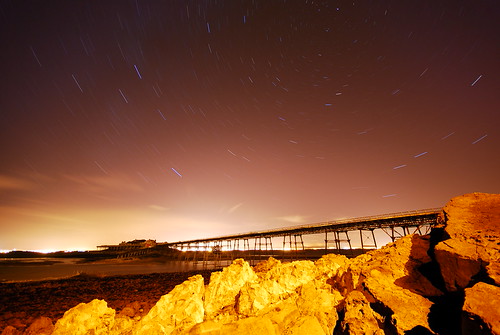
I tried it last night at the seaside
2716252920021447255S600x600Q85.jpg


The exposure was only 20min as it an experimental shot, and there are too many things to improve. Notably the foreground is not the best and I couldn't see a thing when setting up. Also the city lights from Cardiff on the other side of the sea pretty much killed it.
 
The problem with most places in the UK when trying to shoot the night skies is light pollution. Depending on your ISO setting and aperture, this can really become a problem from an exposure as short as a minute, which makes it a complete pain when trying to do star trails.

Because so many stars are very faint, to pick them up we need to use highish ISOs and wide apertures, which compounds the light pollution problem.

As others have already said, the way to get round this is to take a number of shorter exposures, and then stack them in appropriate software. This way you can use a higher ISO and wider aperture, but without washing out the sky.

With regard to focus issues, many cameras will actually focus past infinity, so if you turn the focussing ring to the stop, the stars will actually be out of focus. The way I get round this is to either focus on the moon, if it's out, or use a light in the far off distance, if available.

Finally, contrary to what someone else has said, you do not see maximum movement by pointing at the north star. Think about it - the north star is very close to our rotational axis, and therefore hardly moves at all. It wouldn't be much use for navigation if it did! Consequently, the closer a star is to the north star, the less it will appear to move. For maximum movement, you need to be pointing at stars that are 90 degrees away from the pole star, above the earth's equator.

What pointing at the pole star does give you is a nice centralised point about which the other stars appear to rotate, which can be more pleasing than an image that is just filled with a load of light streaks.

From memory this image was a stack of 40 images of 30 seconds each. There is quite a large town just a couple of miles away in the direction that the shot was taken, but by keeping the exposure relatively short, the resultant light pollution wasn't a problem.

167.jpg
 
Finally, contrary to what someone else has said, you do not see maximum movement by pointing at the north star. Think about it - the north star is very close to our rotational axis, and therefore hardly moves at all. It wouldn't be much use for navigation if it did! Consequently, the closer a star is to the north star, the less it will appear to move. For maximum movement, you need to be pointing at stars that are 90 degrees away from the pole star, above the earth's equator.

sort of, what i meant was if you aim at the north star and do say a 15 min exposre you'll see quite a lot of rotation with the stars going around the north star as the, if you point due south and do the same 15 mins exposure the stars wont appear to have moved so much by comparison, in fact last time i did a south facing 15 mins shot looked like the stars had hardly moved!

go and try it, you'll see what i mean! :)
 
I agree almost entirely with AndWhyNot and Scarecrow, the ISO200, f/4 setting you used first is a nice place to start (unless you have full frame then ISO400 is good as well). To stop the photo becoming overexposed you want to reduce the exposure time to even as short as 30 seconds, 2-5 minutes would probably be fine outside of a town though. To make sure you have the right exposure best bet is to open the lens fully and up the ISO as high as possible and expose for something like 30 seconds. Once you have that you can check focus and exposure (counting back from the highest iso to work out stops and exposure length).

With this technique you can shoot into direct light and still get a decent number of stars. For example, surrounded by streetlamps:

Startrails+finished+copyll.jpg


Death Valley, directly into a fire:

Campfire-rotatedandlenscorrect.jpg
 
Great tips, I'm hoping to have a go at this one night very soon, just waiting for a clear night.
 
Star trails and Perseid meteor "shower", 2007
184772213-L.jpg


Detailed notes on how I did it, and the general DOs and DON'Ts I picked up by trial and error, here.
 
Looks like your lens started misting over towards the end of your exposure Stewart, hence the trails tapering off and becoming more feint. Nice to see you caught a meteor though :)
 
Thanks for the info Stewart, will take a look. Unfortunately, although it's been possibly the best day of the year so far, it's cloudy again tonight :(
 
I am hoping to try this soon, when I travel up into the middle of nowhere where light pollution is non existant...
 
Here is a quick tip regarding focussing for stars. If your camera has live view, enable it and then pop up the flash. On my camera at least, that significantly brightens the image on screen (enough to see stars). Then just manual focus on the star(it will be at infinity but as mentioned some lenses focus past inifinity)
 
Had a go at shooting some trail last night at my folks house (pretty remote location) and I noted two problems...

Focusing - still an issue which I need to master... the stars look out of focus on the preview and taking a number of shots around the infinity mark didn't seem to improve things. I settled on what I thought looked best and went for it.

Power - My Father and I have gripped D90's, both with two batteries, so the power issues didn't relate to capacity, but we noticed our cameras shut down three times in the half hour or so we were shooting for. Each time, the low battery symbol was showing, but turning off and on again allowed us to keep shooting. Checking the battery levels afterwards showed that the battery in use had only dropped by a few percent (with the second battery not being used at all)... so we have no idea what was going on there as temps were around 12 degrees!

We saw a shooting star/asteroid, but it was just outside the frame... gutted :( Oh, and lots of aeroplanes!

Will stack them tonight and see how they look :)
 
Don't get why you're having focus issues tbh, are you following my technique in post 12?

Stick with AF and get familiar with your hyperfocal distances. Unless you're shooting longer than 50mm or more wide open than f/1.4 your hyperfocal point will be within 300ft meaning any light source beyond that can act as your focus point. If you're using a UWA lens your hyperfocal distance could be less than 5ft - literally you could focus on your own toes and (once you've recomposed) the stars would still be in focus.

Don't know about your specific power issues but I regularly shoot 1hr or more on a single battery. I know the Nikon ML-L3 infra red remote limits your single exposure time to 30mins, and there are some Nikon bodies that have a default (but adjustable) consecutive shooting limit of 100 shots. Doesn't sound like your prob but worth knowing.
 
Don't get why you're having focus issues tbh, are you following my technique in post 12?

:thinking: Clearly I need to sort out the focus, and no, I didn't try your advice and hence I struggled. I think I'll try and master the focus element before trying again :bonk:
 
Great image, as are the rest on here... just hope I master this before the Summer... don't fancy waiting until midnight to shoot :lol:
 
Just realised, I've posted from the iPod so no images from me on here yet. Let's sort that out:

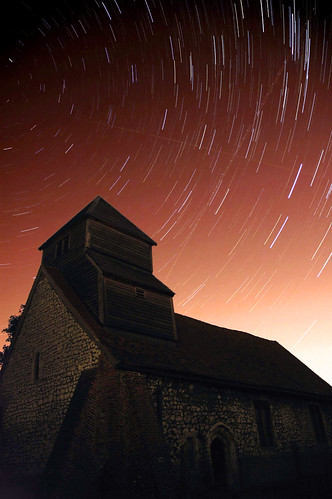
Single exposure (exif on flickr page). Check out the celestial equator where the stars appear to change direction.


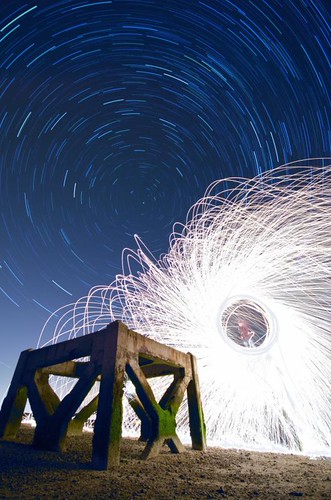
Stacked exposure - 40mins worth. I've just had an A2 canvas of this made for my exhib- looks awesome :thumbs:


To the OP - this is only just down the road from you - Birnbeck Pier on the northern outskirts of Weston. Single exposure (exif on flickr page)
 
Amp, should've said earlier but that lighthouse image of yours is spectacular

Thanks. :)

Those images of yours are stunning as well (especially no. 2! Did you use light painting?).

Don't get why you're having focus issues tbh, are you following my technique in post 12?

Stick with AF and get familiar with your hyperfocal distances. Unless you're shooting longer than 50mm or more wide open than f/1.4 your hyperfocal point will be within 300ft meaning any light source beyond that can act as your focus point. If you're using a UWA lens your hyperfocal distance could be less than 5ft - literally you could focus on your own toes and (once you've recomposed) the stars would still be in focus.

Don't know about your specific power issues but I regularly shoot 1hr or more on a single battery. I know the Nikon ML-L3 infra red remote limits your single exposure time to 30mins, and there are some Nikon bodies that have a default (but adjustable) consecutive shooting limit of 100 shots. Doesn't sound like your prob but worth knowing.

You don't really need to worry about hyperfocal distance, just focus at infinity most of the time. :)

Just finished the tutorial I started about a year ago...

http://wildaboutlife.net/wp/archives/146

Hopefully that'll help some people and may have something that hasn't been posted already. :)

(Any feedback on content or errors/missed are always welcome) :)
 
My attempt 50 exposures overlaid with 30 seconds per exposure,
1642163853_b567729694.jpg


If you want to get rid of the planes... paint over the trails with black prior to stacking them... it works great.

I also go along with stacking a series, it works well..

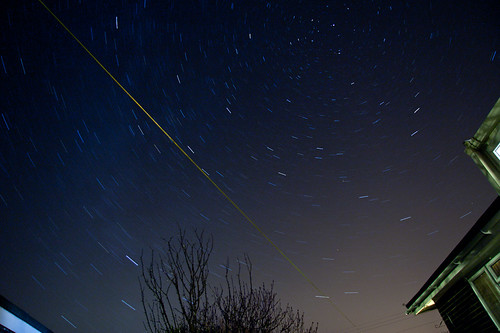
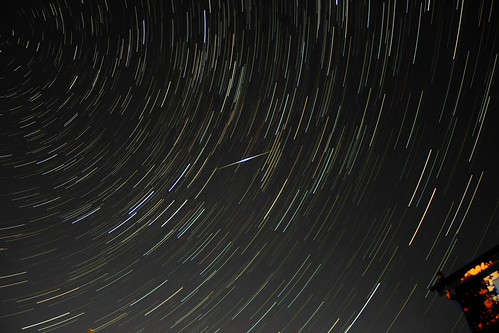
Here's one I did after trying to get some of the Perseid meteor shower... That's not a meteor in the middle, but rather an Iridium flare.

4332272097_31750dbee7.jpg
 
Tonight would be a great time for me to try it as all the planes are grounded. I've got Gatwick's flight paths in my Northern aspect, so I get a lot of plane trails.

Shame about the coulds.
 
Back
Top