Starting Street Photography

That's my view point point Andrew and advice I would give to someone starting out
Just to be clear, then: your claim that "99% dont go long", is not true? If so, what is the correct number? I believe the jury wants to know...

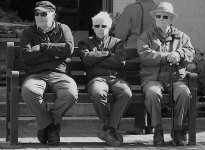
Three men sitting on bench outside Sidmouth market P3250009.JPG
 
Just to be clear, then: your claim that "99% dont go long", is not true? If so, what is the correct number? I believe the jury wants to know...

View attachment 324939
umm.. I answered that in my comment - it's a view point, opinion.. what ever you want to call it. It wasn't analysis based on all images taken, ever. It's advice I'd give if someone was starting out shooting street - using a long lens in street photography would encourage bad habits and not help the photographer grow in terms of confidence, over use of a long lens in street photography will set someone on the road to mediocrity or boring images* Unless the lens was creativity, e.g. not used to photograph heads from across the road.
 
umm.. I answered that in my comment
No you didn't. You made a factual claim.

That claim is either true and you can back it up, or it's false and you should admit that it was false.
using a long lens in street photography would encourage bad habits and not help the photographer grow in terms of confidence,
This is also a claim of fact. Can you back it up or not?
will set someone on the road to mediocrity or boring images
In whose opinion? (and see below)
* Unless the lens was creativity, e.g. not used to photograph heads from across the road.
...and who gets to make that judgement? Is there a "Royal Society of Street Photographers", who set standards and examine candidates for the title "Officially Accredited Street Photographer"?

Of course, it seems clear that the answers to the above questions are "no", "no", "yours" and "no".

If you make these large and, I think it fair to say, arrogant, claims, it's only fair to expect that someone will challenge them. Answering questions such as mine with further and more absurd claims, can only reveal that you are attempting to defend the indefensible and as the saying goes: "when in a hole, stop digging".

My opinion is that there is no right or wrong way to take any non-technical picture. There is however, a right and a wrong way to behave towards others. Your posts suggest that you don't really wish to consider the feelings of others but to impose your will on others, some might say "bully" them, for your own pleasure.

Claims that photographers who seek to record their fellow humans without imposing their presence on them are "voyeuristic" are further evidence of ill intent. Voyeurism is held to be a criminal act in many countries. The UK legal position on this is set out here

...https://www.cps.gov.uk/legal-guidance/voyeurism​

...so to describe the behaviour of others as voyeuristic, without adequate proof, appears to be a libel.

If you had simply said: "this is the way I like to do things", without implying that it's the right or indeed the only way, then you would have been correct. Your claims and the way you have presented them, I believe, have shown you to be in the wrong.

 
No you didn't. You made a factual claim.

That claim is either true and you can back it up, or it's false and you should admit that it was false.

This is also a claim of fact. Can you back it up or not?

In whose opinion? (and see below)

...and who gets to make that judgement? Is there a "Royal Society of Street Photographers", who set standards and examine candidates for the title "Officially Accredited Street Photographer"?

Of course, it seems clear that the answers to the above questions are "no", "no", "yours" and "no".

If you make these large and, I think it fair to say, arrogant, claims, it's only fair to expect that someone will challenge them. Answering questions such as mine with further and more absurd claims, can only reveal that you are attempting to defend the indefensible and as the saying goes: "when in a hole, stop digging".

My opinion is that there is no right or wrong way to take any non-technical picture. There is however, a right and a wrong way to behave towards others. Your posts suggest that you don't really wish to consider the feelings of others but to impose your will on others, some might say "bully" them, for your own pleasure.

Claims that photographers who seek to record their fellow humans without imposing their presence on them are "voyeuristic" are further evidence of ill intent. Voyeurism is held to be a criminal act in many countries. The UK legal position on this is set out here

...https://www.cps.gov.uk/legal-guidance/voyeurism​

...so to describe the behaviour of others as voyeuristic, without adequate proof, appears to be a libel.

If you had simply said: "this is the way I like to do things", without implying that it's the right or indeed the only way, then you would have been correct. Your claims and the way you have presented them, I believe, have shown you to be in the wrong.
Andrew, I'm out - I really don't have time to argue the toss with people on the internet. I could answer your points but I bet this thread would never end. The thread and discussion was about starting out in Street Photography and I was offering my thoughts and advice, I stand by what I said.
 
Andrew, I'm out - I really don't have time to argue the toss with people on the internet.
Forgive if I'm wrong but I believe that what you mean is that you have no tenable answers to my questions.
I was offering my thoughts and advice,
Indeed, that is what the forum is for.
 
Street photography essentials:

- Open eyes, open heart. Watch ‘Soul’ by Pixar/Disney. Or Amelie

- Good shoes

- Hydration

- A camera. Could be a Leica, a Fuji, a Ricoh, an 8x10, and yes, even an iPhone. Anything will do really

That’s it. Don’t forget to have fun, and don’t forget to talk to people if they seem up for a chat.
 
Not sure this is street. Possibly portraiture, as someone else talked about in the thread?
One could argue that every picture of a person is portraiture.

One could also argue, as has been done many times before, that any picture taken in the street is "street photography".

That's the problem with genre-lisation: assigning a name to something when an exact description isn't practical just leads to obfuscation, dissension and confusion.
 
I don't do street photography but rather candid photography. My aim is to record and perhaps share just a tiny proportion of those incidents that reveal how humans behave.
 
It's very rare that I see a long-lens street shot that isn't just glorified surveillance photography (and I used to teach surveillance photography to the military, HMRC and police at Cosford and Lydd and Hythe).
The problem I have with long lens street photography is the lack of connection to the subject. Some may argue that you can't shoot candid with the subject being aware of you and that's true to a degree, but the trick is to make the subject or subjects forget that you're there or at least be unobtrusive to the extent that they no longer acknowledge your presence. That comes down to practice. I think they key to good street photography is that you have to actually like meeting people. If you're terrified of talking to strangers, your photos will reflect this and seem distant and disconnected.
None of the photographers whose work really stands out in this genre - to me - use long lenses for the majority of their work. Instead they'll shoot a 28, 35 or 50.
The skill isn't the photography: the skill is blending-in. We used to call it being the 'grey-man' - be unremarkable; don't stand out; dress-down, appear non-threatening.
Phil Starling once shot a series in New York where he described his first day out in the Bronx: "I was really stupid - two camera bodies, big camera-bag, telephoto lenses, the whole lot" He lasted about an hour before he was mugged at knifepoint and barely made it out alive.
After that he wrapped one camera fitted with a wide lens in a paper shopping bag and moved in closer.
It's not just your subjects you need to worry about, after all.

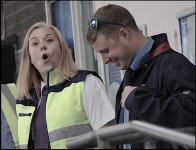
An alternative approach is to brazen it out and elicit a reaction which makes for a better image altogether...

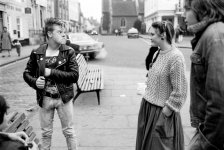
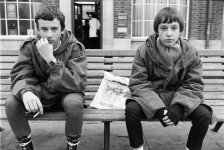
FS-1984 (17).jpg
 

Attachments

  • FS-1984 (6).jpg
    FS-1984 (6).jpg
    150.8 KB · Views: 11
  • FS-Regatta Day-0584 (3).jpg
    FS-Regatta Day-0584 (3).jpg
    107.2 KB · Views: 13
  • Wallingford (3).jpg
    Wallingford (3).jpg
    137.7 KB · Views: 15
  • Wallingford (5).jpg
    Wallingford (5).jpg
    152.4 KB · Views: 15
  • 7BDE,TELIC12,0024,01,0232E.jpg
    7BDE,TELIC12,0024,01,0232E.jpg
    107.9 KB · Views: 14
  • 7BDE,TELIC12,0029,01,0051E.jpg
    7BDE,TELIC12,0029,01,0051E.jpg
    157.1 KB · Views: 12
  • 7BDE,TELIC12,0077,01,0213E.jpg
    7BDE,TELIC12,0077,01,0213E.jpg
    134.6 KB · Views: 11
Last edited:
an exact description isn't practical just leads to obfuscation, dissension and confusion.

Agree with this, which is why genres and labelling can be distracting.
In my option, nothing is taken away from your images which are emotive and interesting, and show attentiveness behind the lens. Thanks for sharing them.
 
It's very rare that I see a long-lens street shot that isn't just glorified surveillance photography
You may not have intended it as such but that's a grossly insulting statement to those who hold a completely different view to yourself.
 
You may not have intended it as such but that's a grossly insulting statement to those who hold a completely different view to yourself.
That you chose to interpret it that way says more about you than me.
That you seemingly can't tolerate opinions that run counter your own without being offended by them is your problem, not mine.
I've read all your posts in this thread and you seem more concerned with scoring points than actually making them.
 
I've read all your posts in this thread and you seem more concerned with scoring points than actually making them.
As you feel that way, I've put you on ignore.
 
That you chose to interpret it that way says more about you than me.
That you seemingly can't tolerate opinions that run counter your own without being offended by them is your problem, not mine.
I've read all your posts in this thread and you seem more concerned with scoring points than actually making them.


Well that's him sussed in three lines flat. It's not as if the images are anything special either.
 
Well that's him sussed in three lines flat. It's not as if the images are anything special either.
I was actually hoping to be less aggressive this time... Older, wiser, take the moral high ground, etc, But coming at me with that s*** is just wrong. He was being really tiresome with one of the other members - @benc98 - earlier in the thread too... I just don't have time for it. Have an opposing view by all means, but at least try to back it up with something that might convince me I might be wrong.
As it is...
 
Last edited:
I was actually hoping to be less aggressive this time... Older, wiser, take the moral high ground, etc, But coming at me with that s*** is just wrong. He was being really tiresome with one of the other members - @benc98 - earlier in the thread too... I just don't have time for it. Have an opposing view by all means, but at least try to back it up with something that might convince me I might be wrong.
As it is...


Don't worry. He'll tell you how long he has been an editor and photographer next.
 
The problem I have with long lens street photography is the lack of connection to the subject. Some may argue that you can't shoot candid with the subject being aware of you and that's true to a degree, but the trick is to make the subject or subjects forget that you're there or at least be unobtrusive to the extent that they no longer acknowledge your presence.

The other thing, not mentioned here, but if a subject spots you pointing a long lens at them they often close up, shy away & it becomes very obvious they've seen you. You make them nervous. A short lens doesn't seem to have this effect.

IMO the best street photography is always shot with a wide (50mm or shorter lens) and shows interaction (of lack of it) with the subjects environment
 
Why the need to tell everyone. Why not just quietly do it and then move on?
Why ask the question? Why not just ignore my bad manners and move on?
 
The other thing, not mentioned here, but if a subject spots you pointing a long lens at them they often close up, shy away & it becomes very obvious they've seen you. You make them nervous. A short lens doesn't seem to have this effect.

IMO the best street photography is always shot with a wide (50mm or shorter lens) and shows interaction (of lack of it) with the subjects environment
Agreed: up close you have the ability to immediately reassure the subject and talk it through - using the 'long-lens sniper-technique' you appear like some kind of creepy stalker - which is exactly how I view it.
 
The other thing, not mentioned here, but if a subject spots you pointing a long lens at them they often close up, shy away & it becomes very obvious they've seen you. You make them nervous. A short lens doesn't seem to have this effect.

IMO the best street photography is always shot with a wide (50mm or shorter lens) and shows interaction (of lack of it) with the subjects environment
I've not been challenged when out shooting on the street, but I always have a polite response or compliment lined up to fire back when I need it. I often think that I'd have a harder job explaining what I was up to if caught taking someones photo from a distance.


Actually, I was challenged once and I just said I liked the chaps hat and he smiled and I moved on ;)
 
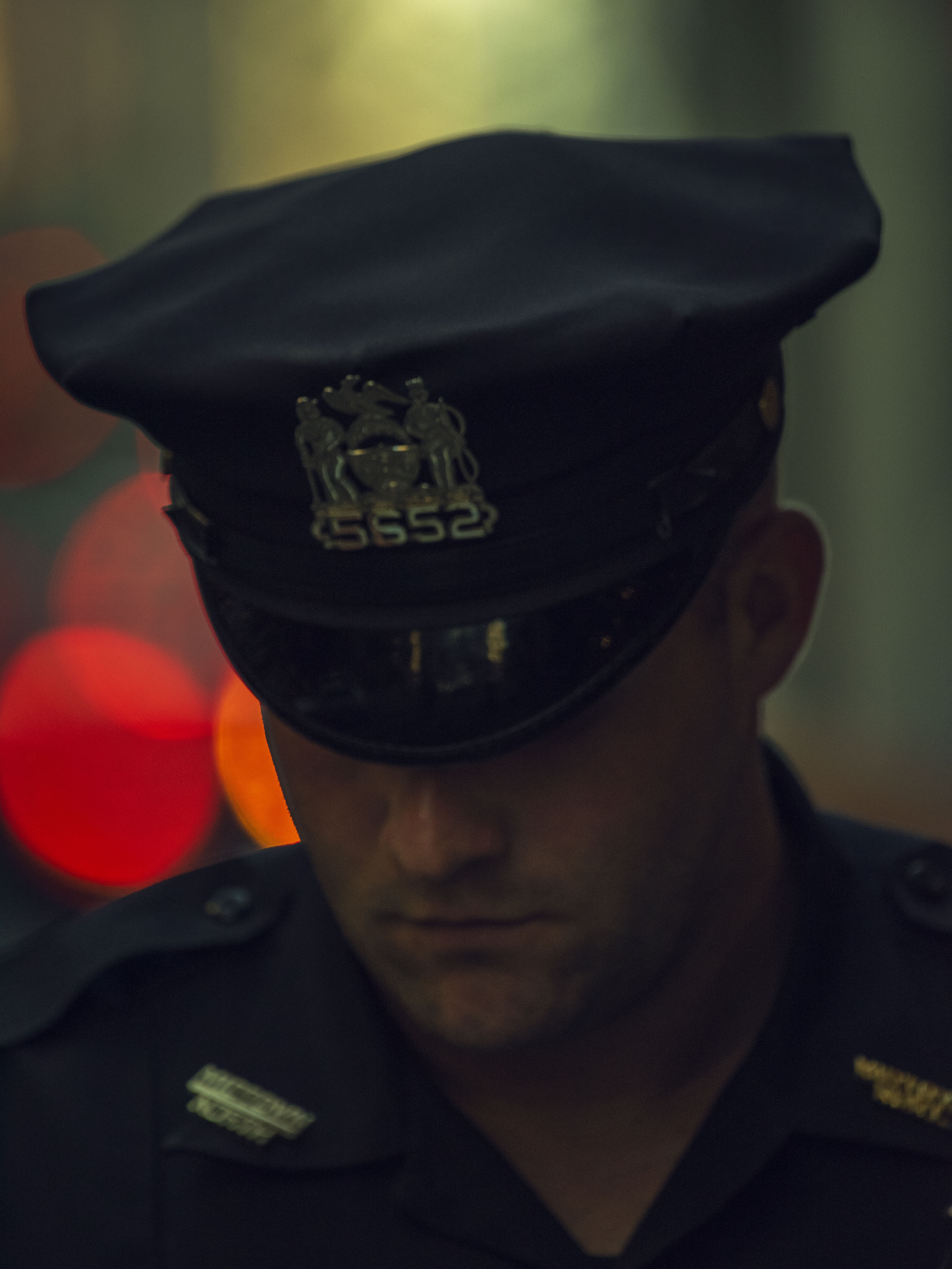
Christopher Anderson has two series, 'Approximate Joy' and 'COP' that make use of a tighter, more compressed perspective but the detached feel works in the context of both series.


Christopher Anderson has two series, 'Approximate Joy' and 'COP' that make use of a tighter, more compressed perspective but the detached feel works in the context of both series.


I quite like the juxtapositions, but ultimately these only reinforce my earlier contention...
Also, while superficially interesting, without a wider context they really don't qualify as 'street' photography other than having been photographed outdoors in an urban environment - in my mind at least. But that's where half the problems lay when categorising this type of work - it means different things to different people. Only by common agreement do we arrive at a consensus of what 'street' actually is.
 
First of all, may I direct you to my posting here: https://www.talkphotography.co.uk/threads/law-and-ethics-in-street-photography.716257/post-8985907
But that's where half the problems lay when categorising this type of work - it means different things to different people.
That is the nub of the problem.
Only by common agreement do we arrive at a consensus of what 'street' actually is.
Agreement is not possible over these matters unless people practice the use of "in my opinion" and mean it when they write it.

In the final analysis; these terms are essentially meaningless, because they only mean what a viewer, often at a particular moment in time, chooses to think that they mean.
 
Last edited:
First of all, may I direct you to my posting here: https://www.talkphotography.co.uk/threads/law-and-ethics-in-street-photography.716257/post-8985907

That is the nub of the problem.

Agreement is not possible over these matters unless people practice the use of "in my opinion" and mean it when they write it.

In the final analysis; these terms are essentially meaningless, because they only mean what an viewer, often at a particular moment in time, chooses to think that they mean.
Absolutely and as with all photography, 'liking' a particular style is purely subjective. I 'dislike' the majority of long-lens 'street' photography (excluding sports and hard news) for the reasons mentioned. Obviously there will be exceptions but we're speaking about generalities here.

"If it's wrong but it works, it's not wrong"...
 
...'liking' a particular style is purely subjective.
This, I think, is at the heart of the discussion.

Another reason why I prefer to work with long lenses is aesthetic: the isolation of the subject matter. Where I want to place the subject in context, I too pull out a wide lens. However, I'll only do it when working with the subject and not (for want of a better term) ambushing them.

This is why I have very few examples of wide lens "street" photography.
 
But that's where half the problems lay when categorising this type of work - it means different things to different people. Only by common agreement do we arrive at a consensus of what 'street' actually is.


My views are:

- absolute quality often isn't important. I'm also of the view that a bit of 'grain' or softness gets away from identifying people and potentially reinforces context.​
- monochrome is a dilemma. There's stuff out there that looks great - but I think it's also a bit of a cliche for street. (I'm not good enough at seeing and exposing for monochrome).​
- I made a decision that I won't photograph homeless or vulnerable people as a main subject unless there is context. (But i won't avoid them if they are not the main subject.)​
- Patterns, light, shadow, people in architecture - I think it's a genre of its own and not 'street'.​
- I personally prefer wide lenses - 16mm - occasionally use a 18-55 - and have started experimenting with 56mm and 90mm - all on APS. I find longer lenses harder to use in a street environment. I have experimented with a 8mm fisheye and I'm intrigued by the perspective in tight spaces or groups of people but for me not yet productive. I prefer primes but that's probably because my brain is too simple to handle a zoom.​
My feelings about 'street' is that it is about people in public within an urban or suburban environment. (Parks are therefore included).
 
- I made a decision that I won't photograph homeless or vulnerable people as a main subject unless there is context. (But i won't avoid them if they are not the main subject.)

Good decision ;)

I do think some street photography verges on the voyeuristic and avoiding what can only be described as homeless porn is a very good thing
 
Good decision ;)

I do think some street photography verges on the voyeuristic and avoiding what can only be described as homeless porn is a very good thing
Unless you're seeking to highlight the plight of homeless people in order to bring attention (and a remedy) to their situation, I think you're right.
 
In my opinion, photograph what takes your fancy and think about it later. There's always the "Deliver" button (joke for "Buffy the Vampire Slayer fans) or a shredder, if you prefer your images in dead cow on a plastic base. :naughty:
 
The definition I like is 'candid public photography' - the word street implies the need for some degree of urban environment - but that doesn't need to be the case, over the history of street photography so much good work has been created on beaches, e.g. the folks in New York shooting on coney island or even Parr or Ray-Jones in the UK + many others

Calling it 'candid public photography' then opens a whole new can of worms haha I get bored with the whole 'definition of' debate so one I avoid where I can ;) I'm sure no other genre has this issue

totally agree with others about photographing homeless people, it's not for me - It feels to me like an easy target for someone getting into street and it becomes a habit for them. A documentary photography piece that tells their story is something different though, but these take time in terms of building trust and getting to know the subject which is essential imo
 
It isn't just homeless people, it's anyone I feel may be disadvantaged in some way, e.g. someone in distress. Unless there is a very good reason to make the picture, then I avoid these scenes - getting compliments on the photo or likes on social media isn't a good enough reason for me. I'm someone who makes photographs for personal enjoyment, not a documentarian or photojournalist.

My basic rule of thumb is to not take "unkind" photographs, although I guess even this can be subjective depending on who views the images.

Regarding the definition of street photography, I think it's best not to pigeon-hole it too much - it encompasses a broad church of styles, often crossing over into other genres. Some great street photographs don't feature people at all, e.g. Matt Stuart's photo of a skip. Some people prefer candid portraits, others more complex scenes with multiple interacting elements. I personally really enjoy interesting coincidences like the ones in this Flickr group and think that they must be very rewarding when you catch such moments.
 
Back
Top