Beginner Starting out

inquisitive_chap

Suspended / Banned
Messages
118
Edit My Images
No
After a few abortive false starts over the years (mainly as I got lost in complexity), I have rekindled my interest in photography. I am trying to think about how to go about learning and improving. These are my thoughts and I'd welcome views

1. Just get out there and take photos frequently with both phone (which takes raw) if I am out and about; and then have 'proper' sessions where I take my camera out with me (a micro four:thirds camera)

2. Read up on composition. (Any recommendations for good books / videos?)

3. Refresh my memory of the relationship between focal lengths and f stops and shutter speed etc and what they all do. Have a guide I found on here. That could take a morning.

4. Learn how my camera works beyond the Aperture priority mode which is all I use right now. That could take an afternoon

5. Post processing. After experimenting with Darktable I took advice from someone here and just bit the bullet (having initially been dead against their subscription model) and got Adobe Lightroom. I tried classic but have ended up using the Lightroom Cloud version. My reasoning is that it is the simplest package to use with the most support (lightroom queen guide is great). I need to spend some time learning the basics of post-processing albeit that shouldn't come at the expense of 1 and 2 above.
 
A couple of book suggestions:
1. The Photographer's Eye by Michael Freeman: A classic guide to composition and design in photography.
2. Understanding Exposure by Bryan Peterson: While focusing on exposure, it delves deeply into how composition and light interplay.

You could set some goals or join one of the challenges here so your efforts are focused. Then, share your results here and ask for constructive feedback.
 
A couple of book suggestions:
1. The Photographer's Eye by Michael Freeman: A classic guide to composition and design in photography.
2. Understanding Exposure by Bryan Peterson: While focusing on exposure, it delves deeply into how composition and light interplay.

You could set some goals or join one of the challenges here so your efforts are focused. Then, share your results here and ask for constructive feedback.
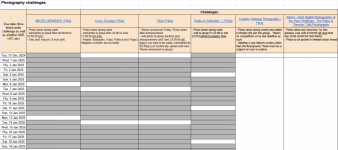
Thanks. I have made myself a little google sheet to track some challenges. Just need to fill in some of the forthcoming themes. I won't do all of them . Just pick a few

1735652122905.png
 
Last edited:
@TimHughes I ordered a physical copy of "The Photographer's Eye" but could not order a physcial copy of "Understanding Exposure". But I bought and downloaded the kindle version which - when viewed on a tablet (rather than an e-reader) shows the pictures etc in full resolution

'Understanding Exposure' is excellent so far
 
Last edited:
1. Just get out there and take photos frequently with both phone (which takes raw) if I am out and about; and then have 'proper' sessions where I take my camera out with me (a micro four:thirds camera)

2. Read up on composition. (Any recommendations for good books / videos?)

3. Refresh my memory of the relationship between focal lengths and f stops and shutter speed etc and what they all do. Have a guide I found on here. That could take a morning.

4. Learn how my camera works beyond the Aperture priority mode which is all I use right now. That could take an afternoon

5. Post processing. After experimenting with Darktable I took advice from someone here and just bit the bullet (having initially been dead against their subscription model) and got Adobe Lightroom. I tried classic but have ended up using the Lightroom Cloud version. My reasoning is that it is the simplest package to use with the most support (lightroom queen guide is great). I need to spend some time learning the basics of post-processing albeit that shouldn't come at the expense of 1 and 2 above.
1. I wouldn't even bother with the phone, tbh. If you want to learn photography in depth then use a camera. My opinion.

2. Simon D'Entremont has some great videos on Youtube covering many different topics. He explains topics very well and gets straight to the point.

3. Again, Simon D'Entremont.

4. Take lots of photos and process them, even if you won't use them. Editing needs to be practiced too. A little side note to editing: If you plan on printing your photos you must calibrate your screen before editing.
 
There are (basically) just 2 aspects.

1. Making interesting photos
2. The technical aspects

And it really is that simple:)

You can create interesting photos with zero technical knowledge, many people do so, very successfully. All that you need to do is to take loads of photos, letting the camera do all the work, and you'll get a % that you'll be delighted with. You'll also get a lot that can't work simply because no camera can do all of the thinking for you, but the success/failure ratio will largely depend on whether or not you push the envelope too far - for example if you want to take photos of tiny flies or if you want to photograph a black cat in the dark, then you'll be pushing your luck.

Or you can learn the technical aspects, so that you get the best out of your camera, and as a trained photographer who is also ancient and who learned his trade before any automation existed, I think that this is very important.

But a camera is just a tool, and using it correctly and to its full potential is just a skill. Like all tools and all skills, there aren't really any shortcuts, it's a process that never completely ends. The trick (if there is one) is to become so good at using the camera that we do it without any thought, it's just there, and once it's there then we use the camera, make the technical decisions almost automatically and concentrate on the creative side, with the result that we get interesting, creative photos that work (nearly) every time, increasing the success rate dramatically.

The problem is when we don't know what we're doing and allow ourselves to mess up the creative side by concentrating on the technical side. One good approach is to use the camera in one of the auto modes (aperture priority except when photographing fast movement, in which case it has to be shutter priority mode) and only do all the thinking yourself with technically difficult subjects or lighting conditions.

As for image processing, it's an essential part of digital photography, but don't let it get in the way of your learning process. It's easy to (up to a point) rescue bad shots on computer, but it's the wrong approach, you need to throw away the bad shots and create good ones, use PP to turn good work into superb work, not as a lazy tool.

If it helps, I've written a basic beginner book about cameras, their settings, lenses etc that may help you, in pdf format. You're welcome to a copy.
 
If I were starting now, my advice to myself (which I probably wouldn't have followed)

- try to combine photography with other interests, if you don't have other interests then find some...

- Photography doesn't need to be all about photography

Not that I'm against books on composition and such like, I think there's more value to be had in spending time with a photobook / monograph

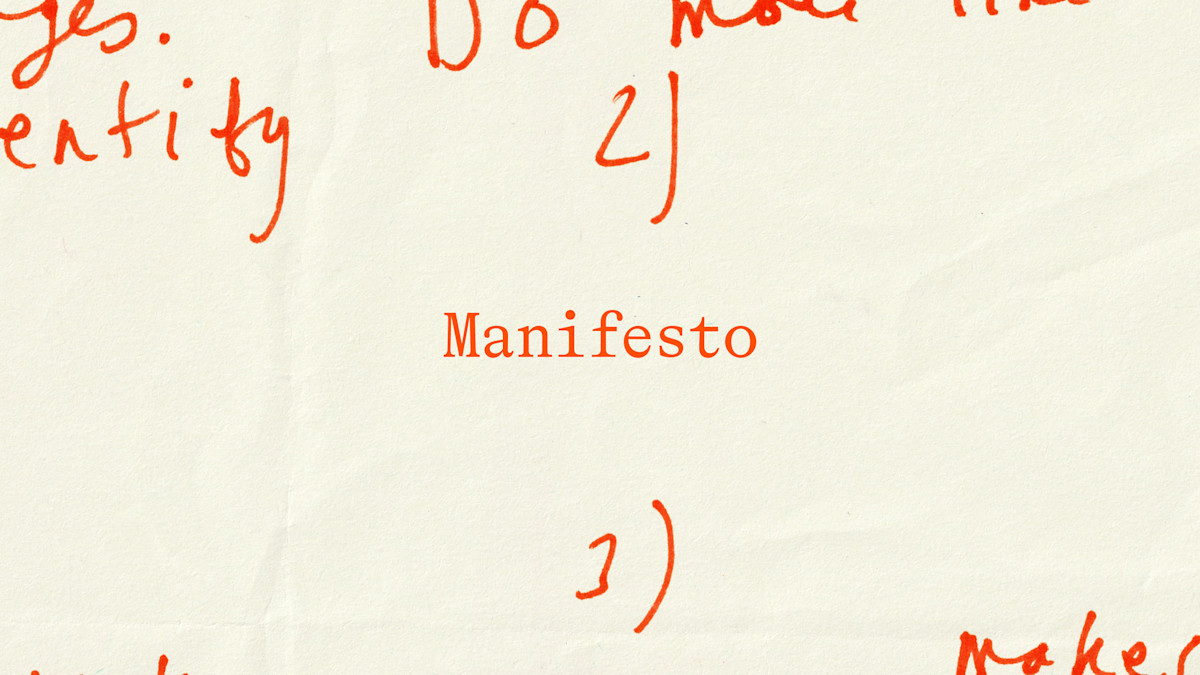
As controversial as he is, this recent 'manifesto' by martin parr is spot on

 
I put together an ebook on depth of field and getting started with the basics.

My advice is if you want to learn, stick to a prime lens for a month and use aperture priority mode. Adjust the variables of aperture, shutter speed and ISO and enjoy it.

David
 
Aperture priority is probably the most general purpose way to go, unless for action - and along with it, maybe consider auto ISO too. You'll find, though, that auto settings need to be overridden at times (eg by dialling in exposure compensation) - and knowing when to do this (& in which direction) will be based on experience &/or studying the exposure simulation / histogram if available in the viewfinder. Highlight protection is a key - the rest can be altered later.

Depth of field is closely allied with framing - they work together. To me that's something to develop a natural feel for, rather than studying any 'rules'. Just be wild, if you like, and see what works.

Hope that isn't overload!
 
I very rarely disagree with @juggler as he's a much better photographer than me.:angelic:

But one of my weaknesses (and I see others suffering too) is that if I've invested heavily in an image, particularly if it's something I'd been looking forward to shooting, then I will see that image as better than it is. Because what I'm seeing is the time and effort, or how clever I've been to conceive something. Whereas the result might not be the success I want and believe it to be.

So you should learn to critique certainly - but don't necessarily rely on your own judgement of your work.
 
Last edited:
Yeah, we can have an emotional investment in an image, & then cling to it - but that's still something we ought to try & rise above - if we can't do that at all, then all is lost! I think our view of our own images is best tempered by lots of looking across the board at other people's. A bigger context. Stuff to bounce off.
 
Yeah, we can have an emotional investment in an image, & then cling to it - but that's still something we ought to try & rise above - if we can't do that at all, then all is lost! I think our view of our own images is best tempered by lots of looking across the board at other people's. A bigger context. Stuff to bounce off.
I'm pretty good at the usual editing, and can easily rank my images most of the time. It's just those odd occasions where I've really really wanted to get something.
 
I've been taking photographs for years, many years. Film & digital. I rarely take an image that I am extremely pleased with, but on the odd occasion, I get a result which is almost identical to how I saw it in my head before I took the shot.

The moral of this tale?

Have an idea of what you want to achieve when making the image. Look at other images, try to understand how they were shot. Then go and play, work on getting that image you saw in your head, Change apertures, shutter speeds, focal lengths. You need to take pictures to learn how to take pictures.
 
You need to take pictures to learn how to take pictures.
:plus1:

Regarding self-criticism; leaving pictures and looking at them after some time can help you look at them more subjectively. Photos thought good for the kinds of reasons @Phil V gave can be seen for what they are, and strangely, photos which seemed average or worse on initial viewing can appear more successful. Time provides clarity.
 
I am quite aware that the photos I take have flaws in them. I may start posting some to get constructive help on how to improve because I do WANT to improve

At the same time, sometimes I just happen to like a photo I've taken. It may be that it just appeals to me (even though to a non-beginner it may seem poor) and I am slightly wary of having my enjoyment and pleasure in photos I have taken crushed out of me by lots of constructive criticism meaning I won't look at the photos without simply seeing its flaws

This says a lot more about my own personal psychology I think! I will probably share some photos but not all, and grow a thicker skin!
 
I am quite aware that the photos I take have flaws in them. I may start posting some to get constructive help on how to improve because I do WANT to improve

At the same time, sometimes I just happen to like a photo I've taken. It may be that it just appeals to me (even though to a non-beginner it may seem poor) and I am slightly wary of having my enjoyment and pleasure in photos I have taken crushed out of me by lots of constructive criticism meaning I won't look at the photos without simply seeing its flaws

This says a lot more about my own personal psychology I think! I will probably share some photos but not all, and grow a thicker skin!
Imo the definition of a good critique is one that leaves you (and everyone else involved) inspired to take more photos. But it’s hard work to create an environment for that to happen
 
Photography is such a broad church that it's difficult to get useful critique, or to give it, because we all approach the subject from a different direction, with a different perspective and a different idea of what constitutes a "good" photo.

It's a very good idea to look at other people's photos, whether we critique them or not, because that's one of the ways in which we learn, and it's also a very good idea to ask people to critique our own photos, but we shouldn't allow comments (positive or negative) to influence us too much. Obviously if 1000 different people made the same comments then we should take note, but in reality that doesn't happen.

As an amateur, you have nobody to satisfy except yourself, so if you're happy with a shot then that's really all that matters. And there's also the personal aspect, if the photo (or subject) has a strong emotional connection then it's a good photo.

Here's one of my old photos. I found it in a drawer and it somehow ended up with a splodge of ink on it. it's of my youngest daughter, so nearly 30 years old. I will have taken it on a 35mm camera, probably the Canon A1 that I had at about that time, it will have been processed and printed by a D&P house that added salt to the developer to "improve" the contrast, so some detail will have been destroyed by that "improvement".

So I scanned it, there's a lot that I could do in PS to clean up all the marks and bits of hair and dust, but it doesn't matter to me. What matters to me is the expression on my daughters' face:)

It's technically competent but has no real qualities, which again doesn't matter to me.

I say that it's competent because it's correctly focussed, the camera will have been on aperture priority and I clearly used a large aperture to de-focus the background, I would have used a low camera viewpoint to avoid the background becoming important, it's backlit because that's the obvious approach, and I will have added a bit of exposure because it was backlit. I also framed it fairly tightly, because (with 35mm film especially) image quality started off low and I learned a very long time ago not to waste image quality by taking a wide view and then cropping.

cathy_baby.jpg

If I posted this shot for critique it would no doubt be heavily criticised, but all that matters to me is the emotional connection, which only exists because it's of my daughter and her mother:)
 
Last edited:
Just starting out as well, and have found that there is so much to photography its hard to describe.
So many genres, styles and so on, it endless.
Joining a club has helped me a great deal. Its very enjoyable and while watching the judging of members photographs I found so helpful in composing my own.
Using a camera took a bit of time but now I am beginning to feel comfortable. The advice I had was use the camera till you can do it with your eyes closed.
Stopping to think about camera settings, is for me quite hard to do, as I always forget. Slow down and compose what you really want to do.
Lots of hep is on here, all it took was for me to precipitate in the forums
I have received lots of encouragement and help.
Finding a genre, what can I say, but I have tried to keep it simple and most of all local till I get enough confidence.
Post processing, the camera I use is a Nikon D3100, and I have a few lenses to fit it.
Sticking to one lens is helping me produce some pics, moving on to the others will come when I feel its right, currently its 35mm 1:1 8G.
The processing for me is done by NX studio, which I imagine is similar to other systems, Pick a photograph and play with it, experiment and get used to the process, so any photograph will do till your used to it.
Currently when I go out I am surprised buy the amount of things I see and the amount of photographs I actually take. Its all part of learning.
It doesn't have to be too complicated, for example this morning it was a short walk to the shop, But just the fact that the camera is in use and the mind is concentrating on images is doing it for me..
Like fishing, you will never catch from the couch.
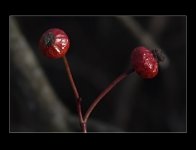
This mornings photograph.
Winter Berries.
Winter berrys.jpg
 
I like the 'you will never catch from the couch' phrase.

Because I am someone guilty sometimes of wanting to learn all the theory and not just getting out there and doing stuff! I tend not to take enough photos!
 
I very rarely disagree with @juggler as he's a much better photographer than me.:angelic:

But one of my weaknesses (and I see others suffering too) is that if I've invested heavily in an image, particularly if it's something I'd been looking forward to shooting, then I will see that image as better than it is. Because what I'm seeing is the time and effort, or how clever I've been to conceive something. Whereas the result might not be the success I want and believe it to be.

So you should learn to critique certainly - but don't necessarily rely on your own judgement of your work.
That's very kind and not entirely true. Send me to a wedding with a speedlite & I'll be a mess.

... but to the point ... If you're emotionally invested in an image then I think you're entitled to include that fact in the critique. It makes the image more successful to you.

Indeed as @benc98 implies: there's an argument that we should only shoot what we're interested in. Why go to the effort of photographing trains & bugs & flowers & mountains because you're a photographer when actually all you're interested in is nudibranches?*

* a friend of mine really does only photograph undersea bugs. She does it very well.
 
I have noticed that I am overly attracted to making my photos black & white. I really like black and white photos but I definitetly overdo it.
 
I have noticed that I am overly attracted to making my photos black & white. I really like black and white photos but I definitetly overdo it.
Mono can often be more meaningful by being a more distilled form, where colour can provide too much information ...
 
I am quite aware that the photos I take have flaws in them. I may start posting some to get constructive help on how to improve because I do WANT to improve

At the same time, sometimes I just happen to like a photo I've taken. It may be that it just appeals to me (even though to a non-beginner it may seem poor) and I am slightly wary of having my enjoyment and pleasure in photos I have taken crushed out of me by lots of constructive criticism meaning I won't look at the photos without simply seeing its flaws

This says a lot more about my own personal psychology I think! I will probably share some photos but not all, and grow a thicker skin!

At the end of the day the only person you need to please is yourself when it comes to taking a photo.

I like the 'you will never catch from the couch' phrase.

Because I am someone guilty sometimes of wanting to learn all the theory and not just getting out there and doing stuff! I tend not to take enough photos!

Get yourself a book on Exposure and read it in stages and get yourself out there and play around with the settings in manual mode. Shoot a subjuct each 1 stop apart and you will "SEE" the difference that aperture does. Don't forget to adjust ISO or shutter speed to keep the exposure exactly the same. Learn by doing!

I have noticed that I am overly attracted to making my photos black & white. I really like black and white photos but I definitetly overdo it.

Black and White is nice. Just don't make it B&W to mask crap light, as B&W needs better light that colour.

If I posted this shot for critique it would no doubt be heavily criticised, but all that matters to me is the emotional connection, which only exists because it's of my daughter and her mother:)

^^^^^^^ This is what I was saying about the only person you need to please is yourself.
 
After a few abortive false starts over the years (mainly as I got lost in complexity), I have rekindled my interest in photography. I am trying to think about how to go about learning and improving. These are my thoughts and I'd welcome views

1. Just get out there and take photos frequently with both phone (which takes raw) if I am out and about; and then have 'proper' sessions where I take my camera out with me (a micro four:thirds camera)

2. Read up on composition. (Any recommendations for good books / videos?)

3. Refresh my memory of the relationship between focal lengths and f stops and shutter speed etc and what they all do. Have a guide I found on here. That could take a morning.

4. Learn how my camera works beyond the Aperture priority mode which is all I use right now. That could take an afternoon

5. Post processing. After experimenting with Darktable I took advice from someone here and just bit the bullet (having initially been dead against their subscription model) and got Adobe Lightroom. I tried classic but have ended up using the Lightroom Cloud version. My reasoning is that it is the simplest package to use with the most support (lightroom queen guide is great). I need to spend some time learning the basics of post-processing albeit that shouldn't come at the expense of 1 and 2 above.
Im a beginner myself and not sure how muych you would get from this but i bought the 'Read this if you want to take great photographs' book by Henry Carroll in December when i started and it has helped me (y)
 
Back
Top