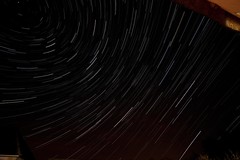
Star Trails

tomwazza

Suspended / Banned
Messages
62
Name
Tom
Edit My Images
Yes
Hi Everyone,

Still experimenting with my camera, and thought that I'd like to give star trails a go. I was just wondering what method gives the best results, a long exposure (several hours) or lots of shorter images merged together.

Also would it be possible to have instructions for my Canon 30D as I've read a few tutorials and have gotten a little lost.

Any suggestions would be really useful,

Thanks,

Tom.
 
Thanks for the link Dave - this may come in handy this summer when I eventually get round to having a bash at this myself!
 
Yeh I've picked that program up from another forum, it looks like it's really useful. So I take it the best way to do it is to take multiple shots in the same position with say 30 second exposures?

Anybody have any settings that produce good results?
 
Your welcome gembobs :)

Tom yes I would use ISO 100 and 30 secs exposure, and take 80 to 120 shots (40 mins to 1hr) in total depending on what you want, on a tripod cable release
 
Anybody have any settings that produce good results?

Depends how dark it is/how many stars you want in the picture. I was out tonight and used the following settings...

ISO 400
f/2.8
120s shutter x30

and I got a lot of stars in it, so when stacked with the above app the sky is a bit cluttered. So it really it depends on how many trails you want.

Just experiment and remember to try an ISO 3200/wide open to figure out the right exposure for your liking, then adjust for the lower ISO.

EDIT: I also use the Yongnuo N3 for my D90 and it works like a charm, best £30 I've spent in a long time.
 
Depends how dark it is/how many stars you want in the picture.

and I got a lot of stars in it, so when stacked with the above app the sky is a bit cluttered. So it really it depends on how many trails you want.

Yes thats the problem Craig getting the right amount but if you took say 80 shots you could use any amount of them, so to many trails, use less combined exposures :thumbs:
 
my settings are usually
tripod with camera bag hanging off the middle to steady it
bulb mode
30s
continuous with remote release
focus on infinity
up the iso as high as it goes and take a few test shots to test focus
is to 100
fire away for two hours
take 10 shots at the end with the lens cap on (used in the startrails program to set the black point and hide any dead pixels)
stack in startrails software

the hardest bit is finding a decent bit of foreground interest
 
Yes thats the problem Craig getting the right amount but if you took say 80 shots you could use any amount of them, so to many trails, use less combined exposures :thumbs:

I also thought about dropping the exposure by 1 or 2 stops in CaptureNX via the batch processing. That way it will take out the lighter stars and keep the brightest ones in the scene. A little more work but it would still allow for an hour long trail instead of say 30 minutes.

The image from last night. A total of 1 hour from 30 2min exposures at 400 ISO and f/2.8. To many stars? :shrug:

http://imgzen.us/images/63857848624818639720.jpg

the hardest bit is finding a decent bit of foreground interest

I just head for the hills. You will always find a nice wind swept tree, worn down wall or a stone built bridge over a burn to use as the foreground. I tried getting big landscapes in my shots but they don't turn out the best since I am looking for a dark spot so the landscape wont show any/much detail, it will just silhouette. A half/full moon would probably help that, though.
 
Craig,

That’s an absolutely cracking shot, that's what I'd like to try and replicate. How did you get the foreground though, did you take a shot during the day and then merge it with the 30 shots you took at night?

Cheers,

Tom.
 
Thanks, Tom.

Nope, all 30 shots were taken at night from 8:56 to 9:57. I picked the location for the cairn and trig point knowing that since it was at the top of the hill it would catch any ambient light that was coming from the lights below. I also had the moon on my side last night since it was very bright and high in the sky. If you can see a little detail around you just from the moonlight then you should get simialr results.

If you want to use something in the foreground that isn't catching any light then you can try using a flash light for a couple of the exposures to light up the foreground. Then just fix it in PP.


Is there something similar you can use on Mac's?

Could you not run it in Bootcamp?
 
Ditto on the 'hardest bit being foreground interest'...


That's 117 30s shots at ISO640, 14mm, f/5 glued together in startrails.de after noiseninja. I'm very impressed how noise-free it is at that ISO. I just wanted to see just how many stars I could capture with a slow UWA lens...
 
Back
Top