Star trails and in-camera noise reduction

justin72

Suspended / Banned
Messages
71
Name
Justin
Edit My Images
No
Hi,

Just a quick question, am going to buy a D700, and want try some star trails when I back in Australia in January. Thinking about long exposures, do you think it be worthwhile turning off the in-camera noise reduction? If I could use bulb for 30 minutes and ISO 100, do you think the noise would be too much by turning this off?

Any tips would be great, thank you.
 
Possibly, but there's every chance that a 30 minute exposure will give you an overexposed sky due to light pollution, even if you are several miles from the nearest city.

Also remember that in camera noise reduction takes a dark frame that is equal in length to the image exposure. So if you make a 30 minute exposure, the camera will then be unuseable for a further 30 minutes whilst it creates the dark frame to effect the noise reduction.
 
Thanks Scarecrow, your last point is essentially why I thought turning NR off may be a good thing. I don't think light pollution will be an issue as I will be litelly 100km for any towns, but I shall see.

I may just turn it back on and see how I go.
 
I would suggest starting with a shorter exposure of maybe 5 or 10 minutes. This should give you an indication as to whether light pollution is going to be a problem, without having to wait 30 minutes first.
 
now here is a thought -

30min = 6x5 mins

take 6 x 5 min exposures - load them all in PS, and do some difference caculations between them. Noise is by essence random, if you can isolate the star trails (should be easy enough as a selection based on luminosity) you are then left with "the scene" containing low level noise. between the 6 shots, the bits that remain constant will not be noise, combine what is "the same between the shots" and in theory you should have a noisless image. Add the star trails back in afterwards
 
When I do startrails I usually do about 50-100 x 30sec exposures and blend them together with free software called startrail.de
This software also has the option to include black frames to your selection of images which will deduct any hot pixels from your final image.
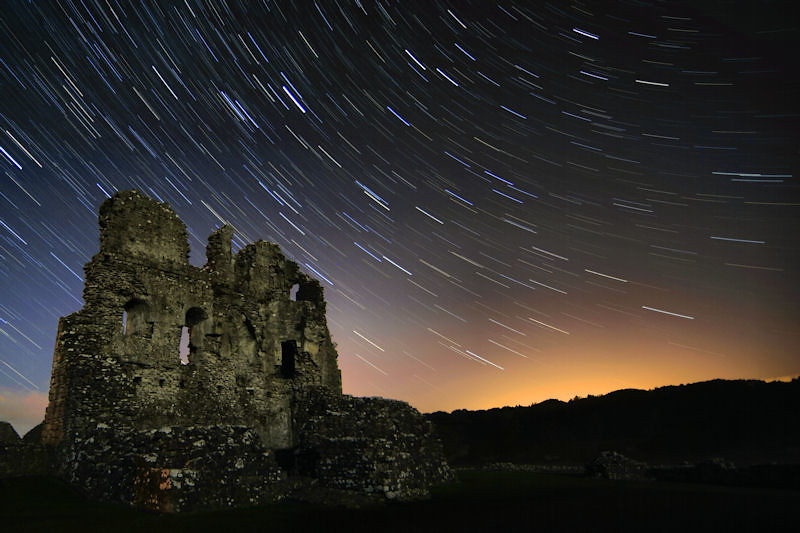
Here's an example of whats possible with the software:

5136619173_b9b0e6941e_b.jpg


Have fun :)
 
When I do startrails I usually do about 50-100 x 30sec exposures and blend them together with free software called startrail.de
Does Statrail.de build up lighting information over the 50-100 shots, or does it only look for lighting differences between shots (i.e. the star trails).

I'm looking at the sky exposure and lighting on the ruins in your example, did you need to expose for these on your initial photo, or was this lighting detail built up over the 50-100 shots ?

Ta.
 
Long Exposure Noise Reduction is a waste of time in the field IMO. Far better to ensure you get a well exposed image/ set of images and minimise the amount of noise in the first place.

Strongly recommend the multi-exposure method of capturing star trails. Numerous benefits including relative star brightness, ability to shoot in a wider range of locations incl those with light pollution, and the fact that the additive nature of compositing tends to minimise noise before noise reduction is applied.

If you have the right gear you can set your remote release to capture consecutive frames that are several minutes long rather than just 30 sec. My preference is to shoot for as long as possible at really wide apertures to capture as many stars as possible without blowing the foreground detail.
 
For star trails long-exposure noise reduction just isn't worth it. If you do a single, long exposure then you have to wait an equivaent time for the LENR exposure - meaning your camera is out of action for half an hour. If you do multiple, short exposures then the stacking process will remove random noise and startrails.de has to option to use a couple of dark frames (also short exposure) to remove non-random noise.
 
Harold Davis in his book Creative Night says in a moonless sky that a 3min exposure at about f5.6 or a 4min at f4 works quite well. Also if you take a black image, say for instance of your lens cap when its still on your lens then this can be stacked quite nicely to create quite a noise free image! I find those exposures and times work ok for me.

I stack them in lightroom using the LR / Enfuse plugin, which is donation-ware! :)

HTH
 
Wow! Thanks for all of the advice, it's really appreciated. As with anything, there's always more than one way to do something. I will have some time back home, so I think I may try both the long expsure & stacking options, and see how the measure up to each other.

Richard, I read you posting a couple of times and don't really understand it. What is a difference calculation? Is it some kind of module in photshop?
 
@Yog - I'm not 100% sure how the startrail program works, it just gives me the images I want with little extra PP :)

@Shutter - Thanks for pointing out LR / Enfuse plugin, I'll have a look tonight. Always good to have a few options.
 
@Yog - I'm not 100% sure how the startrail program works, it just gives me the images I want with little extra PP :) .

Tried it last night (bliimin freezing :eek:). It appears that Startrails.de only adds brightness to an image if the new pixels are brighter than the ones that were there before. So if you have a foreground object that is illuminated with a constant light source, it wont get brighter with successive frames. This means that if you want to get some colour in the sky, you will have to expose for it on the first frame.

The biggest advantage of stacking multiple 30 second exposures is that there is practically no noise build-up. I did a series of car trails covering about 15 minutes and a set of star trails for just over an hour, and I was really surprised how little noise there was :)
 
@Yog - I'm not 100% sure how the startrail program works, it just gives me the images I want with little extra PP :)

@Shutter - Thanks for pointing out LR / Enfuse plugin, I'll have a look tonight. Always good to have a few options.


When I stack using that plugin, I make sure I turn off the auto align feature as it gets confused with the 'moving' stars!! You shouldn't have to auto align anyway because your shooting on a tripod, right? :razz: lol
 
Top tip, thanks Kris :)

And thanks for the info Yog, hope you've thawed out ok
 
Last edited:
Back
Top