Spotty negs.

Cluster

Suspended / Banned
Messages
770
Name
Dave
Edit My Images
Yes
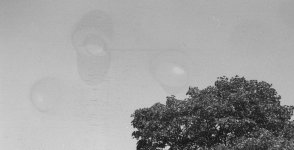
One of my first home developed 120 roll for many years came out with spots in the highlights. These spots are visible in the negatives.
I used a roll of Fomapan 200 (1 of 5), developed in Rodinal 1:50 at 20c, my regular stop bath and regular fix.

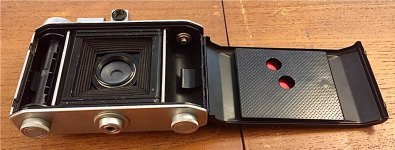
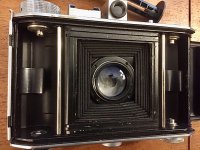
The spots seem to be even across all frames from my new-to-me Ensign Selfix 820 folding camera in 6x9 format.

I am working on the assumption that it was dust in the camera, and will clean the bellows.

It had occurred that this might also be caused by my developing process, is this possible?
My first roll, from a different camera, was developed in Bellini Duo Step. That seems to be OK.

Crop from frame at scanned res..

spots.jpg
 
This is most likely the soft emulsion scratch issue commonly associated with certain batches of Fomapan 200 in 120. Could you provide a screenshot of a magnified section of the highlights?
 
I would go with dust as the spots are black .
Any dust on the emulsion will block light thus rendering the sections of film located beneath the dust particles unexposed.
 
The image is a crop at full scanned resolution. I'll re-scan it.
 
I suspect it is the film, I've got a similar issued with the roll of Foma 200 120 I developed recently and it has also been mentioned in this thread on Photrio https://www.photrio.com/forum/threads/fomapan-creative-200-120-black-dots-and-streaks.181759/
I'm not sure what the solution is though, people had mentioned likely causes of too high a temp in developing or use of an acid stop bath but I kept to around 20° (wash temp may have varied by +/- 2°) and no stop bath - semi stand developed in Caffenol C-L.
 
Last edited:
A crop of about 1/9th of the area of a 6x6 exposure - please excuse the out of focus image, focus ring had not been properly set after cleaning shutter mechanism.3F69189E-CF46-4926-BABF-1A3C9285A6DB.jpeg
 
I prewashed the film in plain water at 20c for 3 minutes before developing. Maybe that had an effect?

Batch O12956 1 exp 11/23
 
Last edited:
Based on what I've read about the fragility of Foma 200 (Foma 100 and 400 seem better) Amazon might have done me a favour in not sending me 10 rolls)!

I should add that the roll I developed was not the Amazon film but a roll I brought earlier in the year - batch no. 013456 2 exp 09 2024.
 
I prewashed the film in plain water at 20c for 3 minutes before developing. Maybe that had an effect?
Maybe, I also did a pre-wash for 5 minutes, the water cameour a lovely shade of green.
 
A short history of my experiences with Foma films.

In roll film, particularly 200 iso, I never obtained what I considered to be good negatives.
Grain was always a problem.

With LF (5x4 through to 10x8), that issue has never occurred , even with 400 speed which I’ve used for portraits.

Similarly , never ever have I experienced problems with so called fragile/delicate emulsion.
Tbh I’ve managed to damage the emulsion of ilford and Kodak films just as easily and this belief that Foma film is more prone to scratches etc ,is I think over exasperated by some togs.

Anyway returning to the spotty effect on the OPs negatives, the only time I’ve had similar with Foma was indeed due to a faulty batch of 10x8 sheet film BUT the spots were white….. thousands of them too.

To be fair to Foma, they not only offered advice on how to remedy the problem and thus salvage my negatives ( albiet the remedy of an alkaline bath didn’t clear away all the spots ), they did replace the said film completely free of any charge and without any request on my part.

Perhaps it may be worth the OP contacting Foma to see what their opinions are on the cause, as black dots is without doubt caused predominantly by debris / crud on the film prior to exposure , but in this case the cause could well be related to a fabrication error.

Edit: I always pre wash my film….. Never posed a problem!
 
Last edited:
A short history of my experiences with Foma films.

In roll film, particularly 200 iso, I never obtained what I considered to be good negatives.
Grain was always a problem.

Funny how experiences vary Asha. It's probably my favourite film in 120 apart from the run of faulty batches I encountered in 2021. I have personally found the grain to be always close to invisible, certainly smaller than the 100, and had attributed this to the proprietary hybrid t-grain/traditional emulsion tech. It might also be due to the developers I use (Foma's own). I have found that in my workflow Foma film doesn't play too well with generic developers apart from Rodinal.

One interesting thing about Foma 200 is its spectral sensitivity, which is very similar to TriX for those who like it. Here's a side by side test (spectral comparison 4:14)

 
I can't answer on behalf of anyone else, and I don't presoak personally. But the following reasons were put forward by a former Kodak chemist as to why he did, and recommended the practice. Wetting the film prevents air bubbles when the developer goes in and gives more even development. Another reason others put forward is to make sure that the tank is at the correct temperature.

In the case of a strong dye coming out in the first solution, I can understand people not wanting green developer, if they aren't using a single use developer.
 
I pre-washed for the reasons noted by Stephen; partly to get the tank to the correct temperature and partly to ensure the film was wet so as to get better initial coverage by the developer. As Caffenol is essentially one-shot (although some have had success storing it for a short while) removing the green dye by pre-wash wasn't a concern.
 
This is the result of using an old camera for the first time. As you advance the film a very small amount of static electricity is generated causing the film surface to be slightly charged. This charge attracts the dust that is lurking inside the camera. Even if you have been meticulous in cleaning the camera, there will still be a surprisingly large amount of dust inside. An Ensign camera has probably not been used for 50 years or more and not been cared for in those years, being stored in a shed or garage for the most part.

When I buy a 'new' old camera, I run a roll of scrap film (which I keep for precisely this purpose) through the camera. I find one roll of film is enough to remove all the dust. Then my roll of proper film does not pick up any dust.
 
Even fairly new field. cameras with bellows attract a surprising amount of dust inside .

It generally shows itself on the groundglass before posing serious problems on actual sheets of film but the issue is clearly evident when focusing with a loop.
I occasionally gently vacuum the insides of my bellows with a hand vac that I use on film holders prior to loading with film.

I
 
Eventually..... ran a third roll (from the same batch, 021956 1).
This roll had the first 6 frames of 6x6 exposed on my Kershaw 450 folder, then the film was rewound and transferred to by Ensign 820 and shot 4 off 6x9 frames in that.
The spots are evident in all frames that show high exposure, such as blank sky. A first film that was exposed on a 4x4 Isoly3 vintage cam also showed the problem, although the smaller scan resolution tends to hide it.
So, three rolls showing the spotty problem. I'm relieved that it must be the film stock.

Here is a portion of a scan from my Ensign folder. Not just spots but some elongated spots..... This roll was developed in R9, rather than in Bellini Duo Step as per the others.

I have two rolls left, so will choose my subject matter very carefully or pop them in the freezer for future test film.
I do have two rolls from the refunded Amazon purchase, but i understand that that particular batch is well known for emulsion problems.


filmdamage.jpg
 
Last edited:
I finally got around to trying another roll of 120 Fomapan 200 (this one taken from the recent Amazon purchase - batch 013456-3 exp 12/2024). Again there was spotting but what has surprised me is the variation between the individual shots. All were taken using the same camera as before - but with the focus properly set up this time! - (Olympus Chrome Six II Zuiko f/2.8 75mm) and developed in Caffenol C-H at 20°C. I couldn't find any suggested time for Foma 200 in C-H so went with the starting time of 15 minutes in the Caffenol Cookbook (although I have seen a similar list which suggests starting at 12 minutes so wonder if I have overdone it a touch although I don't think this will have affected the spotting).

First image on the roll - heavy spotting
FC907485-A4EA-4598-B1D2-1D1967CC7DEA.jpeg
Crop of roughly 2.5%59C40F22-A50D-4139-BE52-9DCC9FF9B8D9.jpeg

3rd picture on the roll - occasional spotting but nowhere near as bad, the light sky seems to be almost untouched, with the spotting being more on the grey areas6B484C2E-2CD9-4E76-A932-1B347A33409A.jpeg
Crop of (again) roughly 2.5%968490E3-C3DB-465C-84B5-9299935CE09A.jpeg
 
Sixth picture on roll, grass is quite spotted but camouflages it well9929813C-3013-4F64-9DE0-7158DFD8A8E2.jpeg
FC0E71A5-1C13-4AB5-99D6-71045C140208.jpeg

Last image on the roll, only limited spotting
919A1CD1-421A-4D19-A7D9-931D3364A19A.jpeg
7A7AF5E6-EB82-4AD5-9A2A-49EB77E8F992.jpeg
 
I have found batch 013456-3 of Foma 200 in 120 to be a vast improvement over the two known previous problematic batches (021856-1 and 021956-1).

It's still a rather soft emulsion, and needs to be developed/handled with extreme care. One key issue is with the film rollers supporting the film in camera. They can, and will, produce or emphasise some of the defects shown.

Some of the issues seem to be exacerbated by acidic stop baths. I have taken to using water only stop and have seen improvements even in the old faulty batches.

With batch 013456-3, I have no issues when I use relatively modern/CLAd cameras, or when I use cameras whose film rollers are smooth and do not have irregularities/rust etc. I also manipulate or touch the emulsion as little as possible during the whole process.

Fantastic film by the way. Beautiful spectral response and extremely long straight portion of the density curve.

Rolleicord Va
Fomapan 200
Fomadon R09 1:50

2 details. 4000dpi raw 16bit/channel scan, followed by inversion+gamma correction. No edits.
zOs80RQ.jpg


Kki2GpJ.jpg
 
Last edited:
Thanks trypdal, I tried to minimise handling the film as much as possible with the last roll. As with the previous roll, I just rinsed with water between developer and fixer, no acid stop bath. Do you use a pre wash?

I haven't tried a roll in my Rollei yet but thought that the Olympus would have had a more gentle film path, no 90° bend. The rollers feel smooth to the touch and no signs of corrosion. I'm not noticing any increase in spotting in the middle of the negative so assume that the springs which keep tension on the roll are not causing an issue?

CB5FAD93-DABA-4702-B8E9-C850E1C10B29.jpeg3FE29144-7067-4D59-B697-165FF8D28BC9.jpeg

I've had heavy spotting on skies and I assume this part of the film would be in contact with the lower half of the pressure plate (inverted image) so not affected by the cut-outs for the exposure number.
 
Last week I developed my first ever roll of 120 film (I have done lots of 35mm) and one of the disappointments was black spots on the negative. I thought it was possible because the film recoiled like a spring when I took it out of the ring binder sleeve to scan, resulting in me dropping the negative on the floor. I thought it must be dust, forgetting that they would appear white on a positive. The film was Fomapan 200. Logic tells me it is something happening in the camera because the black spots are slightly elongated in the direction of the film travel, ie on landscape orientation they run vertical and on portrait they run horizontal. The camera is an Ensign Selfix 16-20 with 645 format. I did clean the rollers and inside element before loading, though.
 
There was a batch of Fomapan that had similar symptoms. I'm not sure what the serial number was but there's a thread about it on here somewhere.
 
My latest 120 roll of Fomapan 200 was processed today. I used a home made film drier and am quite confident that I didn't add any dust to the negs.
This film was a test film, it shows the spots and lines that other users have found. It looks as if a roller has damaged the emulsion. I also have a new set of anomalies on one frame, but I can't absolutely discount the possibility that I made the marks with my finger tips when getting the roll onto the reel in a changing bag.
This was my next to last roll of batch 012956, developed in Bellini Duo Step.

pointers.jpg

crop of sky....
marks.jpg

Plus some other features.....
Blobs.jpg
 
Back
Top