Space shuttle and ISS this evening

bellebouche

Suspended / Banned
Messages
82
Name
Adrian
Edit My Images
Yes
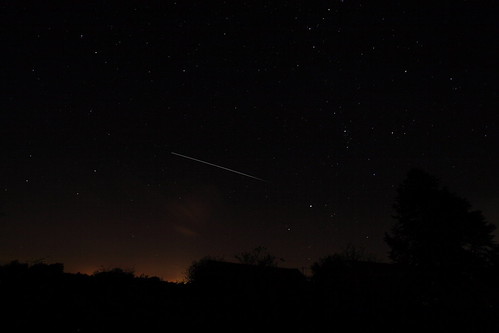
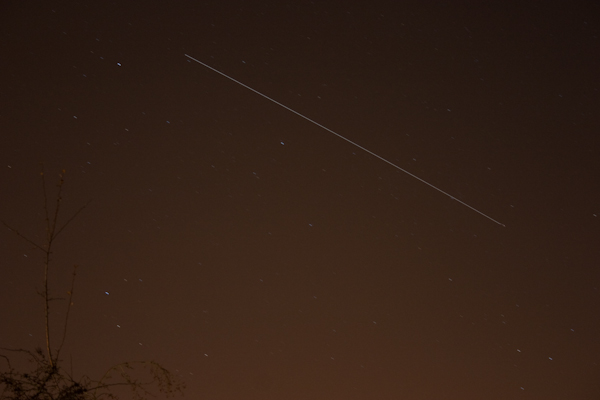
Got a good snap of the ISS and Shuttle Atlantis a few minutes after they'd docked this evening.

4114856605_50dc636caf.jpg


and Larger

http://www.heavens-above.com/ has the skinny on your chances to see them
 
Nice capture matey! It would be quite benign without the hint of a background in sillouette, given off by that wee bit of (street?) lighting. Nice one :thumbs:
 
Good shot...being into astro a wee bit myself...I appreciate the photo...

What you shooting with...

STEVIER
 
Good shot...being into astro a wee bit myself...I appreciate the photo...

What you shooting with...

great capture... what equipment did you use?


Thanks gents!

Canon EOS400D. First time trying to shoot the shuttle with a very wide angle lens. That was 10mm, f4.5, 59 seconds.

I'll have another go this evening and try and get the whole pass in one frame - I was wrongfooted last night and had to do two exposures as I'd not set things up properly.


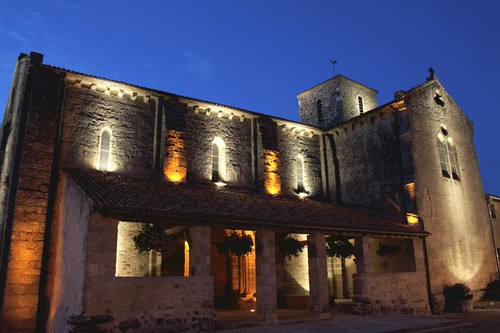
The lighting in the background comes from our local village church which they're just spent a small fortune on to illuminate it like a circus big top.

3845002438_4dbca26d14.jpg


To my eye it's fairly appalling close up but it does however provide a little background frisson and helps pop a dark sky like this.
 
Wow - amazing capture!
 
Ahh.... just checked on http://www.heavens-above.com/ info for this evening and there's a pretty good pass for the UK (and most of Northern Europe!) this evening.

First one is at 16:30 UK time...

4lq.jpg


...and again 90 mins later... but a shorter visible pass because the sun having set a good deal more by then only the upper portion of the atmosphere (and above!) will be illuminated.

cfdr.jpg


If you get the opportunity it's well worth seeing and a good chance to photograph something unusual. The station should fade from sight right above the Isle of Wight as it flies into earths shadow and if it's a clear night should be visible from as far afield as Aberdeen and Gothenburg.

Cloud permitting, pics later! Good luck if you have a go and if you get anything please do share it!
 
Ahhh... too bright here for pass #1 but I rescued that with a pleasant sunset photo.

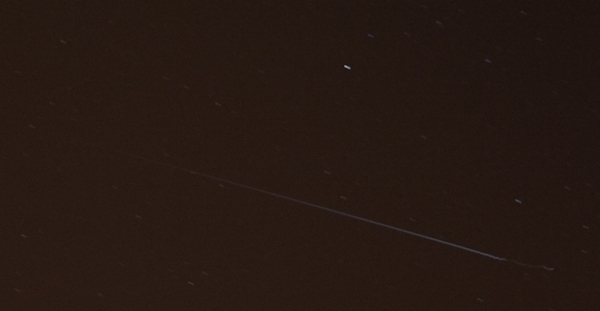
Pass #2 was a bit better but a lot of haze/murk in the atmosphere... it's been unseasonably warm today (mowed the lawn in 14 degrees this afternoon!)

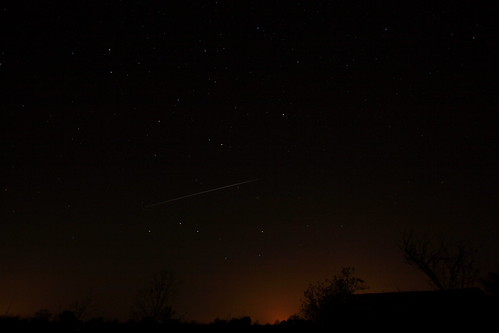
Clock running slightly late and I got out to the garden with it already visible to the west.. and as usual I wasn't fully prepped so I lost 20 seconds while I set the camera to manual, set the aperture, put the thing into 'B' mode, framed the shot, set the FOV, etc. etc. Divvy.

Here's my effort...
4118067120_2eb8f27225.jpg


and large

.. was anyone else inspired to have a go?
 
Fabulous shots

I would have driven to a dark spot if I had known about this earlier. London's light pollution spoils the view somewhat...
 
Well done, nice captures. I did look to see it this evening, it's got so bright now, but to much muck and cloud...
 
It looks like we should have clear skies here tonight, and I'm inspired to try this. What aperture and ISO settings would the experts recommend?
 
Stewart, it's roughly 300miles away at closest point so DOF isn't too much of an issue. I've taken to shooting this sort of thing with my Nifty fifty at about f2.5 which alows for much lower ISO (I tend to use 200/400 now) 30 seconds will get you a nice trail of the ISS but fairly bad traililng in the stars. If I use my kit lens, at 18mm, f3.5, ISO800.
 
Stewart, it's roughly 300miles away at closest point so DOF isn't too much of an issue. I've taken to shooting this sort of thing with my Nifty fifty at about f2.5 which alows for much lower ISO (I tend to use 200/400 now) 30 seconds will get you a nice trail of the ISS but fairly bad traililng in the stars. If I use my kit lens, at 18mm, f3.5, ISO800.

Thanks. I wasn't worried about DOF! - and I'm not worried about star trailing. But I am worried about the amount of light pollution.

Tonight there's a pass which is almost directly overhead, from due west to due east, and I think it would be fun to try to catch as much of it as possible with an ultra-wide angle or a fisheye ... but of course that means a long exposure (the pass lasts about 6 minutes).

Is there some sort of rule of thumb to work out how badly I'd be affected by light pollution, for a given combination of ISO / aperture / shutter speed?
 
Not that I'm aware of Stewart... there's too many factors, like rubbish in the atmosphere reflecting it back, mistiness etc, clouds.. you may not be able to see them, and they may not appear yellow tinted, but the camera will get them. Try a few before hand and see how you get on I guess.
 
Try a few before hand and see how you get on I guess.
Mmmm, that makes sense. Except that the best passes are just after the sun's gone down, so if I take a few test shots before the actual pass then the conditions will be quite different - there would be a fair bit more light in the sky for the test shots than for the pass itself....

Maybe the best approach would be to take a series of 30-second exposures, at (say) f/2.8 and ISO 400 to make sure I get a good image of the ISS, and then stack them to minimise the light pollution?
 
Great shots, and something I would love to be able to do.
Could someone please explain how you get bad star trails at 30 seconds, but the first photo was a 59 second exposure? Have they been edited out?

Thank you.
 
Too cloudy here, so didn't have a go this evening.

A few points on what's been said above. Trying to meter and setup in advance of the pass is difficult, the light changes so quickly for me here.. making it something of a guessing game. The final few minutes before it is due to arrive on your western horizon are key.

On a long pass shooting into a sun that has only recently set can be very bright. I've some time stopped mid way through the pass run to the bottom of the garden and shot it flying east into the shadow - always a better photo.

The wider you shoot, the less of an issue start trails are. Likewise, if you're shooting in closer with a zoom and you're pointing towards north you can minimise the star trails also.

I shoot ISO 100/200 most of the time as I find (my camera at least) to be pretty noisy on low light high speed shots.

I've never tried stacking any images - I'd be interested to see how they looked. If you could do the whole 'subtracting dark flat' thing it might make for a special image.

I've tried shots with all manner of options as there are so many variables. As wide an aperture as you can manage when the light is low, obviously and keep an eye on it when it's at right angles to you and moving away... I (one time) managed to snap a few hopelessly blurry pixels but it's just about enough of a suggestion of the actual shape of it and the solar panels sticking out.

3914246495_32331826ea_o.jpg


300mm, f 5.6, 2.5 seconds, ISO 200
 
Great shots, and something I would love to be able to do.
Could someone please explain how you get bad star trails at 30 seconds, but the first photo was a 59 second exposure? Have they been edited out?

Thank you.

'Bad' is subjective... as they add a sense of motion to the image and convey the motion of the planet and the relative progress of the spacecraft around it.

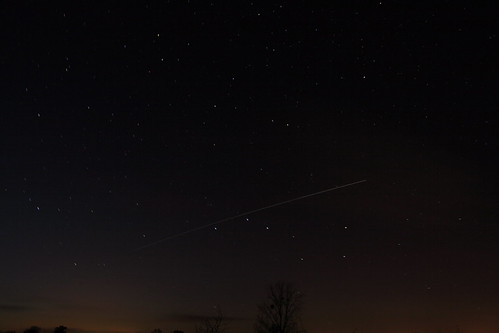
No, not edited out and they're there if you look to the west (bottom left hand corner) of the image you can see them.

Here's another photo that was taken with a longer exposure less than a minute before that first image.... it's much further west, you can see the brightness of the setting sun, and you can see even more star trail artefacts.
4115624450_a95c42e3a9.jpg


But, if you're zoomed in on star/constellation that's far from the north star the motion will be accentuated.

Night sky photography can be a bit of fun and even if it's not really your 'thing' it's worth it for the learning experience.
 
Well I've just been out and had a go. Something, I would guess venus, is very bright out there. I made a guess that's where the ISS would pass (give or take), and setup for 30 second exposures, ISO 200. Racked off lots of exposures.

Anyhoo, just checked, times on that website are GMT+1, not GMT, so I was out in the cold for 10 minutes shooting at an empty sky. Oh well, lesson learned.
 
Great stuff.

Anyone know if a S5pro is suitable for this sort of thing? I'm dying to give it a try.
 
Here's my effort. I deliberately left the back garden in the frame because I have a mate who doesn't believe it's possible to see the ISS :bang:

I'm pretty sure that's Jupiter to the left as well. I'm sure someone will correct me if I'm wrong.

Click to view on my Flickr.

Paul

 
This is what I ended up with on the 6:30 pass.

Err, ok one sec, need to figure out the image tags on here -- fixed it, had it right but the image hadn't uploaded to my blog properly

iss1.jpg


Got this one too, this is cropped and zoomed in a bit. This was as the sun set on the ISS, you can see it fading out. You can also see the camera wiggle as I pressed the shutter...

iss2.jpg
 
I was out in the cold for 10 minutes shooting at an empty sky. Oh well, lesson learned.

I didn't have time to set up the tripod (I had a customer on the phone who seemed to want to talk and talk...!), but I nipped outside to watch the pass at 16:55. I was amazed at how bright it was - certainly comparable to Venus - and how fast it was moving. Once you've seen it once, there's no mistaking it.

Unfortunately the forecast for tomorrow evening is heavy rain...
 
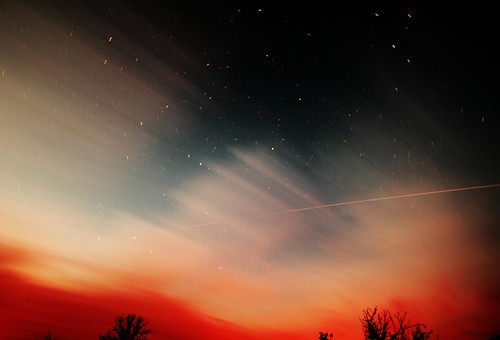
With about 20 mins to go this evening I was pretty sure I was on a hiding to nothing. Low thick cloud almost all day was only just starting to break and I thought that the majority of a long well lit fairly close pass to me would be obscured.

So, last minute change of plan. I decided to point at the north star and expose for the clouds in the half light. Upped the ISO and let it blow through for 4.5 minutes.

The raw looked overblown but I was able to rescue the contrast and dusky blue colours with a -2.0 some exposure tweak and a subtle tone curve work in DPP.

Here's the shot.

I also cooked the processing on this shot and picked a custom WB point to throw some false colour and real contrast.


I'm reminded that all this data is there inside the RAW you just need to dig a little to suck the marrow out of it a bit. Shooting the ISS remains fun, different challenge every day... and well worth it even with some hairy looking cloud.
 
Suppose I was expecting to actually see an outline of the ISS taken through a telescope :D. I can get trails like this easy where I am. Okay I can't see any stars due to the light pollution, but the sky is full of aircraft from Heathrow and Gatwick :D
 
Having seen the ISS pass over for the first lst summer it really is a humbling experience,

Great capture
 
Atlantis is due to land tomorrow so this evenings pass was the last opportunity to catch the pair together before the space shuttle does its de-orbit burn to return back to earth.

After the space shuttle undocked yesterday they've slowly been putting a little distance between each other and from the right place and with a short enough exposure it was possible to catch the two spacecraft dancing a tango.

22mm, f4.5, 13 second exposure. ISO 400

4136631256_12af9e1d5d.jpg


Larger and Original flickr page with a bit of spiel on it.

Three more astronauts leave the space station next week and then it's all quiet for a while. Lots of viewing opportunities over the winter with clear, cold, still nights.
 
Once accidentally captured the ISS in August. Was out at 4am trying my hand at startrails, tripod mounted 30sec exposures with 1 second between shots due to having no pc or remote release to hand. About halfway through this went across my view, I only wish I'd looked this up before otherwise I'd have shot landscape. Linked due to image size:

http://steeps.net/steeps/ocuk/comp/aug09_02s.jpg
 
Once accidentally captured the ISS in August. Was out at 4am trying my hand at startrails, tripod mounted 30sec exposures with 1 second between shots due to having no pc or remote release to hand. About halfway through this went across my view, I only wish I'd looked this up before otherwise I'd have shot landscape. Linked due to image size:

http://steeps.net/steeps/ocuk/comp/aug09_02s.jpg

Steeps, accidents are often the best. I love your photo for a number of reasons.. having so much tree in frame really adds to the drama of the motion behind it. Choosing to focus on that foreground element and have the startrails soft also makes them look somehow accelerated. Lastly, it's just wide enough to appreciate the parabola of the path and close enough to see that flare mid way through the exposure. Great!
 
Some very nice shots there all, I particularly like bellebouche's heavily cooked shot.

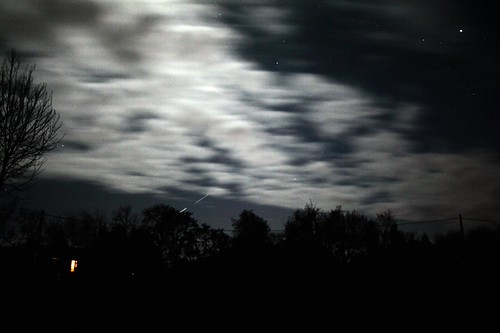
I took one nearly a year ago, (how time flies), 184secs : f8: iso400: 10.5mm

Note lots of light pollution:

429019025_XdxKK-L-1.jpg
 
Back
Top