Something New

Barney

Suspended / Banned
Messages
3,043
Name
Wayne
Edit My Images
No
How do you guys and gals find something new to photograph with the big gear when virtually every photo opportunity has been done to death.

Misty lighthouse
lovely ruins
cars
boats
trains
lakes
mountains with inversions
lovely sunsets
flowers
vases

When ever I look at scene its nearly always been done before and usually far better that I could ever hope to achieve.

How do you keep it original and add your unique style?
 
By not worrying too much about other people... and just taking my shot...
Why are you taking photos - if for yourself, then it doesn't matter what anyone else has done...
If commercially, then fulfil the commercial brief and don't worry about others...

There is too easy an access to others' photography which gives people too much time to compare - switch off social media and internet for a bit and you won't compare...
 
By not worrying too much about other people... and just taking my shot...
Why are you taking photos - if for yourself, then it doesn't matter what anyone else has done...
If commercially, then fulfil the commercial brief and don't worry about others...

There is too easy an access to others' photography which gives people too much time to compare - switch off social media and internet for a bit and you won't compare...
:agree:
 
Well for me have run out of things to photograph in a 6 mile radius from my house, but now look out for very old photographs and do "then and now shots" and have postage a few here. Also must get around to do some more night shots e.g.

FDkkU8n.jpg
 
Well for me have run out of things to photograph in a 6 mile radius from my house, but now look out for very old photographs and do "then and now shots" and have postage a few here. Also must get around to do some more night shots e.g.

FDkkU8n.jpg

Is this Saint Andrew in Grantchester - close by the Orchard Tree Garden?
 
When ever I look at scene its nearly always been done before and usually far better that I could ever hope to achieve.

My first, and probably harsh, thought is that you are not actually looking at the scene but at what others have seen.

My first self question when seeing something I want to photograph is "why do I want to photograph it" and let the answer determine the how of photographing it.

The second thought I have is that you aren't looking closely enough at things you don't find attractive. Photographs are objects in their own right, not representations of reality.

There are several incidents in both Ansel Adams' and Edward Weston-super-Mare's (autocorrected!) careers where someone with them asked "why didn't I see that?"

I recommend a book with the title The Invisible Gorilla to you.
 
I only take pictures for myself and also maybe Mrs WW too :D and the picture has to mean something to me, it has to be connected to a person or place or moment that means something to me. I can appreciate other peoples pictures and I can see the skill and the beauty but they're not connected to my memories and my feelings so it doesn't really matter to me if someone else has taken a picture I'm about to take.
 
My trouble is that I've got too many cameras loaded with film, and there is a lot of psychological pressure to finish them. So I end up not doing anything. I still do take the occasional shot of a flower in the garden with digital, but often that's on a whim to try out a lens. Really though, I feel I've exhausted my possibilities at the moment. But there is a local car show next weekend, so I really ought to find something there. If not particularly exciting.
 
I only take pictures for myself and also maybe Mrs WW too :D and the picture has to mean something to me, it has to be connected to a person or place or moment that means something to me. I can appreciate other peoples pictures and I can see the skill and the beauty but they're not connected to my memories and my feelings so it doesn't really matter to me if someone else has taken a picture I'm about to take.

I often thing that's the key. There has to be some personal connection.
 
My trouble is that I've got too many cameras loaded with film, and there is a lot of psychological pressure to finish them. So I end up not doing anything. I still do take the occasional shot of a flower in the garden with digital, but often that's on a whim to try out a lens. Really though, I feel I've exhausted my possibilities at the moment. But there is a local car show next weekend, so I really ought to find something there. If not particularly exciting.

I've been in a bit of a rut recently, not with photography but just with ongoing issues. I thought I'd try something different so I did some long exposure shots including water. In the past I didn't like these and couldn't bring myself to take one but I gave it a go just for something different. I still generally prefer some movement in water but I have taken some long exposures I like just because they're different to what I usually take.

maybe there's something different you can try?
 
How do you keep it original and add your unique style?
By not bothering if it's been done before, nor how it was done.

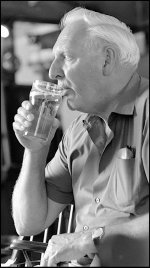
I just look for what interests me and don't bother what others may have done. Like someone drinking beer: every slurp is a different picture (Nikon F, probably a 200mm Nikkor) ...

Nikon F 1991 28-14.jpg
 
Last edited:
I too take pictures for my own pleasure, but also I have in mind images that might be good enough for comps etc. For those images, I can forget any nature type of image that uses a long lens and also "chocolate box" landscapes in good weather, they've been covered extensively by far better photogs than me. I'd take photos if I were there, but I doubt that I'd show them unless it incorporated some element that won't be there again (weather/conditions etc).
 
How do you keep it original and add your unique style?
As others have said, don't worry about what's been done before. Any originality will come from a period of taking photos during which a personal style will evolve.

Style isn't about gear or processing choices, style comes from choice of subject (not in the usual 'object' sense, but in something broader such as 'where I live'), and the way you 'see' things - frame shots, select viewpoints etc. With that developed you can photograph the subjects in your list and the pictures will look like yours.
 
I too take pictures for my own pleasure, but also I have in mind images that might be good enough for comps etc. For those images, I can forget any nature type of image that uses a long lens and also "chocolate box" landscapes in good weather, they've been covered extensively by far better photogs than me. I'd take photos if I were there, but I doubt that I'd show them unless it incorporated some element that won't be there again (weather/conditions etc).
Me too (for own pleasure)...... I take many record shots e.g. houses rebuilt in my road i.e. old and new, also have photographed my changing back and front garden over 33 years.
 
I too take pictures for my own pleasure, but also I have in mind images that might be good enough for comps etc. For those images, I can forget any nature type of image that uses a long lens and also "chocolate box" landscapes in good weather, they've been covered extensively by far better photogs than me. I'd take photos if I were there, but I doubt that I'd show them unless it incorporated some element that won't be there again (weather/conditions etc).
I enjoy taking part in photo challenges where there's a specific theme or hardware requirement (like the nifty-fifty challenge on here, for instance) - it makes me think about photos that I wouldn't normally take, or think about something I would normally shoot, but in a different way.
 
Photography for me ( where the > symbol is used to convey 'better than') is ...

Being outside in the fresh air,looking at things > Using the camera to take a photograph > Editing and looking at my images > Looking at other peoples images > Comparing mine to theirs.
 
Last edited:
I take photos for me. To paraphrase Garry Winogrand, I photograph things because I want to see what they look like when photographed. I don't want them to perfectly replicate the reality of the scene (they can't anyway), I want them to be photographs.

If other people like my pictures, then that makes me happy, of course, but I take pictures of what I want to see, whether they be pretty chocolate-box scenes, or cooking oil cans re-purposed as ash-trays. Every subject and every location has promise, it's just a case of working out what it is. Being in the right frame of mind also helps. :)

What I'm trying to say is that anything can make a good subject if it's something you want to see a photograph of. Good light and composition are really important (although these can be dependent on the intent of the photographer), but subject can be anything you want, whether it's the first time it's ever been photographed, or if there are tripod holes in the ground.

Unless you're being commissioned, or are entering a competition, then I think the worst thing you can do is attempt to take pictures with the intent of others liking them - it's a great way for everyone to be disappointed. :)
 
Thank you all for the considered replies and detailing your approaches to making your images unique and original.

Also, I found thought provoking the reasons for making images in the first place and what makes them important to you.

There are so many looking for "gimmicks" that a whole industry is sprouting up supplying weird films with sprocket holes and lighting flashes coming through them to strange colours and emulsion effects, and these are commanding the highest prices so there must be many asking for, and receiving, something different in their photography than the usual composition and subject ponderings.

Is it a trend or the future?
 
Is it a trend or the future?

If this isn't a rhetorical question, read Beaumont Newhall's History of Photography.
 
Not rhetorical at all Stephen, I think that people of a certain age want more from the "hobby" of photography by individualizing their images.

I will give that recommendation a look after i have finished Make your Pictures Sing - By Paul Hextar (1940), which is, IMO, an eye opening "how to" of photographic technique principals.

Your suggested reading list is proving interesting, educational and invaluable.
 
I agree totally with the comments about taking photos for yourself and not worrying what others think.

If you want to take photos that haven't been taken before, you might use still life photography as a means to create an image, rather than taking an image. Start with a plain background and add one object, then another object, and so on. Experiment with the placing of the objects and the lighting. Have fun.
 
I agree totally with the comments about taking photos for yourself and not worrying what others think.

If you want to take photos that haven't been taken before, you might use still life photography as a means to create an image, rather than taking an image. Start with a plain background and add one object, then another object, and so on. Experiment with the placing of the objects and the lighting. Have fun.
That's so interesting Kevin, not least because its something I have been pondering for a few weeks, Traditionally art is taking a blank canvas and adding things to make the picture( the process of addition) whereas photography is a process of subtraction, take an image and then remove annoying aspects to make the picture.

Is photographic art addition or subtraction?
 
Last edited:
If you look at the history of art, and specifically the history of certain paintings, you'll find painters did quite a lot of subtraction to arrive at the final result.

On the other hand, if you look at "The Two Ways of Life" you'll find a photographer working on the additive principle.

Edit to add - this time I'm not assuming a rhetorical question, but equally I'm not providing a reading list...
 
Last edited:
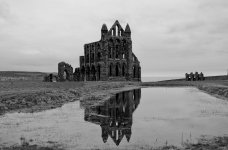
I've just remembered this picture.

1-1 054-R4.jpg

I took that in 2004. We'd had biblical rain and I thought that that puddle was just a timely puddle. I didn't know it was a feature. I just thought that it looked good with the reflection. I was with my then GF and it was only when we got back to her place that I spotted a just about identical framed picture on her wall. I don't know who it was taken by or if it's particularly famous or not but if it is I don't care. I didn't set out to copy anything or anyone and it's my picture and I remember everything about that day :D
 
Frank Meadow Sutcliffe, I think. The original has three cows and a cowherd in the foreground.
 
Frank Meadow Sutcliffe, I think. The original has three cows and a cowherd in the foreground.

Thank you. Well known :D

Just googled my way to that one and I think that's it.

Mine was taken with a Canon 300D and a Sigma 28-300mm at 28mm which would be 44mm in FF money.
 
Last edited:
He was a well known Whitby photographer in the 19th century. There are two or three (modern) books of his photographs which I have, as well as a few framed prints. If I'm being honest, I recognised the picture and got up from my seat and walked into the corridor to look at my print of that photo to count the cows :).
 
I've never followed anyone else's photography so I've never knowingly copied anyone else and of course sometimes there are limited places to stand so you can end up taking the same picture as someone else with the only differences being focal length and the weather and lighting on the day, tide in or out etc.

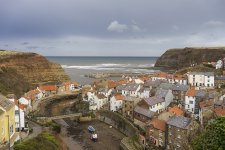
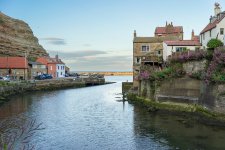
Last example from me.

1-DSC00687.jpg

If you wanted to take that picture and I'm sure it's been taken a million times you'd stand where I did and maybe use a different lens on a day with different lighting and the tide might be in :D
 
I've never followed anyone else's photography so I've never knowingly copied anyone else and of course sometimes there are limited places to stand so you can end up taking the same picture as someone else with the only differences being focal length and the weather and lighting on the day, tide in or out etc.

Last example from me.

View attachment 462096

If you wanted to take that picture and I'm sure it's been taken a million times you'd stand where I did and maybe use a different lens on a day with different lighting and the tide might be in :D
I took mine from that bridge at lower left. :)
 
Joe Cornish, Frank Sutcliffe spring to mind :D

More seriously, given the original question, I'm less than convinced that knowing what other photographers have photographed should be a disincentive to anyone. Perhaps more a creative challenge, to "do different" as the motto of one UK university has it.

On Sutcliffe, I don't know what format camera he used for the Whitby Abbey photograph as I can't immediately locate the books that might give the information. I did discover that his first camera was a 15"x12" camera, but suspect that the photo in question was probably 10x8 or whole plate; in which case, the lens would have been about 300mm give or take.
 
Being an insomniac, and like @excalibur2, I have also walked and photographed all the roads around here in a six mile radius. But what I enjoy is the differing light rather than subject matter. I also notice subtle changes, an open gate, and big ones like the seasons. I’m always trying to improve on an image I’ve already taken. Be it something big like a church, someone left the gates open, giving access to a different angle. Or maybe colour changes on bracken or fern.

I enjoy looking at other people’s work, it’s akin to learning and getting ideas. Just enjoy and keep taking photos! I hope you find your mojo, maybe you haven’t lost it?! Enjoy!
 
Well Wayne just to add..... other than taking night shots where tourist don't go, you could try panos and IMO e.g. using a 28mm lens with two shots and joining in Photoshop looks better than a 20mm lens. This is where the digi guys win as I've seen a pano of a large castle where the guy has taken about 12 shots with a 50mm lens and joined them together and you don't see everything small if using a 20mm lens.
Pano 28mm lens;-

EwD1r48.jpg


Might be 24mm lens:-
brdB4V7.jpg
 
Last edited:
Well Wayne just to add..... other than taking night shots where tourist don't go, you could try panos and IMO e.g. using a 28mm lens with two shots and joining in Photoshop looks better than a 20mm lens. This is where the digi guys win as I've seen a pano of a large castle where the guy has taken about 12 shots with a 50mm lens and joined them together and you don't see everything small if using a 20mm lens.
Pano 28mm lens;-

EwD1r48.jpg


Might be 24mm lens:-
brdB4V7.jpg
That's a great idea Brian, I like the idea of the manufactured angle of view without the need for huge distortion in a real wide view
 
There are so many looking for "gimmicks" that a whole industry is sprouting up supplying weird films with sprocket holes and lighting flashes coming through them to strange colours and emulsion effects...
I think "gimmicks" like that are more about exploration of ideas. I like making photos while moving the camera (ICM, can be expensive on film) and also making colour images from black and white film (trichromes), plus occasionally using redscaled film or (once upon a time) cross processing slide film. Not yet done much pinhole or multiple exposure, but, one day. It's not about following a trend, for me, it's just natural curiosity. Bit like the mantra that @FishyFish quoted, I try these things to see what they look like in my very inexpert hands. Whatever anyone else might feel about it (is irrelevant, really), I've managed not to be bored by own photography!
 
That's so interesting Kevin, not least because its something I have been pondering for a few weeks, Traditionally art is taking a blank canvas and adding things to make the picture( the process of addition) whereas photography is a process of subtraction, take an image and then remove annoying aspects to make the picture.

Is photographic art addition or subtraction?
Not all photography is about subtraction People like Henry Peach Robinson " constructed" their photographs.

More recently, we have Angus McBean and Cecil Beaton.

Not forgetting Cindy Sherman

And there are many people like Brooke Shaden who carefully design the photographs they make.

These are the ones that come to mind, but throughout the history of photography, not everyone has faithfully followed this idea of subtraction.
 
Last edited:
Back
Top