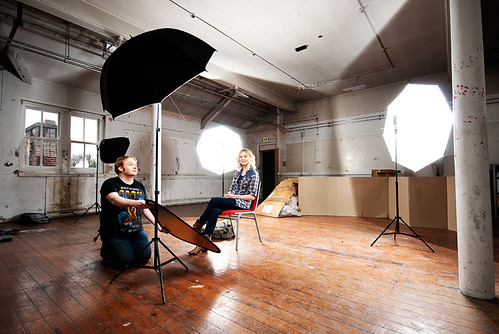
I don't use them with studio heads, but I don't see how it would really be any different to something like an Alien Bees ringflash with the moon unit for a similar sort of effect. There's no light coming from the center of that either.

You might be right John

I thought I'd try it - Lastolite UmbrellaBox, Elinchrom D-Lite (which is small for a studio unit). Sekonic 308 with Lumidisc attached.
The
worst I could get was about 0.2-0.3 stops of light reduction in the centre, with the diffusion surface exactly
one foot away from the meter. This is impossibly close, and even then the light reduction relatively insignificant. You could argue that the quality of the light in that position is different, ie coming from the sides, not straight on, but that would be pedantic.
Moving just six inches further away (18ins from the surface) still crazy close, there was no measureable light reduction at all. Zilch.
Fitting a regular white umbrella yielded a greater light reduction in the centre, almost half a stop measured in exactly the same way, one foot away from the plane of the near edge. You'd never want to use one as close as that either.
I'd say that was a victory for the UmbrellaBox

The main problem, if there is one, is that whatever sort of flash head you've got, it just gets in the way a bit when working very close. And you can see the reflection in catchlights. But at normal portrait shooting distances, zero problems in terms of positioning or light quality.
Because they are reverse firing (most of them) unlike a regular softbox, the light output is very even across the diffusion surface. You don't need a double-diffusion layer.