Small Home Made light tents?

Digital camera April 2013.

IMG_6299.jpg

IMG_6300.jpg


I hope that this is helpful

IMG_6299.jpg
 
Last edited:
John, as far as lighting goes, I would think that as long as it's reasonably full spectrum, pretty much anything would do the job. Raw and custom WB should sort out any potential colour cast problems.
 
thanks Guys :thumbs:

And thanks Nod as you make a very valid point :thumbs:
 
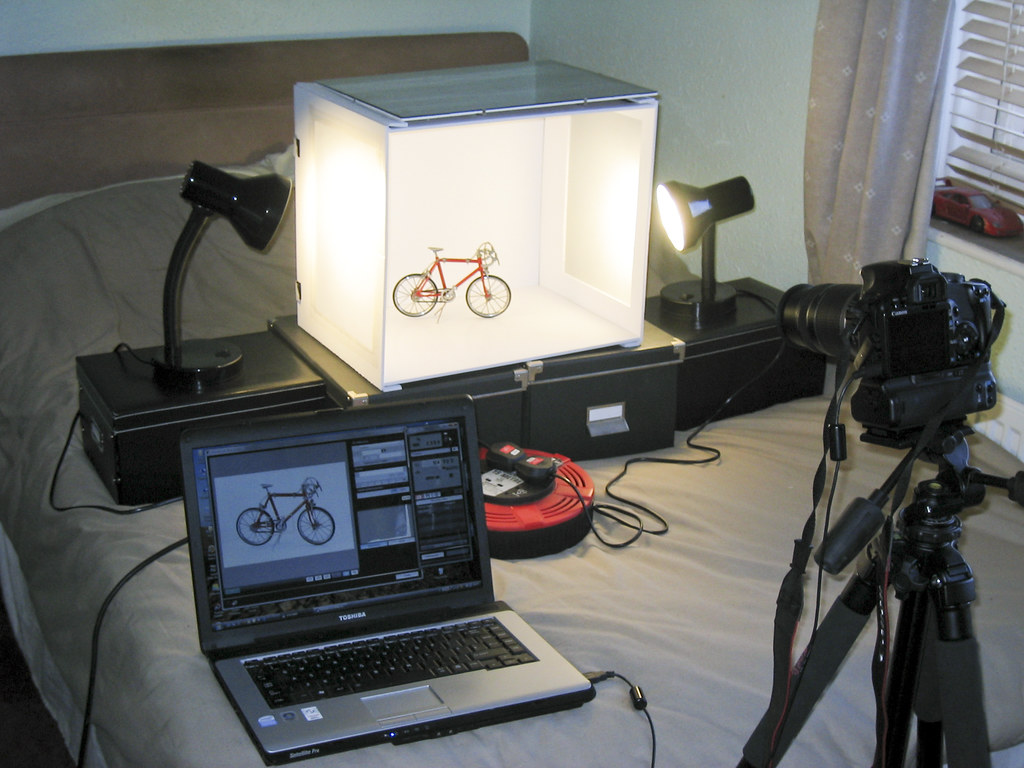
made one a couple of years ago... 5 sheets of white foamboard, 2 pages of tracing paper, and a handful of velcro dots...

3353914898_56b9918a7b_b.jpg


the frameless frame on the top of the box donated it's glass when a shiny floor to the box was needed :)
 
Last edited:
A lightbox is something you use to view slides/negs or trace graphics. These are light tents, which you could just make with some tracing paper / cloth and basically any light you want.

Oooops title just changed sorry :thumbs:
 
Mark thanks you so much looks easy enough so may have a go when my construction skills come back to me :ty:
 
I find it easier to just use some white background paper and a couple of soft boxes for the lights. Some trace and some black card will allow you to manipulate the light and reflections.
 
I find it easier to just use some white background paper and a couple of soft boxes for the lights. Some trace and some black card will allow you to manipulate the light and reflections.

Always presuming you've GOT a couple of lights and softboxes... At the time 2 bedside lamps borrowed from the bedside and a fivers worth of kit from staples got me started, and the next week was pressed into a "online catalog / in house web reference" for a client for around 800 images in an afternoon.

I do actually now have a proper flash kit, and yes, it's easier, much easier to get the plain whites etc right straight out of camera, but its a different league in terms of cost of purchase :lol:

I agree, if you've GOT the lights and softboxes fine, but if not, or you just want the fun of experimenting or building something yourself to pass a rainy saturday, then this is worth a punt at least.
 
Last edited:
Always presuming you've GOT a couple of lights and softboxes... At the time 2 bedside lamps borrowed from the bedside and a fivers worth of kit from staples got me started, and the next week was pressed into a "online catalog / in house web reference" for a client for around 800 images in an afternoon.

I do actually now have a proper flash kit, and yes, it's easier, much easier to get the plain whites etc right straight out of camera, but its a different league in terms of cost of purchase :lol:

I agree, if you've GOT the lights and softboxes fine, but if not, or you just want the fun of experimenting or building something yourself to pass a rainy saturday, then this is worth a punt at least.

The OP didn't specify either way what he had so it was just an alternative suggestion. I've used light tents with studio lights before and they do work (well, cones made out of tracing paper, same concept), but the light is so soft, it's just not suitable for everything. Had to do it that way when I shot 200 fountain pens because there was just no other way...
 
Useful link here seems fairly simple and cheap:)

Couple of off camera flashes would sort the lighting or as the big furry one suggests a couple of cheap bedside lamps and shoot raw to rectify any white balance misdemeanours

Steve
 
I find it easier to just use some white background paper and a couple of soft boxes for the lights. Some trace and some black card will allow you to manipulate the light and reflections.

hang on a minute I'm only wanting to experiment a bit. Bear in mind I'm an Old Timer on me pension - but it will be going up 2.5% in April so perhaps I can splash out :)
 
Steve a good link thank you :ty:
 
hang on a minute I'm only wanting to experiment a bit. Bear in mind I'm an Old Timer on me pension - but it will be going up 2.5% in April so perhaps I can splash out :)

Fair enough.

It might be best to say what you *do* already own?

The absolute simplest way to approach this, without any tricky construction at all, would be to take a large sheet of tracing paper (the thicker stuff from art shops), roll it into a cone, sellotape it and cut a little hole where you want the lens to go through. Then you can use lamps from around the house to light it. This way you can put the lens in at any angle (including the top), eliminate almost every reflection and actually get pretty good results. Put it on a sheet of translucent perspex and you can light from the bottom too.

In fact, this is something I shot using pretty much that technique. Cone of paper, some bits of black cardboard and a tripod. I used studio lights, but you could use anything really as long as the colour temps were consistent.

I_128419999_50_20100416
 
..... I'm an Old Timer on me pension - but it will be going up 2.5% in April so perhaps I can splash out :)
Your in the wrong line John should be an MP :shrug:

Steve
 
Your in the wrong line John should be an MP :shrug:

Steve

Well I've always been able to talk enough bullsh1t to qualify me but I would rather aim for MEP with more generous allowances.
 
Thanks for the tip/s Charlotte.

As for what I own - well not as much as I used to many many years ago when I was into my SLR with a big bag full of lenses & other bits & pieces. I spend far more time at PP than taking photographs as I am in poor health as well as being wheelchair bound outside of the house so have been trying to satisfy my needs with advanced compacts. Nikon P7700 & Canon G15 but they just aren't doing it for me. So last week sold the Nikon & now looking at getting a DSLR because of the influence of my reading the forum as it does unsettle you :)

The light tent is something I could do inside the home so one of a few ideas for me to look at for the future :clap:
 
There are dozens of these little light tent/cube type jobbies around, just the thing for simple product shots and very popular with ebayers. Put 'light tent' into the Amazon search bar, many of them very cheap.

External lights will give you more control. A simple desk lamp will be fine, but need a tripod to avoid camera shake. Just make sure all lights use the same type of bulb or you'll get colour problems, then do a custom white balance or correct in post processing.
 
I think charlottes technique above sounds great and one that I might have to pinch!

I own a £12 light tent from amazon, 80cm x 80 cm. I help my father to photograph his studio ceramic work and the highly reflective glazes can be tricky. Haven't even remotely started trying yet but was 'disappointed' to realise that a single flash bounced off a white ceiling and then filtered through a fully enclosed light tent (in a darkened room) actually gave better results than I could have ever hoped for. Disappointed as it was too a easy lol!
 
Back
Top